Author: r2Jamong
Compiled by: AididiaoJP, Foresight News
Entering the second half of 2026, Upbit's token listing pace suddenly accelerated noticeably. After using Surf AI to comprehensively compile the data on Upbit's new token listings month-by-month this year, we found that the speed of new token listings has significantly increased since June. Meanwhile, the entire Korean Won market is cooling rapidly: Upbit's monthly trading volume in KRW trading pairs fell from 72.7 trillion won in January to 27.1 trillion won in July, a staggering decline of 63%. The price of Bitcoin also dropped from around 118 million won at the beginning of the year to the 90 million won range. The colder the market, the more frequent Upbit's new listing actions become—this forms a sharp contrast with the conventional logic of 'listing actively only when the market is good'.
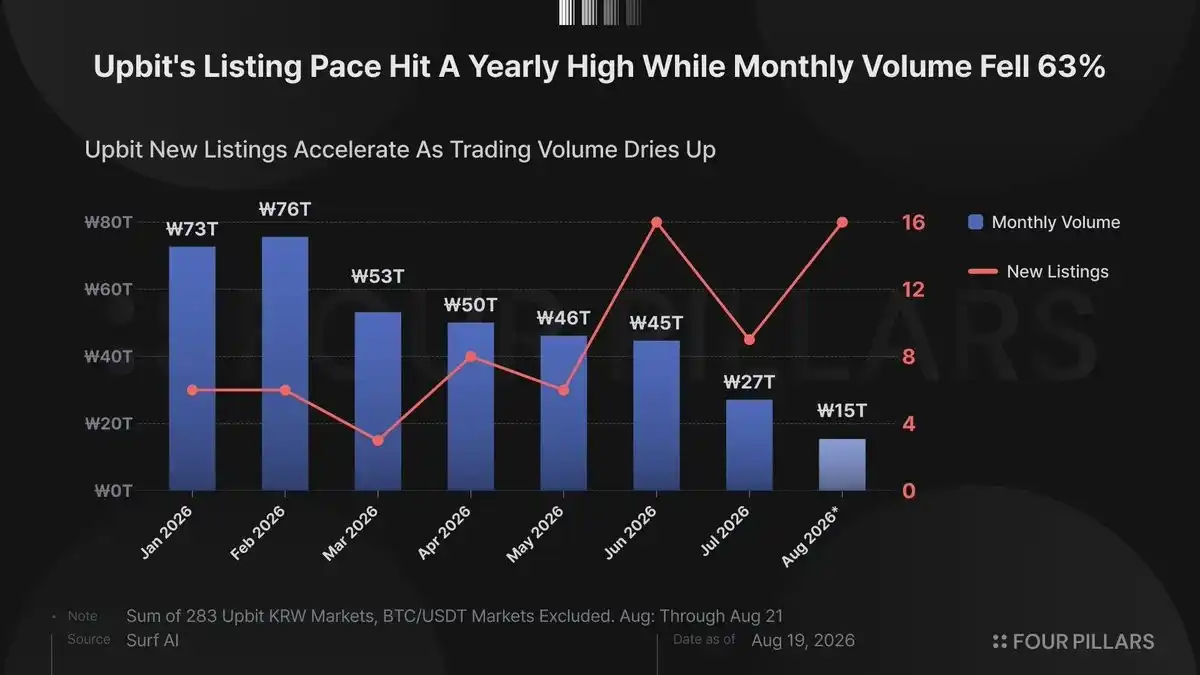
Listing new tokens has almost become Upbit's last line of defense to actively boost trading volume during a bear market.
As of August, 61 tokens have opened KRW trading pairs on Upbit this year. These new tokens collectively contribute between 3 trillion and 8 trillion won in monthly trading volume. Although the total market volume has shrunk to one-third of its beginning-of-year level, the trading volume from new tokens listed this year has continued to rise from its low point. The result is that the share of total trading volume contributed by tokens listed this year has climbed from a mere 5% in January to 27.6% in August. Given that Upbit implements a uniform fee rate for the KRW market, this means close to a quarter of the fee revenue now comes directly from these tokens listed just this year.
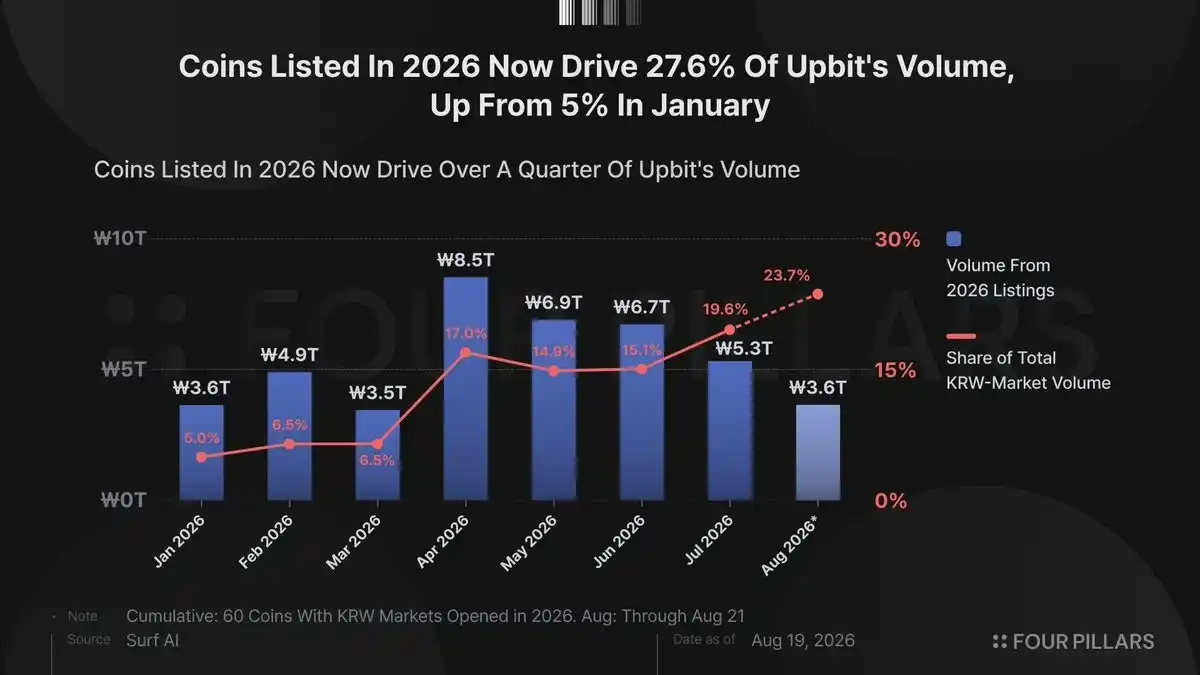
Looking at the performance of individual tokens, on average, a newly listed token can contribute 1.2% of the total market trading volume within the first 30 days after listing. Notable projects have even reached a 4%–5% share: CHIP achieved 4.8%, RE reached 4.0%, and SLX reached 3.8%. CAP, which was just listed in August, has already recorded a 4.5% share in its first 16 days and continues to contribute. In stark contrast are stablecoins—the trading shares of USDS, RLUSD, and USDG have consistently remained below 0.1%. Even a new listing brings almost no incremental volume.
In other words, during the market downturn, new token listings have become practically the only leverage Upbit can control to generate trading volume. But this lever is not increasing the overall market pie, nor is it genuinely activating market sentiment. It is merely increasing the share of new tokens within an overall market that is shrinking drastically.
For a long time, Korean digital asset exchanges, represented by Upbit and Bithumb, have been regarded as the sole important gateway for global access to Korean Won exposure, possessing extremely high strategic value. A listing itself often brings a significant 'Upbit premium,' making it a scarce resource fiercely contested by project teams. However, the situation is changing this year—the 'Upbit listing' is increasingly less seen as an event to create new demand and attract incremental capital. Instead, it is being used more as a tool to defend against shrinking trading volume and stabilize fee revenue.
The listing premium remains effective to this day, indicating that real buyers still exist in this market. But the more frequently this lever is pulled, the fewer other available tools remain. The premium is inherently built on scarcity, and now it is being gradually consumed to barely maintain trading scale in the bear market. When the next real market upturn arrives, whether the strategic value of Korean Won liquidity can be fully preserved, or if it will be diluted due to frequent listings, remains an unresolved question.
For the broader Asian centralized exchange landscape, Upbit's choice might be just a microcosm: when both macro liquidity and market sentiment weaken, exchanges are forced to rely on the short-term tool of 'listing' to maintain their basic operations. However, once scarcity is excessively consumed, the foundation of long-term competitiveness may also be undermined.