Source: Odaily Planet Daily
Author:jk
Original Title: Deciphering the Crypto Salary Report in 10,000 Words: Huh? Do These People Really Earn This Much?
In the crypto industry, compensation has always been a topic frequently discussed but one of the most difficult to draw reliable conclusions about. Whether it's founders establishing internal salary frameworks or candidates evaluating the reasonableness of an offer, reality often lacks data support. Industry discussions often rely on scattered individual cases, anonymous sharing, or emotional judgments rather than a universal salary structure.
Against this backdrop, top crypto venture capital firm Dragonfly first released an annual crypto industry salary report in 2023, conducting extensive questionnaire surveys to summarize a universal set of salary data. Two months ago, Dragonfly released the 2025 version. This report collected feedback from 85 crypto companies and, for the first time, expanded the research scope to companies outside Dragonfly's portfolio, making the data more representative of the true industry cross-section.
Data collection covered late 2024 to the first quarter of 2025, introducing approximately 3,400 deduplicated data points on employee and candidate levels for the first time. While the data isn't the most recent, fortunately, salaries don't fluctuate as wildly as coin prices. The report details salary data for every function, level, and region, moving beyond "average position" or "rough ranges." Compared to the 2023 report, this research not only answers "how much does the crypto industry pay" but also begins to show "how money is allocated, and how certainty and risk flow within organizations."
Let's take a look at the highlights worth referencing. Whether you're a fresh graduate eager to enter Web3 or a mid-level manager considering the crypto industry, this report should contain plenty of data you can use for reference.
All salary units in this article are in US dollars/USDT, and salaries refer solely to cash compensation, excluding token/equity grants.
I. Overall Market Summary
TL;DR (Too Long; Didn't Read) Version: Here are the top ten summaries from Dragonfly's official report.
-
Most crypto companies are in growth mode, not high-speed expansion phase.
-
Crypto hiring is global from the start; hiring solely within the US is almost non-existent.
-
Europe has become the primary international hiring hub.
-
Salaries and token compensation have declined for almost all levels and regions.
-
Remote work still dominates, and companies are not planning to change this status quo.
-
The barrier to entry into the crypto industry is high, with entry-level positions accounting for less than 10%.
-
Engineering roles remain core. Product roles typically start at senior levels, and design roles value individual contributors more than management.
-
US salary levels set the global pricing standard for engineering management.
Looking at the overall environment, crypto industry salaries in 2024-2025 exhibit a clear characteristic: it's a market in a downward adjustment phase but gradually stabilizing. Although mainstream crypto asset prices remain strong, and the US policy environment has periodically sent positive signals to the industry, these macro changes have not quickly translated into the hiring and compensation side. Companies remain cautious in hiring and pricing, with comprehensive contraction in positions and compensation.
At the hiring geography level, the global nature of the crypto industry has further solidified. Teams hiring only within the US are almost non-existent; cross-regional collaboration is the default configuration from the beginning. Europe has risen significantly in this cycle, becoming one of the most important international hiring centers, especially for engineering and product-related functions.
Remote work is a very clear long-term trend in this report. Most companies have not shown clear plans to return to the office, which directly weakens the single logic of "location determines salary." Salary differences are beginning to reflect more on an individual's influence within the organization, scarcity, and responsibility boundaries, rather than geographic location itself.
Entry-level positions have been hit the hardest, with significant declines in salary and tokens, partially compensated by higher equity proportions. US entry-level positions still hold an advantage in cash compensation, but international peers often receive 2-3 times more equity and higher token rewards. Mid-level positions are generally squeezed, with limited growth space; senior positions are relatively more stable, with smaller salary reductions, more stable equity, and tokens increasingly concentrated at the top. The most significant salary increases appear for Senior Individual Contributors (Senior ICs) and executive levels, forming a clear "barbell structure," a phenomenon particularly prominent in product and engineering roles.
Engineering remains the core of the entire industry, but functions outside engineering are showing more明显的 (more obvious) hierarchical differentiation, with returns concentrated on high-level talent and execution layers, while mid-level and junior positions bear more明显的 (more obvious) compression pressure. Product roles almost always require experienced professionals from the start, and design functions clearly favor high-level individual contributors over management paths. In design roles, the value of management is less than that of senior designers. Senior individual contributors in the US have higher total compensation than design managers, and even some executives.
Finally, from a year-on-year perspective, the bosses, i.e., the founders, are increasing their own salaries every year. The larger the funding round, the higher the founder's salary, and the lower their equity stake. US founders generally have higher salaries, equity, and tokens than their international counterparts.
In summary, salaries and token grants have decreased for almost all levels. US positions still lead in cash compensation, while international teams narrow the gap through higher proportions of equity and token allocations.
II. In-depth Analysis of Six Key Roles
2.1 Software Engineer: The Industry Backbone
As the technical backbone of the crypto industry, software engineers' salary levels have always been at the forefront.
US Market Career Progression Path:
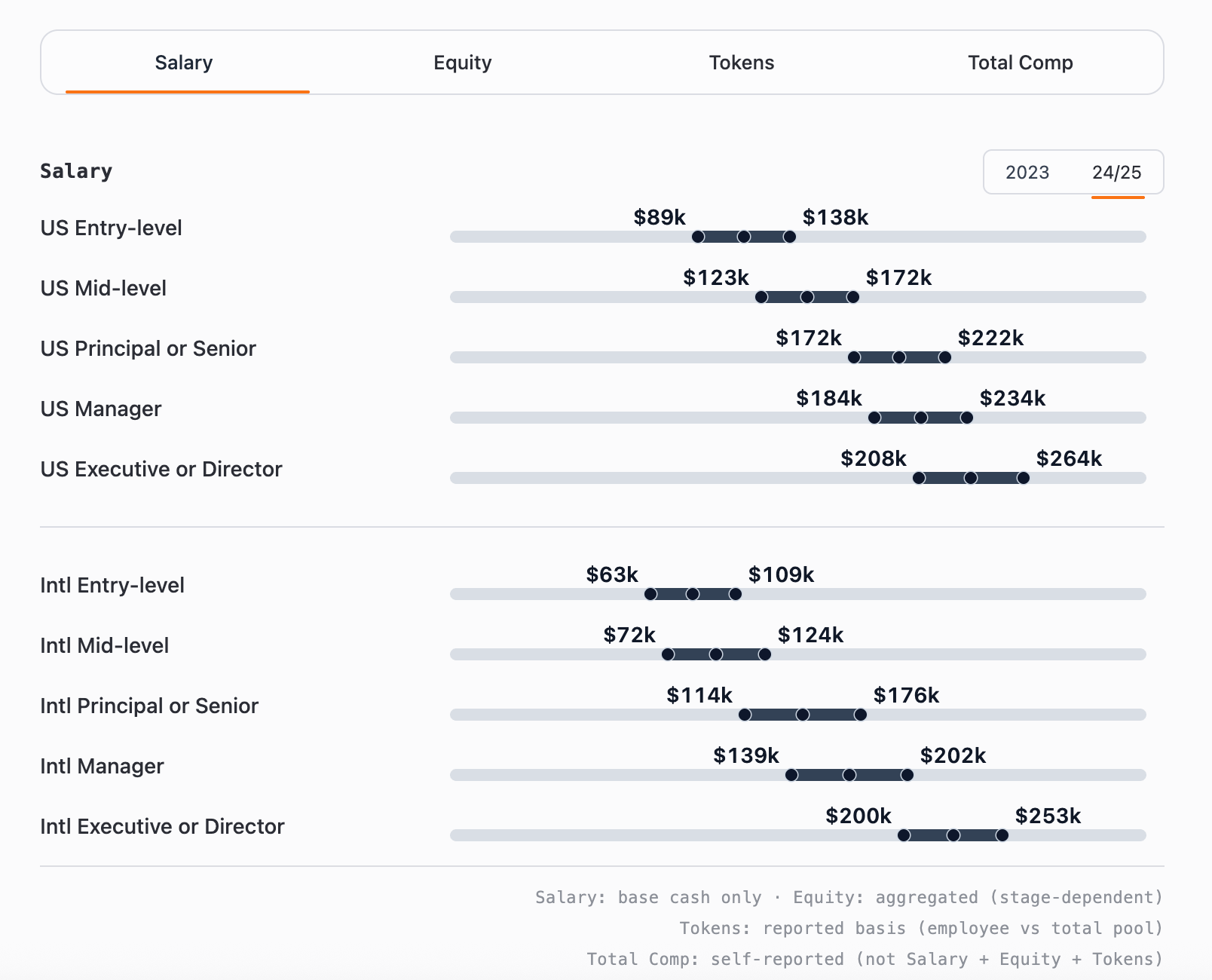
From the data, the career development path for software engineers is quite clear. The entry-level salary range is $89k-$138k, averaging around $113k. At the mid-level stage, the salary increases to $123k-$172k, averaging around $147k. Upon promotion to Principal or Senior level, roughly after 7-8 years of experience, the salary sees a significant jump to $172k-$222k, averaging around $197k.
Software Engineer Salaries
Upon reaching the Executive or Director level, the salary can reach $208k-$264k, averaging around $236k. From entry to executive level, the salary nearly triples.
It is particularly noteworthy that the jump from Mid to Senior Engineer is the most significant, i.e., from the 3-5 year experience Mid-level to the 7-8 year Senior position, with a salary increase of over 40%. It can be seen that companies are willing to pay a premium for engineers who can truly solve complex problems.
International Market:
Software engineer salaries in the international market, while lower, are still quite attractive. Entry-level is $63k-$109k, roughly equivalent to 400,000 - 700,000 RMB. This is already a considerable income in many countries, especially in regions with lower living costs like Eastern Europe and Southeast Asia.
Simultaneously, high-level position salaries are quickly catching up to US levels. Executive or Director levels can reach $200k-$253k, already接近 (approaching) US peer levels. That is to say, with the proliferation of remote work and intensified global talent competition, geographical differences are gradually narrowing. For capable engineers, choosing where to work has become more flexible.
One can see how important it is to learn English, engineers!
2.2 Crypto Engineer: The Reward of Specialization
Crypto engineers, commonly referred to as smart contract engineers, as an industry-specific role, show a unique salary pattern.
US Market:
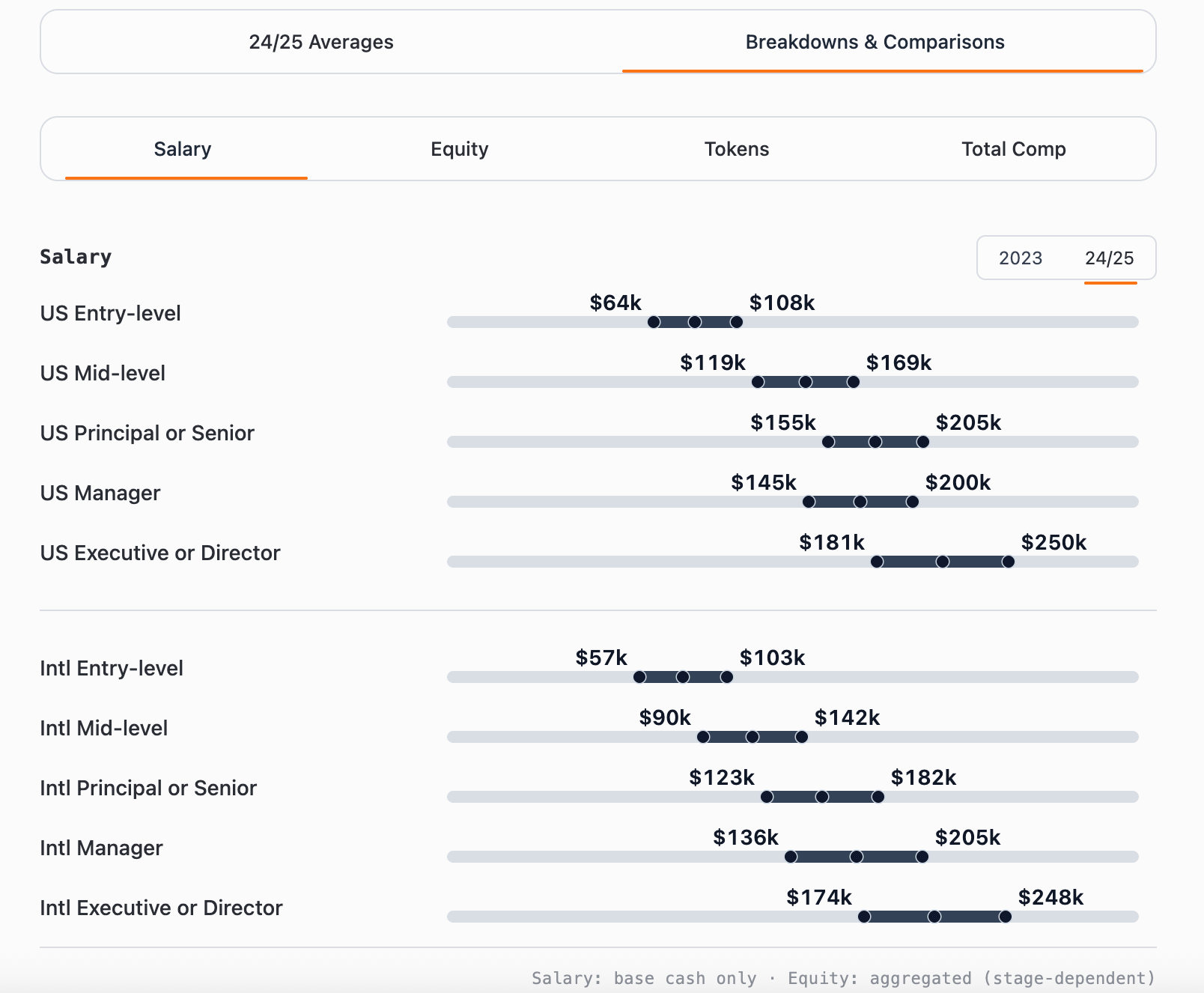
In the US market, the salary trajectory for crypto engineers shows an interesting phenomenon. Entry-level salaries ($64k-$108k) are actually lower than those of traditional software engineers, possibly because novice crypto engineers need more time to accumulate domain-specific knowledge, such as deeply understanding various consensus mechanisms, learning Solidity, etc.
But by the Mid-level ($119k-$169k), the professional advantage begins to show, with a staggering salary increase of 85%. Continuing development to the Senior level ($155k-$205k), salaries maintain strong growth. This steep growth curve illustrates an important fact: once you master core crypto technologies, your value increases dramatically.
Smart Contract Engineer Salaries
Interestingly, crypto engineers at the management level (Manager: $145k-$200k) have slightly lower salaries than the pure technical track. This might reflect an industry characteristic: deep technical expertise is more valued than management ability in this field; talent that can truly understand and improve zero-knowledge proofs or optimize Layer 2 solutions is extremely scarce.
International Market:
In the international market, mid-level crypto engineers perform particularly well. Their salaries ($90k-$142k, RMB 600,000 - 1,000,000) even exceed the senior levels of some traditional positions. The reason behind this phenomenon is simple: talent mastering blockchain, smart contracts, and other professional skills is extremely scarce globally. Whether you are in Silicon Valley or Singapore, excellent Solidity developers are highly sought after by various companies.
2.3 Product Manager: The Dark Horse of Salary Explosion
Product managers showed惊人的 (astonishing) salary growth in 2024/25, especially at senior levels.
US Market:
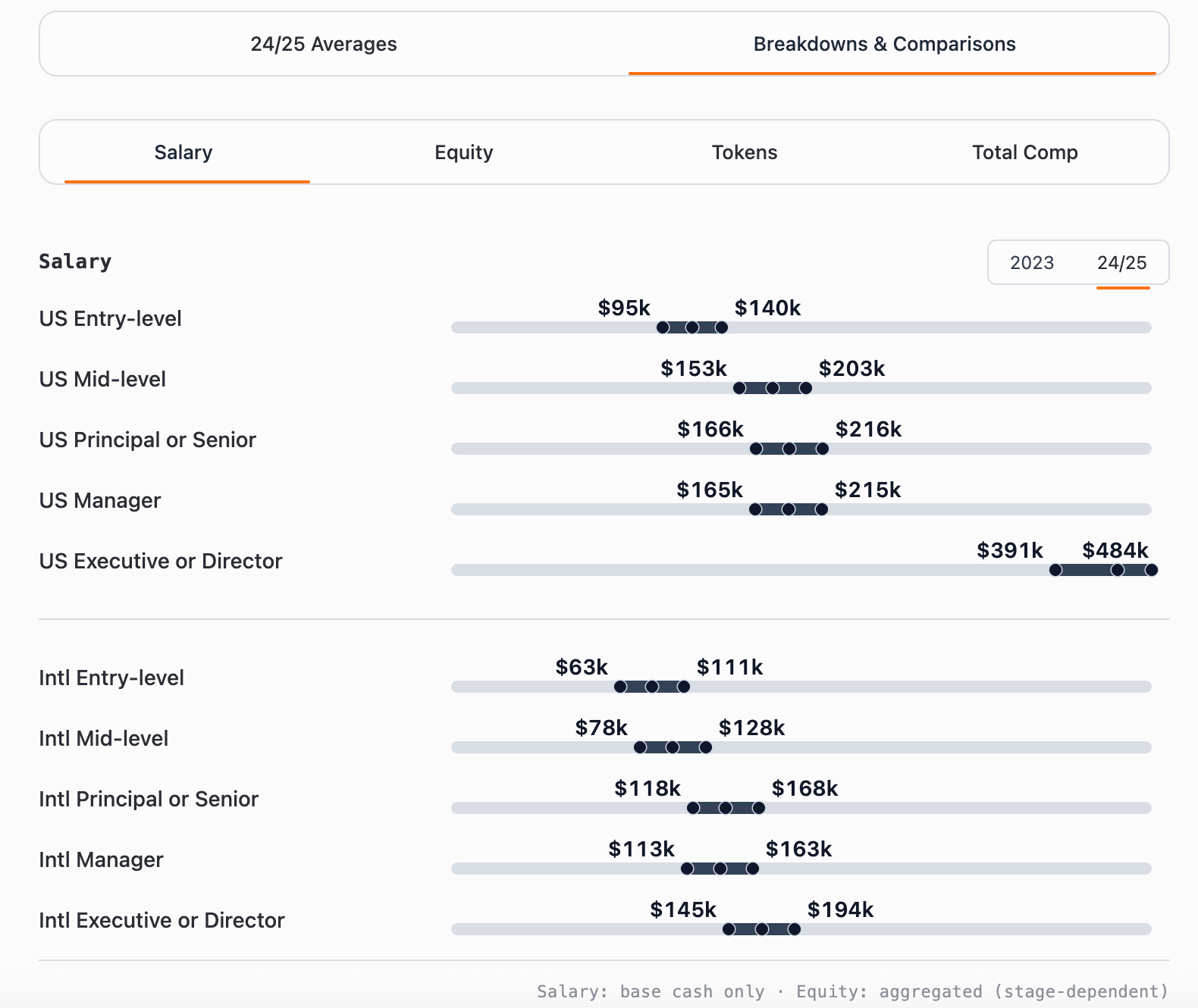
The most eye-catching data point is undoubtedly the salary for Executive-level product managers, reaching an astonishing $391k-$484k, far exceeding all other positions. This number even makes many people怀疑 (doubt) if the data is wrong. But thinking carefully, this abnormally high salary actually reflects several important points.
First, the complexity of Web3 products far exceeds that of traditional internet products. One must not only understand user needs but also deeply understand technical details like token economics, on-chain data, cross-chain interactions, etc. Second, PMs who can truly understand technology and translate it into user value are extremely scarce in the market. Finally, the commercial value a successful crypto product can bring is enormous; a successful DeFi protocol or NFT platform can easily have transaction volumes in the billions of dollars.
That is to say, if one firmly stays on this path, there are great opportunities.
For product managers just entering or in the mid-stage of their careers, the Entry-level PM salary ($95k-$140k) is second only to software engineers. By Mid-level ($153k-$203k), PM salaries have surpassed all technical roles, becoming the highest-paid position at the same level.
But this is only true in the US.
International Market:
Compared to the craziness of the US market, international PM salaries appear more rational and much lower. The Executive-level salary is $145k-$194k, nowhere near as exaggerated as in the US;同时 (at the same time), entry-level PMs, like their peer-level smart contract engineers and software engineers, don't see much difference in salary. Remote work is enough for someone earning an average of 750,000 RMB to live very well.
2.4 Designer: Underestimated but Rising
Design roles have long been underestimated in the crypto industry, but the data shows the situation is changing.

US Market:
The salary trajectory for designers is an interesting story. The starting salary for Entry-level ($53k-$103k) is among the lowest for all positions, which aligns with the reality of the crypto industry: for a long time, crypto projects focused more on technical implementation and neglected user experience, leading to the often abysmal interfaces of early DApps. Even projects with tens of millions in funding frequently had poor interactions and user experiences.
But the situation is changing rapidly. When designers grow to the Senior level ($139k-$182k), salaries see a significant leap. This jump shows that the market is finally realizing the importance of an experienced designer with 7-8 years of experience, capable of leading a team, to the success of a product.
However, mid-level designers face the biggest challenge among all positions. Their salaries ($80k-$120k) grow slowly, increasing only about 30% compared to entry-level. This "mid-career crisis" might cause excellent design talent to leave for other industries or transition to other functions.
International Market:
Interestingly, designer salaries in the international market are relatively more balanced. Especially at mid-to-senior levels, the salary gap between designers and other functions is smaller. This provides a fairer development environment for designers. If you are a designer, when choosing a work location, you might consider opportunities in the international market more.
2.5 Marketing: The Steadily Growing Backbone
Marketing plays an increasingly important role in the crypto industry, and the salary data reflects this trend.
US Market:
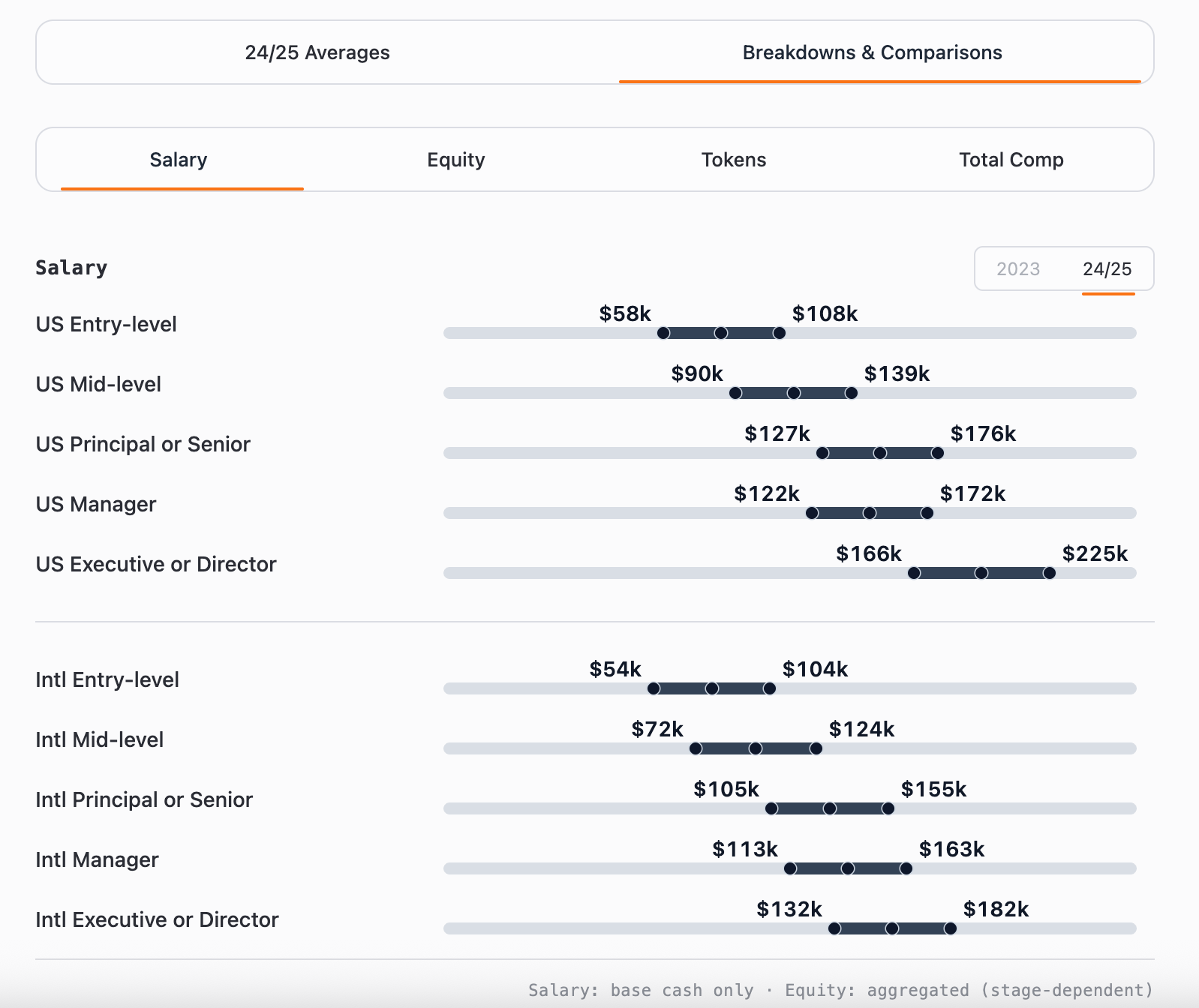
Marketing岗位的薪资呈现出一种稳健而平衡的增长模式 (Marketing岗位的薪资呈现出一种稳健而平衡的增长模式 - Marketing岗位的薪资呈现出一种稳健而平衡的增长模式). Entry-level salary ($58k-$108k) provides a reasonable starting point, neither the highest nor the lowest. At the Mid-level ($90k-$139k), the salary achieves a stable growth of about 55%. The Senior level salary is $127k-$176k, and the Executive level reaches $166k-$225k. This means there's a clear transition for marketing professionals from executing marketing strategies to formulating them. In the crypto industry, the value of marketing experts who can understand complex technical concepts and turn them into compelling stories is huge.
Characteristics of the International Market:
The international market for marketing roles shows a more standardized salary structure, with relatively small differences between levels, indicating a steady growth trend.
2.6 Business Development (BD/Go-to-Market): The Growth Engine
BD/GTM roles play a key role in the success of crypto projects, and the salary data reflects this importance.

US Market:
The salary story for BD might be the most inspiring. The Entry-level ($50k-$100k) starting salary is the lowest among all positions, but don't be scared by this number. Look at the Mid-level data ($105k-$154k) – the salary potentially doubles! That is, after 3-5 years of work, the salary can double, the largest increase among all positions. At the Executive level ($195k-$252k), the salaries of excellent BD leaders prove their crucial role in company growth.
New BD hires might just be sending cold emails, attending meetings, and doing preliminary market research. But once you build your network and understand how the ecosystem operates, your value increases dramatically.
Think about it, a good BD can help a project get listed on major exchanges, establish key partnerships, and open up new markets. In the current market environment of "building in the bear market, harvesting in the bull market," BD talent that can bring actual business growth is naturally highly valued. They need to understand not only business but also token economics, the characteristics of various public chains, and the workings of DeFi protocols. This type of复合型人才 (versatile talent) is sought after everywhere.
International Market:
There's a particularly interesting phenomenon with BD salaries in the international market. The Principal/Senior level ($127k-$177k) performs exceptionally well internationally, and the Manager level ($136k-$189k) salary even exceeds that of US peers.
The reason behind this is not hard to understand: the international market relies more on localized business development capabilities. If you can help US projects land in Asia or help Asian projects enter the European and American markets, your value is enormous.
It can be seen that US positions lead in cash compensation and total compensation for almost all levels.
2.6 Founder Salaries: How Much Do the Bosses Pay Themselves?
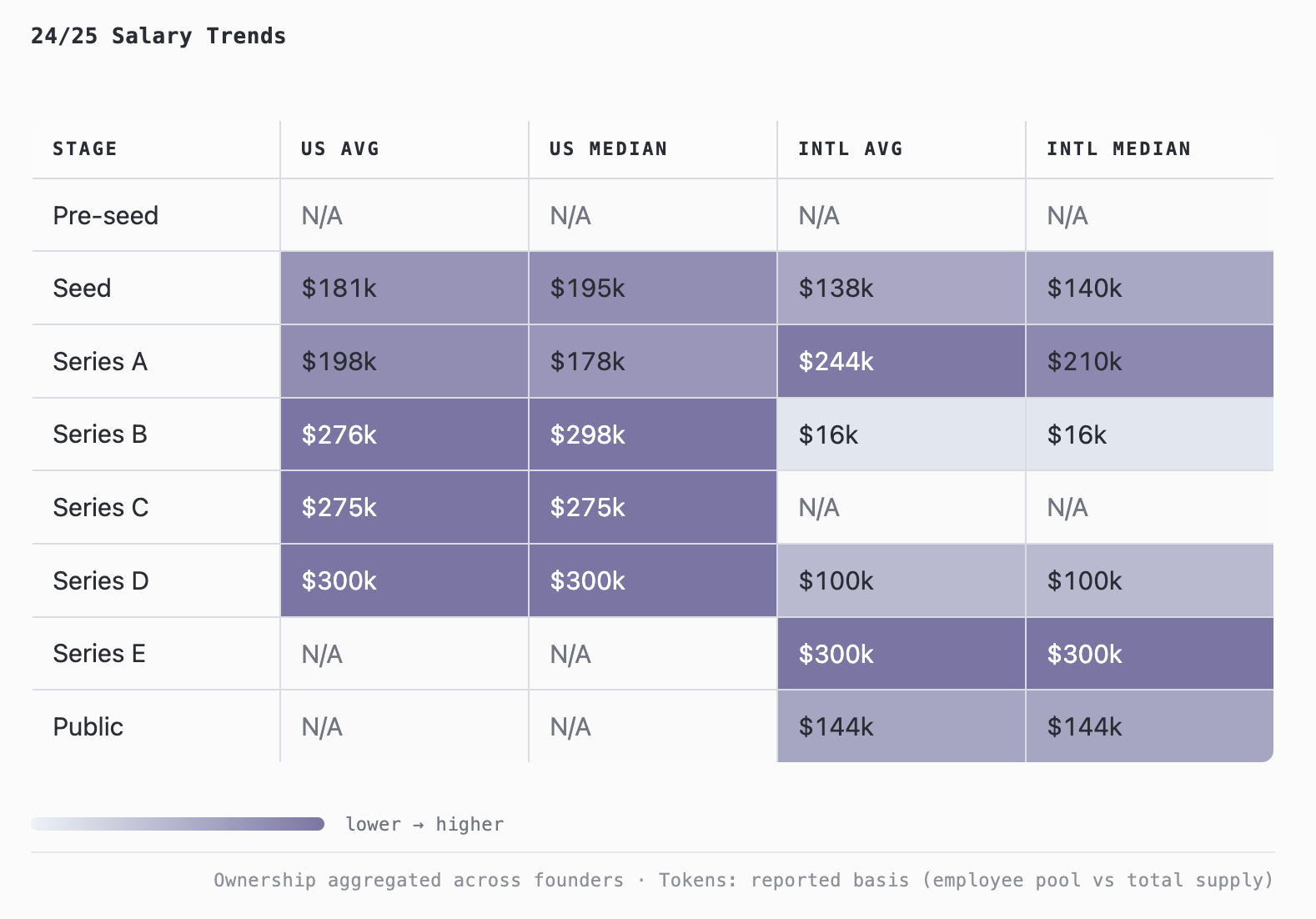
We can see a very interesting phenomenon: founder salaries show a clear positive correlation with the company's funding stage, but this growth is not linear, and the US and international markets show截然不同的模式 (completely different patterns).
US Market:
In the US market, founder salaries show a step-like increase as funding rounds progress. Starting from $181k (median $195k) at the Seed round, it rises slightly to $198k at Series A – growth at this stage is relatively moderate. The real jump happens at Series B, where the average salary surges to $276k (median $298k), an increase of over 40%.
This jump point is interesting. Series B is typically when a company truly begins to scale, product-market fit is validated, and the business model is基本成熟 (basically mature). At this point, founders transition from "entrepreneurs" to "CEOs," needing to manage larger teams and handle more complex business matters. The significant salary increase reflects this role change and increased responsibility.
By Series C and D, salaries stabilize in the $275k-$300k range. The Series C salary ($275k) is even slightly lower than Series B, and only recovers to $300k at Series D.
International Market:
The international market data presents a completely different picture. Early-stage (Seed to Series A) founder salaries are relatively reasonable, growing from $138k-$140k (Seed) to $210k-$244k (Series A). But by Series B, the data shows only $16k – this is either due to a very small sample size or founders in certain regions indeed choosing extremely low salaries to keep the company running.
Even more surprising is the Series E data: founder salaries in the international market reach $300k, on par with US Series D levels. This might reflect a trend: companies that can raise an E round internationally are usually already unicorns or准独角兽 (quasi-unicorns) in their respective regions, and their founder salaries naturally align with international standards.
Salaries for founders of public companies ($144k) are relatively lower because after going public, the main source of wealth for founders shifts to equity/token value rather than cash compensation.
III. Where Are Employees Working?
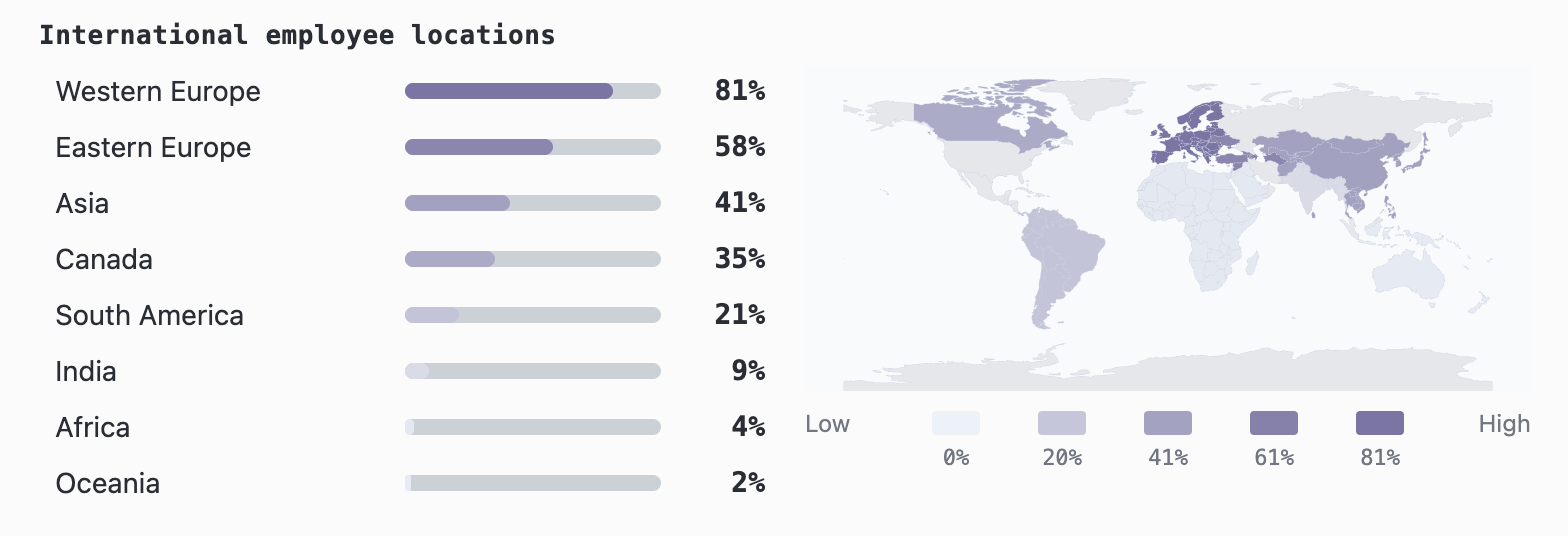
Dragonfly's data shows that Western Europe is the primary international hiring hub.
Changes in regional hiring typically occur when companies enter Series B and beyond. As companies mature and require stronger local operational capabilities, teams begin to expand into regions like Asia, Canada, and Eastern Europe.
Simultaneously, this might also reflect that this data report differs significantly from the Asian crypto project salary benchmarks we usually see domestically; among these thousands of data points, the vast majority of salaries are likely offered for European positions, hence the inflation.
However, without looking, one really wouldn't know – these people are living really well!
Dragonfly's official summary tells us:
Among companies from Series B to Series E, 84% employ staff in Western Europe; this proportion is基本相同 (largely the same) among companies with funding exceeding $40M.
Among later-stage companies, 63% hire in Eastern Europe, primarily benefiting from the strong supply of engineers and relatively cost-effective talent.
Presence in Asia almost doubled year-on-year, from 20% to 41%, to adapt to stronger user adoption and market demand. This suggests that the number of employees in Asia is actually not mainstream.
Among companies from Series B to Series E, 38% expanded to Canada, leveraging its proximity to the US, relatively friendly regulatory environment, and mature developer ecosystem as a risk hedging choice.
From Series B to Series D, only 13% of companies expanded to South America.
Relatively rare exception regions include: India (9%), Africa (4%), and Oceania (2%).
IV. What Can We Learn?
3.1 Entry-Level Talent
If you have a technical background, congratulations, you're already ahead at the starting line. Software engineers, smart contract engineers, and product managers have the highest starting salaries; even at entry-level, you can earn a six-figure annual salary in the US market. In traditional industries, this might take several years of experience to achieve.
But here's a suggestion: don't just focus on the starting salary. Learning opportunities and growth space are more important. Choosing a team where you can grow quickly is more valuable than an extra ten or twenty thousand dollars in starting salary, because the salary jump from entry to mid-level is huge – the key is how quickly you can complete this transition.
Although BD and Marketing have lower starting salaries, don't be discouraged. Look at their growth curves, especially BD, where salaries can double from entry to mid-level. If you are good at building relationships and understanding business logic, BD might be an excellent choice. The first year or two might be tough with low pay, but once you build a reputation and network in the circle, your value will grow exponentially.
3.2 Mid-Level Talent
The salary for Mid-level PMs surpasses all other positions, and this is no accident. The market is疯狂地寻找 (desperately searching for) that复合型人才 (versatile talent) that "understands technology + understands users." If you are an engineer but find yourself always thinking "Do users really need this feature?" or "This product logic is flawed," then transitioning to product might be a good choice.
For BD, the mid-level stage is simply the golden period. At this stage, you have accumulated enough experience and connections to start independently driving important collaborations. You know how to deal with different stakeholders and understand the operating rules of the ecosystem. In the crypto industry, industry reputation is everything. Attend more industry events, share your insights on Twitter, and build your professional image in a specific领域 (field). These investments will bring huge returns when you seek your next opportunity.
3.3 Geographic Strategy
Choosing where to work is not just about salary. The US market确实薪资高 (indeed has high salaries), but don't forget the cost of living. Earning $150k in San Francisco might leave you worse off than earning €80k in Berlin. Plus, competition in the US market is exceptionally fierce, and work pressure is usually greater.
The international market offers a better quality of life balance. Many European crypto companies offer more flexible work arrangements, longer vacations, and a relatively relaxed work atmosphere. If you value work-life balance, the international market might be more suitable for you.
Most importantly, remote work is changing the game. More and more US companies are willing to hire international remote employees. Although salaries might be adjusted, they are still very attractive.
There's an interesting arbitrage opportunity here:获取 (obtain) international market salaries in low-cost areas. For example, living in Eastern Europe or Southeast Asia while working remotely for a company paying "international market" salaries. Even if the salary is lower than the US standard, your quality of life might actually be higher.
Geographical differences for certain positions are narrowing quickly, especially for senior engineers. If you are a Senior-level engineer, no matter where you are, you can likely command a pretty good salary. Companies care more about whether you can solve problems than where you sit to write code.
Conclusion
The 2025 crypto industry salary data reveals a market full of opportunities but also full of challenges. Technical talent continues to enjoy a premium, product managers have emerged as a dark horse, and growth-oriented roles like BD and marketing show great potential.
For job seekers, choosing the right position and development path is more important than simply pursuing high salaries. The industry's rapid development means today's entry-level employees could become domain experts within a few years. The key is to keep learning, build networks, and find your unique value in this exciting industry.
For companies, establishing a fair and competitive compensation system is just the first step. The real challenge lies in creating an environment that can attract, develop, and retain top talent. In an industry where talent defines success, investing in human capital will yield the highest returns.
As the crypto industry continues to mature and develop, we can expect to see more细分 (segmented) positions, more professional skill requirements, and a more globalized talent market. Those individuals and organizations that can adapt to these changes, continuously learn and grow, will occupy the most advantageous positions in this digital future.
Twitter:https://twitter.com/BitpushNewsCN
Bitpush TG Discussion Group:https://t.me/BitPushCommunity
Bitpush TG Subscription: https://t.me/bitpush