UK MPs warn Bank of England stablecoin plans could drive innovation offshore

cointelegraphPublished on 2025-12-12Last updated on 2025-12-12

Abstract

A cross-party group of UK MPs and Lords, including prominent figures like former Defense Secretary Sir Gavin Williamson and shadow Science and Tech Minister Viscount Camrose, has written to Chancellor Rachel Reeves expressing concerns over the Bank of England’s proposed stablecoin regulations. They warn that the plans could drive innovation and capital offshore by imposing restrictive measures such as prohibiting most wholesale stablecoin use outside a limited sandbox, banning interest on reserves, and setting impractical holding limits—£20,000 for individuals and around $13.3 million for businesses. The signatories argue that stablecoins are already a foundational part of the digital economy and that the UK’s approach risks making it a "global outlier," weakening London’s role as a financial hub. They emphasize that pound-pegged stablecoins represent less than 0.1% of global issuance and caution that overly strict rules may push activity toward dollar-based stablecoins like USDT and USDC. Industry leaders echo these concerns, stating that the proposed caps and reserve requirements—which mandate 40% of reserves be held as non-interest-bearing deposits—could limit functionality and encourage relocation to more flexible jurisdictions like the EU or U.S., which are adopting more innovation-friendly frameworks.

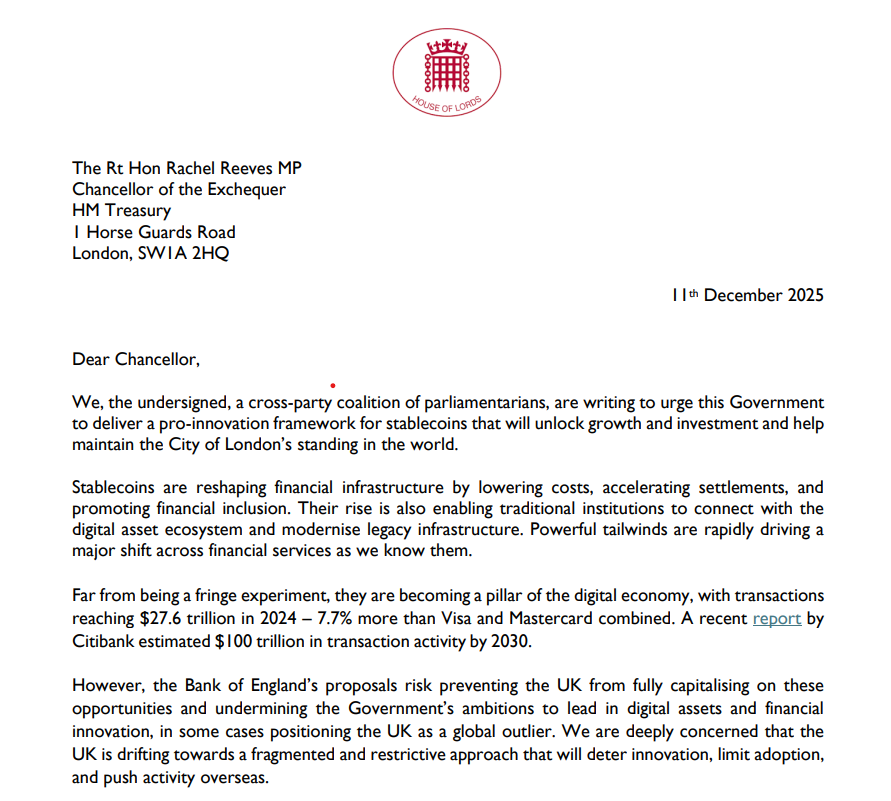
A cross-party group of members of the House of Commons and the House of Lords in the United Kingdom, including former Defense Secretary Sir Gavin Williamson, shadow Science and Tech (AI) Minister Viscount Camrose, and the former Prime Minister, Rishi Sunak’s Chief Whip Lord Hart, have urged Chancellor Rachel Reeves to intervene over the Bank of England’s proposed regime for systemic stablecoins.

In a joint open letter to the Chancellor on Dec. 11, they warned that the Bank of England’s proposals for regulating stablecoins could drive innovation and capital offshore.

Stablecoins already a “pillar” of the digital economy

The parliamentarians say the plans risk turning the UK into a “global outlier” by barring most wholesale use of stablecoins outside the Digital Securities Sandbox, prohibiting interest on reserves, and imposing what they call “impractical and anti-innovation” holding caps that could push activity into dollar stablecoins such as USDC (USDC) and USDt (USDT).​

Open Letter to the Chancellor shared with Cointelegraph

The signatories argue that stablecoins are already becoming a “pillar of the digital economy,” and warn that the UK is “drifting towards a fragmented and restrictive approach” that will deter adoption and weaken London’s global role.

Related: UK central bank still ‘disproportionately cautious’ about stablecoins

They stress that British pound-pegged stablecoins represent less than 0.1% of global issuance, claiming the current framework overstates depositor-flight risk while undercutting the government’s goal of making the UK a “world‐leading destination for digital assets.”​

Asher Tan, co-founder and CEO of UK Financial Conduct Association-registered CoinJar, one of the longest-running cryptocurrency exchanges globally, told Cointelegraph that the letter reflected a “growing frustration across the digital asset industry” that the UK risks “regulating tomorrow’s financial infrastructure with yesterday’s assumptions.”

Jakob Kronbichler, co-founder and CEO of Clearpool onchain credit marketplace, said that stablecoins are already functioning as settlement infrastructure for payments, capital markets, and onchain credit, not “as experimental products.”

He said that if regulation continues to treat them as “niche or provisional,” it risks slowing adoption in the very areas where the UK wants to lead.

Related: FCA trials crypto transparency templates as UK shapes new rulebook

The Bank of England’s stablecoin plans

Under the proposed regulatory regime for sterling-denominated systemic stablecoins, the Bank proposes temporary holding limits of 20,000 pounds ($26,500) per coin for individuals and around $13.3 million for businesses, with exemptions for the largest corporations.

Issuers would have to keep at least 40% of reserves as unremunerated deposits at the Bank and up to 60% in short-term UK government debt.

Tan said that proposals like hard caps or constraints on reserve economics limit functionality too aggressively. “They won’t completely eliminate risk,” he added, “it will simply relocate activity to jurisdictions with more flexible regulatory frameworks.”

Related: Bank of England governor says stablecoins could reduce reliance on banks

How the UK shapes up to other jurisdictions

In the European Union, the Markets in Crypto-Assets Regulation, or MiCA, already provides a live framework for euro and other asset-referenced tokens across the EU, capping non‐EU currency stablecoins to protect monetary sovereignty rather than to limit overall market growth.

By contrast, the Bank of England’s per-user caps and wholesale limits go further in constraining scale, meaning the UK could end up with tighter usage constraints than MiCA.

In the US, the newly enacted GENIUS Act is designed to support large‐scale payment and settlement use without blanket per‐wallet caps or a narrow sandbox model, which the UK letter’s authors argue leaves London at risk of watching the EU and US capture the “next wave of capital markets innovation.” Kronbichler commented:

“If pound-denominated stablecoins are structurally less efficient than offshore alternatives, activity won’t disappear, it will migrate overseas.”


Related Reads

Trading

Spot
Futures

Hot Articles

What is $BANK

Bank AI: A Revolutionary Step in the Future of Banking Introduction In an era marked by rapid advancements in technology, Bank AI stands at the intersection of artificial intelligence (AI) and banking services. This innovative project seeks to redefine the financial landscape, enhancing operational efficiency, security measures, and customer experiences through the power of AI. As we embark on this exploration of Bank AI, we will delve into what the project entails, its operational dynamics, its historical context, and significant milestones. What is Bank AI? At its core, Bank AI represents a transformative initiative aimed at integrating artificial intelligence into various banking operations. This project harnesses the capabilities of AI to automate processes, improve risk management protocols, and enhance customer interaction through personalised services. The primary objectives of Bank AI include: Automation of Banking Functions: By leveraging AI technologies, Bank AI aims to automate routine tasks, reducing the burden on human resources and enhancing efficiency. Enhanced Risk Management: The project utilises AI algorithms to predict and identify risks, thereby fortifying security measures against fraud and other threats. Personalisation of Banking Services: Bank AI focuses on offering tailored financial products and services by analysing customer data and behaviours. Improving Customer Experience: The implementation of AI-driven solutions, such as chatbots and virtual assistants, aims to provide users with more human-like interactions, revolutionising the way customers engage with banks. With these goals, Bank AI positions itself as a crucial player in rendering banking more efficient, secure, and user-centric. Who is the Creator of Bank AI? Details regarding the creator of Bank AI remain unknown. As such, no specific individual or organisation has been identified in the available information. The anonymity surrounding the project's inception raises questions but does not detract from its ambitious vision and objectives. Who are the Investors of Bank AI? Similar to the project's creator, specific information regarding the investors or supporting organisations of Bank AI has not been disclosed. Without this information, it is challenging to outline the financial backing and institutional support that might be propelling the project forward. Nevertheless, the importance of having a robust investment foundation is pivotal for sustaining development in such an innovative field. How Does Bank AI Work? Bank AI operates on several innovative fronts, focusing on unique factors that differentiate it from traditional banking frameworks. Below are key operational features: Automation: By applying machine learning algorithms, Bank AI automates various manual processes within banks. This results in reduced operational costs and allows human workers to redirect their efforts towards more strategic activities. Advanced Risk Management: The integration of AI into risk management practices equips banks with tools to accurately predict potential threats such as fraud, ensuring that customer information and assets remain secure. Tailored Financial Recommendations: Through continuous learning from customer interactions, the AI systems develop a nuanced understanding of user needs, enabling them to offer tailored advice on financial decisions. Enhanced Customer Interactions: Utilizing chatbots and virtual assistants powered by AI, Bank AI enables a more engaging customer experience, allowing users to have their queries resolved quickly, thus reducing wait times and improving satisfaction levels. Together, these operational features position Bank AI as a pioneer in the banking sector, establishing new benchmarks for service delivery and operational excellence. Timeline of Bank AI Understanding the trajectory of Bank AI requires a look at its historical context. Below is a timeline highlighting important milestones and developments: Early 2010s: The conceptualisation of AI integration into banking services began to gain attention as banking institutions recognised the potential benefits. 2018: A marked increase in the implementation of AI technologies occurred when banks started using AI tools like chatbots for basic customer service and risk management systems for improved security handling. 2023: The sophistication of AI continued to advance, with generative AI being introduced for more complex tasks such as document processing and real-time investment analysis. This year marked a significant leap in the capabilities afforded to banks by AI technology. 2024-Current Status: As of this year, Bank AI is on an upward trajectory, with ongoing research and developments poised to further enhance capabilities in banking operations. Continued exploration of AI applications hints at exciting developments yet to come. Key Points About Bank AI Integration of AI in Banking: Bank AI focuses on adopting artificial intelligence to streamline banking processes and improve user experiences. Automation and Risk Management Focus: The project strongly emphasises these areas, aiming to shift the burden of routine tasks while enhancing security frameworks through predictive analytics. Personalised Banking Solutions: By harnessing customer data, Bank AI enables tailored banking services that cater to individual user needs. Commitment to Development: Bank AI remains committed to ongoing research and development efforts, ensuring its adaptability and ongoing relevance as technology continues to evolve. Conclusion In summary, Bank AI exemplifies a crucial step forward in the banking industry, leveraging artificial intelligence to reshape operational paradigms, enhance security, and promote customer satisfaction. Despite gaps in information surrounding the creator and investors, the clear objectives and functional mechanisms of Bank AI provide a strong foundation for its ongoing evolution. As AI technology continues to advance and merge with the banking sector, Bank AI is well-positioned to significantly impact the future of financial services, enhancing the way we understand and interact with banking.

152 Total ViewsPublished 2024.04.06Updated 2024.12.03

What is $BANK

Discussions

Welcome to the HTX Community. Here, you can stay informed about the latest platform developments and gain access to professional market insights. Users' opinions on the price of BANK (BANK) are presented below.

活动图片