UK Moves To Shut Down Crypto Exchange Tied To Iran’s Military

bitcoinistPublished on 2026-03-21Last updated on 2026-03-21

Abstract

A UK-registered cryptocurrency exchange, Zedxion, is being shut down after a TRM Labs investigation revealed that nearly 90% of its 2024 transactions, totaling around $1 billion, were linked to Iran’s Islamic Revolutionary Guard Corps (IRGC). The UK’s Companies House initiated a compulsory strike-off after discovering the firm filed false information, including a fictitious director named Elizabeth Newman, whose image was traced to a stock photo. The previous director was linked to Babak Zanjani, an Iranian businessman previously sentenced for corruption. The action follows US sanctions imposed in January against Zedxion and a related platform, Zedcex, for supporting the IRGC.

A blockchain analytics firm found that nearly 90% of money processed by a UK-registered crypto exchange in 2024 was connected to Iran’s most powerful military organization.

A Billion Dollars And A Fake Boss

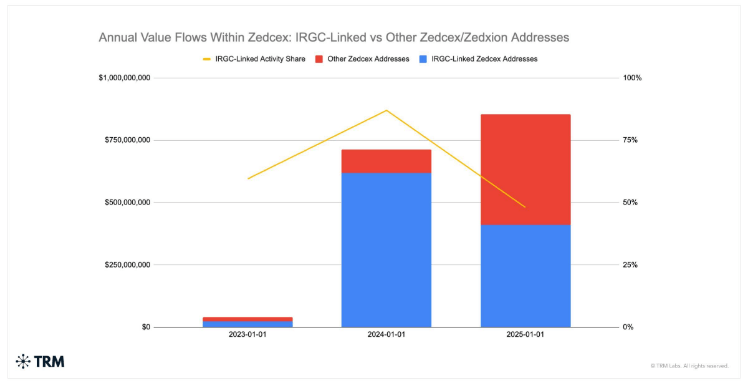
TRM Labs, which tracks cryptocurrency flows, reported that Zedxion Exchange and a related platform called Zedcex moved roughly $1 billion tied to Iran’s Islamic Revolutionary Guard Corps (IRGC).

In 2024, IRGC-linked payments made up about 87% of all transactions the two exchanges handled. Even as that share fell to roughly 48% in 2025, the raw dollar amounts connected to the Iranian military group remained massive.

Now the UK is shutting the exchange down.

Britain’s Companies House — the government body that registers businesses — has started a compulsory strike-off against Zedxion Exchange Ltd. Authorities say the company filed false information, including listing a director who never existed.
Stock Photo, Fake Name, Real Money

The fictitious director was registered under the name Elizabeth Newman, listed as a citizen of the Dominican Republic.

An investigation by the Organized Crime and Corruption Reporting Project (OCCRP) found that the woman behind the name was likely manufactured entirely — her image in company marketing videos traced back to a stock photo.

Babak Zanjani, an Iranian billionaire accused of corruption, previously voiced pride in his role helping Iran sidestep oil sanctions during periods of economic strain. Source: https://www.iranintl.com/

Before Newman appeared in company records, a man named Babak Morteza held the director position. His details matched those of Babak Zanjani, an Iranian businessman who had previously been sentenced to death in Iran for stealing state oil funds.

That sentence was reduced in 2024, and Zanjani resumed business operations. Morteza was listed as director and the person with significant control of Zedxion from October 2021 to August 2022.

Zanjani is also said to head DotOne Holding Group, a conglomerate with operations across cryptocurrency, foreign exchange, logistics, and telecommunications — sectors that have been used in the past to sidestep international sanctions.

Total crypto market cap currently at $2.4 trillion. Chart: TradingView

Washington Acted First

The UK crackdown follows US sanctions imposed in January by the Treasury Department’s Office of Foreign Assets Control (OFAC).

Both Zedxion and Zedcex were named in that action. OFAC said Zanjani helped fund projects supporting the IRGC and the Iranian government more broadly.

Company filings for the two exchanges also showed dormant accounts, a detail that stood in sharp contrast to the enormous transaction volumes blockchain analysts traced through them.

The UK passed the Economic Crime and Corporate Transparency Act in 2023, giving Companies House new authority to verify the identities of directors and check that registered businesses were set up for lawful purposes.

The Zedxion case marks one of the more visible uses of those powers.

Featured image from Unsplash, chart from TradingView

Related Questions

QWhat percentage of transactions processed by Zedxion Exchange in 2024 were linked to Iran's IRGC?

AApproximately 87% of transactions processed by Zedxion Exchange and Zedcex in 2024 were connected to Iran's Islamic Revolutionary Guard Corps (IRGC).

QWhat was the fictitious name of the director listed for Zedxion Exchange Ltd. and what was her alleged citizenship?

AThe fictitious director was registered under the name Elizabeth Newman, who was listed as a citizen of the Dominican Republic.

QWhich US government agency imposed sanctions on Zedxion and Zedcex, and when did this action occur?

AThe US Treasury Department's Office of Foreign Assets Control (OFAC) imposed sanctions on Zedxion and Zedcex in January 2025.

QWhat is the name of the Iranian businessman previously sentenced to death, who was linked to the directorship of Zedxion under an alias?

ABabak Zanjani, an Iranian businessman previously sentenced to death for stealing state oil funds, was linked to the directorship of Zedxion under the alias Babak Morteza.

QWhat new UK legislation gave Companies House enhanced powers to verify company directors and lawful purposes, which was used in the Zedxion case?

AThe Economic Crime and Corporate Transparency Act, passed in 2023, gave Companies House new authority to verify the identities of directors and check that registered businesses were set up for lawful purposes.

Related Reads

Annual Salary of Millions Competing for Electricians, Meta Rushes to Open Its Own Technical School

The AI boom is facing an unexpected bottleneck: a severe shortage of skilled construction workers and electricians. As tech giants like Meta, OpenAI, and Alphabet race to build massive data centers—such as OpenAI's $16 billion "Stargate" project—they are hitting a critical labor wall. The U.S. needs an estimated 130,000 more electricians, 240,000 construction workers, and 150,000 supervisors by 2030 for AI infrastructure alone, but tens of thousands of electrician jobs go unfilled each year. While AI companies offer high premiums, with electricians earning up to $280,000 annually, worker scarcity still causes massive losses—delays on a single project can cost $14.2 million per month. The complexity of building AI data centers, which require immense power (equivalent to powering hundreds of thousands of homes), sophisticated electrical systems, and advanced liquid cooling solutions, demands highly skilled technicians who are in short supply. To combat this, companies are investing heavily in training. Meta has committed $115 million to a free training school offering tuition, housing, and stipends, targeting 5,000 new workers. OpenAI is partnering with unions to secure skilled labor. These efforts are paying off, with a significant rise in Gen Z interest in trade schools over college. However, the power demands are staggering. AI data centers are driving a rapid surge in electricity consumption, projected to account for up to 12% of U.S. power use by 2028 and raising costs for consumers. Furthermore, the construction boom is project-based, leading to a potential future glut of trained workers once building peaks, which could depress wages industry-wide. The race for AI supremacy now depends as much on skilled hands as on advanced chips.

marsbit1h ago

Annual Salary of Millions Competing for Electricians, Meta Rushes to Open Its Own Technical School

marsbit1h ago

OpenAI No Longer Sells Its Most Expensive Model for Profit

OpenAI is shifting its business strategy away from promoting its most expensive, flagship models for every task. Recent price cuts—80% for GPT-5.6 Luna and 20% for Terra—signal a deeper change: the company now actively advises users that many tasks don't require the most powerful model. Instead, OpenAI recommends a tiered approach: use the high-end GPT-5.6 Sol for complex planning and analysis, then delegate execution to cheaper models like Luna. This mirrors moves by Anthropic, which recently launched Claude Opus 5 at half the price of its top model, Fable 5. Both companies are de-emphasizing flagship models as primary revenue drivers, using them instead for brand prestige and technological showcases. The industry is entering a "mass-market" phase, similar to automotive, where high-volume, cost-effective models handle daily operations and drive scale. OpenAI's price reductions are partly enabled by AI models themselves optimizing underlying code and infrastructure, creating a self-reinforcing cycle of efficiency gains and cost reduction. Competition is shifting from "who is smartest" to "who offers the best value." The goal is no longer selling individual models but fostering widespread API adoption and ecosystem lock-in. By making AI calls cheap and ubiquitous, companies like OpenAI aim to become the indispensable, utility-like infrastructure powering automated workflows—the "water and electricity" of software, quietly embedded everywhere.

marsbit1h ago

OpenAI No Longer Sells Its Most Expensive Model for Profit

marsbit1h ago

Trading

Spot
活动图片





