Turkey & Tether Freeze $544M: Why $BMIC Is The Safe Haven

bitcoinistPublished on 2026-02-09Last updated on 2026-02-09

Abstract

Turkish authorities, in collaboration with Tether, froze approximately $544M in assets linked to a money laundering network. This event highlights the power centralized stablecoin issuers have to blacklist addresses, challenging crypto's censorship-resistant narrative and exposing the fragility of centralized infrastructure. This vulnerability, combined with the looming threat of quantum decryption, is shifting the value proposition toward unbreakable security. BMIC ($BMIC) is presented as a solution, offering a quantum-secure finance stack with features like 'Zero Public-Key Exposure' to protect against both regulatory overreach and future quantum attacks. Its ongoing presale, having raised over $444K, is attracting investors seeking a safe haven in defensive, next-generation infrastructure.

The clash between centralized enforcement and decentralized speculation hit a fever pitch this week. Turkish authorities, working alongside Tether, executed one of the largest asset freezes in recent memory. The operation targeted a massive money laundering network, resulting in the seizure and freezing of roughly $544M in value. Originally, the authorities did not disclose which crypto company was involved, but Tether CEO Paolo Ardoino confirmed it was Tether to Bloomberg.

It’s a stark reminder of the reach centralized stablecoin issuers actually possess. While Tether ($USDT) remains the liquidity backbone of the crypto economy, its ability to blacklist addresses at the request of law enforcement, like Turkey’s Interior Ministry, shows that the wild west era of digital finance is closing fast.

That challenges the censorship-resistance narrative many early adopters cling to. While the seizure targets illicit actors, a net positive for industry legitimacy, it also exposes the fragility of relying on centralized infrastructure.

Smart money, however, is watching this closely. The juxtaposition of a half-billion-dollar freeze and retail exuberance suggests a massive blind spot in the market. As centralized vectors like Tether become more compliant and quantum computing threats loom, the real value proposition is shifting.

It’s moving toward genuine, unbreakable security. This is where the conversation pivots from simple price speculation to infrastructure that can actually withstand both regulatory overreach and future tech assaults. Right in that gap, between the desire for safety and the reality of vulnerable legacy tech, BMIC ($BMIC) is emerging as a critical solution for the post-quantum era.

CHECK OUT BMIC ON ITS OFFICIAL PRESALE PAGE

Quantum-Proofing Finance In An Era of Centralized Vulnerability

While the Turkey-Tether collaboration highlights legal vulnerabilities in current crypto holdings, a far more dangerous technical threat is quietly developing: the quantum decryption crisis. Most current blockchain cryptography (including the keys securing those very frozen wallets) relies on math that quantum computers will eventually trivialize.

Industry veterans call this the ‘Harvest Now, Decrypt Later’ threat. Bad actors are collecting encrypted data today to unlock it once quantum processing power matures.

BMIC addresses this existential risk by introducing a Full Quantum-Secure Finance Stack. Unlike legacy wallets that leave public keys exposed on-chain, making them sitting ducks for future quantum algorithms, BMIC uses post-quantum cryptography combined with ‘Zero Public-Key Exposure.’ This approach ensures that even if the underlying network is scrutinized or attacked by advanced computational power, the user’s assets remain mathematically invisible to unauthorized decryption.
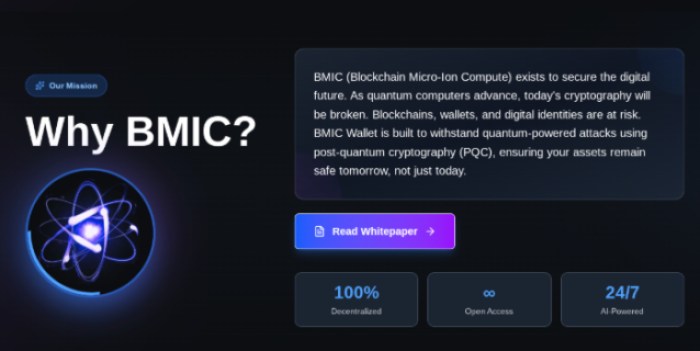
The platform integrates these defenses directly into a usable ecosystem, featuring ERC-4337 Smart Accounts and AI-Enhanced Threat Detection. This isn’t just about paranoia; it’s about future-proofing. If a centralized issuer can freeze $544M with a keystroke, and a quantum computer can eventually crack a standard private key in seconds, the only safe harbor is an architecture built explicitly to resist both.

BMIC’s ‘Burn-to-Compute’ model and Quantum Meta-Cloud extend this utility further, offering a decentralized alternative to the fragile infrastructure currently dominating the headlines.

Smart Money Pivots to BMIC as Presale Metrics Climb

The market’s appetite for defensive infrastructure is showing up in the BMIC capital raise. Sophisticated allocators are positioning themselves in protocols that solve fundamental security flaws. $BMIC has already raised over $444K, a significant figure for an early-stage infrastructure play.

With the token sitting at $0.049474, early participants are entering at a valuation that reflects the project’s development phase rather than its fully realized utility. The appeal lies in the dual-layer value proposition: $BMIC serves as both a governance token for the Quantum Meta-Cloud and the fuel for a wallet ecosystem that enterprises and privacy-conscious individuals desperately need. It’s not surprising that $BMIC made our list of best crypto to watch.

The risk here is inaction. History suggests that security solutions are often undervalued until a catastrophic event, like a major exchange hack or a cryptographic breakthrough, forces a repricing of ‘safety.’ By combining quantum-secure staking with no exposed keys, BMIC offers a yield-bearing asset that doesn’t compromise on security. As the presale continues to draw liquidity away from purely speculative assets, the window to acquire allocation at sub-five-cent levels is narrowing.

SEE HOW THE QUANTUM FUTURE IS BEING BUILT BEFORE LEGACY SYSTEMS FAIL

This article is for informational purposes only and does not constitute financial advice. Cryptocurrency investments carry high risks, including the potential loss of all invested capital. Always conduct independent research before investing.


Related Questions

QWhat was the amount frozen in the joint operation between Turkish authorities and Tether, and what was the stated reason?

ATurkish authorities, working with Tether, froze approximately $544 million. The operation targeted a massive money laundering network.

QAccording to the article, what does the Tether ($USDT) asset freeze demonstrate about centralized stablecoin issuers?

AIt demonstrates that centralized stablecoin issuers possess the ability to blacklist addresses at the request of law enforcement, showing that the 'wild west era' of digital finance is ending and challenging the censorship-resistance narrative.

QWhat is the 'Harvest Now, Decrypt Later' threat mentioned in the article?

AThe 'Harvest Now, Decrypt Later' threat is a strategy where bad actors collect encrypted data today with the intention of decrypting it once quantum computing power becomes advanced enough to break current cryptographic standards.

QHow does BMIC ($BMIC) claim to protect against the quantum decryption crisis?

ABMIC uses a Full Quantum-Secure Finance Stack featuring post-quantum cryptography and 'Zero Public-Key Exposure.' This ensures a user's assets remain mathematically invisible to unauthorized decryption, even from future quantum algorithms.

QWhat is the dual-layer value proposition of the $BMIC token as described in the article?

AThe $BMIC token serves as both a governance token for the Quantum Meta-Cloud and as the fuel for a wallet ecosystem designed for enterprises and privacy-conscious individuals.

Related Reads

Must-Watch Events Next Week|CLARITY Act Could Face Senate Vote; SpaceX, Circle to Report Earnings (8.3-8.9)

**Summary: Key Events and Developments to Watch (August 3-9)** The upcoming week is marked by significant financial disclosures, key legislative deadlines, and notable product updates. **Major Financial Events:** Several companies are scheduled to release their Q2 2026 earnings. American Bitcoin (ABTC) will report on August 3, followed by SpaceX and Hut 8 Mining Corp. on August 4, and Circle on August 5. Notably, a significant portion of SpaceX shares (up to 12% of total shares) will be unlocked on August 6 following their earnings release. **Key Legislative Deadline:** The U.S. Senate faces an August 7 deadline to secure 60 votes for the CLARITY Act, a bipartisan bill aiming to establish a federal regulatory framework for cryptocurrencies. The Senate may hold a full vote on the bill during the week. **Economic Data:** The U.S. July Non-Farm Payrolls report will be released on August 7, providing crucial labor market data. **Technology & Product Updates:** * **Shutdowns:** DeFi portfolio tracker Zapper and wallet app Ctrl Wallet will cease operations on August 3. * **Upgrades:** LayerZero will deprecate its v1 relayers on August 3. XRP Ledger's new version 3.3.0, featuring five new functions, is expected next week. * **AI:** Elon Musk announced that the advanced Grok 4.6 AI model is set for release around August 7. * **Bitcoin:** The BIP-110 forced signaling for a potential Bitcoin network change is scheduled to begin around August 8. **Other Notable Events:** Chinese robotics firm Unitree Tech has set its preliminary price inquiry for its IPO for August 5. South Korean exchange Upbit will delist AQT and AERGO tokens on August 3.

marsbit1h ago

Must-Watch Events Next Week|CLARITY Act Could Face Senate Vote; SpaceX, Circle to Report Earnings (8.3-8.9)

marsbit1h ago

Stocks Are Plummeting More Sharply Than Cryptocurrencies. Where Has the Money Gone?

Stock Markets Plunge Deeper Than Cryptocurrencies: Where Did the Money Go? In late July, Seoul's Kospi index triggered circuit breakers for two consecutive days, plummeting over 40% from its June high. The collapse was led by heavyweight stocks like SK Hynix, whose record profits still disappointed investors, and devastating leveraged ETFs, with one major product losing over 83% of its value. This signaled a global, forced deleveraging targeting the most crowded trades. Interestingly, while stocks exhibited extreme volatility akin to crypto markets, Bitcoin rose nearly 15% in July after a prior steep drop. Analysis shows the money fleeing equities did not flow into Bitcoin. Instead, Bitcoin had already absorbed its sell-off in May-June, when U.S. spot Bitcoin ETFs saw historic outflows. The true safe-haven beneficiary was gold, whose price rose over 20% year-on-year, highlighting a decoupling between Bitcoin and gold as "digital gold." The sell-off was a targeted unwinding of leveraged positions in tech and semiconductors, accelerated by broker-dealer risk management and shifts in the AI narrative, including new competition from Chinese memory chipmakers. The retreat path was clear: from high-valuation tech stocks to cash and U.S. Treasuries, then to gold. For Bitcoin to attract sustained institutional inflows, conditions like eased global liquidity pressure, a "soft-landing" Fed rate cut, and U.S. regulatory clarity via legislation like the stalled CLARITY Act are needed. Currently, Bitcoin is not a safe haven but an already-cleared asset. Its low correlation with tech stocks, however, makes it a potential diversification play for institutional portfolios once the storm passes. The money isn't here yet, but the positioning is underway.

marsbit1h ago

Stocks Are Plummeting More Sharply Than Cryptocurrencies. Where Has the Money Gone?

marsbit1h ago

In Conversation with Ray Dalio: We Are Currently in an AI Bubble, with 1% of My Portfolio in Bitcoin

Ray Dalio, founder of Bridgewater Associates, warns in an interview that the current AI boom shows classic bubble characteristics, which could lead to significant economic downturns as seen in past cycles like 1929 or 2000. He explains that speculative enthusiasm, fueled by debt and overvaluation, often precedes a crash when rising rates or taxation force asset sales, causing widespread losses and recession. Dalio also outlines his "Big Cycle" theory, describing an approximate 80-year pattern where widening wealth gaps, massive government deficits, and shifting geopolitical power (like China's rise) create internal conflict and global instability. He emphasizes that we are in a late-cycle, transitional phase where traditional powers like the US and UK face decline. For personal wealth protection, Dalio advises diversification beyond cash into assets like stocks, bonds, real estate, and particularly gold, which he prefers over Bitcoin. While he holds about 1% of his portfolio in Bitcoin as a non-printable hard asset, he views gold as more secure from technological or governmental threats. Regarding AI's impact, Dalio believes it will disproportionately benefit capital owners, worsening inequality by replacing both physical and cognitive labor. He suggests that human intuition and emotional intelligence, combined with AI, will be key for future workers. On taxation, Dalio argues that wealth taxes are impractical and risk triggering asset sell-offs, reducing productive investment. He points to the UK as a cautionary example of debt, low productivity, and political strife. Geopolitically, Dalio foresees a more regionalized world, with the US showing weakness in prolonged conflicts like with Iran, akin to past imperial declines. The ideal outcome, he suggests, is coexisting powerful blocs (e.g., Americas, China-Asia Pacific) without major war.

marsbit5h ago

In Conversation with Ray Dalio: We Are Currently in an AI Bubble, with 1% of My Portfolio in Bitcoin

marsbit5h ago

Trading

Spot
活动图片




