Turkey & Tether Freeze $544M: Why $BMIC Is The Safe Haven

bitcoinistPublished on 2026-02-09Last updated on 2026-02-09

Abstract

Turkish authorities, in collaboration with Tether, froze approximately $544M in assets linked to a money laundering network. This event highlights the power centralized stablecoin issuers have to blacklist addresses, challenging crypto's censorship-resistant narrative and exposing the fragility of centralized infrastructure. This vulnerability, combined with the looming threat of quantum decryption, is shifting the value proposition toward unbreakable security. BMIC ($BMIC) is presented as a solution, offering a quantum-secure finance stack with features like 'Zero Public-Key Exposure' to protect against both regulatory overreach and future quantum attacks. Its ongoing presale, having raised over $444K, is attracting investors seeking a safe haven in defensive, next-generation infrastructure.

The clash between centralized enforcement and decentralized speculation hit a fever pitch this week. Turkish authorities, working alongside Tether, executed one of the largest asset freezes in recent memory. The operation targeted a massive money laundering network, resulting in the seizure and freezing of roughly $544M in value. Originally, the authorities did not disclose which crypto company was involved, but Tether CEO Paolo Ardoino confirmed it was Tether to Bloomberg.

It’s a stark reminder of the reach centralized stablecoin issuers actually possess. While Tether ($USDT) remains the liquidity backbone of the crypto economy, its ability to blacklist addresses at the request of law enforcement, like Turkey’s Interior Ministry, shows that the wild west era of digital finance is closing fast.

That challenges the censorship-resistance narrative many early adopters cling to. While the seizure targets illicit actors, a net positive for industry legitimacy, it also exposes the fragility of relying on centralized infrastructure.

Smart money, however, is watching this closely. The juxtaposition of a half-billion-dollar freeze and retail exuberance suggests a massive blind spot in the market. As centralized vectors like Tether become more compliant and quantum computing threats loom, the real value proposition is shifting.

It’s moving toward genuine, unbreakable security. This is where the conversation pivots from simple price speculation to infrastructure that can actually withstand both regulatory overreach and future tech assaults. Right in that gap, between the desire for safety and the reality of vulnerable legacy tech, BMIC ($BMIC) is emerging as a critical solution for the post-quantum era.

CHECK OUT BMIC ON ITS OFFICIAL PRESALE PAGE

Quantum-Proofing Finance In An Era of Centralized Vulnerability

While the Turkey-Tether collaboration highlights legal vulnerabilities in current crypto holdings, a far more dangerous technical threat is quietly developing: the quantum decryption crisis. Most current blockchain cryptography (including the keys securing those very frozen wallets) relies on math that quantum computers will eventually trivialize.

Industry veterans call this the ‘Harvest Now, Decrypt Later’ threat. Bad actors are collecting encrypted data today to unlock it once quantum processing power matures.

BMIC addresses this existential risk by introducing a Full Quantum-Secure Finance Stack. Unlike legacy wallets that leave public keys exposed on-chain, making them sitting ducks for future quantum algorithms, BMIC uses post-quantum cryptography combined with ‘Zero Public-Key Exposure.’ This approach ensures that even if the underlying network is scrutinized or attacked by advanced computational power, the user’s assets remain mathematically invisible to unauthorized decryption.
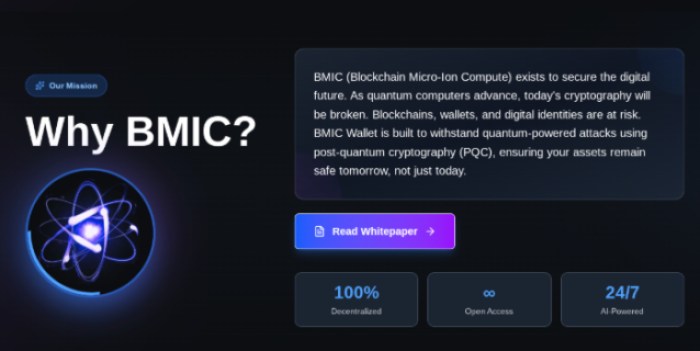
The platform integrates these defenses directly into a usable ecosystem, featuring ERC-4337 Smart Accounts and AI-Enhanced Threat Detection. This isn’t just about paranoia; it’s about future-proofing. If a centralized issuer can freeze $544M with a keystroke, and a quantum computer can eventually crack a standard private key in seconds, the only safe harbor is an architecture built explicitly to resist both.

BMIC’s ‘Burn-to-Compute’ model and Quantum Meta-Cloud extend this utility further, offering a decentralized alternative to the fragile infrastructure currently dominating the headlines.

Smart Money Pivots to BMIC as Presale Metrics Climb

The market’s appetite for defensive infrastructure is showing up in the BMIC capital raise. Sophisticated allocators are positioning themselves in protocols that solve fundamental security flaws. $BMIC has already raised over $444K, a significant figure for an early-stage infrastructure play.

With the token sitting at $0.049474, early participants are entering at a valuation that reflects the project’s development phase rather than its fully realized utility. The appeal lies in the dual-layer value proposition: $BMIC serves as both a governance token for the Quantum Meta-Cloud and the fuel for a wallet ecosystem that enterprises and privacy-conscious individuals desperately need. It’s not surprising that $BMIC made our list of best crypto to watch.

The risk here is inaction. History suggests that security solutions are often undervalued until a catastrophic event, like a major exchange hack or a cryptographic breakthrough, forces a repricing of ‘safety.’ By combining quantum-secure staking with no exposed keys, BMIC offers a yield-bearing asset that doesn’t compromise on security. As the presale continues to draw liquidity away from purely speculative assets, the window to acquire allocation at sub-five-cent levels is narrowing.

SEE HOW THE QUANTUM FUTURE IS BEING BUILT BEFORE LEGACY SYSTEMS FAIL

This article is for informational purposes only and does not constitute financial advice. Cryptocurrency investments carry high risks, including the potential loss of all invested capital. Always conduct independent research before investing.


Related Questions

QWhat was the amount frozen in the joint operation between Turkish authorities and Tether, and what was the stated reason?

ATurkish authorities, working with Tether, froze approximately $544 million. The operation targeted a massive money laundering network.

QAccording to the article, what does the Tether ($USDT) asset freeze demonstrate about centralized stablecoin issuers?

AIt demonstrates that centralized stablecoin issuers possess the ability to blacklist addresses at the request of law enforcement, showing that the 'wild west era' of digital finance is ending and challenging the censorship-resistance narrative.

QWhat is the 'Harvest Now, Decrypt Later' threat mentioned in the article?

AThe 'Harvest Now, Decrypt Later' threat is a strategy where bad actors collect encrypted data today with the intention of decrypting it once quantum computing power becomes advanced enough to break current cryptographic standards.

QHow does BMIC ($BMIC) claim to protect against the quantum decryption crisis?

ABMIC uses a Full Quantum-Secure Finance Stack featuring post-quantum cryptography and 'Zero Public-Key Exposure.' This ensures a user's assets remain mathematically invisible to unauthorized decryption, even from future quantum algorithms.

QWhat is the dual-layer value proposition of the $BMIC token as described in the article?

AThe $BMIC token serves as both a governance token for the Quantum Meta-Cloud and as the fuel for a wallet ecosystem designed for enterprises and privacy-conscious individuals.

Related Reads

7 Months After the Collapse of Huiwang, Southeast Asia's Escrow Platforms Undergo a Major Reshuffle

Following the collapse of Huione Pay—dubbed the "Alipay of Southeast Asia"—seven months ago, the region's underground financial guarantee platform sector is undergoing a significant reshuffle. This power vacuum has been swiftly filled by emerging platforms such as XinBi, Tiger/Navigator, JinBei (renamed JinBo), Dali/Tiancheng, and FullyLight. These platforms, operating largely via Telegram and offering services like escrow for illicit transactions, have absorbed the vast user base and markets left behind by Huione. While positioning themselves as "trust intermediaries," their primary clientele consists of networks involved in online scams, money laundering, illegal gambling, and even human trafficking. For instance, the Tiger/Navigator platform explicitly provides "escrow" services for kidnapping-for-ransom operations ("强押车交易"). Data underscores the immense scale: Huione alone processed over $103 billion in cryptocurrency payments and facilitated over $31 billion through its escrow market before its downfall, linking it to Cambodia's notorious Prince Group. Since its collapse, competitors have seen explosive growth. For example, the XinBi platform has accumulated over $1.6 billion in total USDT revenue, while platforms like NewPay, OkPay (under Dali), and FullyLight Wallet collectively processed over $4.8 billion in USDT in a single year. This ecosystem thrives in regions like Cambodia and Myanmar, where regulatory gaps allow these platforms to act as critical financial infrastructure for sprawling cybercrime industries, from scam compounds to online casinos. The article concludes that the moniker "Southeast Asian Alipay" is a misnomer, obscuring the platforms' fundamental role in enabling serious criminal enterprises rather than representing legitimate financial innovation.

Odaily星球日报36m ago

7 Months After the Collapse of Huiwang, Southeast Asia's Escrow Platforms Undergo a Major Reshuffle

Odaily星球日报36m ago

The Changing Landscape: What Are Crypto VCs Experiencing?

Title: The Shifting Landscape of Crypto Venture Capital The era of dedicated crypto venture capital funds is undergoing a significant transformation. Once essential for navigating the sector's complexity and high risk, these specialized funds are now facing an identity crisis as the market matures. This shift mirrors historical patterns in other specialized investment classes like cleantech and SPACs, where initial information advantages dissipate as technologies become mainstream and integrated into existing industry frameworks. The article argues that crypto is reaching a critical inflection point, transitioning from a "building phase" to an "integration phase." Major players like Stripe, BlackRock, and Visa now engage with crypto not for its novel mechanics but as a foundational financial infrastructure. Their needs—regulatory compliance, banking partnerships, distribution channels—align with traditional fintech, a domain easily understood by large, generalist funds like Sequoia and Founders Fund. This evolution creates a "barbell effect" within the VC landscape. On one end are massive, diversified platforms that can incorporate crypto as one vertical among many. On the other are small, nimble funds focused on niche, experimental projects. The middle ground—medium-sized dedicated crypto funds—is being squeezed out. Their typical fund size makes it impossible to generate sufficient returns solely from early-stage crypto bets, yet they cannot compete with giants for later-stage deals. Consequently, leading crypto-native firms like Paradigm and Framework Ventures are expanding into AI, robotics, and other sectors, driven partly by LP pressure for better returns amid a broader VC DPI crisis. Others, like Dragonfly and a16z, have narrowed their crypto focus predominantly to financial infrastructure like stablecoins, reframing the sector's core narrative. For crypto entrepreneurs, this consolidation presents challenges. While generalist funds offer larger checks and broader resources, crypto projects now compete fiercely with AI for attention and capital within these firms. Furthermore, the long-term, non-commercial foundational work that built the ecosystem—funded by dedicated crypto VCs—is less likely to attract generalist capital focused on direct returns. The conclusion is that "crypto investor" as a standalone category is becoming obsolete, akin to "internet investor." Crypto is becoming a baseline infrastructure layer. The future will see a barbell structure: large-scale growth financing handled by generalist funds, while pioneering, speculative projects are funded by small, specialized vehicles. The dedicated crypto funds of the 2017-2021 boom, which incubated core infrastructure, are giving way to this new, bifurcated reality.

Foresight News53m ago

The Changing Landscape: What Are Crypto VCs Experiencing?

Foresight News53m ago

As Consensus Accelerates, What Are Young Investors Betting On?

Title: As Consensus Forms Faster, What Are Young Investors Betting On? In the rapid evolution of tech investment, a new generation of young investors is navigating a landscape where AI, robotics, commercial aerospace, and quantum computing are advancing simultaneously. Traditional investment logic based on financial models is giving way to a need for deep technical understanding and the ability to act before industry consensus forms. An analysis of trends from the "WAIC FUTURE TECH" list of young investment leaders reveals key shifts in focus. The first major trend is the movement of AI from the digital screen into the physical world. Investment is shifting from large language models and chatbots towards embodied AI, robotics, AI hardware, and edge computing. While demonstrations generate excitement, the real challenge lies in achieving scalable, reliable, and cost-effective delivery in complex real-world environments like factories and logistics. Success depends not just on algorithms but on the integration of sensors, actuators, and control systems. Second, the competitive focus for large models is moving beyond raw capability toward building an "intelligence flywheel." The goal is to create self-reinforcing systems where user interaction generates data, improving the model, which in turn enhances the user experience and attracts more engagement. Companies that successfully embed AI into workflows to create these closed-loop systems can build lasting value that isn't easily erased by the next model upgrade. Third, facing a potential bottleneck in high-quality human-generated data, investors are looking at new underlying technologies. Reinforcement learning and self-play, as demonstrated by AlphaGo Zero, offer paths for AI to generate its own experience. Scientific foundation models, which aim to build general AI capabilities for fields like life sciences and materials discovery, represent a non-consensus direction that could unlock new frontiers of knowledge and data. Finally, in deep-tech areas like quantum computing, commercial aerospace, and space-based infrastructure, patient capital is essential. These fields have long, uncertain development and validation cycles involving complex engineering, supply chains, and regulations. Investment here requires a long-term view, focusing on foundational team capabilities and the eventual emergence of market demand, even if commercial returns are distant. Collectively, these trends illustrate how young investors are adapting to a new era. They are learning to make earlier, technically-informed judgments, balance hype with real-world viability, and provide the patient capital needed to build the deep-tech foundations of the future.

marsbit1h ago

As Consensus Accelerates, What Are Young Investors Betting On?

marsbit1h ago

Trading

Spot
活动图片




