Trump Tweets After Hours, Pushing On-Chain Perpetual Contracts into the Mainstream

marsbitPublished on 2026-03-24Last updated on 2026-03-24

Abstract

Trump, who calls himself the "Crypto President," is also driving the adoption of perpetual futures contracts. He frequently makes market-moving statements outside traditional trading hours, coinciding with the rise of 24/7 trading infrastructure. Over a single weekend, Hyperliquid’s S&P 500 proxy product experienced three major price swings triggered by Trump’s tweets—first rising on positive remarks, then falling after a threat against Iran, and surging again following claims of diplomatic progress (later denied by Iran). This highlights a structural shift toward perpetual contracts and round-the-clock markets. Perpetual DEX trading volume reached $739 billion in January 2026, accounting for 10.2% of all crypto perpetual trading—up from just 2.0% two years prior. While it remains uncertain whether perps will dominate traditional finance, growth is undeniable. Recent developments, like Katana’s acquisition of IDEX and the launch of Katana Perps, signal increasing momentum. Regulatory clarity and macro risks are accelerating the move toward 24/7 trading, where price discovery happens continuously.

Author: FintechFrank

Compiled by: Deep Tide TechFlow

Deep Tide Guide: This article captures an ongoing structural shift: Trump's habit of making market-moving statements after the market closes, which coincides with the rise of 24/7 trading infrastructure. The S&P 500 proxy product on Hyperliquid experienced three significant fluctuations triggered by Trump's tweets over the same weekend. This is not a coincidence but a preview of a new normal.

Full Text Below:

Trump calls himself the "Crypto President," but in many ways, he is also the "Perpetual Contracts President."

It is well-known that Trump doesn't sleep, and he doesn't hesitate to make statements that can shake the market outside of traditional trading hours. This is a peculiar yet fitting backdrop: the market is evolving toward 24/7 trading, and we happen to have a president who can best be described as "spontaneous and sometimes chaotic."

This dynamic was fully demonstrated over the weekend.

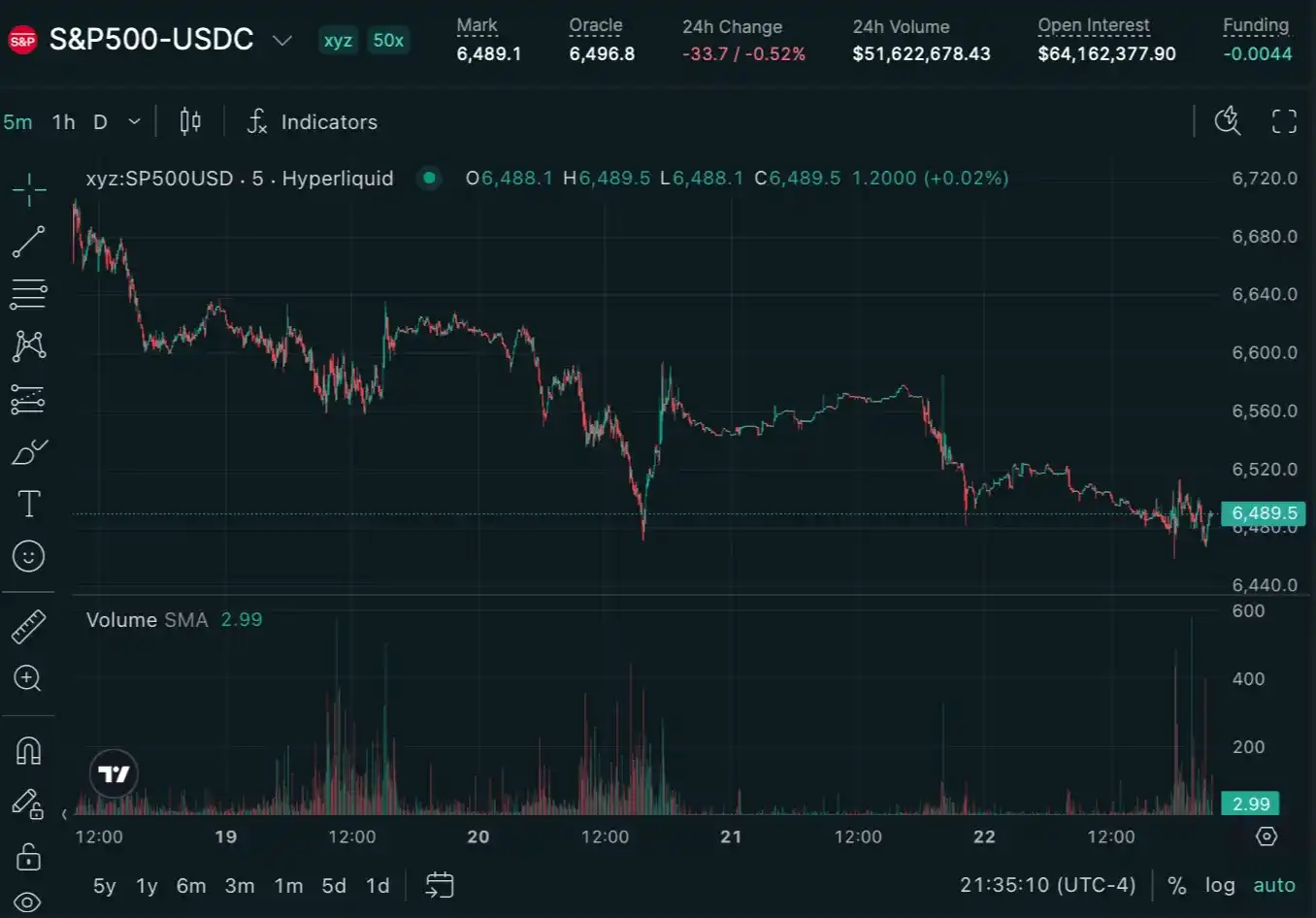
Just days after S&P Global announced it would authorize trading of the S&P 500 on Hyperliquid, Trump stated on Friday afternoon after the market closed that the U.S. is "very close to achieving our goals." The S&P 500 proxy product on Hyperliquid immediately rose.

Then, on Saturday at 7:44 PM Eastern Time, Trump escalated his threats, warning that he would strike Iran's power facilities if the Strait of Hormuz was not reopened. The reaction was instantaneous: the S&P 500 on Hyperliquid immediately fell.

But it didn't end there. On Monday morning, Trump claimed that the U.S. and Iran had held talks on a "comprehensive and thorough resolution of hostilities." S&P 500 futures surged by over 3.5%. Iran later denied Trump's statement.

Trump's presidency may not be driving the arrival of 24/7 markets, but it has made it impossible to ignore the issue.
It remains unclear which perpetual contract product will dominate or whether perpetual contracts will become the primary structure for 24/7 markets. Futures have historically been far less familiar to U.S. retail investors than options, and whether traditional brokerages can successfully promote these products to their customer base remains an open question. I am skeptical. What works in crypto markets may not seamlessly translate to traditional finance users.

Nevertheless, growth is undeniable.

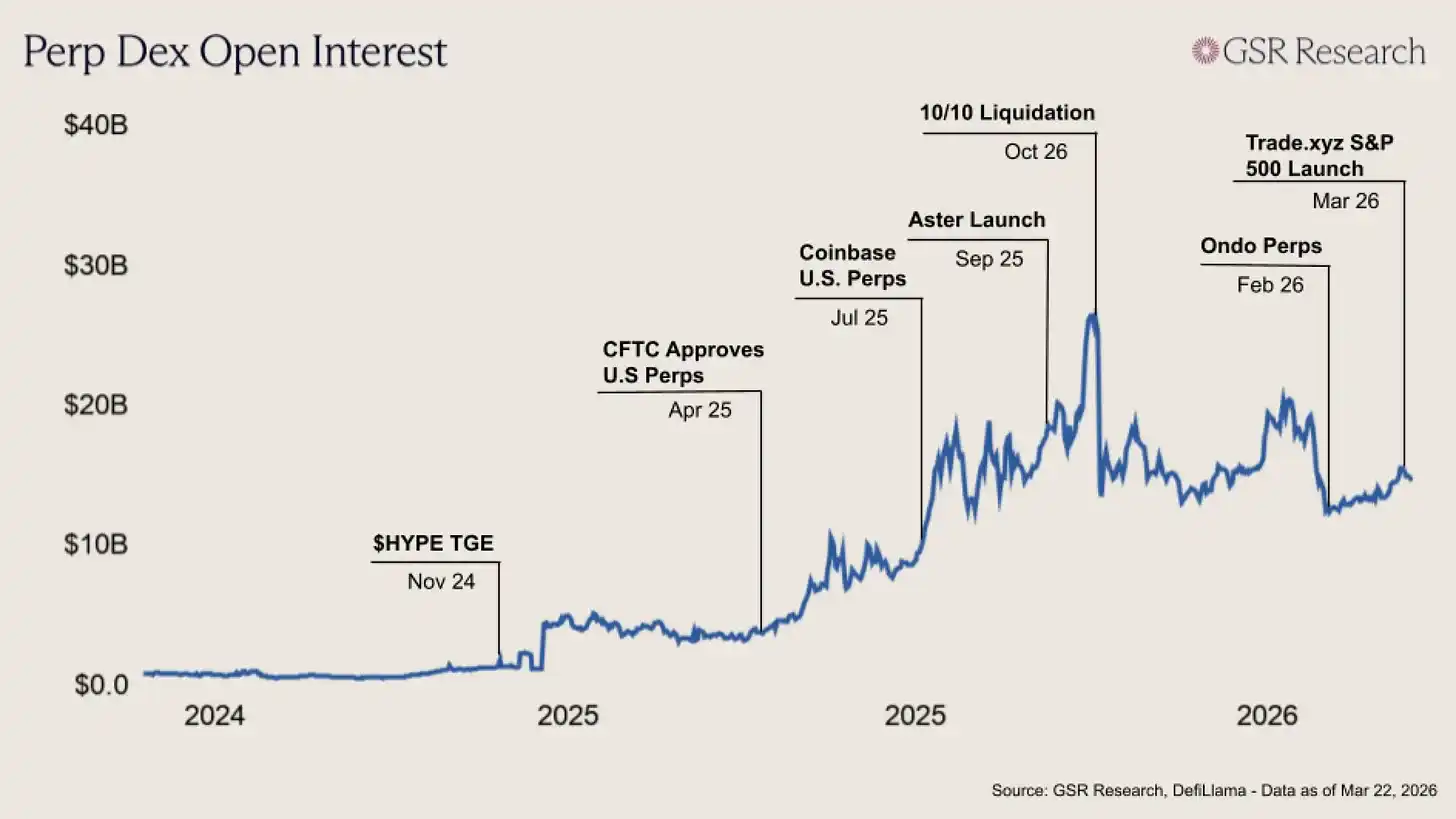
The open interest on perpetual contract DEX platforms has surged significantly. In January 2026, the trading volume of perpetual contract DEXs reached $739 billion, accounting for 10.2% of the total crypto perpetual contract trading volume on decentralized platforms—compared to just 2.0% two years ago.

As Carlos Guzman and Slater Santer of GSR Research show in the chart, news flow in both centralized and decentralized perpetual contract markets has accelerated since the HYPE TGE:
This morning, there was further momentum within the GSR ecosystem:

Katana acquired the early decentralized exchange IDEX and launched Katana Perps, a platform designed to unify spot and derivatives trading on-chain. This is the first major move by CEO Matthew Fisher since taking office, reflecting a pursuit of controlling more of the trading stack and capturing greater economic value.

This move also highlights a broader shift: the environment for perpetual contracts is becoming increasingly favorable. Here’s how Katana put it:

"This move coincides with U.S. regulators sending clear signals allowing crypto perpetual contracts, marking a potential inflection point for on-chain derivatives. At the same time, trading activity continues to migrate toward 24/7 markets, with price discovery increasingly happening in real-time rather than during fixed trading hours. As global markets adapt to new realities, macro risks no longer wait for trading hours, reinforcing the importance of a continuous 24/7 trading environment."


Related Questions

QWhat is the main argument of the article regarding Trump and the financial markets?

AThe article argues that former President Trump, through his habit of making market-moving statements after traditional trading hours, is inadvertently accelerating the adoption and mainstream relevance of 24/7 on-chain perpetual contracts, making him a 'Perpetuals President'.

QWhich platform's S&P 500 proxy product is highlighted as reacting to Trump's tweets?

AThe S&P 500 proxy product on the Hyperliquid platform is highlighted, as it experienced significant price movements in response to a series of Trump's tweets over a single weekend.

QWhat significant change in market share for perpetual DEXs does the article mention?

AThe article states that perpetual DEX trading reached $739 billion in January 2026, accounting for 10.2% of all crypto perpetual trading volume, a significant increase from just 2.0% two years prior.

QWhat recent corporate acquisition and product launch is cited as evidence of growing momentum in the on-chain derivatives space?

AKatana acquired the early decentralized exchange IDEX and launched 'Katana Perps', a platform aiming to unify spot and derivatives trading on-chain.

QAccording to the article, what broader shift in trading is being reinforced by global macro events?

AThe article states that trading activity is shifting towards 24/7 markets, with price discovery happening increasingly in real-time, a trend reinforced by the fact that global macro risks no longer wait for traditional market hours.

Related Reads

Within Strategy's Framework, STRC's Dividend Yield Remains at 12% as Share Price Stays Below Par Value

Michael Saylor, Executive Chairman of Strategy (MSTR), confirmed that the dividend rate for its STRC perpetual preferred shares will remain at 12.00% through August 2026. The rate has increased from 9% at its July 2025 launch to the current high via a "ratchet" mechanism, which permanently raises the rate by 0.5% whenever the share price falls below $95. This mechanism is intended to push the price back toward its $100 par value and support Strategy's "at-the-market" (ATM) program for issuing new shares to fund Bitcoin purchases. However, the mechanism has not worked as intended. STRC shares closed at $89.46 on July 31, remaining about 10-11% below par value despite the record-high dividend. Competition from rival Strive's higher-yielding SATA securities has pressured demand. The persistent discount has forced Strategy to suspend new STRC issuances via its ATM program, limiting this funding channel for Bitcoin acquisitions. STRC's struggles reflect Bitcoin's own volatility, as the preferred shares historically move in tandem. Analysts have warned the ratchet structure carries long-term, one-way risk. A law firm is investigating Strategy's ability to maintain dividend payments if Bitcoin's price stays low. Retail investors own roughly 83% of outstanding STRC shares, a group seen as prone to panic selling during downturns. In response, Strategy has established financial reserves, including a liquidity cushion covering about 26 months of dividend/interest obligations, and a $2 billion share buyback program alongside a Bitcoin monetization framework, though the company emphasized it is not obligated to sell any Bitcoin.

cryptonews.ru42m ago

Within Strategy's Framework, STRC's Dividend Yield Remains at 12% as Share Price Stays Below Par Value

cryptonews.ru42m ago

Trading

Spot
活动图片