Trump Family-Linked Crypto Company Faces More Scrutiny Over Auditor Controversy

bitcoinistPublished on 2025-12-30Last updated on 2025-12-30

Abstract

Trump-linked crypto treasury company Alt5 Sigma faces intensified scrutiny and potential Nasdaq delisting after appointing an auditor with an expired license and regulatory violations. The firm, which rebranded to hold Donald Trump’s WLFI token, failed to file quarterly reports and has seen high-level departures, including Eric Trump. Its newly hired auditor, Victor Mokuolu CPA, had its license expired in Texas and previously failed a peer review. Alt5 Sigma has since replaced the auditor amid ongoing compliance issues and risks violating audit committee requirements.

Recent reports claim that the internal turmoil of a crypto treasury company backed by the Trump family has deepened as the firm risks being delisted from Nasdaq and has appointed an audit company facing regulatory scrutiny.

Crypto Treasury Company’s Turmoil Intensifies

On Monday, Nasdaq-listed crypto treasury company Alt5 Sigma is facing renewed scrutiny after appointing a new audit company with an expired and inactive license earlier this month, the Financial Times initially reported.

The Las Vegas-based company rebranded from a biotech company to a Digital Asset Treasury Company (DAT) earlier this year, seeking to become the first publicly traded firm to accumulate WLFI, the token of US President Donald Trump’s crypto ventures, World Liberty Financial.

As the report noted, the company’s financial position has turned murky over the past few months due to its failure to file quarterly results on schedule. Now, its recent switch of auditors has deepened its current position as the newly appointed firm, Victor Mokuolu CPA PLLC, was allegedly fined by accounting regulators and failed an inspection under the standard peer review process.

According to the Financial Times, filings in the state of Texas show that the company’s licence expired in August. Meanwhile, the board’s records show that its license has not been renewed by December 26. Therefore, state regulations prohibit the firm from doing any audit work until the licence is renewed.

The audit company has reportedly been working for over two years to address its deficiencies, which previously resulted in a failing grade under the accounting profession’s peer review process in 2023.

This year’s failure to renew its license follows the Texas State Board of Public Accountancy and another US regulator’s actions against the firm for “repeatedly failing to file regulatory paperwork on time.”

In a statement to the news media outlet, Alt5 Sigma affirmed that the auditor is “undergoing a peer review per Texas State Board of Accountancy regulations and will be completed by the end of January 2026, at which point the auditor expects the firm’s licence to be active.”

The Trump-backed crypto treasury firm emphasized that “No reviews or audits of Alt5’s financial statements will be issued by our auditor until the firm’s licence is active.”

In an update, the Financial Times added that Alt5 Sigma fired the audit firm on Christmas Day following its inquiries about the issue. A regulatory filing made on Monday reportedly shows that the company has hired LJ Soldinger Associates as its new accounting firm.

Alt5 Sigma Risks Nasdaq Delisting

The controversial December 8 appointment comes amid a period of turmoil for the company, the report noted, as it already risks being delisted from Nasdaq, where it trades under the ticker “ALTS.”

The company failed to submit its quarterly results for the period ending in late September, blaming the delay on the “timeliness and responsiveness” of its previous auditor, who seemingly quit last month. This has opened the door to a potential delisting from the stock exchange.

In August, World Liberty Financial unveiled its partnership with Alt5 Sigma and became an investor in the technology firm, which sought to raise $1.5 billion for its crypto treasury strategy based on WLFI.

As a result, multiple World Liberty Financial co-founders joined Alt5 Sigma’s board. Notably, Zach Witkoff, son of President Trump’s Special Envoy Steve Witkoff, was appointed as chairman of the crypto treasury firm.

Similarly, Eric Trump joined the company’s board as a director, while Zak Folkman became a board observer. Nonetheless, Trump stepped down from his position in September, just weeks after being appointed, as revealed in a Securities and Exchange Commission (SEC) filing

Jonathan Hugh, Alt5’s Chief Financial Officer (CFO), left the company after just three months, while chief executive Peter Tassiopoulos resigned in October. Meanwhile, board member David Danziger parted ways with the firm in November.

This also puts the company “in violation of a requirement to have an audit committee of a certain size and with accounting experience,” the report concluded.
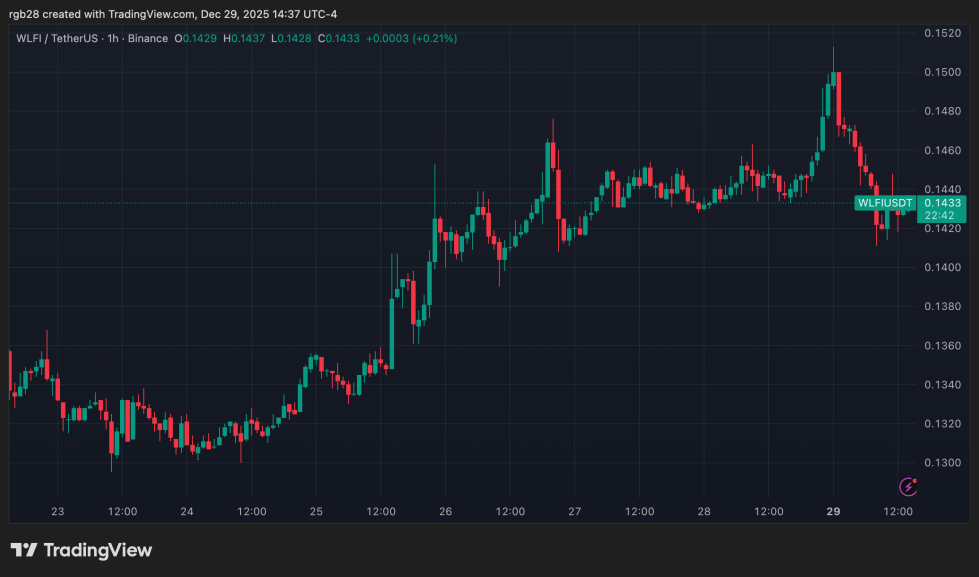
WLFI trades at $0.14 in the one-week chart. Source: WLFIUSDT on TradingView


Related Questions

QWhat is the name of the crypto treasury company backed by the Trump family that is facing scrutiny?

AThe company is called Alt5 Sigma.

QWhy is Alt5 Sigma at risk of being delisted from Nasdaq?

AThe company failed to submit its quarterly results for the period ending in late September, which opens the door to a potential delisting.

QWhich audit firm did Alt5 Sigma initially appoint in December, and what was the main issue with it?

AThe company initially appointed Victor Mokuolu CPA PLLC, whose license had expired and was inactive, and the firm had been fined by regulators and failed a peer review.

QWhich member of the Trump family briefly served on Alt5 Sigma's board of directors?

AEric Trump joined the company's board as a director but stepped down from his position in September, just weeks after being appointed.

QWhat is the primary cryptocurrency token that Alt5 Sigma's treasury strategy is based on?

AThe strategy is based on WLFI, the token of former US President Donald Trump's crypto ventures, World Liberty Financial.

Related Reads

$30 Billion DeFi Capital Exodus: LayerZero Stumbles, Chainlink Feasts

Following the major DeFi security incident involving Kelp DAO, a significant migration of funds is underway from the cross-chain protocol LayerZero to Chainlink's CCIP (Cross-Chain Interoperability Protocol). Over $30 billion in Total Value Locked (TVL) from protocols like Kelp DAO, Solv Protocol, Re, and Tydro has moved to Chainlink in the past week, driven by security concerns. LayerZero is facing a severe trust crisis after the attack. Initially denying responsibility, LayerZero Labs has now issued a public apology, acknowledging management oversights. These include a vulnerable "1/1" single-node configuration for its Decentralized Verification Network (DVN) and past misuse of a multi-signature wallet by a team member. The protocol's weekly bridge volume has slumped to near-historic lows of around $470 million. In contrast, Chainlink is experiencing a surge in adoption and activity. Its independent active addresses recently hit multi-month highs, and whales have been accumulating LINK tokens. Beyond DeFi, Chainlink is securing partnerships with traditional finance giants like DTCC, European stock exchange operator SIX Group, and asset manager Amundi. While LayerZero has announced security upgrades—such as migrating to stronger multi-signature configurations and developing a second DVN client—and contributed to a rescue fund, the event underscores that security is becoming a decisive competitive factor as DeFi matures.

marsbit22m ago

$30 Billion DeFi Capital Exodus: LayerZero Stumbles, Chainlink Feasts

marsbit22m ago

The $13 Trillion Repo Market Is Quietly Being Rewritten by Blockchain

The $13 trillion repurchase agreement (repo) market, a crucial artery for global short-term funding, is experiencing a significant transformation through blockchain technology. After years of limited impact in finance, blockchain is finding substantial adoption in repo transactions. Major institutions like JPMorgan Chase, HSBC, and Broadridge are deploying tokenized repo platforms, with daily volumes already reaching tens of billions of dollars. Traditional repo markets operate with fixed hours, rely on intermediaries, and involve manual, time-consuming processes. Tokenized repos, by contrast, use blockchain to create digital tokens representing cash and securities collateral. This enables near-instantaneous settlement, 24/7 trading, automated execution, and enhanced auditability. The key drivers for adoption include maturing technology, more receptive regulators, and growing client recognition of tangible benefits like reduced operational friction and capital efficiency. Analyses, such as one from Broadridge, indicate that moving a portion of repo activity onto blockchain can significantly reduce a bank's required liquidity buffers, potentially freeing up billions in capital. The infrastructure is also seen as foundational for a future of round-the-clock trading for traditional assets. Challenges remain, including the existence of fragmented blockchain networks, the need for stress testing under extreme market conditions, and the loss of operational flexibility compared to manual processes. However, the industry consensus is that these are implementation hurdles. Tokenized repo has moved beyond pilot stages to become one of blockchain's most concrete and impactful applications in traditional finance, marking a pivotal shift in how a core market functions.

marsbit23m ago

The $13 Trillion Repo Market Is Quietly Being Rewritten by Blockchain

marsbit23m ago

From Gas Limit to 'Keyed Nonces', How to Understand the Next Step in Ethereum Scalability?

Ethereum’s scalability efforts are shifting toward a user-centric approach—focusing not only on higher TPS, but on translating technical upgrades into lower costs, smoother operations, and better wallet experiences. Two recent developments highlight this direction: - **Raising the Gas Limit to 200 million**: Following the Fusaka upgrade that increased it to 60 million, a consensus has formed around a potential future increase to 200 million. This would boost Ethereum’s execution capacity, but it is planned alongside other upgrades—such as ePBS, Block-Level Access Lists (BAL), and EIP-8037—to manage state growth and keep node operation viable for average participants. - **Keyed Nonces (EIP-8250)**: This proposal aims to improve how transactions are queued. Instead of a single linear nonce per account, it introduces multiple independent nonce domains. This prevents different types of transactions—such as private payments, session keys, or batch operations—from blocking each other. Vitalik Buterin views this as a foundational step toward better privacy support and more flexible state scalability. Together, these upgrades are part of a broader move to push complexity from wallets, DApps, and relays back into the protocol layer. For everyday users, this means future Ethereum interactions could become less congested, more intuitive, and safer—especially as core improvements in account abstraction, cross-L2 interoperability, and node decentralization continue to progress. Ultimately, Ethereum is evolving to handle not just more transactions, but more varied and complex on-chain use cases while preserving its decentralized foundation.

marsbit45m ago

From Gas Limit to 'Keyed Nonces', How to Understand the Next Step in Ethereum Scalability?

marsbit45m ago

Leaving OpenAI, How Much Has Their Net Worth Increased?

Former OpenAI employees have collectively accrued near-trillion dollar valuations through ventures and investments, charting AI's future. The article highlights two main paths: founding high-value companies like Anthropic and Perplexity, or applying insider insights as investors. Leopold Aschenbrenner exemplifies the investor path. After being fired from OpenAI, he leveraged firsthand knowledge of AI's massive energy demands to make hugely successful public market bets on nuclear and fuel cell companies, practicing "cross-industry cognitive arbitrage." Other alumni, like the Zero Shot VC fund founders, use their technical foresight for early-stage investing. Their key advantage lies not just in picking winners, but in knowing which technical approaches are likely dead ends—a "veto list" derived from internal OpenAI experience. Angel investing within the network, as seen with Mira Murati and Sam Altman, operates on deep, pre-existing understanding of a founder's capabilities, reducing due diligence to near zero. This creates an ecosystem bound by a shared belief in AGI's imminent arrival, differing from networks like the "PayPal Mafia" which were built on shared past struggles. The shift of these builders to investors signals a profound conviction: their situational awareness of the AI landscape is now so clear that deploying capital based on that judgment is more efficient than building themselves. They are allocating bets on the future they helped shape from the inside.

marsbit56m ago

Leaving OpenAI, How Much Has Their Net Worth Increased?

marsbit56m ago

Trading

Spot
Futures
活动图片