By:Anna Irrera, Bloomberg
Compiled by:Saoirse, Foresight News
For years, major banks largely watched from the sidelines as stablecoins evolved from a niche cryptocurrency category into payment networks handling trillions of dollars annually. Now, the banking industry aims to replicate the collaborative model that built Zelle, hoping that shared infrastructure can stop various digital dollars from eroding their business turf.
Leading banks including JPMorgan Chase, Bank of America, HSBC Holdings, Citigroup, and Wells Fargo recently announced a plan to build an interoperable network for tokenized bank deposits. Tokenized bank deposits are a digital form of funds held within the commercial banking system, which can be transferred via blockchain payment rails – technology first popularized by the crypto industry.

The Zelle logo on a smartphone. Photographer: Tiffany Hagler-Geard / Bloomberg
This initiative, to be operated by The Clearing House (TCH), represents the U.S. banking industry's first large-scale coordinated effort to counter stablecoins. Stablecoins are typically pegged to the U.S. dollar and can process payments and settlements around the clock, with their use cases continually expanding.
Banks are increasingly realizing that the competitive threat posed by stablecoins is no longer theoretical. While initially used mostly for cryptocurrency trading, stablecoins are now being adopted by more payment firms and financial institutions seeking cheaper and faster channels for fund transfers. Data from analytics firm Artemis Analytics shows stablecoin transaction volume surged 72% last year to about $33 trillion. Bloomberg Intelligence predicts stablecoin payment flows could exceed $50 trillion by 2030.
The obvious blueprint for this banking action is Zelle. Over a decade ago, banks joined forces to create a person-to-person shared payment network to combat the rapid rise of consumer payment apps like Venmo. The project took years to materialize, but Zelle now processes over $1 trillion in payments annually, standing as one of the banking industry's most successful defenses against external competitors.
Whether banks can replicate this success is highly uncertain. With the market evolving rapidly, dozens of competing institutions need to agree on technical standards, governance rules, and commercial incentives. The financial sector has a history of alliance projects stalling due to diverging interests slowing decision-making and investment.
Alessandro Hatami, managing partner at fintech consultancy Pacemakers.io and former head of digital payments at Lloyds Bank, said: "These are the same banks that have been announcing various blockchain projects for the past decade. Banks compete with each other, making it inherently difficult to build shared infrastructure."
With regulatory winds shifting toward leniency during the Trump administration, Wall Street aggressively advanced tokenization efforts. U.S. policymakers believe dollar-pegged tokens can reinforce the dollar's global dominance while boosting demand for U.S. Treasury bonds.
The passage of the GENIUS Act last year, which established a comprehensive regulatory framework for stablecoins, effectively sounded the trumpet for stablecoins to enter the mainstream. Policy discussions have since shifted toward market regulations and whether to allow stablecoin issuers to offer interest or rewards – a policy that, if enacted, could severely divert bank deposits.
Nicole Sandler, Chief Ecosystem Officer at tokenized settlement startup Ubyx, stated: "The competitive threat is now visible and quantifiable. Banks are continuously finding their clients using stablecoins to move money. This is completely different from the distant, abstract potential threat of the past."
Connecting Various Payment Rails
Major banks have been experimenting with blockchain technology for years, both independently and collaboratively. Several large institutions, including JPMorgan, Citigroup, and Bank of New York Mellon, have launched their own blockchain-based payment systems allowing clients to transfer funds 24/7.
While these proprietary platforms share some characteristics with stablecoins and benefit from the advantages of commercial bank money—such as earning interest and deposit insurance—transfers are often limited to clients within the same bank. In contrast, stablecoin users can transfer funds to any party globally, unrestricted by their banking institution.
A core objective for The Clearing House is to achieve interoperability between different digital money systems, thereby significantly expanding reach and transaction scale.
Debopama Sen, Head of Payments for Citi's Services business, noted: "Achieving system interoperability and building a scalable platform to simplify client operations is crucial. Many of our large clients operate globally and work with more than one bank."
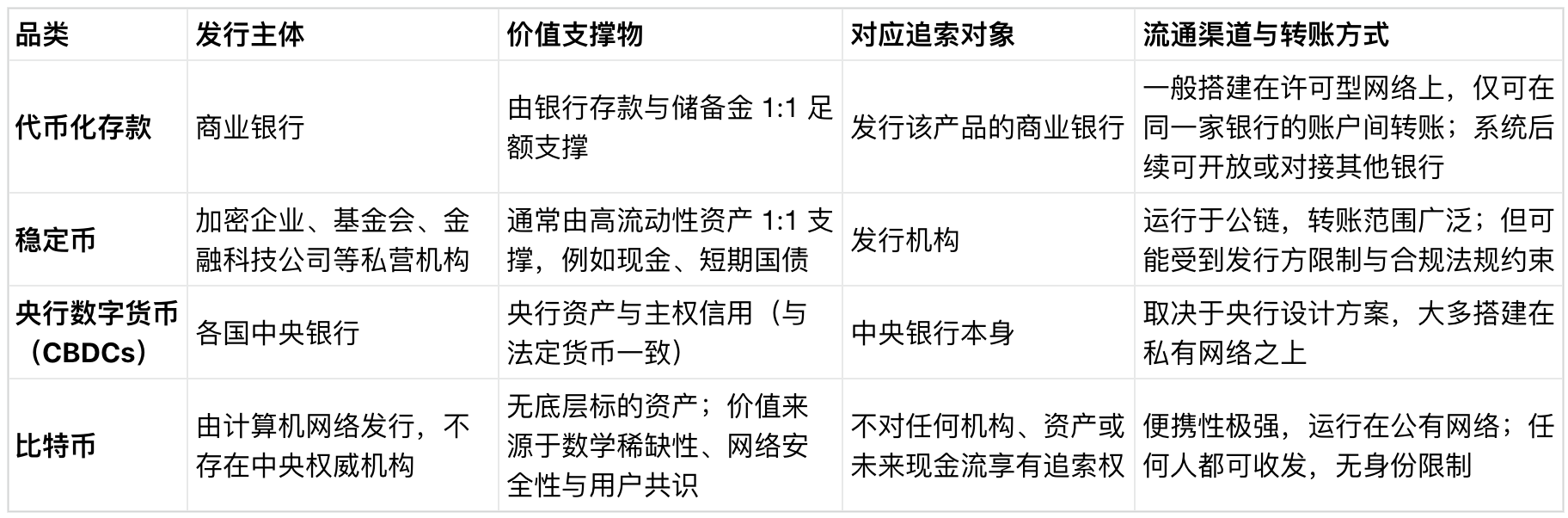
Blockchain-Based Forms of Money, Source: Bloomberg
The Clearing House plans to connect financial institutions that collectively manage trillions in deposits and serve tens of millions of customers. Upon completion, its scale and breadth would far surpass the current stablecoin market.
Christopher Ward, Head of Enterprise Payments at Truist Financial, said: "The logic is no different from when the U.S. pushed for real-time payment system development. Parties come together to set unified rules for widespread adoption. The current project follows the same thinking."
The Clearing House, with its deep experience in operating industry networks and balancing the needs of community banks, regional banks, multinational giants, and foreign institutions operating in the U.S., is well-suited for a coordinating role. The project aims for a formal launch next year.
Elena Casal, Chief Client Officer at The Clearing House, stated: "Building shared industry infrastructure is in our DNA. We already have mature governance frameworks and regulatory compliance processes, which can help accelerate the project's rollout."
Casal mentioned that demand is primarily concentrated in the wholesale payments space, particularly for corporate treasury management and liquidity调度. This network could also provide digital cash for the clearing and settlement of tokenized securities, empowering the development of tokenized capital markets. The Clearing House is currently selecting technology service providers, and the network is designed with extensibility to potentially support stablecoin settlement in the future.
A Crowded Field with Multiple Players
Despite The Clearing House's solid foundation for success, the bank-led digital currency arena is already crowded, with many similar projects initiated a decade ago. The simultaneous participation of banks in multiple parallel projects risks further industry fragmentation, making it difficult to consolidate efforts.
Last week, payments network SWIFT revealed that over 17 banks are preparing to pilot cross-border tokenized payments on its new distributed ledger. Additionally, an alliance including Goldman Sachs, Deutsche Bank, Bank of America, and Spain's Santander formed late last year to develop stablecoin-like digital currency.
Manish Kohli, Global Head of Payments Solutions at HSBC, analyzed that platforms built by upgrading existing systems have a much higher chance of success than projects built from scratch. Taking The Clearing House's current plan as an example: "The project leverages existing infrastructure, has a stable membership base, clear domestic U.S. use cases, and much lower implementation risks." HSBC is participating in multiple projects, including the SWIFT pilot, the UK's "UK Tokenized Deposit Initiative," and Hong Kong's Ensemble project.
The Difficult Path of Self-Reinvention
While banks possess significant advantages in asset size and compliance credentials, their inherent weakness is slow decision-making and implementation. Zelle itself took years to develop and might not have flourished without pressure from competitors like Venmo; even after technical development was complete, alliance members debated over the product name.
Furthermore, transformation for established payment giants isn't guaranteed to be smooth. PayPal launched its PYUSD stablecoin in August 2023, but adoption has been minimal, with a circulation of only $2.9 billion—paltry compared to leading stablecoins: Tether's USDT circulation is about $184 billion, and Circle's USDC stands at $73 billion.
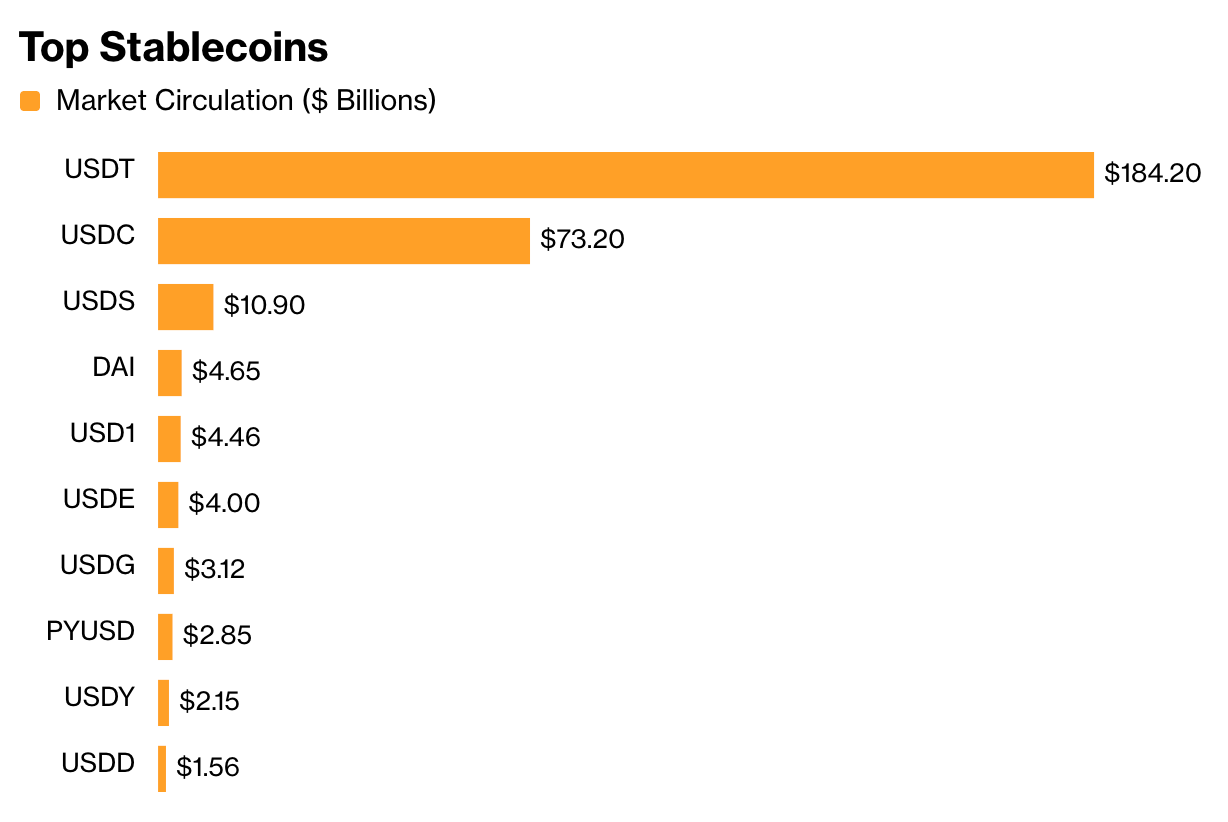
Major Stablecoins, Source: GoinGecko
From this perspective, leading stablecoin issuers need not panic excessively for now. However, banks also don't need to rush for first-mover advantage: many of the largest and most profitable corporate clients in banks' payment segments currently don't have an urgent need for programmable dollars.
Marieke Flament, co-founder of digital currency consultancy Currency of Power, commented: "Banks may seem slow to act, but once they decide to move forward with a project, they can mobilize massive resources. However, the crypto space evolves extremely fast, and whether banks can keep pace remains a major challenge."
Reporting assistance by Paige Smith, Olga Kharif, Yizhu Wang