Treasuries and yield funds – Is this the next phase of tokenization?

ambcryptoPublished on 2026-04-10Last updated on 2026-04-10

Abstract

Tokenized finance is experiencing significant growth, with BNB Chain's tokenized asset market cap reaching a record $16.6 billion, more than doubling year-over-year. The broader tokenized funds market has expanded to $31.9 billion, driven primarily by yield-bearing products rather than simple stablecoins. While Tether and USDC remain the largest issuers, faster growth is occurring among smaller players like Ondo Finance, Maple Finance, and Centrifuge. The trend highlights a shift beyond cash proxies toward income-generating on-chain assets, signaling a new phase in asset tokenization.

Tokenized finance is one of crypto’s most serious growth stories today. However, is this just another trend or the foundation of something new?

AMBCrypto previously reported that S&P Dow Jones Indices moved its iBoxx U.S. Treasuries Index on-chain via the Canton [CC] Network, one of the clearest steps forward. The move came as tokenized U.S Treasuries crossed $12.6 billion.

BNB Chain’s tokenized asset market cap at a record $16.6B

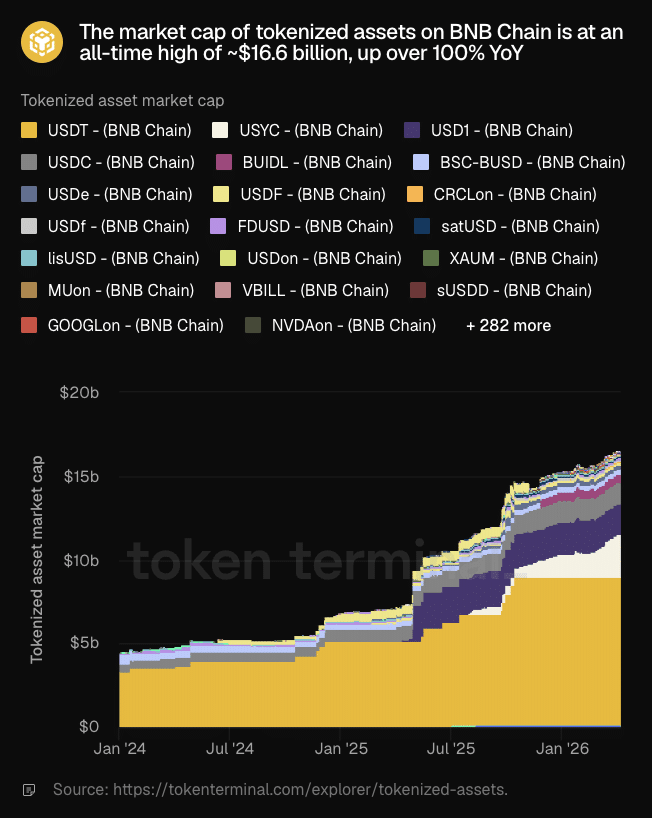
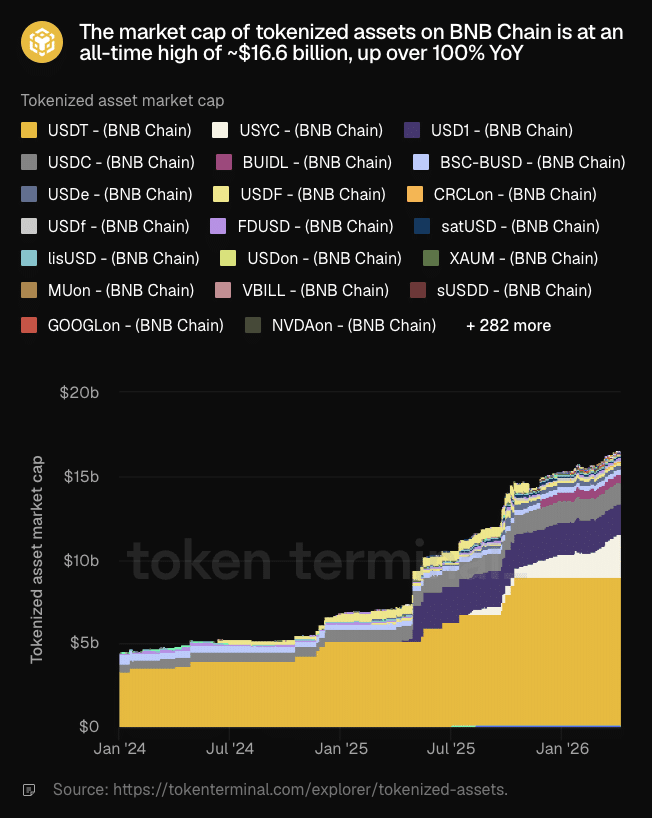
BNB Chain’s tokenized asset market has expanded over the past year, reaching an all-time high of about $16.6 billion! According to Token Terminal, that is more than 2x higher YoY, up from roughly $4 billion to $5 billion in early 2024.
Source: Token Terminal

Growth sped through 2025, with the market cap first pushing past $10 billion and then moving above $15 billion. Tether [USDT] still makes up the largest share of the stack, but a broader base is forming across names like USD Coin [USDC] and WLFi’s USD1.

Growth is spread beyond the top 2

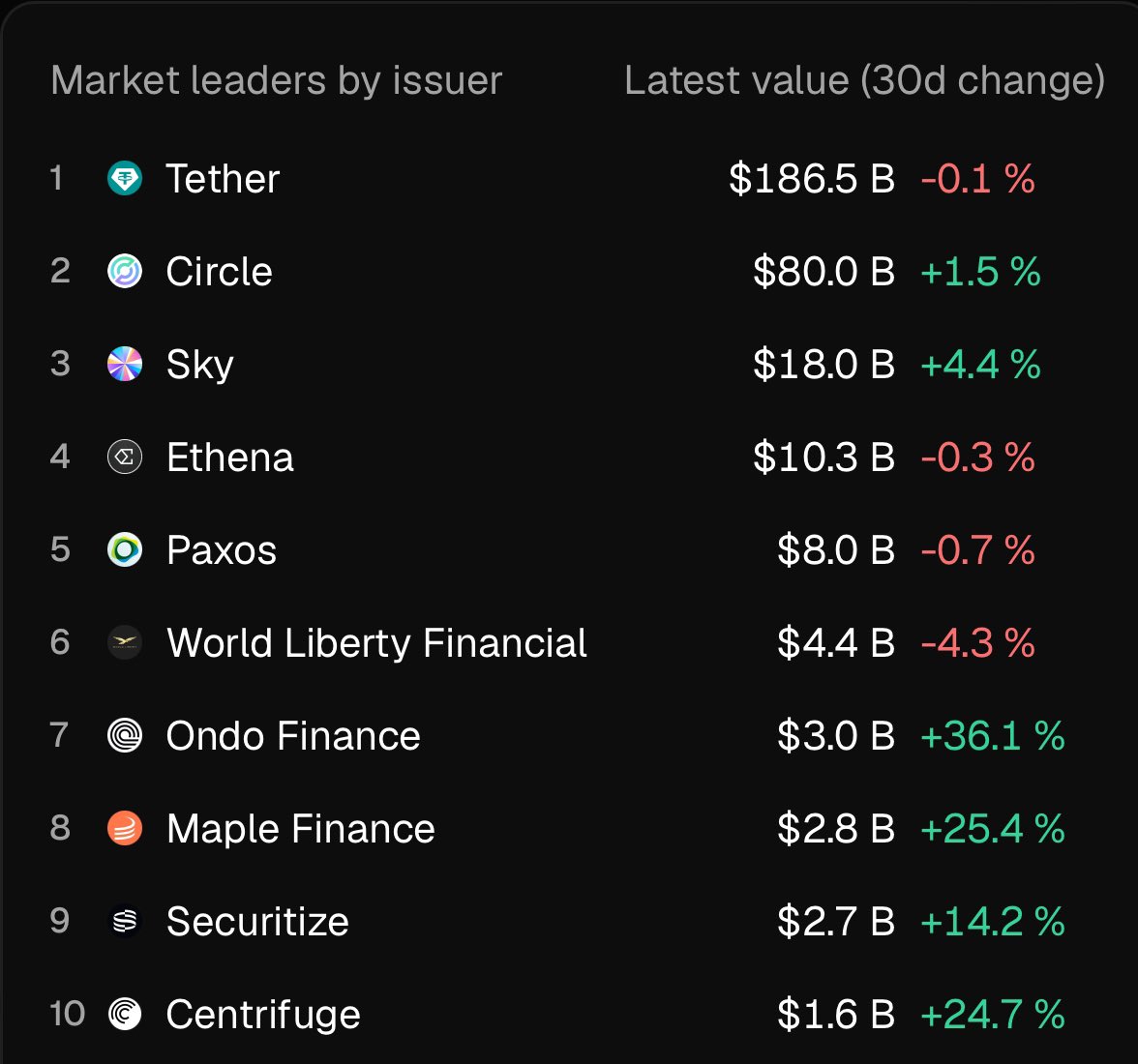
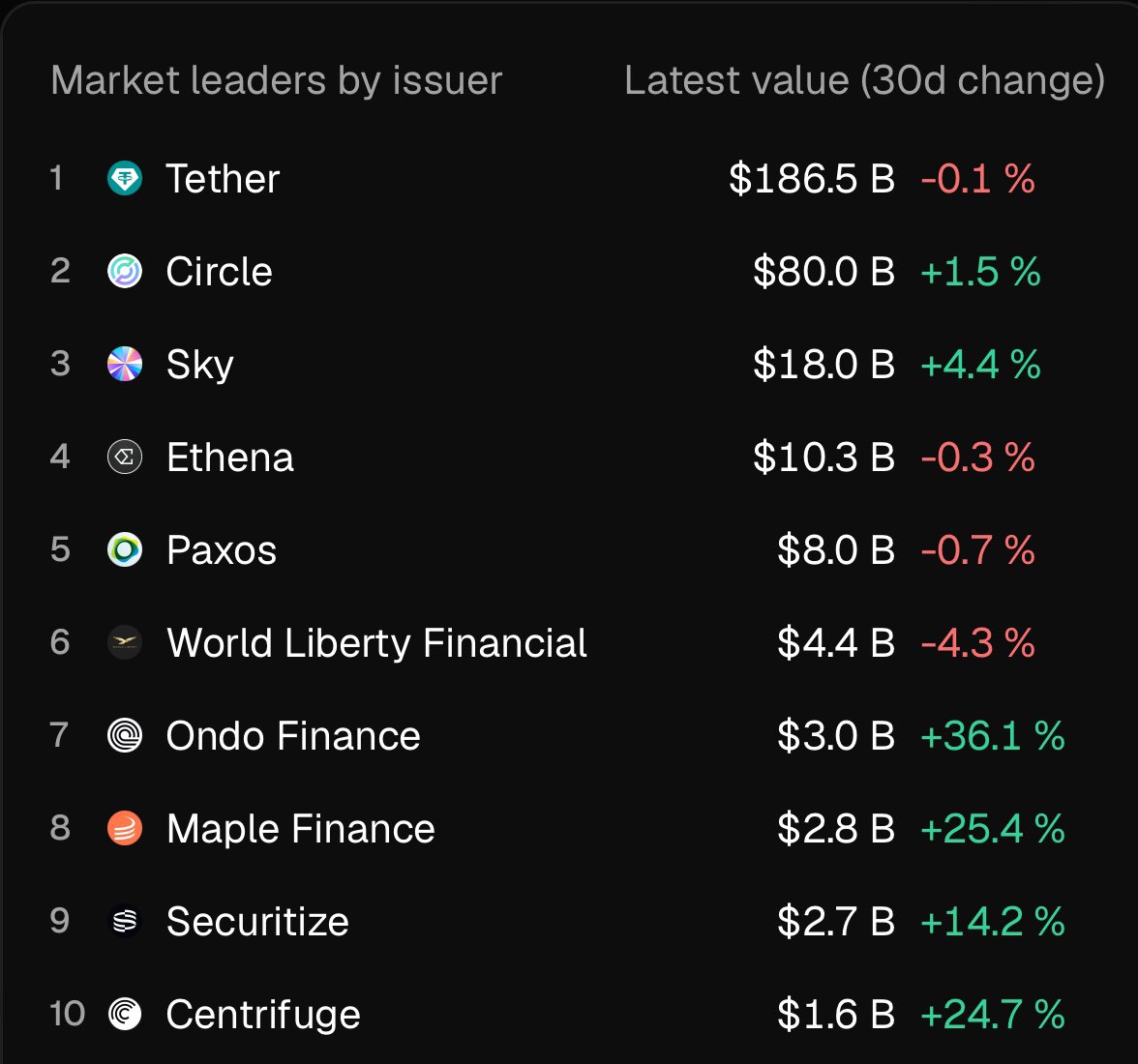
At press time, Tether still led issuance by a wide margin at $186.5 billion, while Circle followed at $80.0 billion. However, the faster growth is happening lower down the table.
Source: X

Over the last 30 days, Ondo Finance has expanded by 36.1% to $3 billion. Similarly, Maple Finance climbed by 25.4% to $2.8 billion and Centrifuge added 24.7% to reach $1.6 billion. Securitize also grew 14.2% to $2.7 billion.

On the contrary, Tether’s growth was nearly flat at -0.1%.

Tokenized funds reach $31.9B as yield products take the lead

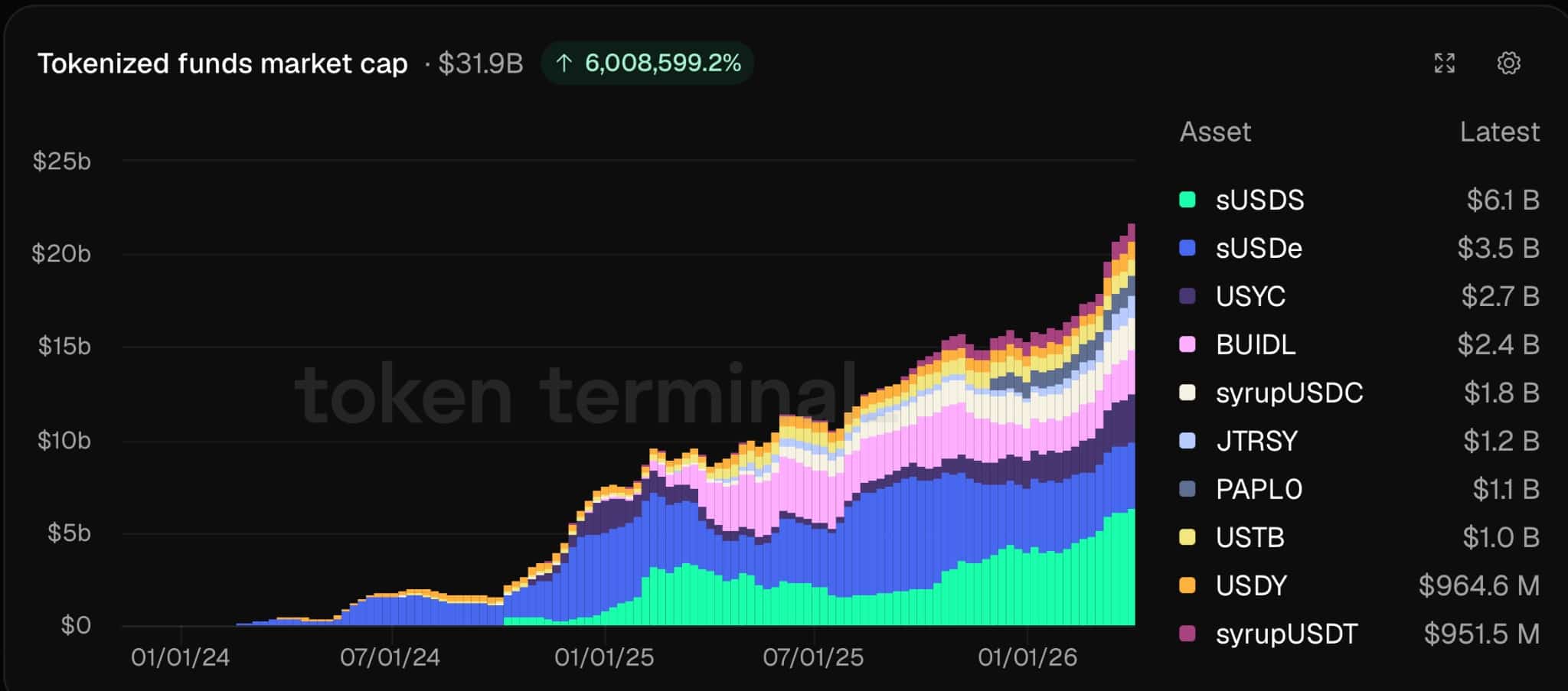
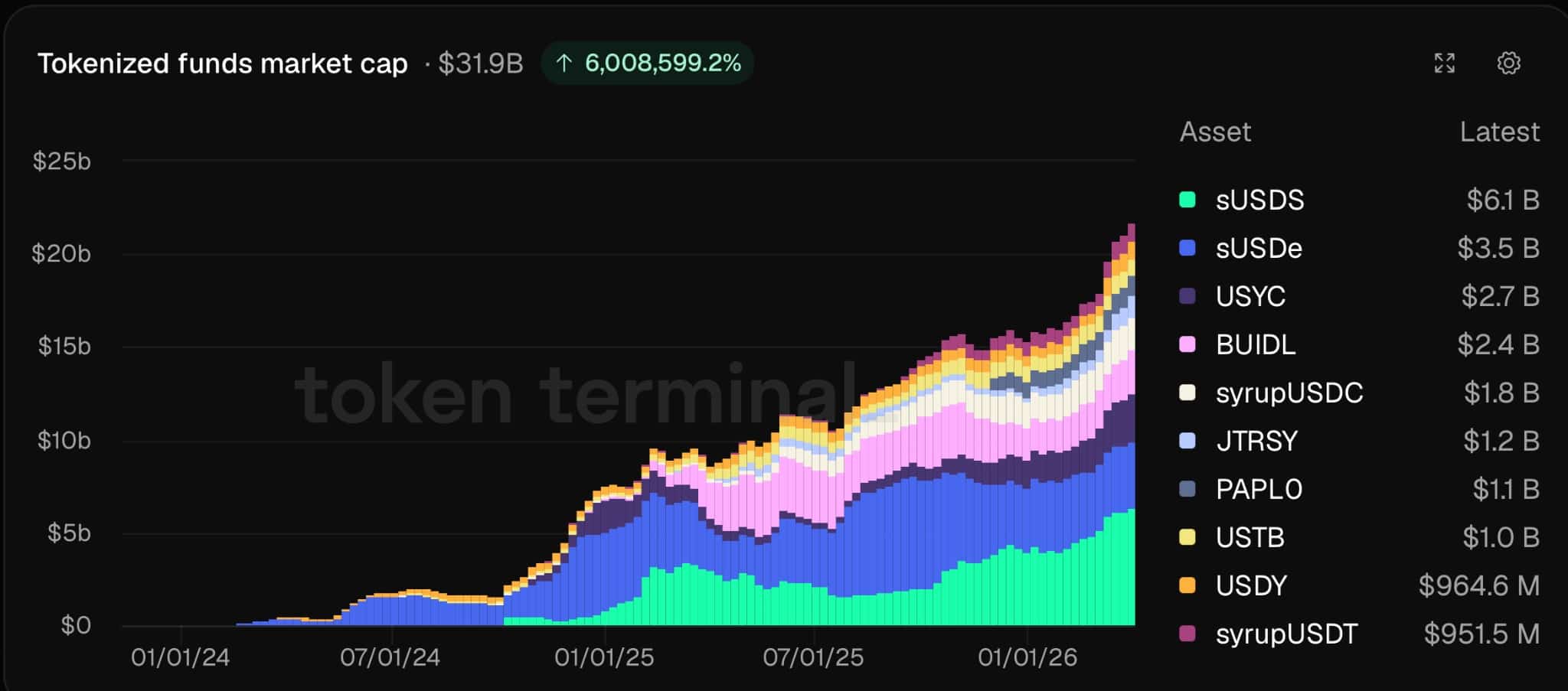
The tokenized funds market was at $31.9 billion at press time. Growth has been led by yield-oriented products, rather than plain cash proxies alone.
Source: Token Terminal

sUSDS was the largest fund at $6.1 billion, followed by sUSDe at $3.5 billion, USYC at $2.7 billion, and BUIDL at $2.4 billion. The next layer also appeared to be meaningful – syrupUSDC is at $1.8 billion, JTRSY at $1.2 billion, and PAPLO at $1.1 billion.

It’s not just stablecoins anymore. Income-bearing on-chain products are scaling fast!


Final Summary

  • BNB Chain’s tokenized asset market cap has reached a record $16.6 billion – 2x YoY!
  • Tokenized funds climbed to $31.9 billion, with yield-bearing on-chain products in the lead.

Related Questions

QWhat is the current market cap of BNB Chain's tokenized assets and how does it represent growth year-over-year?

ABNB Chain's tokenized asset market cap has reached a record $16.6 billion, which is more than 2x higher year-over-year (YoY).

QWhich two stablecoins are the largest by issuance in the tokenized asset market, and what are their respective market caps?

ATether [USDT] leads with an issuance of $186.5 billion, followed by USD Coin [USDC] at $80.0 billion.

QWhich tokenized funds have shown the most significant growth in the last 30 days, and what were their growth rates?

AOndo Finance grew by 36.1% to $3 billion, Maple Finance climbed 25.4% to $2.8 billion, and Centrifuge added 24.7% to reach $1.6 billion.

QWhat is the total value of the tokenized funds market, and what type of products are leading this growth?

AThe tokenized funds market was valued at $31.9 billion, with growth being led by yield-oriented, income-bearing on-chain products rather than plain cash proxies.

QWhat was the significance of S&P Dow Jones Indices moving its iBoxx U.S. Treasuries Index on-chain?

AIt was one of the clearest steps forward for tokenized finance, occurring as the same time that tokenized U.S. Treasuries crossed $12.6 billion in value.

Related Reads

Telegram Takes Direct Control of TON, Social Traffic Rewrites the Public Chain Narrative

Telegram founder Pavel Durov announced that Telegram will replace the TON Foundation as the core driver and largest validator of The Open Network (TON). Key initiatives include a sixfold reduction in transaction fees, performance upgrades, and improved developer tools within the next few weeks. This marks a strategic shift from Telegram merely providing user access to deeply integrating TON into its platform's core infrastructure. The goal is to transform Telegram's massive social traffic into sustainable on-chain activity. While viral mini-apps like Notcoin have demonstrated Telegram's ability to drive user adoption, TON aims to support frequent, low-value transactions inherent to social platforms—such as tipping, in-app payments, and game rewards. Ultra-low fees and sub-second finality (0.6 seconds) are crucial to making blockchain interactions seamless and nearly invisible within the Telegram user experience. However, Telegram's increased central role raises questions about network decentralization. Durov argues that Telegram's participation will attract more large validators, thereby enhancing decentralization. TON also offers high annual staking rewards (18.8%), aiming to retain capital within its ecosystem. The fundamental challenge for TON is no longer leveraging Telegram's user base, but becoming an indispensable, seamless infrastructure layer for Telegram's everyday applications—moving from an adjacent chain to an embedded utility.

marsbit4m ago

Telegram Takes Direct Control of TON, Social Traffic Rewrites the Public Chain Narrative

marsbit4m ago

OpenAI Post-Training Engineer Weng Jiayi Proposes a New Paradigm Hypothesis for Agentic AI

OpenAI engineer Weng Jiayi's "Heuristic Learning" experiments propose a new paradigm for Agentic AI, suggesting that intelligent agents can improve not just by training neural networks, but also by autonomously writing and refining code based on environmental feedback. In the experiment, a coding agent (powered by Codex) was tasked with developing and maintaining a programmatic strategy for the Atari game Breakout. Starting from a basic prompt, the agent iteratively wrote code, ran the game, analyzed logs and video replays to identify failures, and then modified the code. Through this engineering loop of "code-run-debug-update," it evolved a pure Python heuristic strategy that achieved a perfect score of 864 in Breakout and performed competitively with deep reinforcement learning (RL) algorithms in MuJoCo control tasks like Ant and HalfCheetah. This approach, termed Heuristic Learning (HL), contrasts with Deep RL. In HL, experience is captured in readable, modifiable code, tests, logs, and configurations—a software system—rather than being encoded solely into opaque neural network weights. This offers potential advantages in explainability, auditability for safety-critical applications, easier integration of regression tests to combat catastrophic forgetting, and more efficient sample use in early learning stages, as demonstrated in broader tests on 57 Atari games. However, the blog acknowledges clear limitations. Programmatic strategies struggle with tasks requiring long-horizon planning or complex perception (e.g., Montezuma's Revenge), areas where neural networks excel. The future vision is a hybrid architecture: specialized neural networks for fast perception (System 1), HL systems for rules, safety, and local recovery (also System 1), and LLM agents providing high-level feedback and learning from the HL system's data (System 2). The core proposition is that in the era of capable coding agents, a significant portion of an AI's learned experience could be maintained as an auditable, evolving software system.

marsbit1h ago

OpenAI Post-Training Engineer Weng Jiayi Proposes a New Paradigm Hypothesis for Agentic AI

marsbit1h ago

Your Claude Will Dream Tonight, Don't Disturb It

This article explores the recent phenomenon of AI companies increasingly using anthropomorphic language—like "thinking," "memory," "hallucination," and now "dreaming"—to describe machine learning processes. Focusing on Anthropic's newly announced "Dreaming" feature for its Claude Agent platform, the piece explains that this function is essentially an automated, offline batch processing of an agent's operational logs. It analyzes past task sessions to identify patterns, optimize future actions, and consolidate learnings into a persistent memory system, akin to a form of reinforcement learning and self-correction. The article draws parallels to similar features in other AI agent systems like Hermes Agent and OpenClaw, which also implement mechanisms for reviewing historical data, extracting reusable "skills," and strengthening long-term memory. It notes a key difference from human dreaming: these AI "dreams" still consume computational resources and user tokens. Further context is provided by discussing the technical challenges of managing AI "memory" or context, highlighting the computational expense of large context windows and innovations like Subquadratic's new model claiming drastically longer contexts. The core critique argues that this strategic use of human-centric vocabulary does more than market products; it subtly reshapes user perception. By framing algorithms with terms associated with consciousness, companies blur the line between tool and autonomous entity. This linguistic shift can influence user expectations, tolerance for errors, and even perceptions of responsibility when systems fail, potentially diverting scrutiny from the companies and engineers behind the technology. The article concludes by speculating that terms like "daydreaming" for predictive task simulation might be next, continuing this trend of embedding the idea of an "inner life" into computational processes.

marsbit1h ago

Your Claude Will Dream Tonight, Don't Disturb It

marsbit1h ago

Trading

Spot
Futures

Hot Articles

How to Buy ONE

Welcome to HTX.com! We've made purchasing Harmony (ONE) simple and convenient. Follow our step-by-step guide to embark on your crypto journey.Step 1: Create Your HTX AccountUse your email or phone number to sign up for a free account on HTX. Experience a hassle-free registration journey and unlock all features.Get My AccountStep 2: Go to Buy Crypto and Choose Your Payment MethodCredit/Debit Card: Use your Visa or Mastercard to buy Harmony (ONE) instantly.Balance: Use funds from your HTX account balance to trade seamlessly.Third Parties: We've added popular payment methods such as Google Pay and Apple Pay to enhance convenience.P2P: Trade directly with other users on HTX.Over-the-Counter (OTC): We offer tailor-made services and competitive exchange rates for traders.Step 3: Store Your Harmony (ONE)After purchasing your Harmony (ONE), store it in your HTX account. Alternatively, you can send it elsewhere via blockchain transfer or use it to trade other cryptocurrencies.Step 4: Trade Harmony (ONE)Easily trade Harmony (ONE) on HTX's spot market. Simply access your account, select your trading pair, execute your trades, and monitor in real-time. We offer a user-friendly experience for both beginners and seasoned traders.

3.4k Total ViewsPublished 2024.03.29Updated 2025.06.04

How to Buy ONE

Discussions

Welcome to the HTX Community. Here, you can stay informed about the latest platform developments and gain access to professional market insights. Users' opinions on the price of ONE (ONE) are presented below.

活动图片