Original | Odaily Planet Daily(@OdailyChina)
Author | Asher(@Asher_ 0210)
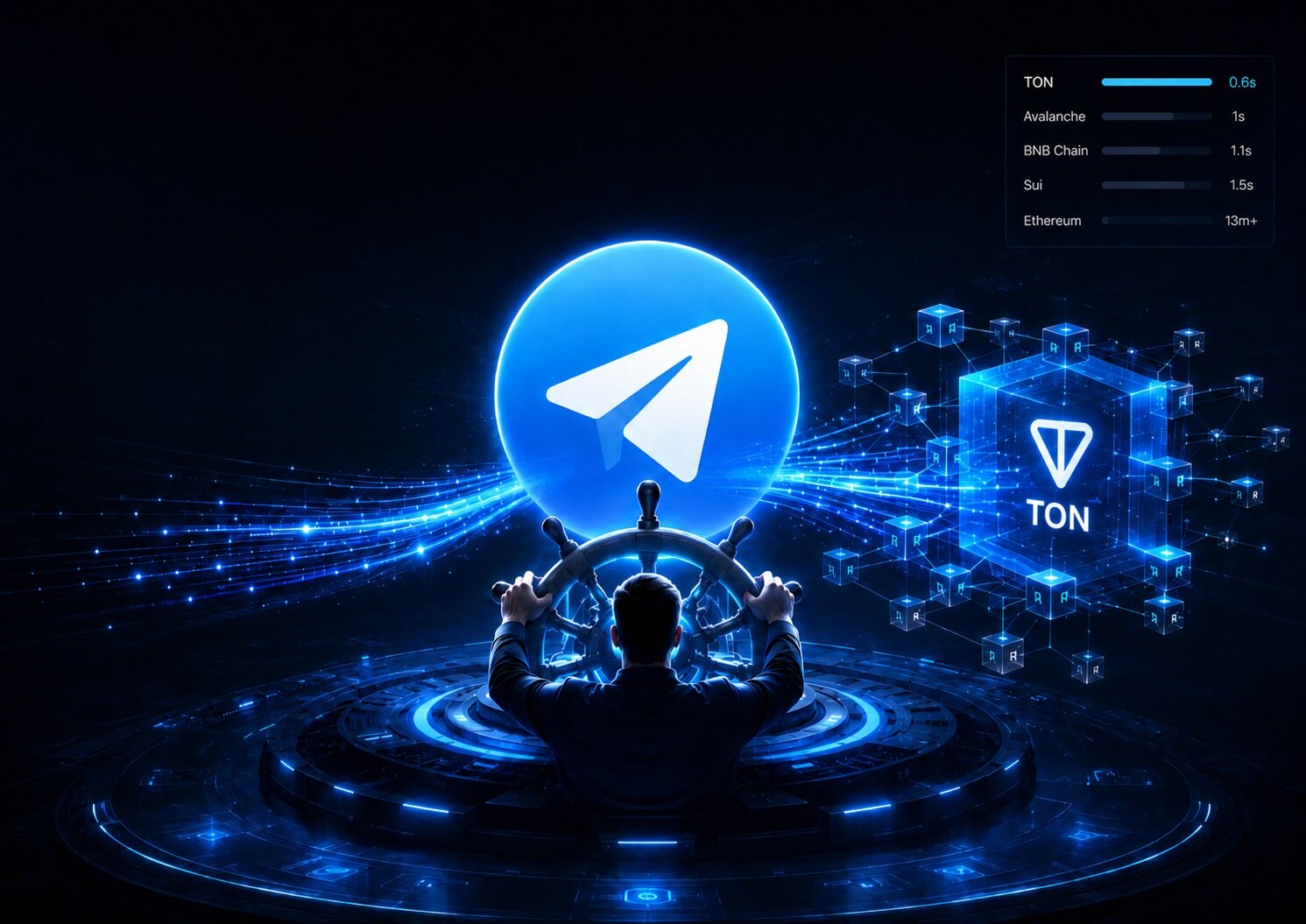
On May 4th, Pavel Durov, the founder of Telegram, stated on platform X that TON network fees have been reduced sixfold, now nearly zero. More crucially, he announced that Telegram will replace the TON Foundation to become the new core driver of the TON network and its largest validator. TON's upcoming focus will shift to technical advantages, including a new ton.org, new developer tools, and performance upgrades, all within the next 2 to 3 weeks.
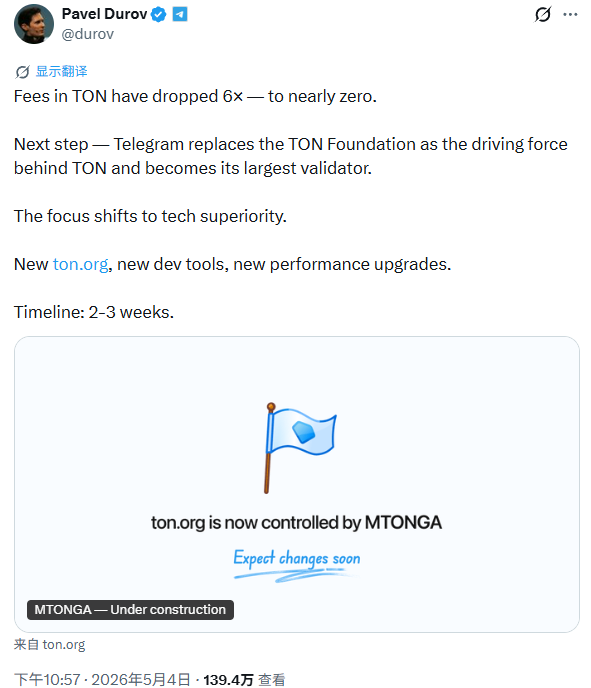
Telegram Founder: TON Fees Reduced 6x, Telegram to Become Largest Validator
Previously, the relationship between TON and Telegram was more like a strong binding with weak leadership. Telegram provided the entry point, while the Foundation and community were responsible for driving progress, maintaining a certain distance. But this time, Telegram is not just continuing to bring users to TON; it's starting to enter more fundamental positions like validator, technical roadmap, and development tools. TON is no longer just a chain adjacent to the Telegram ecosystem; it's being reintegrated into Telegram's product system.
TON Never Lacked an Entry Point; It Lacked Turning That Entry into Usage Scenarios
Past market discussions about TON often revolved around Telegram's user scale. But for a public chain, having an entry point does not equal having an ecosystem, and having user reach does not equal having long-term usage. The unique aspect of TON is its inherent connection to a high-frequency social platform, where Mini Apps, wallets, channels, bots, games, and payments already exist within Telegram. This means TON doesn't have to start from scratch to find users like most Layer1s. However, if these scenarios cannot translate into sustained on-chain interactions, Telegram's traffic can only bring waves of short-term hype.
Projects like Notcoin and Dogs have already proven that Telegram can quickly generate viral spread. Simple gameplay combined with social connections can indeed attract a massive number of users into crypto applications in a short time. But such explosions come and go quickly. TG mini-games and airdrops can bring attention but can hardly sustain a long-term ecosystem alone.
Therefore, the fee reduction, speed improvements, developer tools, and validator role emphasized by Pavel Durov this time point not to a single technical upgrade, but to TON addressing its most crucial missing piece — turning Telegram's entry point into sustainable usage scenarios. When fees are low enough, confirmation speeds are fast enough, and developer integration is simple enough, actions like channel tipping, Mini App tasks, game rewards, creator revenue, ad revenue sharing, bot calls, and small group payments have the potential to evolve from product features into on-chain activities.
TON doesn't need to repeat the story of "backed by Telegram." What it truly needs to prove is whether the high-frequency behaviors within Telegram can be supported by TON.
Fee Reduction and Speed Boost Are for Smaller, Higher-Frequency Transactions
The fee reduction by TON this time cannot be understood merely as a regular public chain cost optimization. Viewed within the context of Telegram, it genuinely addresses whether small, high-frequency interactions can be viable.
Potential on-chain behaviors within Telegram are mostly not large transfers but more fragmented daily operations. The amount per transaction is small, but the frequency is high. If users have to perceive fees, wait for confirmations, and repeatedly handle wallet interactions with every button click, such scenarios would struggle to truly take off.
Therefore, fee reduction and speed improvement must be considered together. Near-zero fees lower the barrier to entry; reducing final confirmation time to 0.6 seconds lowers the perception of waiting. For Telegram, the chain shouldn't be an extra layer perceived by users; it should be hidden behind product actions like sending messages, clicking buttons, and balance changes as much as possible.
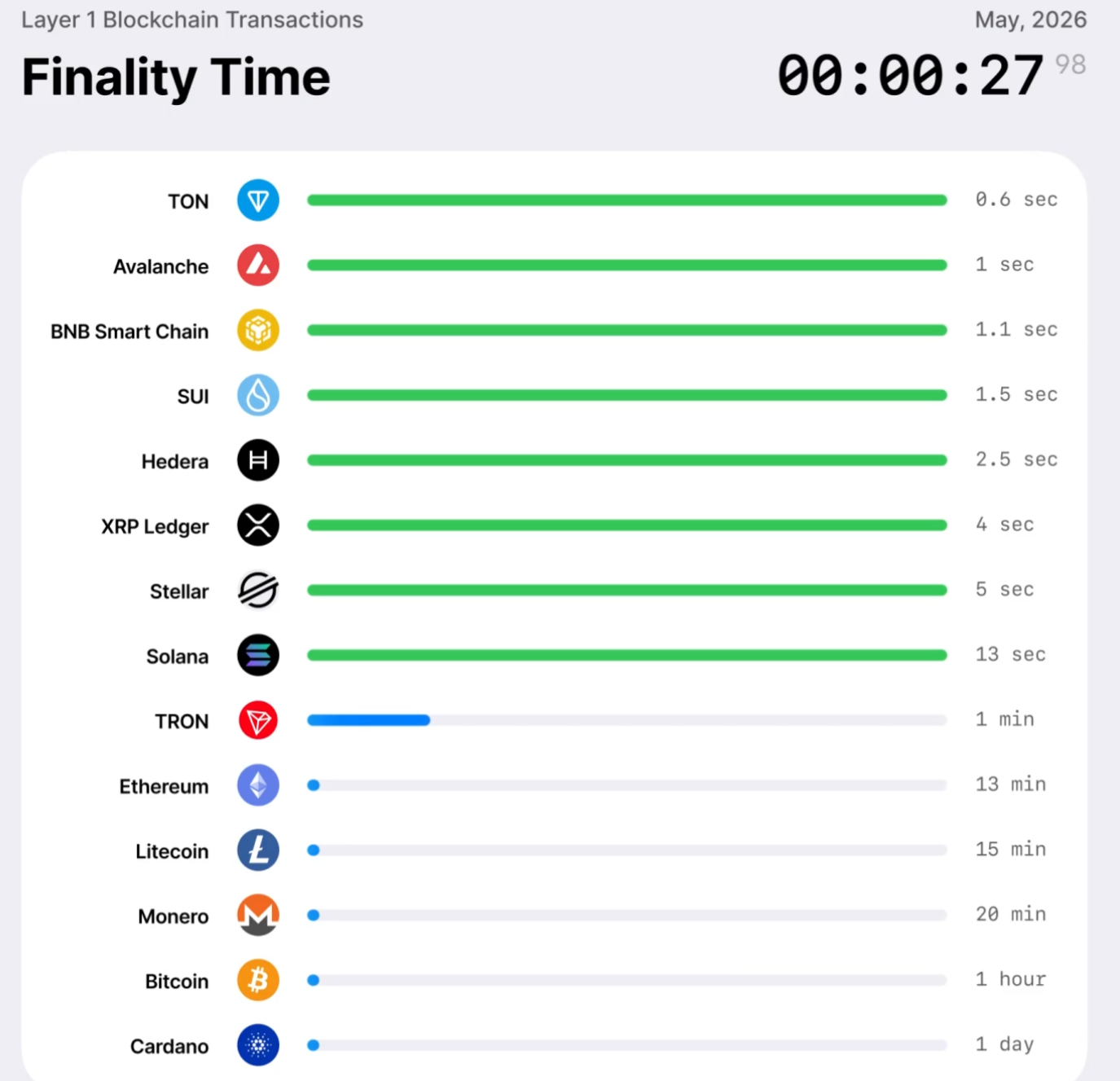
Comparison of "Finality Time" Among Mainstream Public Chains
This is also where TON differs from many Layer1s. It's not solely about making DeFi transactions faster or transfers cheaper; it's about embedding the chain into Telegram's daily usage. Only when costs, wait times, and wallet operations are sufficiently minimized can TON potentially evolve from a Telegram-related public chain into an underlying network directly accessible by the Telegram application layer.
From Entry Point to Validator, Telegram Begins Delving into TON's Core
Telegram becoming TON's largest validator is the most significant step in this change. It signifies that Telegram is no longer just providing TON with an entry point and brand endorsement; it's entering the network's security and operational mechanisms. Previously, TON was driven by the Foundation and community, which offered greater openness but a more dispersed pace. Now, with Telegram directly involved, products, wallets, Mini Apps, payments, and developer tools have the opportunity to be realigned under a single vision.
Efficiency will increase, but so will controversy. Telegram replacing the TON Foundation as the primary driving force and becoming the largest validator will inevitably lead to renewed discussions about TON's centralization risks. In response, Pavel Durov stated that Telegram's participation would attract more large-scale participants into the validator pool, thereby enhancing decentralization. This logic isn't unfounded, but the outcome matters more than the statement.
The truly important aspects going forward are whether the validator structure can become more diverse, whether governance information is sufficiently transparent, whether the Foundation and community still have independent space, and whether ecosystem projects can continue to develop without depending on Telegram's will.
Therefore, Telegram's return isn't purely positive news; it's a trade-off. For TON to enter the mainstream application layer, it needs Telegram's strong execution capability. But the more prominent Telegram becomes, the more TON needs to prove it's not merely an internal settlement chain serving Telegram.
High Staking Rewards Retain More Value for TON
Pavel Durov subsequently emphasized that TON ranks first in annual staking rewards among the top 50 cryptocurrencies by market cap, with a high rate of 18.8%. Compared to fee reductions and speed improvements, high staking rewards are more likely to stir capital sentiment, giving TON an additional reason for holding in the eyes of the market.
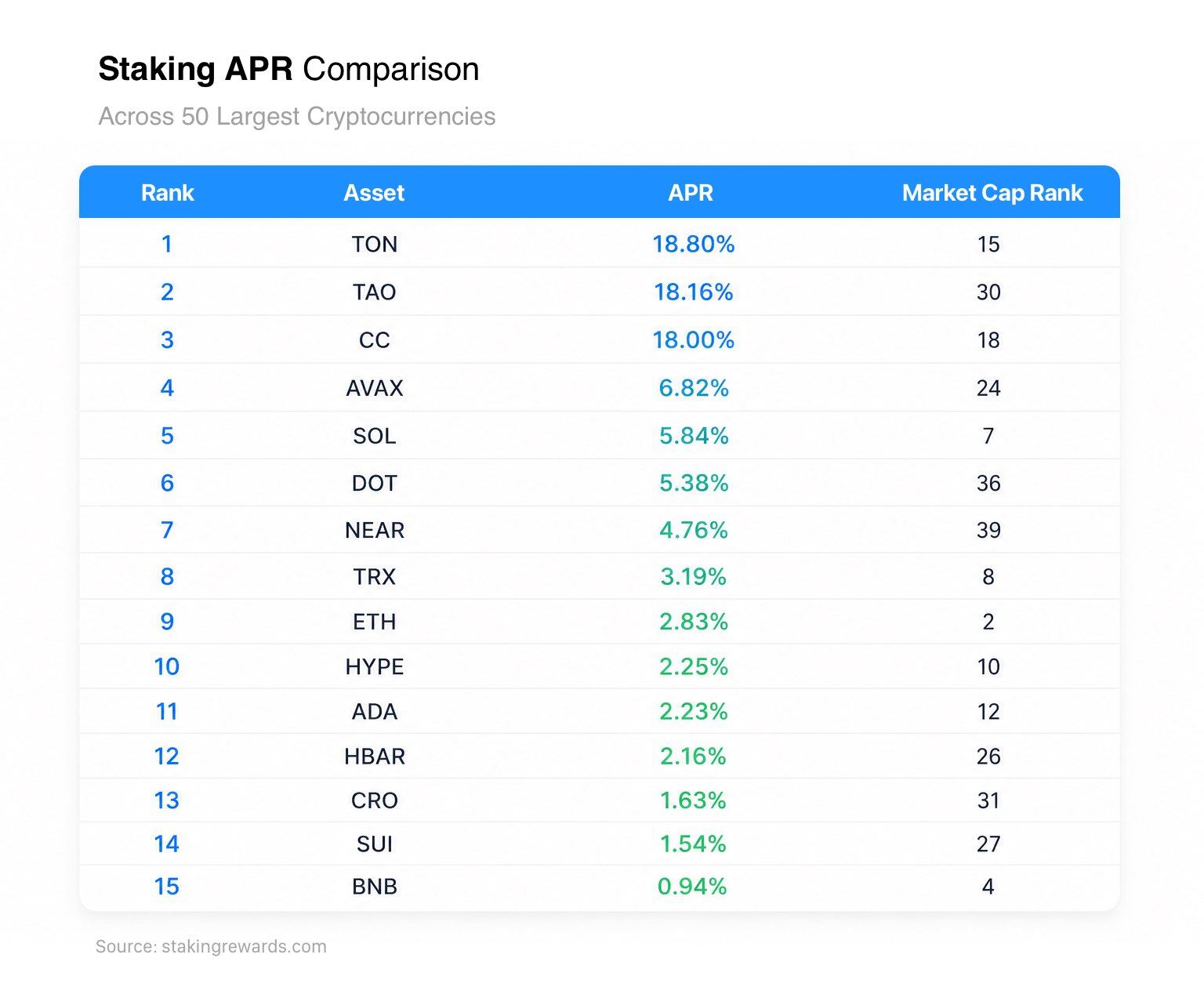
TON Annual Staking Reward Ranks First Among Top 50 Cryptocurrencies
This also makes TON's story somewhat more complete. It doesn't just rely on Telegram's user entry to attract attention or improve experience through technical upgrades; it's also using staking rewards to keep capital within the ecosystem. The simultaneous emergence of entry point, performance, validator role, and yield gives this change more weight than a single positive factor.
Of course, high yield itself is not the end goal; it's more like buying TON a longer observation period. If subsequent developer tools and performance upgrades are delivered, and more capital is locked into the network, it could form a positive feedback loop with real usage. For TON, the value of staking rewards isn't just about increasing holding returns; it's about making the market willing to continue waiting for it to truly convert Telegram's entry advantage.
TON Returning to Telegram Is Not the Finish Line, But a More Difficult Hurdle
The key for TON going forward is not to continue leveraging Telegram for traffic, but to truly become part of Telegram's application ecosystem. If Telegram's chatting, payments, applications, creator economy, and automated interactions are gradually handled by TON, then TON's competitors would not just be other Layer1s, but all networks attempting to become the next-generation application infrastructure.
TON isn't just retelling the social traffic story; it's beginning to attempt to turn social traffic into on-chain order. The entry point is just the beginning; usage is the answer. Telegram can bring TON to the forefront, but whether it stays depends ultimately on TON's ability to become that layer of infrastructure operating behind user perception, within application mechanics.
If past TON was proving how close it was to Telegram, now it must prove how deeply it can integrate into Telegram's daily usage. True mainstream adoption isn't making users aware they're using a chain; it's making the chain an integral part of the application experience.
TON's opportunity lies here, and so does its pressure.