Trader's Practical Guide: Avoiding 'Catching Falling Knives' - A Bottom-Fishing Methodology Integrating Fundamentals, Technicals, and Sentiment

marsbitPublished on 2026-01-23Last updated on 2026-01-23

Abstract

This guide outlines a systematic framework for buying stocks at their bottom, integrating fundamental, technical, and sentiment analysis to avoid premature buying ("catching a falling knife"). The process begins by identifying the catalyst for a stock's decline and assessing whether it's a temporary issue or a fundamental break in the investment thesis. A thorough fundamental review using the "4M" framework (Business Model, Moat, Management, Margin of Safety) and conservative DCF valuation is essential. Technically, patience is key; wait for signs of seller exhaustion. Strategies include buying on the right side of a V-shaped reversal, after a 5-day EMA crosses above the 20-day EMA, near long-term support levels, or after a base forms at least 5% above 52-week lows. Riskier "waterfall decline" entries require careful scaling-in. Sentiment analysis acts as a contrarian indicator. Extreme pessimism, such as drastically lowered price targets or widespread capitulation from retail investors, can signal a potential bottom. Combining these elements creates a disciplined approach to identify high-probability entry points with a margin of safety.

Author: SixSigmaCapital

Compiled by: Yuliya, PANews

This article aims to summarize a set of procedures for buying at stock price bottoms, detailing practical experiences and lessons learned, and establishing a sustainable framework for identification and execution. It is recommended that investors combine this strategy with other investment philosophies to gain a more comprehensive understanding of the market.

Initial Analysis and Catalyst Tracking

When a stock an investor is interested in begins to decline, close attention should be paid. Identify any upcoming catalysts, whether positive or negative. If there are no clear catalysts, it usually means the investor has more time for analysis.

At this point, the key is to figure out the reason for the stock's decline: is it a company-specific issue or an industry-wide problem? Is the price decline reasonable, or is the market over-penalizing? Is this a temporary problem, or one that fundamentally alters the original investment thesis? If the reason for the decline does not break the initial investment logic, then you can move to the next steps for a more thorough consideration of this investment opportunity.

Fundamental Due Diligence

It is essential to complete fundamental research as early as possible. The classic "4M Framework" is an effective tool, consisting of four dimensions:

  • Business Model (Meaning): What business the company is specifically in.

  • Moat: What competitive advantages the company possesses.

  • Management: The capability and integrity of the management team.

  • Margin of Safety: Whether the current stock price provides a sufficient margin of safety.

It is recommended that investors carefully review the company's financial filings and familiarize themselves with its three main financial statements (Income Statement, Balance Sheet, Cash Flow Statement). Attention should also be paid to earnings call transcripts. If using a DCF (Discounted Cash Flow) model for valuation, be sure to use conservative estimates to determine the stock's intrinsic value. This ensures that when the time comes, the investor knows clearly they are buying at a significant discount.

Incorporating Technical Analysis

Do not bottom-fish too early; patience is key. Ideally, an investor should aim to be among the last to buy the bottom. This is crucial because it allows time to study prior price action and wait for selling pressure to gradually exhaust itself. It is recommended to study charts across multiple timeframes; daily and weekly charts are good starting points.

Here are several technical analysis methods that can be used individually or in combination:

  • Buying on the "right side" of a V-shaped reversal

  • Waiting for the 5-period EMA (Exponential Moving Average) to cross above the 20-period EMA

  • Buying at long-established support levels

  • Waiting for the stock to base build after holding at least 5% above the 52-week low before initiating a tentative buy

  • Buying during a "waterfall decline" (this method is higher risk)

The application of these methods is illustrated below with some case studies.

1. Buying on the "Right Side" of a V-Shaped Reversal

This is a relatively simple strategy: first, determine an ideal price you are willing to pay, then patiently wait for the stock to stop falling. When the price rebounds and rises back to that level, you can execute the trade. This is a higher-probability entry method and allows you to place a stop-loss near the recent low to protect the position.

2. Exponential Moving Average Crossover

Waiting for the 5-period EMA to cross above the 20-period EMA is a straightforward strategy. The core idea is to wait for a potential trend reversal confirmation signal before committing any capital.

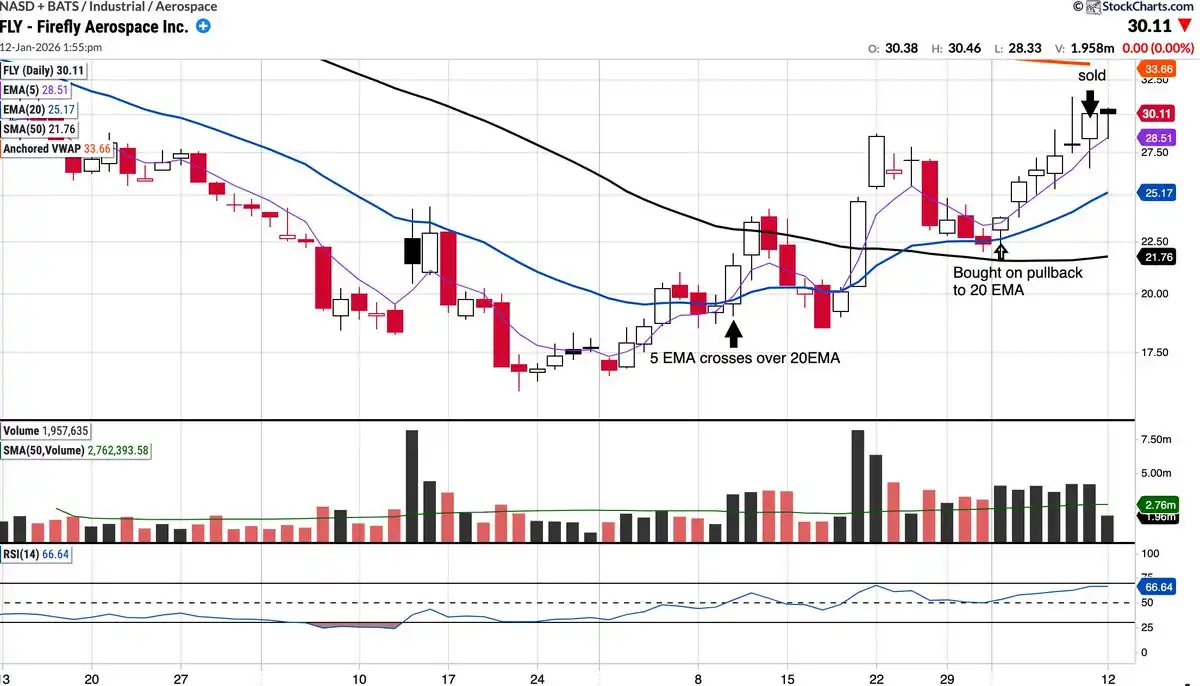
Take the recent FLY trade as an example. The stock had initially caught the investor's attention, but a buy was initiated only after waiting for the 5-day EMA to cross above and hold above the 20-day EMA, entering on a pullback to test the 20-day EMA. This trade ultimately proved successful, yielding a gain of about 35% to 36% over approximately six trading days.
3. Base Building (Basing)

Waiting for a stock to hold and start building a base above its 52-week low (e.g., at least 5% above the low) is another recommended strategy. The reason is simple: investors need to see evidence that the price is likely to hold the previous low and that a trend change might be occurring.

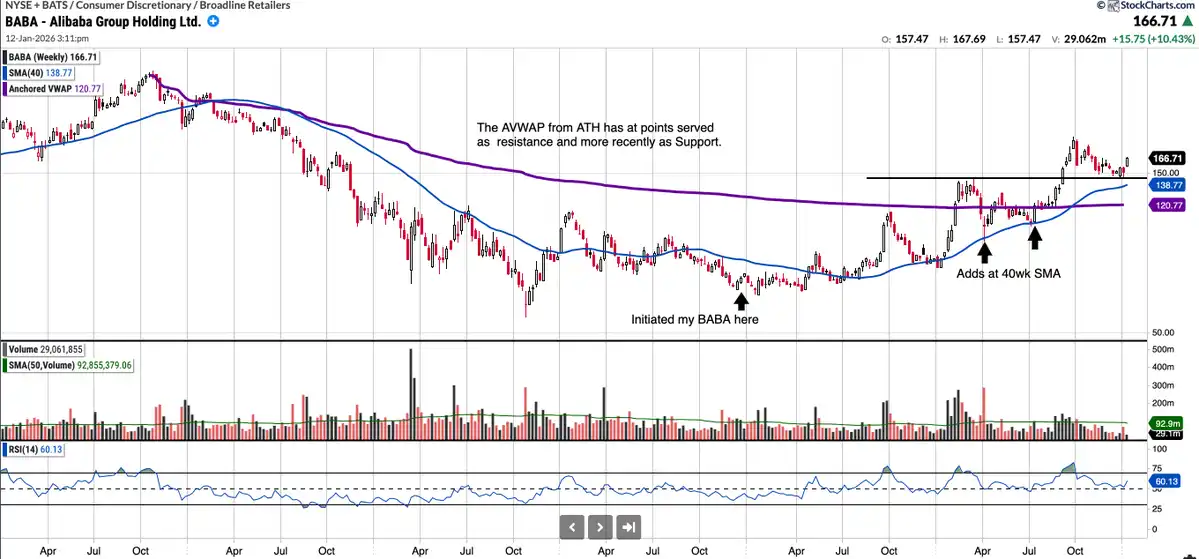
Looking back to 2023, BABA is a good example. Although the stock had bottomed at $55 per share the previous year, an investor chose to enter in December 2023 when the price was between $68 and $70. At that time, the stock was basing, and there was a significant dislocation between price and value, with a P/E ratio of only 7. Later, the investor added to the position when the price pulled back to test the 40-week SMA (Simple Moving Average) and still holds these shares to this day.
4. Waterfall Decline

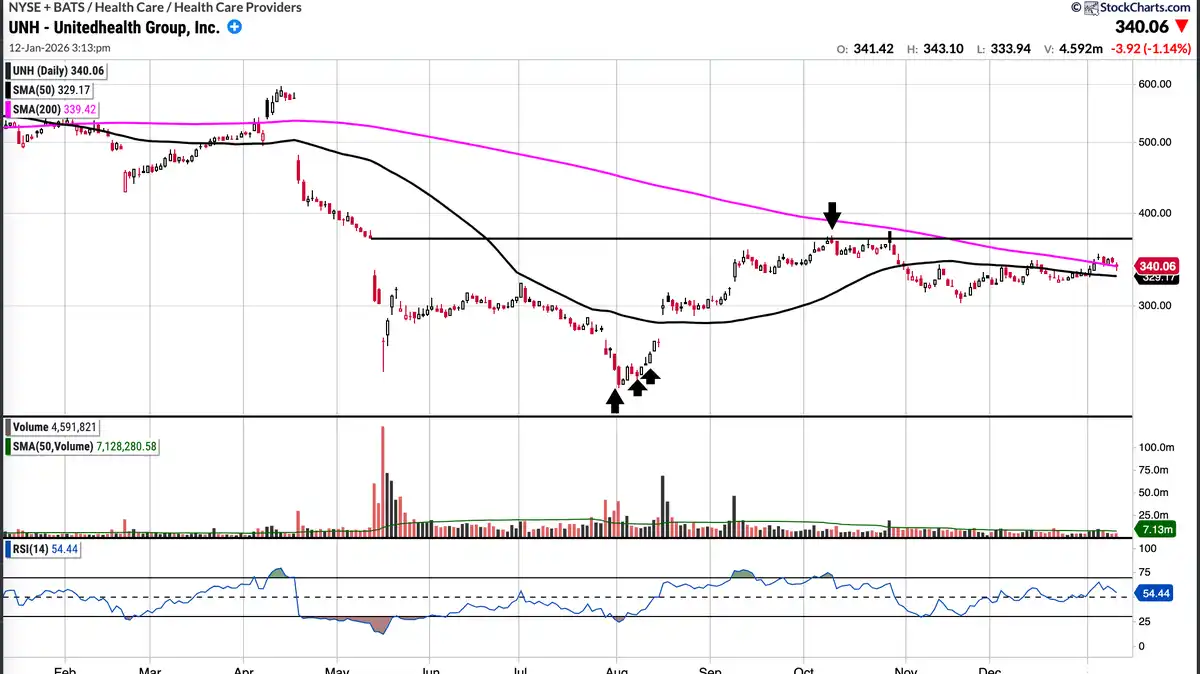
UNH is a case study for trading a "waterfall decline." This is a higher-risk setup, but the risk can be managed by combining the principle of "delayed buying" (waiting for sellers to diminish) and adding on the "right side" of the V-shaped reversal.

When UNH's stock price first declined in mid-May, it entered the investor's watchlist but was not bought immediately. The massive selling volume at the time was enough to cause hesitation. However, after completing fundamental analysis, $240 was marked from a valuation perspective as a level worth considering for a buy. When the price began to fall rapidly in August, buying operations commenced. Buys were made in batches as the price began to recover, in the range of the $230s to $240s. Finally, the position was closed out after the gap was filled in mid-October.
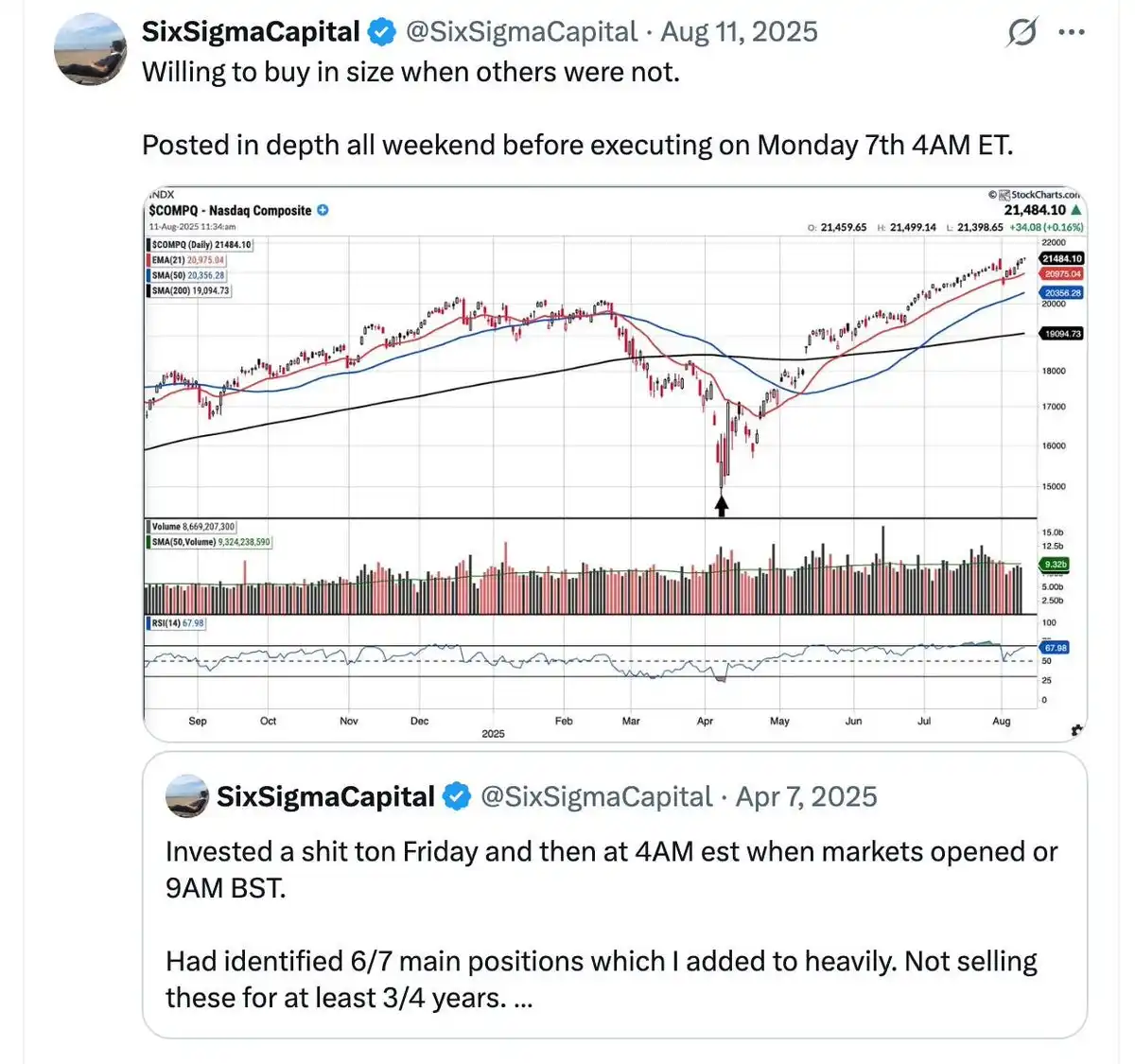
Another successful case of buying a waterfall decline was catching the bottom on April 7, 2025. Deep analysis was conducted throughout the weekend before executing the trade at 4 AM ET that Monday morning.
Sentiment Analysis

Tracking market sentiment is another crucial piece of the decision-making puzzle. Although it is not an exact science, there are several specific methods to incorporate it into the analysis process.

As mentioned before, it is not advisable to buy when the general public is bottom-fishing. Instead, one should look for entry points when early buyers have become frustrated and finally capitulated. An important signal is when extremely pessimistic price targets start circulating in the market, or when investors who are "all-in" on a single stock sell their positions out of despair. Typical examples include the crash Tesla experienced when its stock fell to $150 in April 2024, and the widespread belief at the time that Google was "destined to fail" in artificial intelligence.

Furthermore, waiting for analysts to lower their expectations and price targets is also an effective strategy. This process often reduces risk; once market expectations are lowered, the company only needs to achieve a small beat to potentially trigger a positive stock reaction.

Finally, if you have a following on social media, you can use them to gauge current market sentiment. For example, you can test sentiment by posting something like: "I bought UNH at $237, am I screwed?" If the post gets unusually high engagement and the replies are overwhelmingly bearish, even with some calling for prices below $100, such extreme pessimism can be seen as a good contrarian indicator.


Related Questions

QWhat is the four-dimensional framework mentioned for fundamental due diligence?

AThe four-dimensional framework is the '4M Framework', which includes: 1. Meaning (What business the company is in), 2. Moat (The company's competitive advantages), 3. Management (The capability and integrity of the management team), and 4. Margin of Safety (Whether the current stock price provides a sufficient margin of safety).

QAccording to the article, what is a key technical analysis strategy for entering a position after a 'V-shaped reversal'?

AThe key strategy is to buy on the 'right side' of the V-shaped reversal. This involves first identifying an ideal price you are willing to pay, then waiting for the stock to stop falling. When the price rebounds and rises back to that level, you can execute the trade, allowing you to set a stop-loss near the recent low.

QHow does the article suggest using market sentiment as a contrarian indicator?

AThe article suggests looking for extreme pessimism as a contrarian indicator. This includes when extremely bearish price targets are circulating, when 'all-in' investors sell out of desperation, or when analyst expectations and price targets are downgraded. It also mentions gauging sentiment through social media, where a high volume of bearish replies to a post about a purchase can signal a potential buying opportunity.

QWhat is the recommended approach for buying during a 'waterfall decline' to manage risk?

AThe recommended approach for a 'waterfall decline' is to manage risk by combining the principle of 'delayed buying' (waiting for selling pressure to subside) with adding to the position on the 'right side' of a V-shaped rebound. This avoids buying into the initial, high-volume selloff and instead focuses on entering as the price begins to recover.

QWhy does the article emphasize the importance of identifying the catalyst for a stock's decline?

AIdentifying the catalyst is crucial to determine if the price drop is due to a company-specific issue or a broader industry problem, and to assess whether it is a temporary setback or a fundamental change that breaks the original investment thesis. This analysis helps investors decide if the sell-off is an overreaction and if the opportunity warrants further investigation.

Related Reads

Raising Interest Rates Is Not a Tech Killer, EPS Is: A Strategy for Discarding the Weak and Retaining the Strong After the AI Theme's Sharp Decline

**Summary: Rising Interest Rates Are Not the Killer of Tech; EPS Is: The "Keep the Strong, Ditch the Weak" Strategy After the AI Theme Plunge** The author argues that the sharp sell-off in tech and AI-related stocks, triggered by a strong US jobs report that heightened Fed rate hike fears, represents a "pullback to pick up passengers" rather than a "car crash." The true end of a tech bull market is not determined by an extra 25 basis point hike, but by industry overcapacity and the disproval of earnings per share (EPS) expectations. Historical analysis shows that during past rate hike cycles, the Nasdaq-100 often outperformed, provided EPS growth remained strong. The current phase is seen as a shift from a "broad narrative-driven rally" to a "focused verification stage" for AI. The investment strategy should be to "keep the strong, ditch the weak." * **Retain exposure** to high-conviction AI infrastructure leaders with clear order visibility, stable margins, strong cash flow, and upward EPS revisions (e.g., AI servers, advanced packaging, optical modules, key cloud suppliers). * **Reduce exposure** to high-beta, narrative-driven stocks with unclear profit paths (e.g., some quantum computing, space, or speculative chip stocks), especially on rebounds. Valuation concerns should focus on whether earnings can catch up to high multiples, not on high P/E alone. Crowded positioning signals a concentration into quality assets, not necessarily a market top. The upcoming Q2 earnings season will be a key validation point. The core principle is to hold stocks with proven EPS, while using macro events (CPI data, central bank meetings) to manage timing and risk.

marsbit34m ago

Raising Interest Rates Is Not a Tech Killer, EPS Is: A Strategy for Discarding the Weak and Retaining the Strong After the AI Theme's Sharp Decline

marsbit34m ago

The Largest IPO in History Ignites Heated Debate: Is SpaceX Worth $1.77 Trillion?

SpaceX's potential IPO is priced at $135 per share, aiming to raise $75 billion and valuing the company at approximately $1.77 trillion, which would make it the largest IPO in history. This valuation has sparked intense debate among investors. Bullish analysts, including major underwriters Goldman Sachs and Morgan Stanley, argue the valuation is justified by SpaceX's long-term potential. They see it not just as a rocket company but as a future leader in space infrastructure, with key growth drivers being Starlink satellite internet, low-cost rocket launches, and future AI-related ventures. They project revenues reaching hundreds of billions to trillions of dollars by 2030-2040. ARK Invest's model suggests a 2030 enterprise value could reach $2.5 trillion. Bearish analysts from independent research firms like Morningstar, PitchBook, and New Constructs contend the IPO price is excessively high, already pricing in unrealistic future growth. Using DCF and sum-of-the-parts models, they estimate fair value between $780 billion and $1.7 trillion, significantly below the IPO target. They highlight risks such as the speculative nature of AI projections, over-dependence on Elon Musk, high growth expectations, and corporate governance concerns. Trefis set a target price of just $79 per share. While both sides acknowledge SpaceX's unique position in commercial space, the core disagreement centers on whether the $135 share price offers a reasonable margin of safety or is overly optimistic. Despite the valuation controversy, reported strong demand for the IPO indicates significant market interest.

marsbit2h ago

The Largest IPO in History Ignites Heated Debate: Is SpaceX Worth $1.77 Trillion?

marsbit2h ago

After the Passage of the GENIUS Act and the CLARITY Act, What Is the Correct Architecture for On-Chain Yield?

The article discusses the evolution of on-chain credit, distinguishing three markets: overcollateralized crypto lending, unsecured lending (largely unsuccessful), and asset-backed credit (ABC). ABC, backed by identifiable real-world collateral with legal recourse, is identified as the fastest-growing category and the only one credibly addressing adverse selection—the core problem in credit where the riskiest borrowers self-select. Current growth in on-chain Real World Assets (RWAs), particularly tokenized private credit funds (e.g., Maple Finance, Centrifuge), is substantial but often merely "wraps" existing fund structures, inheriting their risks rather than solving adverse selection at the protocol level. The regulatory landscape is a key driver, with the US GENIUS Act (prohibiting stablecoin issuers from paying yield) and the proposed CLARITY Act (closing loopholes on indirect yield) set to redefine permissible yield-bearing products. This makes vaults (like ERC-4626) the critical architecture—they become the primary compliant vehicle for delivering yield, functioning as issuance, disclosure, distribution, and recovery mechanisms. The author's thesis is that the correct post-GENIUS/CLARITY architecture involves building ABC solutions where credit assessment, structure, and recovery are encoded directly into the smart contract vault layer, moving beyond mere tokenized fund wrappers to solve adverse selection fundamentally and ensure regulatory compliance.

Foresight News2h ago

After the Passage of the GENIUS Act and the CLARITY Act, What Is the Correct Architecture for On-Chain Yield?

Foresight News2h ago

Trading

Spot
Futures
活动图片