Tracking Digital Asset Markets Beyond Crypto-Native Venues

insights.glassnodePublished on 2026-06-03Last updated on 2026-06-03

Abstract

Glassnode has expanded its platform with new metrics for tracking digital asset markets beyond crypto-native venues, focusing on US spot ETFs and US Digital Asset Treasury (DAT) companies. These additions allow users to access daily price and trading volume data for relevant ETFs and publicly listed treasury firms tied to specific crypto assets. The DAT metrics enable comparisons between equity behavior and underlying crypto assets, helping identify stocks that act as strong proxies versus those with more idiosyncratic profiles. ETF volume data offers insights into liquidity, participation, and institutional flows, revealing how much trading activity occurs through traditional finance channels compared to crypto-native markets. These tools provide a unified view of digital asset exposure across spot markets, ETFs, and listed vehicles, enhancing analysis for institutional and traditional finance integration.

Glassnode has continued to expand its Traditional Finance coverage in Studio, helping users connect crypto-native market activity with the growing universe of listed instruments tied to digital assets.

This expansion reflects the growing role of ETFs, treasury companies, and other listed vehicles in digital asset market analysis, as institutional exposure increasingly moves beyond spot markets.

Two new metric families are now live:

  • US Spot ETF Price & Volume
  • US Digital Asset Treasury Company Price & Volume.

For each selected crypto asset, users can now retrieve daily price and traded volume across the relevant US spot ETFs and publicly listed treasury companies, with one time series per ticker. This gives investors a more complete view of how crypto exposure is being expressed through traditional equity markets.

DATs: Analyzing Equity Behavior Relative to Crypto

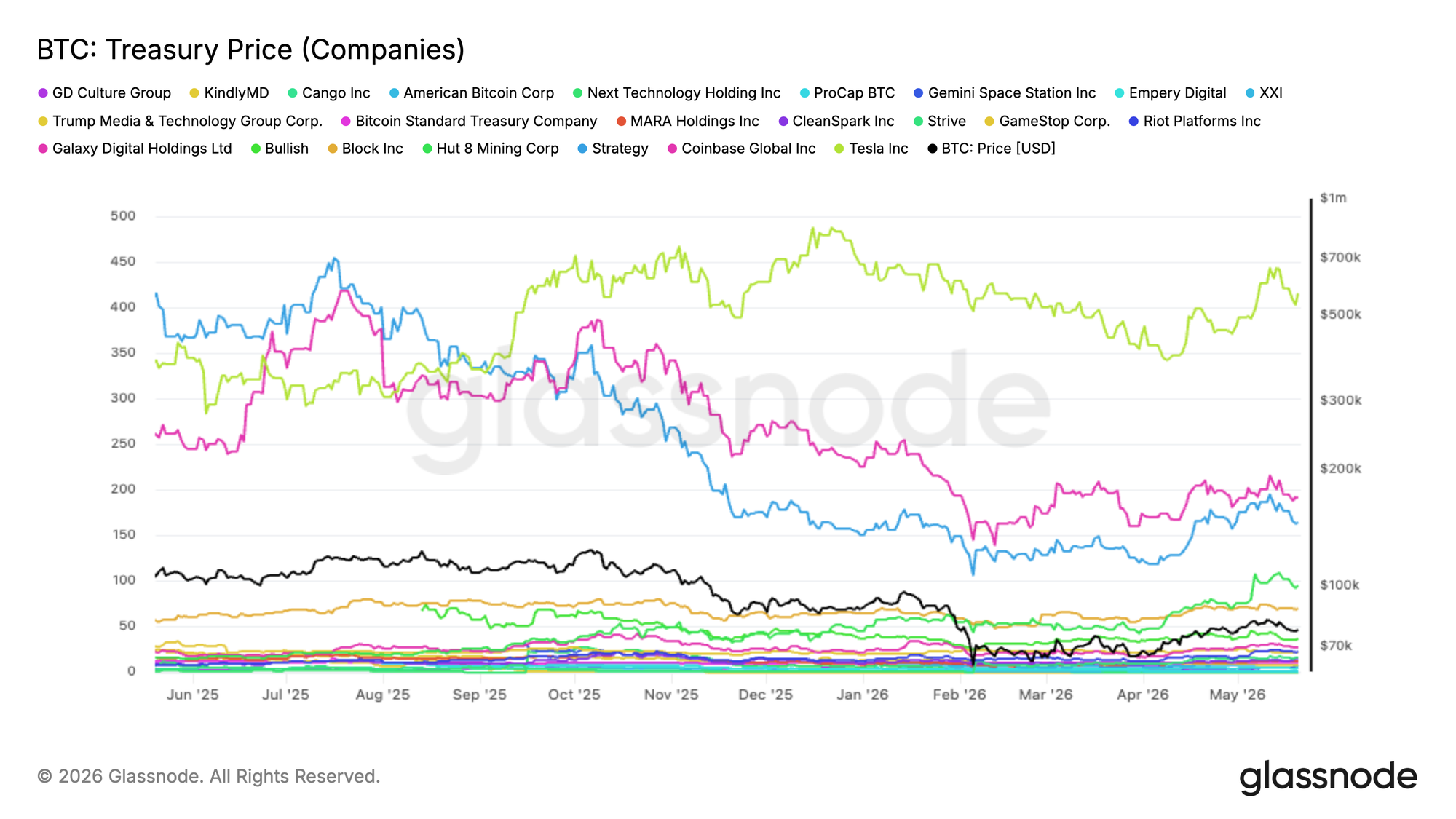
For US Digital Asset Treasury (DAT) companies, the data makes it easier to compare how listed equities behave relative to the underlying crypto asset and assess which names exhibit stronger or weaker equity beta to crypto market movements.

For example, users can compare BTC performance against companies holding BTC on their balance sheet to identify which stocks behave more like direct crypto proxies, and which names trade with a more idiosyncratic equity profile.
View live chart

US Spot ETF Volume: Assessing Participation and Liquidity Conditions

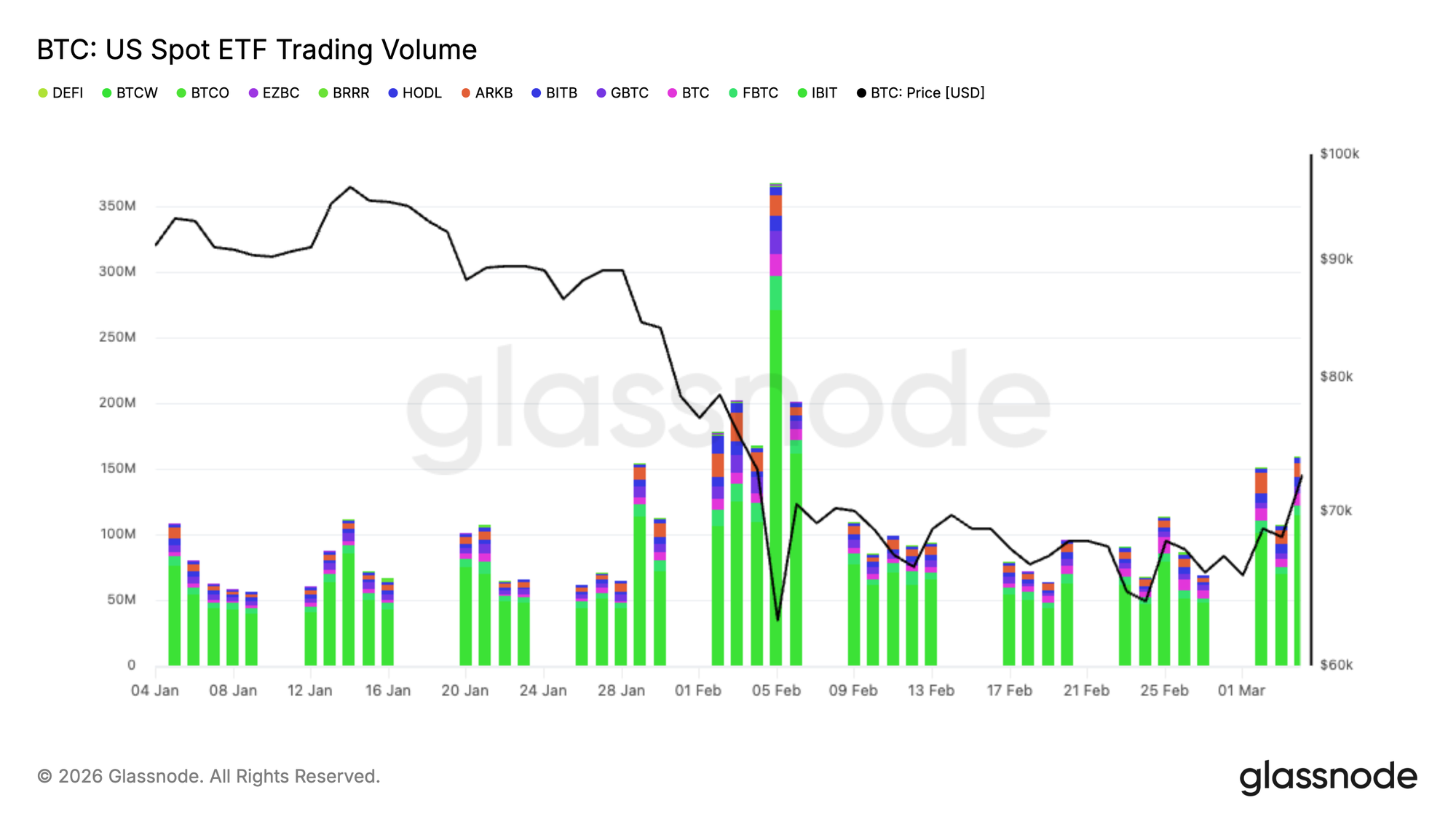
The addition of trading volume is particularly useful for US spot ETFs. Trading volume provides insight into liquidity, participation, and conviction.

For example, a sharp spike in ETF trading volume around a major price move or macro event can signal heavy institutional repositioning — and comparing ETF volume against the underlying spot market shows how much real flow is moving through TradFi venues versus crypto-native ones. Sustained volume can confirm genuine demand behind a price trend, while thin volume on a move may warrant more caution.
View live chart

Together, these new metrics strengthen Glassnode’s ability to bridge crypto-native data with traditional market instruments, giving users a unified view of spot assets, ETFs, and listed treasury vehicles directly in Studio.

Explore the new metrics in Studio

  • DAT Price Companies
  • DAT Trading Volume Companies
  • US Spot ETF Price
  • US Spot ETF Trading Volume

  • Follow us on X for timely market updates and analysis
  • Join our Telegram channel for regular market insights
  • For on-chain metrics, dashboards, and alerts, visit Glassnode Studio

Disclaimer: This report is for informational and educational purposes only. The analysis represents a limited case study with significant constraints and should not be interpreted as investment advice or definitive trading signals. Past performance patterns do not guarantee future results. Always conduct thorough due diligence and consider multiple factors before making investment decisions.


Related Questions

QWhat two new metric families has Glassnode added to its Studio platform to track digital asset markets beyond crypto-native venues?

AThe two new metric families are US Spot ETF Price & Volume and US Digital Asset Treasury Company Price & Volume.

QAccording to the article, what advantage does tracking US Spot ETF trading volume provide for market analysis?

ATracking US Spot ETF trading volume provides insight into liquidity, participation, and conviction. It can signal institutional repositioning and help determine how much real flow is moving through traditional finance venues compared to crypto-native ones.

QHow can the data on US Digital Asset Treasury (DAT) companies help investors?

AThe data makes it easier to compare how listed equities of DAT companies behave relative to the underlying crypto asset, helping to assess which stocks have a stronger or weaker equity beta to crypto market movements and identify which act more like direct crypto proxies.

QWhat is the overall purpose of Glassnode's expansion with these new metrics, as described in the article?

AThe overall purpose is to bridge crypto-native data with traditional market instruments, giving users a unified view of how crypto exposure is expressed through spot assets, ETFs, and listed treasury vehicles in traditional equity markets.

QWhere can users access these new metrics and find additional market insights from Glassnode, based on the article's final sections?

AUsers can access the new metrics in Glassnode Studio. For timely updates, they can follow Glassnode on X, join their Telegram channel for market insights, and visit Glassnode Studio for on-chain metrics, dashboards, and alerts.

Related Reads

Fei-Fei Li's Team Clarifies the Concept of 'World Models', Sora Merely a Renderer

"World Models" has become a widely used yet confusing term in AI. To address this, a team led by Fei-Fei Li and World Labs proposed a functional taxonomy based on the Partially Observable Markov Decision Process framework. This taxonomy categorizes systems called "world models" into three distinct projections: Renderers, Simulators, and Planners. Renderers, like OpenAI's Sora and other video generation models, focus on producing photorealistic visual outputs for human perception. They prioritize visual fidelity over physical accuracy. Simulators, such as NVIDIA Omniverse, aim to compute precise future environmental states for computational tasks like engineering analysis or digital twins. Planners, like Vision-Language-Action models, take in observations and goals to output executable actions for robots or agents. The article clarifies that most current "world models," including Sora, are primarily Renderers. They generate convincing visuals but lack the core ability to simulate state transitions based on actions, a key requirement for a true world model in classic reinforcement learning definitions. This conceptual confusion has practical implications, leading to potential misalignment in technology selection, investment, and public understanding of AI capabilities. Clear categorization is crucial. It helps enterprises avoid costly mistakes (e.g., using a renderer for robot training), allows investors to accurately assess markets, and enables researchers to build comparable benchmarks. While future systems may integrate these functions, recognizing current boundaries is essential for honest assessment and progress.

marsbit57m ago

Fei-Fei Li's Team Clarifies the Concept of 'World Models', Sora Merely a Renderer

marsbit57m ago

Bloomberg Uncovered: How Do China's Wealthy Circumvent the Annual $50,000 Limit to Transfer Assets?

**Summary: How Wealthy Chinese Circumvent $50,000 Annual Foreign Exchange Limits** Despite China's strict capital controls, including an annual $50,000 per person foreign exchange quota, an estimated $150 billion in funds still leaves the country annually via various gray and underground channels. This report outlines the evolution of China's "capital wall" and the methods used to bypass it. **The Evolving Capital Controls:** * **Foundation (1994):** The system of "current account convertibility with strict capital account controls" was established. * **Quota Set (2007):** The $50,000 individual annual forex purchase limit was formalized. * **Crackdown Begins (2015-2017):** Following market volatility, enforcement tightened. Banks were required to scrutinize transactions, and channels like using UnionPay cards for Hong Kong insurance premiums or buying overseas property were blocked. * **Digital & Legal Upgrades (2024-2026):** Enhanced algorithms now flag suspicious patterns (e.g., "smurfing"). The Common Reporting Standard (CRS) provides Chinese tax authorities with data on citizens' offshore accounts. Unlicensed cross-border brokers have been targeted. **Five Primary Methods for Moving Capital:** 1. **Underground Banking / "Hawala" (Duiqiao):** The largest-scale method. No money crosses borders. Clients pay RMB to a domestic account; an overseas associate deposits equivalent foreign currency into the client's offshore account. Risks include high fees, account freezes, and legal penalties. 2. **"Smurfing" or "Ant Moving":** Using multiple individuals' $50,000 quotas to pool funds for one offshore recipient. Increasingly detected by anti-money laundering algorithms. 3. **Trade Invoice Manipulation:** Businesses over-invoice imports or under-invoice exports via offshore shell companies, creating a pretext to transfer excess funds abroad under the guise of trade. 4. **Channel Migration:** After a crackdown on internet brokers, funds flow toward more compliant but costly channels like major banks' cross-border wealth management services or Qualified Domestic Institutional Investor (QDII) quotas. 5. **Structural Arrangements:** High-net-worth individuals use complex, high-cost legal structures involving offshore trusts, insurance, and investment migration programs to transfer asset ownership. **Regulatory Response: Focusing on People, Not Just Money** The current strategy extends oversight from enterprises to **individual residents**. Tools like CRS allow retroactive visibility into offshore assets. Cryptocurrencies, once seen as a potential loophole, are now actively monitored and prosecuted as an illegal channel. The underlying driver remains: with significant wealth concentrated among millions of affluent households seeking diversification amid domestic economic shifts, the incentive to move assets offshore persists despite regulatory barriers.

marsbit1h ago

Bloomberg Uncovered: How Do China's Wealthy Circumvent the Annual $50,000 Limit to Transfer Assets?

marsbit1h ago

Trading

Spot
Futures
活动图片