Tom Lee Signals Market Bottom: Why Smart Money is Rotating into Quantum Security and BMIC

bitcoinistPublished on 2026-02-09Last updated on 2026-02-09

Abstract

Tom Lee of Fundstrat signals a crypto market bottom, citing cooling inflation and Bitcoin's resilience. He suggests the narrative is shifting from survival to expansion, with new liquidity likely flowing into infrastructure that addresses existential threats like quantum computing. This creates a risk for traditional encryption and an opportunity for quantum-resistant solutions. BMIC ($BMIC) is highlighted as a project building a full quantum-secure finance stack, using post-quantum cryptography and ERC-4337 smart accounts to protect assets against future attacks. Its presale has raised over $444K, indicating early investor confidence. The token fuels a 'Quantum Meta-Cloud' and features a 'Burn-to-Compute' mechanism. The thesis is that as the market matures, the premium for quantum security will grow, and BMIC aims to become the standard for secure digital asset storage.

Fundstrat’s Head of Research, Tom Lee, is known for calling market reversals while everyone else is still panic-selling. His recent analysis suggests the crypto market bottom is already in, or at least dangerously close. Lee points to a ‘perfect storm’ of indicators: cooling inflation, the market finally absorbing the supply overhang from major bankruptcies, and Bitcoin’s surprising resilience during geopolitical tension. The ‘purge’ phase of the cycle, it seems, has concluded.

But staring at price action alone misses the point. The significance of a market bottom isn’t just that prices stop falling; it’s that the narrative shifts from survival to expansion. When liquidity returns (driven by the Fed’s inevitable pivot and ETF inflows), it doesn’t just flow back into the same old coins.

It seeks new infrastructure that solves existential threats. In previous cycles, we saw this capital flood into scaling solutions and DeFi primitives. This time? The next major rotation could prioritize security layers capable of handling institutional-grade value.

That matters because the ‘next leg up’ faces a technological cliff that previous bull runs didn’t: the looming threat of quantum computing. As asset values swell, the incentive to break current encryption standards grows exponentially.

This creates a massive blind spot where traditional wallets are essentially undervalued risks, and quantum-resistant infrastructure is the undetected alpha. Investors tracking Tom Lee’s ‘risk-on’ signals are now hunting for projects that secure the digital future against next-generation threats.

Enter BMIC ($BMIC), a project positioning itself as the fortified layer for this new liquidity cycle.

Institutional Inflows Demand Post-Quantum Armor

The ‘harvest now, decrypt later’ attack vector is perhaps the industry’s elephant in the room. State actors and sophisticated hacking groups are currently scraping encrypted data from blockchains, storing it, and simply waiting for quantum computing power to shatter standard RSA and Elliptic Curve Cryptography (ECC).

If Tom Lee’s prediction of Bitcoin reaching six figures holds true, the ‘honeypot’ for these attackers becomes worth trillions.

BMIC addresses this by offering what it claims to be the only platform with a full quantum-secure finance stack. Unlike legacy wallets that rely on encryption methods from the 1990s, BMIC uses post-quantum cryptography to ensure that assets stored today remain secure against tomorrow’s computational brute-force attacks. (And no, this isn’t just paranoia; it’s a mathematical necessity for any enterprise planning to hold digital assets for more than five years).
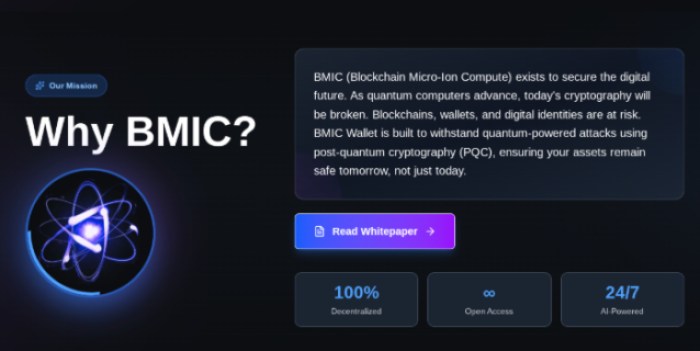
Beyond the encryption layer, the project integrates ERC-4337 smart accounts. This standard allows for ‘account abstraction,’ meaning users get the robust security of quantum resistance without the headache of managing complex seed phrases, often the biggest barrier for institutional clients. By combining AI-enhanced threat detection with zero public-key exposure, the protocol effectively creates a moat around user assets that even a quantum computer can’t cross.

LEARN MORE ABOUT THE $BMIC PRESALE

BMIC Presale Metrics Signal Early Adopter Confidence

While the herd waits for confirmation of the reversal Tom Lee predicts, smart money often moves into presales to maximize asymmetry. The current data from the BMIC raise indicates a disconnect between general market apathy and the high conviction of security-focused investors. $BMIC has raised over $444K, with tokens currently priced at $0.049474.

This capital raise is notable not just for the total, but for the utility of its funding. The $BMIC token isn’t merely a governance instrument; it acts as ecosystem fuel for the ‘Quantum Meta-Cloud’ and powers a unique ‘Burn-to-Compute’ mechanism. As the network grows, the demand for quantum-secure processing power drives token velocity. With what it’s offering its not surprising that we feel $BMIC is one of the best long-term crypto investments.

Investors analyzing the risk-reward ratio here are betting on a simple premise: as the crypto market matures, security premiums will likely skyrocket. The gap between a standard wallet and a quantum-secure wallet is currently priced at zero by the market. If BMIC succeeds in becoming the standard for post-quantum storage, that gap closes rapidly. With the presale still active, the entry point remains pegged to early development rather than the immense speculative value of the security narrative.

BUY YOUR $BMIC FROM THE OFFICIAL PRESALE PAGE

This article is for informational purposes only and does not constitute financial advice. Cryptocurrency investments, particularly in presale stages, carry high risks including total loss of capital. Always conduct your own due diligence.


Related Questions

QAccording to Tom Lee, what are the key indicators suggesting the crypto market bottom is in or near?

ATom Lee points to a 'perfect storm' of indicators: cooling inflation, the market finally absorbing the supply overhang from major bankruptcies, and Bitcoin's surprising resilience during geopolitical tension.

QWhat is the 'harvest now, decrypt later' attack vector mentioned in the article?

AIt is an attack where state actors and sophisticated hacking groups scrape encrypted data from blockchains, store it, and wait for quantum computing power to become available to break the current encryption standards like RSA and ECC.

QHow does the BMIC project claim to protect assets against future quantum computing threats?

ABMIC uses post-quantum cryptography to secure assets against future computational brute-force attacks and integrates ERC-4337 smart accounts for account abstraction, eliminating the need to manage complex seed phrases.

QWhat is the current status of the BMIC presale as described in the article?

AThe BMIC presale has raised over $444K, with tokens currently priced at $0.049474, indicating high conviction from security-focused investors despite general market apathy.

QWhat role does the $BMIC token play within its ecosystem beyond governance?

AThe $BMIC token acts as ecosystem fuel for the 'Quantum Meta-Cloud' and powers a unique 'Burn-to-Compute' mechanism, where demand for quantum-secure processing power drives token velocity as the network grows.

Related Reads

Google and Amazon Simultaneously Invest Heavily in a Competitor: The Most Absurd Business Logic of the AI Era Is Becoming Reality

In a span of four days, Amazon announced an additional $25 billion investment, and Google pledged up to $40 billion—both direct competitors pouring over $65 billion into the same AI startup, Anthropic. Rather than a typical venture capital move, this signals the latest escalation in the cloud wars. The core of the deal is not equity but compute pre-orders: Anthropic must spend the majority of these funds on AWS and Google Cloud services and chips, effectively locking in massive future compute consumption. This reflects a shift in cloud market dynamics—enterprises now choose cloud providers based on which hosts the best AI models, not just price or stability. With OpenAI deeply tied to Microsoft, Anthropic’s Claude has become the only viable strategic asset for Google and Amazon to remain competitive. Anthropic’s annualized revenue has surged to $30 billion, and it is expanding into verticals like biotech, positioning itself as a cross-industry AI infrastructure layer. However, this funding comes with constraints: Anthropic’s independence is challenged as it balances two rival investors, its safety-first narrative faces pressure from regulatory scrutiny, and its path to IPO introduces new financial pressures. Globally, this accelerates a "tri-polar" closed-loop structure in AI infrastructure, with Microsoft-OpenAI, Google-Anthropic, and Amazon-Anthropic forming exclusive model-cloud alliances. In contrast, China’s landscape differs—investments like Alibaba and Tencent backing open-source model firm DeepSeek reflect a more decoupled approach, though closed-source models from major cloud providers still dominate. The $65 billion bet is ultimately about securing a seat at the table in an AI-defined future—where missing the model layer means losing the cloud war.

marsbit17m ago

Google and Amazon Simultaneously Invest Heavily in a Competitor: The Most Absurd Business Logic of the AI Era Is Becoming Reality

marsbit17m ago

Computing Power Constrained, Why Did DeepSeek-V4 Open Source?

DeepSeek-V4 has been released as a preview open-source model, featuring 1 million tokens of context length as a baseline capability—previously a premium feature locked behind enterprise paywalls by major overseas AI firms. The official announcement, however, openly acknowledges computational constraints, particularly limited service throughput for the high-end DeepSeek-V4-Pro version due to restricted high-end computing power. Rather than competing on pure scale, DeepSeek adopts a pragmatic approach that balances algorithmic innovation with hardware realities in China’s AI ecosystem. The V4-Pro model uses a highly sparse architecture with 1.6T total parameters but only activates 49B during inference. It performs strongly in agentic coding, knowledge-intensive tasks, and STEM reasoning, competing closely with top-tier closed models like Gemini Pro 3.1 and Claude Opus 4.6 in certain scenarios. A key strategic product is the Flash edition, with 284B total parameters but only 13B activated—making it cost-effective and accessible for mid- and low-tier hardware, including domestic AI chips from Huawei (Ascend), Cambricon, and Hygon. This design supports broader adoption across developers and SMEs while stimulating China's domestic semiconductor ecosystem. Despite facing talent outflow and intense competition in user traffic—with rivals like Doubao and Qianwen leading in monthly active users—DeepSeek has maintained technical momentum. The release also comes amid reports of a new funding round targeting a valuation exceeding $10 billion, potentially setting a new record in China’s LLM sector. Ultimately, DeepSeek-V4 represents a shift toward open yet realistic infrastructure development in the constrained compute landscape of Chinese AI, emphasizing engineering efficiency and domestic hardware compatibility over pure model scale.

marsbit54m ago

Computing Power Constrained, Why Did DeepSeek-V4 Open Source?

marsbit54m ago

Trading

Spot
Futures
活动图片




