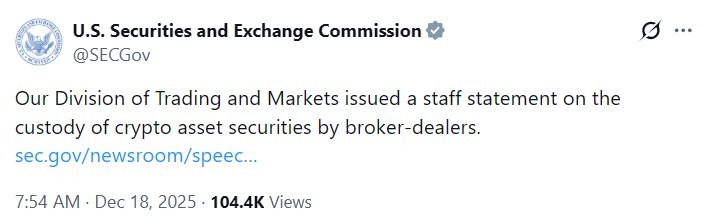
The US Securities and Exchange Commission’s Trading and Markets Division on Wednesday laid out how broker-dealers can custody tokenized stocks and bonds under existing customer protection rules, signaling that blockchain-based crypto asset securities will be slotted into traditional securities safeguards rather than treated as a new category.
The division said it would not object to broker-dealers deeming themselves in possession of crypto asset securities under existing customer protection rules, as long as they meet a set of operational, security and governance conditions. This applies only to crypto securities, including tokenized stocks or bonds.
While the statement is not a rule, it provides clarity on how US regulators expect tokenized securities to fit within traditional market safeguards.
The guidance suggests that tokenized securities are not treated as a new asset class with unique rules. Instead, they are being placed into existing broker-dealer frameworks, even if they settle within blockchain networks.
TradFi on a blockchain: Tokenized securities’ custody rules
At the core of the statement is Rule 15c3-3, the regulator’s consumer protection rule. This requires broker-dealers to maintain control or physical possession of fully paid customer securities.
The division said that crypto asset securities recorded in blockchains may satisfy the “physical possession” requirements under certain circumstances. This means broker-dealers must retain exclusive control over the private keys used to access and transfer the assets.
Despite being on a blockchain, customers and third parties, including affiliates, should not have the ability to move the security without the authorization of the broker.
The statement draws a clear boundary between tokenized securities and crypto-native self-custody models. It prioritizes customer protection over crypto’s permissionless ethos.
Broker-dealers are expected to prepare for scenarios like 51% attacks, hard forks, airdrops and other disruptions. They must also maintain plans that account for seizure, freezing or transfer restrictions under lawful orders.
The guidance reinforces that, regardless of the technologies used to issue or settle tokenized stocks or bonds, they are expected to behave like securities first.
Trading tokenized securities inside regulated market rails
In a separate statement issued the same day, SEC Commissioner Hester Peirce highlighted the trading-side challenges that remain for crypto asset securities.
Peirce raised questions focusing on national securities exchanges and alternative trading systems that facilitate trading crypto asset securities, including pairs where one asset is a security and the other is not.
The questions reflect growing pressure to settle blockchain-based assets with market-structure rules originally designed for traditional equities.
Peirce’s request raises whether existing frameworks and related disclosures and reporting requirements impose costs that outweigh their benefits when applied to crypto trading platforms.
Related: US Fed pulls guidance blocking its banks from engaging with crypto
Platforms jumping into tokenized equities
The statements come as crypto platforms and trading institutions have increasingly begun to tokenize securities.
On Nov. 30, Nasdaq's head of digital assets strategy, Matt Savarese, said the exchange plans to move fast on tokenized stocks. He said the exchange plans to work with the SEC as quickly as possible to make the feature available in the trading platform.
On Tuesday, Securitize, which focuses on tokenizing securities, announced that it plans to launch compliant, onchain trading for tokenized stocks. The company said that it will be presented in a swap-style interface familiar to decentralized finance (DeFi) users.
On Thursday, crypto exchange Coinbase launched a stock trading feature as part of its push to become an “everything exchange.”
Magazine: Koreans ‘pump’ alts after Upbit hack, China BTC mining surge: Asia Express





