Tokenized Deposits vs. Stablecoins: The Future of Finance is Not Replacement, but Integration

深潮Published on 2025-12-10Last updated on 2025-12-10

Abstract

Tokenized deposits and stablecoins represent complementary, not competing, visions for the future of finance. Banks create money through fractional reserve lending, offering low-cost credit to large clients in exchange for deposits—tokenized deposits extend this on-chain but remain within the banking system’s regulatory and operational framework. Stablecoins, like USDC or USDT, function as permissionless, 24/7 cash-like instruments ideal for global settlements, especially in cross-border payments. The future lies in interoperability: corporations may hold tokenized deposits for credit benefits while using stablecoins for efficient, off-ledger transactions. Smart contracts enable complex, multi-party financial workflows beyond what traditional APIs offer. Rather than one replacing the other, both tokenized deposits (for banking-integrated credit) and stablecoins (for borderless liquidity) will coexist on-chain, enabling a more efficient and accessible financial system. The key is building bridges between these models, not choosing sides.

Author: Simon Taylor

Compiled by: Block Unicorn
Banks create money; stablecoins move it. We need both.

Proponents of tokenized deposits say: "Stablecoins are unregulated shadow banking. Once banks tokenize deposits, everyone will prefer to use banks."

Some banks and central banks love this narrative.

Proponents of stablecoins say: "Banks are dinosaurs. We don't need them on-chain. Stablecoins are the future of money."

Crypto natives particularly favor this story.

Both sides are missing the point.

Banks Provide Cheaper Credit to Their Largest Clients

You deposit $100, it becomes $90 in loans (or even more). This is how fractional reserve banking works. For centuries, it has been an engine of economic growth.

  • A Fortune 500 company deposits $500 million at JPMorgan Chase.

  • In return, they receive a massive line of credit at below-market interest rates.

  • Deposits are the bank's business model, and large corporations know this.

Tokenized deposits bring this mechanism on-chain, but they only serve the bank's own customers. You are still within the bank's regulatory perimeter, still subject to its business hours, processes, and compliance requirements.

For businesses that need low-cost credit lines, tokenized deposits are a good option.

Stablecoins Are Like Cash

Circle and Tether hold 100% reserves, equivalent to $200 billion in bonds. They earn a 4-5% yield but don't pay you anything.

In return, you get funds free from any bank's regulatory oversight. An estimated $9 trillion will be moved cross-border via stablecoins by 2025. Accessible anytime, anywhere with an internet connection, permissionless, 24/7.

No correspondent bank inquiries, no waiting for SWIFT settlement, no "we'll get back to you in 3-5 business days."

For a company that needs to pay an Argentine supplier at 11 PM on a Saturday, stablecoins are a good option.

The Future is Both

A company that wants a good credit line from a bank might also want to use stablecoins as an on-ramp to long-tail markets.

Imagine this scenario:

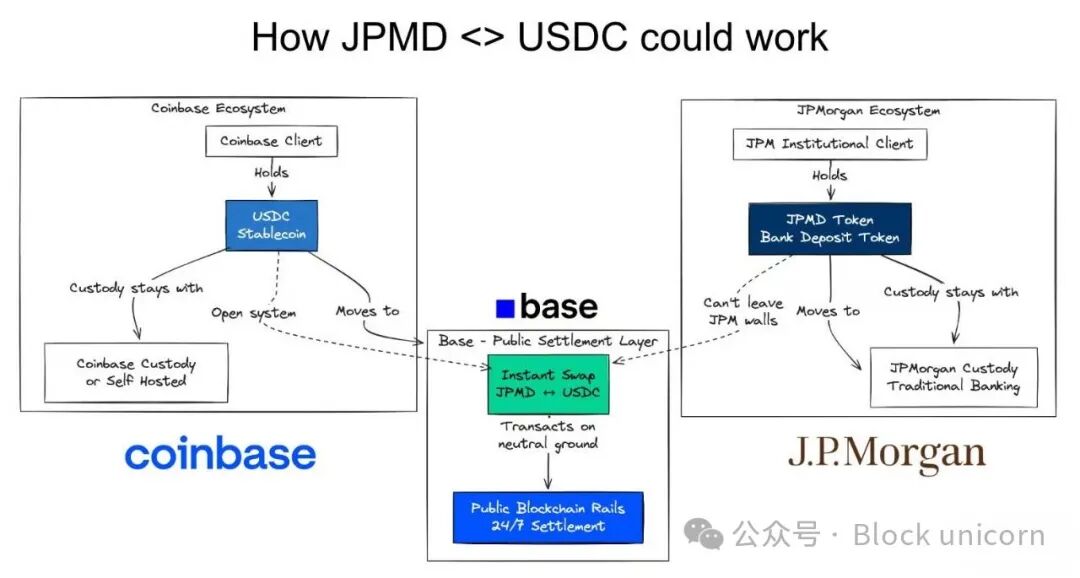
  • A Fortune 500 company holds tokenized deposits at JPMorgan Chase

  • In return, it gets a preferential credit line for its US operations

  • It needs to pay an Argentine supplier who prefers stablecoins.

  • So, it swaps JPMD for USDC.

This is an example of where we are headed.

On-chain. Atomic.

Having both.

Using traditional rails where they work.

Using stablecoins where they don't.

It's not an either/or. It's both.

  • Tokenized deposits → Low-cost credit inside the banking system

  • Stablecoins → Cash-like settlement outside the banking system

  • On-chain swaps → Instant conversion, zero settlement risk

Both have pros and cons.
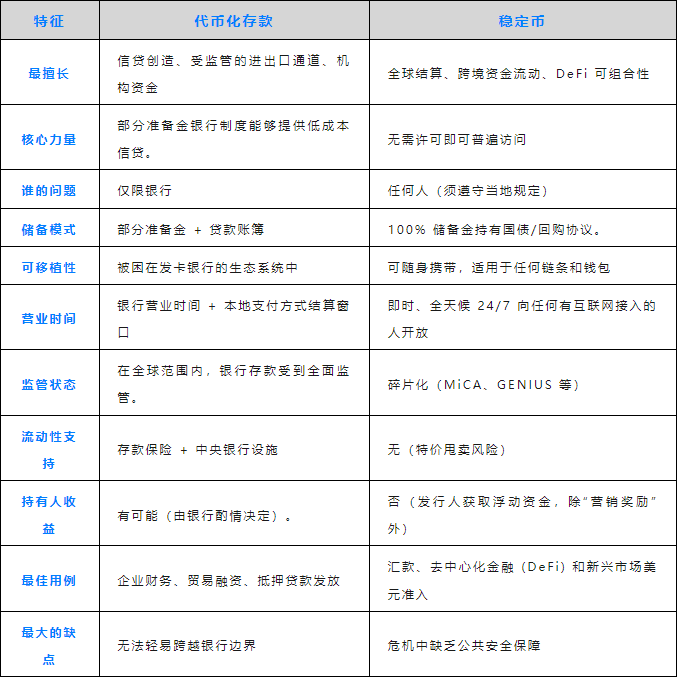
They will coexist.

On-Chain Payments > APIs for Payment Orchestration

Some large banks might say "We don't need tokenized deposits, we have APIs," and in some cases, they are right.

This is precisely the power of on-chain finance.

Smart contracts can build logic across multiple firms and individuals. When a supplier's deposit arrives, a smart contract can automatically trigger inventory financing, working capital financing, FX hedging. Automatically. Instantly. Whether from a bank or a non-bank.

Deposit → Stablecoin → Pay invoice → Downstream payments complete.

APIs are point-to-point. Smart contracts are many-to-many. This makes them ideal for workflows that cross-organizational boundaries. This is the power of on-chain finance.

It's a fundamentally different architecture for financial services.

The Future is On-Chain

Tokenized deposits solve for low-cost credit. Deposits are locked in. Banks lend against them. Their business model remains.

Stablecoins solve for the portability of money. Funds flow permissionless, anywhere. The Global South gets access to dollars. Businesses get fast settlement.

Proponents of tokenized deposits want regulated payment rails only.

Proponents of stablecoins want to replace banks.

The future needs both.

Fortune 500s want massive credit lines from banks AND instant global settlement. Emerging markets want local credit creation AND dollar on-ramps. DeFi wants composability AND real-world asset backing.

Arguing about who wins misses what's happening. The future of finance is on-chain. Tokenized deposits and stablecoins are both necessary infrastructure to get there.

Stop arguing about who wins. Start building interoperability.

Composable money.

Related Questions

QWhat is the core argument of the article regarding tokenized deposits and stablecoins?

AThe article argues that the financial future is not about one replacing the other, but about the fusion and coexistence of both tokenized deposits and stablecoins. Each serves a distinct purpose: tokenized deposits provide low-cost credit within the banking system, while stablecoins offer cash-like, permissionless settlement outside it.

QAccording to the article, what primary benefit do tokenized deposits offer to large corporate clients?

ATokenized deposits offer large corporate clients access to substantial, low-cost credit lines from their banks, as the deposits form the basis of the bank's lending business model.

QWhat key advantage do stablecoins provide for cross-border payments as highlighted in the text?

AStablecoins provide a permissionless, 24/7, and fast settlement method for cross-border payments, enabling transactions like sending money to an international supplier at any time without relying on traditional banking hours or intermediaries like SWIFT.

QHow does the article describe the role of smart contracts in the future of on-chain finance?

AThe article states that smart contracts enable multi-party logic and automation across organizational boundaries. They can automatically trigger actions like inventory financing, working capital loans, and FX hedging upon payment's receipt, making them more powerful than point-to-point APIs for complex financial workflows.

QWhat is the final call to action for the industry presented in the conclusion?

AThe final call to action is to stop arguing about which will win—tokenized deposits or stablecoins—and instead start building interoperability to create a future of composable money on-chain.

Related Reads

A New Scaling Variable for Text-to-Image Generation, Discovered by ByteDance's Seed Team

ByteDance's SEED team investigated a crucial but often overlooked scaling variable in text-to-image diffusion models: the amount of image-grounded information in training captions. They found that simply increasing caption length with natural language does not improve model performance, as it often adds redundancy without new, usable visual supervision. The core discovery is that the final training loss of a diffusion model can be predicted by the *information content* of its text condition, measured by two complementary metrics: Grounded Perplexity Gain (GPG) and Effective Detailness (ED). This establishes a scaling relationship for text conditioning. To systematically increase information content, the team proposed **Structured Prompt (SP)**, a JSON-based representation that organizes visual variables (global scene, object attributes, spatial relationships) into clear fields, enhancing **Diffusability**—the model's ability to learn from captions. For inference, an LLM **Prompter** is trained to convert user queries into detailed SP instances, defining **Promptability**. The overall generation quality is viewed as a product of Diffusability and Promptability. A three-stage training strategy (SFT, cold-start reasoning distillation, and verifier-guided reinforcement) significantly improves the prompter's capability. The structured format also enables efficient iterative refinement through a *refine-render-judge* loop. In matched-control experiments using the same Qwen-Image backbone, data, and compute, the SP-based system substantially outperformed its natural-language counterpart, demonstrating that gains stem from the structured information interface, not just more training. The work shows that scaling text-to-image models requires scaling the *usable visual information* in conditions, not just model size or data volume.

marsbit18m ago

A New Scaling Variable for Text-to-Image Generation, Discovered by ByteDance's Seed Team

marsbit18m ago

In Just 6 Months, 4 Rounds of Funding: West Lake University Professor's Venture Takes Off

Westlake Robotics, an embodied artificial intelligence company, has completed its Series A financing round within just six months and a total of four rounds, raising a cumulative 5 billion RMB. The investor lineup includes prominent institutions such as SAIF Partners, Xiaomiao Langcheng, Henan Investment Group Huirong Fund, and Haiyuan Fund, forming a high-quality capital matrix comprising state-owned, industrial, and leading venture capital. The rapid and intensive capital injection reflects strong market confidence in the company's technological approach, product deployment capabilities, and long-term potential. The newly acquired funds will be primarily allocated to the research and development of a unified large model for humanoid robots and the establishment of a talent cultivation base for embodied AI. Founded in 2024, Westlake Robotics originated from the industrial transformation of pioneering achievements in AI and robotics at Westlake University. The founding team is led by Wang Donglin, a leading figure in China's embodied AI and robot learning field, and co-founder Zhang Yue, an expert in natural language processing. The core R&D members hail from top-tier tech companies like Alibaba, ByteDance, Tencent, and Huawei, as well as prestigious global universities. The company follows a fully self-developed strategy integrating a "universal brain + humanoid body-specific cerebellum + proprietary humanoid hardware." It is one of the few domestic enterprises capable of holistically connecting the three core areas of embodied AGI cognitive reasoning, full-body motion control, and humanoid hardware. Its proprietary technologies include the General Motion Model-GAE system for low-latency teleoperation and motion generalization, and a dual pre-trained architecture for general and body-specific processing to bridge cognitive reasoning and physical movement. In 2026, Westlake Robotics launched its self-developed humanoid robot "Westlake o1," completing the full technology chain from underlying algorithms to pre-trained models and hardware. The company has secured nearly 100 million RMB in orders, with applications in scientific research, education, data collection, and power inspection. Future targets include high-risk industrial inspection, post-disaster search and rescue, and remote precision assembly. The company has also partnered with the Longyou County government to establish a county-wide real-scenario training base for humanoid robots, aimed at collecting high-quality motion data and validating technology in authentic environments. With the latest funding, Westlake Robotics plans to further advance its core model development and talent acquisition strategy, accelerating progress toward the "GPT moment" for embodied intelligence in China.

marsbit43m ago

In Just 6 Months, 4 Rounds of Funding: West Lake University Professor's Venture Takes Off

marsbit43m ago

Volatility Plummets to Historic Lows, When Will Bitcoin's 'Summer Sideways Move' End?

Bitcoin is experiencing a classic summer of stagnant price action, trapped in a tight range between approximately $62,000 and $66,000. Analysts point to historically low implied volatility and thin summer liquidity as key characteristics of the current market. The consensus among traders is that the catalyst for a decisive breakout will come from macroeconomic factors, not internal crypto dynamics. The immediate focus is on upcoming U.S. CPI data, which could influence Federal Reserve policy expectations. A softer inflation print is seen as potentially supportive for risk assets like Bitcoin. Furthermore, the pending *Clarity Act* legislation is identified as a crucial long-term catalyst that could boost institutional participation by providing regulatory clarity. While U.S. spot Bitcoin ETFs, led by BlackRock's IBIT, have seen their strongest inflows since April, providing underlying support, this buying pressure is being offset by selling from miners and other large holders. This has resulted in continued consolidation even as global crypto trading volumes hit multi-year lows. Market participants expect the range-bound, low-volatility environment to persist for several more weeks, at least until there is clearer progress on macro policy or regulatory fronts. Any sustained break above or below the current range is likely to trigger a significant expansion in volatility. Long-term bullish narratives around adoption, institutional demand, and Bitcoin's unique attributes as collateral remain intact, but the short-term path depends on external macroeconomic catalysts.

marsbit46m ago

Volatility Plummets to Historic Lows, When Will Bitcoin's 'Summer Sideways Move' End?

marsbit46m ago

Trading

Spot
活动图片