Author: ponyo_fp, Four Pillars
Compiler: AididiaoJP, Foresight News
Key Takeaways
- Funding rates, basis, and lock-up discounts are essentially 'taxes' on crypto speculation. Consequently, when demand for stablecoins is high, the real yield on synthetic dollars tends to be compressed.
- The supply schedule of stock lock-ups depends on IPO timetables and insider liquidity arrangements, having no relation to crypto market cycles.
- The daily trading volume of stock perpetual contracts has surged from $84 million to $5.5 billion, giving crypto asset managers their first real ability to hedge stock exposure.
- A typical locked-stock transaction yields approximately 20.5 percentage points over a six-month holding period—15 points from the entry discount and 5.5 points from funding rate positions, independent of the stock's price movement.
- The size of the eligible locked-stock pool is about 4.5 times that of the filtered crypto unlock pipeline.
- Looking ahead, any market that develops liquid shorting instruments—commodities, interest rates, or the next tokenized asset—will follow the same trading logic.
Neutrl is exploring extending its delta-neutral strategy to tokenized stocks and pre-IPO shares. Below, we break down the logic behind this, how much a representative trade can earn, why the opportunity is significant, and why the buyer market is still nascent.
Note: Neutrl is an on-chain market-neutral synthetic dollar protocol. It issues NUSD (a tradable, composable synthetic dollar) and sNUSD (the staked, yield-bearing version). The core approach is to package OTC arbitrage, locked token discount trades, and basis/funding rate arbitrage—strategies typically accessible only to institutions and hedge funds—onto the blockchain, allowing everyday users to earn relatively stable, non-directional yields. While similar to synthetic dollar protocols like Ethena, it places greater emphasis on the structural opportunity of OTC locked token discounts and is currently exploring expanding its strategy to areas like tokenized stocks and pre-IPO shares.
The Structural Mismatch of Yield
Synthetic dollars inherently have a structural mismatch: when the crypto market cools, capital most often flocks to stablecoins seeking a low-volatility haven; yet precisely at that time, the yield on synthetic dollars thins. The reason is that funding rates, basis, and unlock discounts all stem from crypto speculation. Until recently, there were almost no hedgeable assets outside the crypto cycle, making this mismatch unsolvable. But this year, a second dimension of timing is emerging.
In the first half of 2026, the 30-day average trading volume of the top 30 altcoin perpetual contracts fell from $8.4 billion to $5.9 billion, a 30% contraction. As volume shrinks, so does the room supporting funding rates and basis. Delta-neutral strategies built entirely on crypto-native spreads tend to perform best when markets are quiet and weakest when they are lively. Switching trading assets doesn't change this, as these spreads almost all breathe with the same crypto cycle.
But the supply of stock lock-ups follows a different rhythm. IPO schedules, employee unlock windows, and shares from fund lock-up periods release gradually according to their own calendars. Packed listing schedules, funds nearing distribution deadlines, insiders needing liquidity per plans set years ago—none of these are correlated with Bitcoin. These discounts have existed in private secondary markets for years; the barrier has never been insufficient supply, but rather a lack of hedging tools. A discount without a hedge isn't yield; it's just exposure with a story attached.
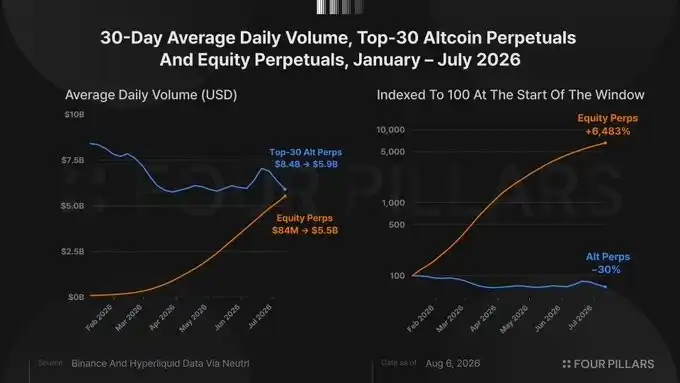
A market becomes truly investable when it becomes shortable. Holders of tokenized stocks grew from about 70,000 in September last year to over 670,000 by July this year. Simultaneously, the daily trading volume of stock perpetual contracts leapt from $84 million to $5.5 billion within six months. Crossing this threshold transforms the asset class of locked, discounted shares from 'visible' to 'investable.'
This is precisely the logic behind Neutrl's focus—not layering a strategy on top of existing logic, but finding a yield channel with a driver completely independent of the crypto cycle.
A Robust Yield of Approximately 20 Percentage Points
The most intuitive way is to examine a representative transaction under evaluation by Neutrl (specific target undisclosed, still under discussion). The trading desk plans to acquire shares in a late-stage private company at a 15% discount to the reference price, with a lock-up of about six months (corresponding to the pre- and post-IPO window). This 15% is not the market average nor a fixed rate; it's merely indicative terms for a current evaluation. Discounts vary with lock-up duration, transfer restrictions, and seller liquidity needs.
On the hedge side, they short an equivalent notional amount of the same stock's perpetual contract. From day one, the delta is near zero; the profit or loss no longer depends on stock price movement, only on whether the discount converges after the lock-up expires and the yield generated from the hedge during the holding period.
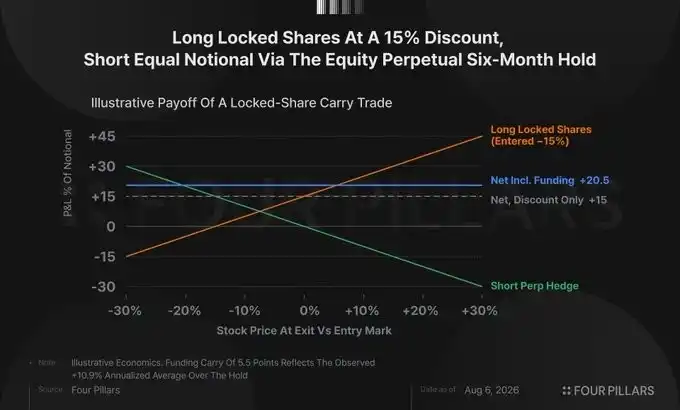
The hedge itself also generates yield. During the actual observation window from late May to mid-July, the annualized funding rate for the short side of stock perpetual contracts averaged 10.9%, with volatility ranging from approximately -35% to +55%. Such dramatic swings are common in young funding rate markets not yet smoothed by professional capital. Estimated over a six-month holding period, this contributes about 5.5 percentage points. Adding the initial 15-point discount, the overall yield is roughly 20.5 percentage points, with directional exposure hedged. The final result is a smooth yield line—regardless of the stock's final price movement, it runs about 20 percentage points above zero.
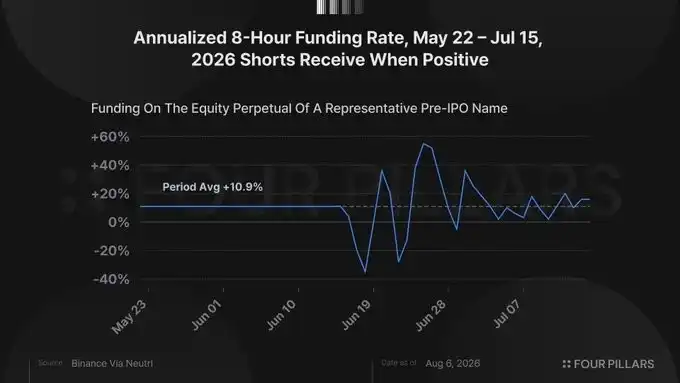
Why is the market willing to pay such high rates for the short side? Because demand is one-sided. The buyers of stock perpetual contracts are traders seeking round-the-clock, leveraged stock exposure, bypassing traditional trading hours and broker restrictions. They far outnumber the professional capital willing to sit on the other side. Young perpetual markets have historically offered rich compensation to shorts until sufficient arbitrage capital flows in, compressing spreads to lower levels. The stock perpetual market is at the starting point of this curve, with a substantial underlying pool. Excluding the largest single stock, the size of the eligible locked-stock pool is approximately $48.2 billion, about 4.5 times the size of the filtered crypto unlock pipeline. Including that stock pushes the estimated size to $1.74 trillion. Spreads are fattest when a market is born—this isn't a flaw in the argument; it *is* the argument.
One Trading Framework, Covering All Shortable Assets
For stakers, the real change is independence. The income stream from listing calendars and lock-up expirations continues to pay out even as crypto-native markets quiet down—precisely when stablecoin holders need yield most.
Stocks are the first market outside crypto to develop liquid shorting instruments, but they won't be the last. Commodities follow closely, then interest rates, and then, the next tokenized asset. Every newly opened perpetual market adds a layer of previously visible but unreachable spreads. Expansion itself is the essence of this business model. Neutrl's approach is: buy the locked asset, short the liquid asset, and capture the spread between them as long as both coexist. This opportunity set will compound alongside the process of tokenization.