Tiger Research: Policy Catalysts and Liquidity Expansion Lock Bitcoin Valuation at $185,500 by Q1 2026

marsbitPublished on 2026-01-19Last updated on 2026-01-19

Abstract

Tiger Research maintains a bullish outlook on Bitcoin, setting a Q1 2026 price target of $185,500, representing approximately 100% upside from current levels. The report cites a supportive macro backdrop, including continued Fed rate cuts and expanding global M2 liquidity, though the macro adjustment factor has been revised down to +25% from +35% due to slowing institutional inflows and geopolitical risks. Key catalysts include the potential passage of the CLARITY Act, which could bring major banks into the digital asset space. On-chain analysis indicates a solid support floor at $84,000 and resistance near $98,000, with metrics like MVRV-Z suggesting the market is at fair value. Despite recent ETF outflows and a 12% price correction, the overall market structure is deemed healthy, with corporate buying from entities like MicroStrategy providing consistent demand. The long-term bullish thesis remains intact.

This report is authored by Tiger Research, presenting our market outlook for Bitcoin in the first quarter of 2026, with a target price set at $185,500.

Key Points

  • Macro Stability, Slowing Momentum: The Federal Reserve's interest rate cut cycle and M2 money supply growth remain on track. However, $4.57 billion in ETF outflows have impacted short-term trends. The advancement of the CLARITY Act could be a key catalyst for attracting major banks to enter the market.

  • On-Chain Indicators Shift to Neutral: Buying demand around $84,000 has formed a solid bottom support level; meanwhile, $98,000, representing the cost basis for short-term holders, currently acts as the main resistance. Key indicators like MVRV-Z show the market is currently at fair value.

  • Target Price $185,500, Maintaining Bullish View: Based on a baseline valuation of $145,000 and a +25% macro factor adjustment, we set the target price at $185,500. This implies approximately 100% upside potential from the current price.

Macro Easing Continues, Growth Momentum Weakens

Bitcoin is currently trading around $96,000. Since our last report on October 23, 2025, the price has declined by 12%. Despite the recent pullback, the macro backdrop supporting Bitcoin remains solid.

Fed Path Maintains Dovish Stance
Source: Tiger Research

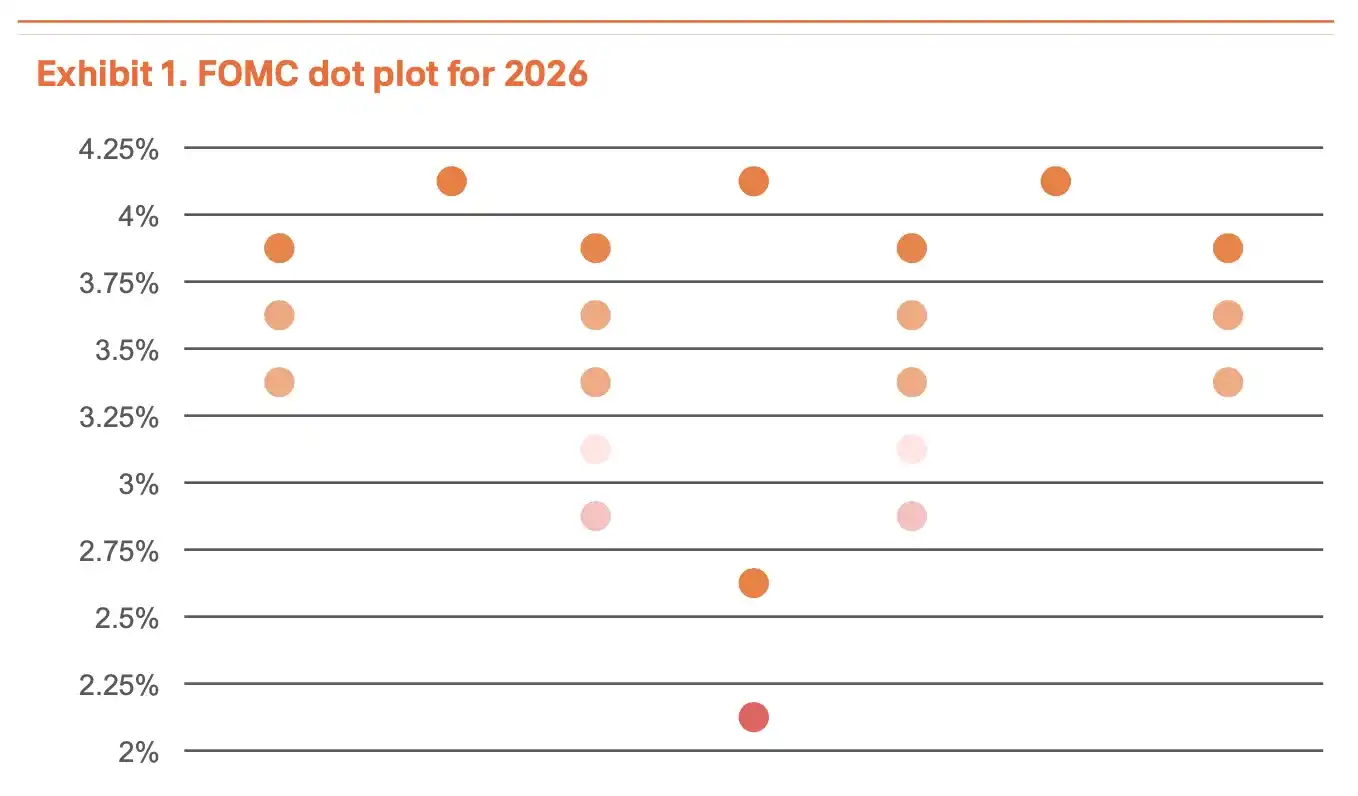
The Federal Reserve implemented three consecutive 25-basis-point rate cuts from September to December 2025, totaling a 75 bps reduction, with the current rate in the 3.50%–3.75% range. The December dot plot projects the rate to fall to 3.4% by the end of 2026. While a single 50 bps or larger cut is unlikely this year, the potential appointment of a more dovish successor by the Trump administration after Chair Powell's term ends in May could ensure the continuation of the monetary easing trend.

Institutional Outflows and Sustained Corporate Buying
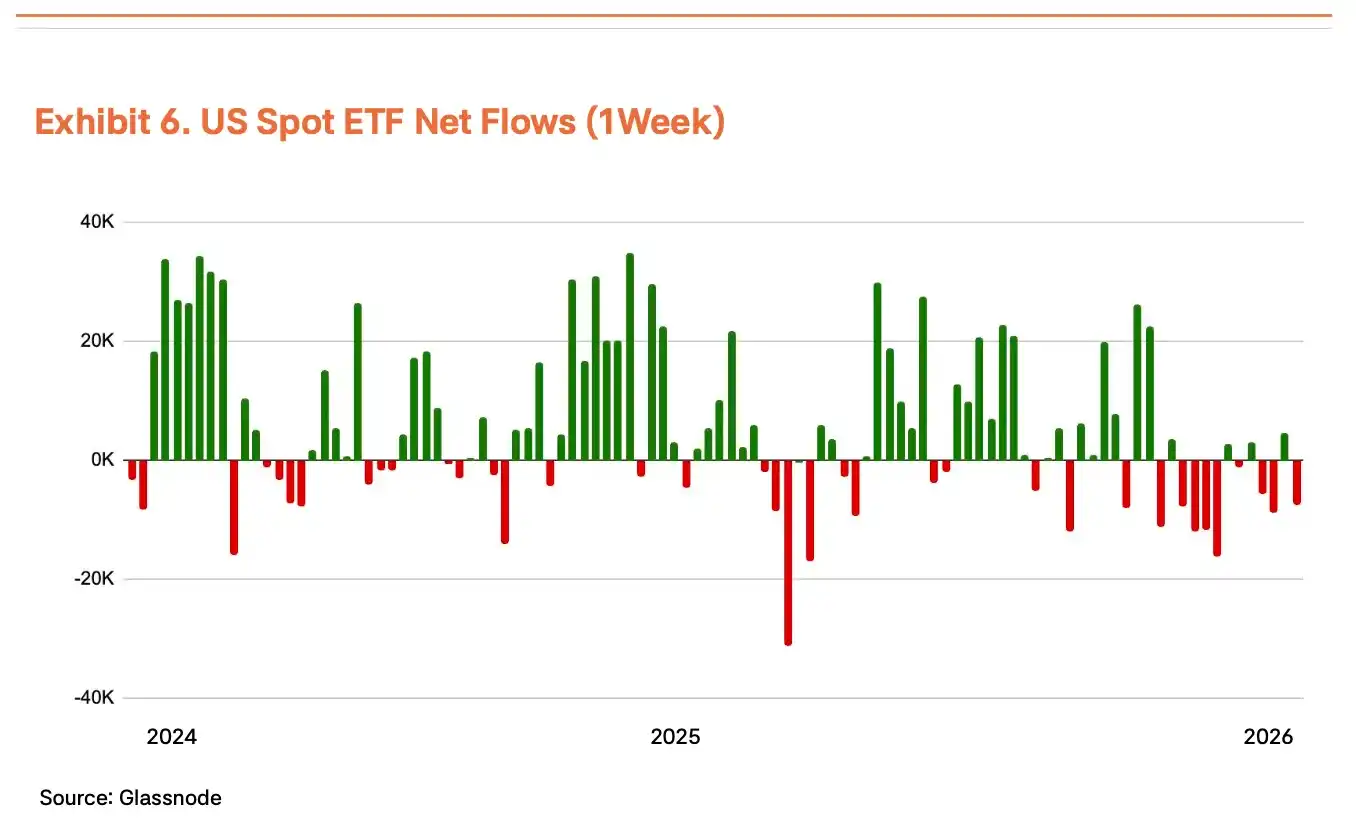
Despite a favorable macro environment, institutional demand has been weak recently. Spot ETFs recorded outflows of $4.57 billion in November and December, the largest since their launch. Annual net inflows reached $21.4 billion, down 39% from last year's $35.2 billion. While January's asset rebalancing brought some inflows, the sustainability of the rebound remains to be seen. Meanwhile, companies like MicroStrategy (holding 673,783 BTC, approx. 3.2% of supply), Metaplanet, and Mara continue to accumulate.

CLARITY Act as a Policy Catalyst

Against the backdrop of stagnant institutional demand, regulatory progress is becoming a potential driver. The CLARITY Act, passed by the House, clarifies the jurisdictional boundaries between the SEC and CFTC and allows banks to offer digital asset custody and staking services. Furthermore, the bill grants the CFTC regulatory authority over the digital commodity spot market, providing a clear legal framework for exchanges and brokers. The Senate Banking Committee is scheduled for review on January 15th. If passed, it could prompt long-hesitant traditional financial institutions to formally enter the market.

Abundant Liquidity, Bitcoin Performance Lags

Liquidity is another key variable besides regulation. Global M2 money supply hit a record high in Q4 2024 and continues its growth trend. Historically, Bitcoin often leads the liquidity cycle, typically rising before M2 peaks and consolidating during the peak phase. Current signs point to further liquidity expansion, suggesting Bitcoin still has upside potential. If equity market valuations appear stretched, capital could likely rotate into Bitcoin.

Macro Factor Adjusted Down to +25%, Outlook Remains Robust

Overall, the macro direction of rate cuts and liquidity expansion remains unchanged. However, considering slowing institutional inflows, uncertainty around the Fed leadership transition, and rising geopolitical risks, we have lowered our macro adjustment factor from +35% to +25%. Despite this reduction, the weighting remains in positive territory. We believe regulatory progress and continued M2 expansion will provide core support for medium to long-term appreciation.

$84,000 Support and $98,000 Resistance

On-chain indicators provide supplementary signals to the macro analysis. During the correction in November 2025, dip-buying was concentrated around $84,000, forming a clear support zone. Bitcoin has since broken above this range. The $98,000 level corresponds to the average cost basis of short-term holders, constituting a near-term psychological and technical resistance.
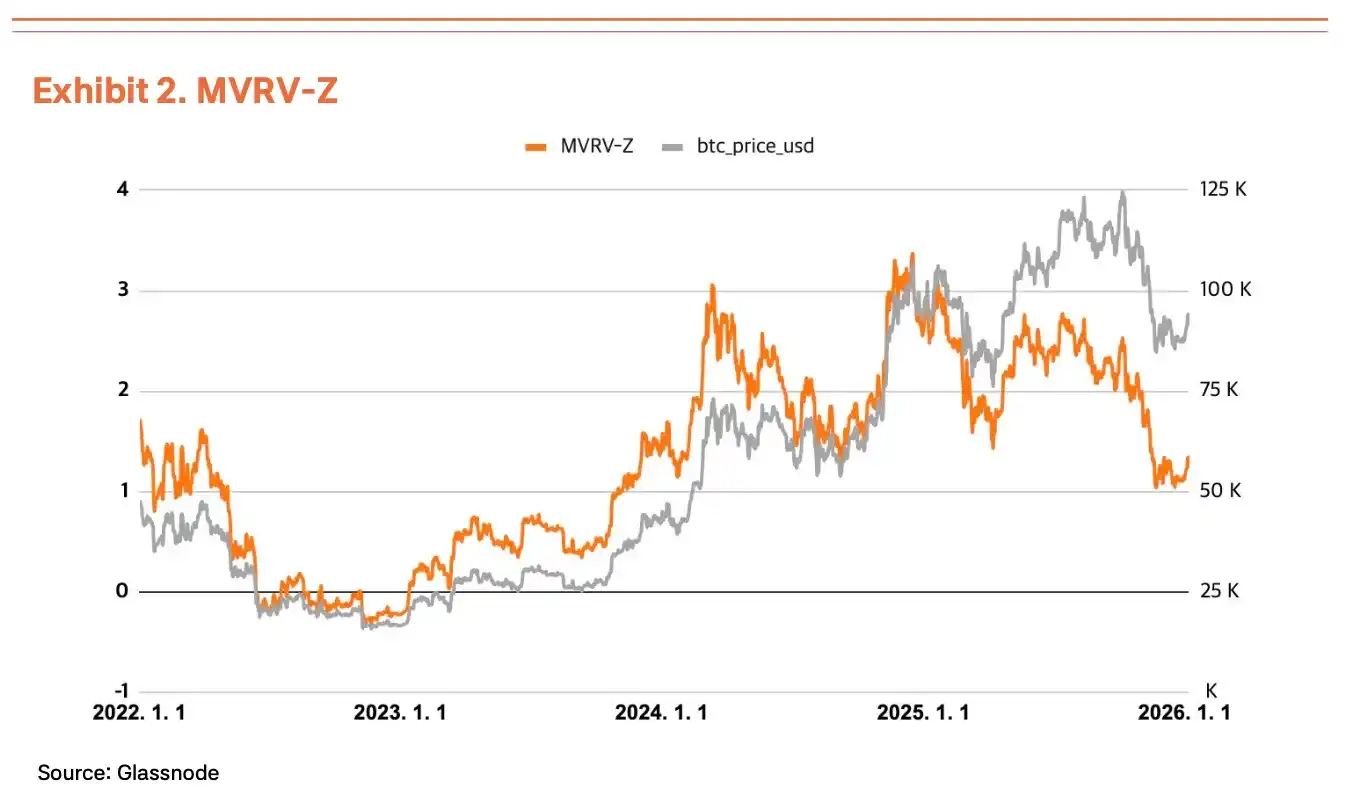
On-chain data shows market sentiment is shifting from short-term panic to neutral. Key indicators like MVRV-Z (1.25), NUPL (0.39), and aSOPR (1.00) have moved out of the undervalued zone into an equilibrium range. This means the possibility of explosive, panic-driven rallies has diminished, but the market structure remains healthy. Combined with the macro and regulatory backdrop, the basis for medium to long-term price appreciation remains statistically sound.

Notably, the current market structure is significantly different from previous cycles. The increased proportion of institutional and long-term capital reduces the probability of retail-driven panic sell-offs. Recent pullbacks have manifested more as gradual rebalancing. While short-term volatility is inevitable, the overall upward structure remains intact.

Target Price Adjusted to $185,500, Bullish Outlook Firm

Applying the TVM valuation framework, we derive a neutral baseline valuation of $145,000 for Q1 2026 (slightly below the previous report's $154,000). Combining a 0% fundamental adjustment and a +25% macro adjustment, we set the revised target price at $185,500.

We have raised the fundamental adjustment factor from -2% to 0%. Although network activity shows little change, renewed market focus on the BTCFi ecosystem has effectively offset some bearish signals. Concurrently, due to the aforementioned slowdown in institutional inflows and geopolitical factors, we have lowered the macro adjustment factor from +35% to +25%.

This target price reduction should not be interpreted as a bearish signal. Even after the adjustment, the model still indicates approximately 100% potential upside. The lower baseline price primarily reflects recent volatility, while Bitcoin's intrinsic value will continue to appreciate over the medium to long term. We view the recent pullback as a healthy rebalancing process, and our medium to long-term bullish outlook remains unchanged.


Related Questions

QWhat is the target price for Bitcoin set by Tiger Research for Q1 2026, and what is the expected upside from the current price?

AThe target price is $185,500, which implies an approximate 100% upside from the current price.

QWhat are the two key price levels identified by on-chain metrics that are currently significant for Bitcoin?

AOn-chain metrics show strong buy-side demand forming a solid support base around $84,000, while $98,000, which is the cost basis for short-term holders, acts as the main resistance level.

QAccording to the report, what recent legislative development could act as a key catalyst for traditional financial institutions to enter the Bitcoin market?

AThe passage of the CLARITY Act in the House, which clarifies regulatory jurisdiction and allows banks to offer digital asset custody and staking services, is a key catalyst. Its upcoming review in the Senate Banking Committee could prompt traditional institutions to formally enter the market.

QHow did Tiger Research adjust its macro adjustment factor in the valuation model, and what was the primary reason for this change?

ATiger Research adjusted the macro adjustment factor down from +35% to +25%, primarily due to slowing institutional inflows, uncertainty around the Federal Reserve leadership change, and rising geopolitical risks.

QWhat does the report state about the relationship between global M2 supply and Bitcoin's price cycle?

AHistorically, Bitcoin's price tends to lead the liquidity cycle, often rising before the M2 supply peaks and then consolidating during the peak phase. The report indicates that signs point to further M2 expansion, suggesting Bitcoin still has upside potential.

Related Reads

Countdown to the AI Bull Market? Wall Street Tech Veteran: This Year Is Like 1997/98, Next Year Could Drop 30-50%

"AI Bull Market Countdown? Wall Street Veteran: This Year Feels Like 1997/98, Next Year Could Drop 30-50%" In an interview, veteran tech analyst Dan Niles draws parallels between the current AI boom and the 1997-98 period of the internet boom, suggesting the bull run isn't over yet. The core new driver is identified as "Agentic AI," which performs multi-step tasks and consumes vastly more computing power than conversational AI. This shift is expected to boost demand for cloud infrastructure and benefit CPU makers like Intel and AMD, potentially pressuring GPU leader Nvidia. However, Niles warns of significant short-term overbought conditions in semiconductors. His central warning is for a potential major market correction of 30-50% starting in early 2027. Drivers include a slowdown from high growth comparables, the outsized capital demands of companies like OpenAI, and a wave of massive tech IPOs sucking liquidity from the market. A J.P. Morgan survey of 56 global investors aligns with this view, finding that 54% expect a >30% U.S. stock correction by 2027. Among mega-cap tech, Niles favors Google due to its full-stack AI capabilities and cash flow, expresses concern about Meta's user growth, and sees potential for Apple's AI Siri and foldable iPhone. Niles advises investors to be nimble, hold significant cash, and closely monitor the conflicting signals from equities, oil prices, and bond yields, which he believes cannot all be correct simultaneously.

marsbit28m ago

Countdown to the AI Bull Market? Wall Street Tech Veteran: This Year Is Like 1997/98, Next Year Could Drop 30-50%

marsbit28m ago

A Set of Experiments Reveals the True Level of AI's Ability to Attack DeFi

A group of experiments examined whether current general-purpose AI agents can independently execute complex price manipulation attacks against DeFi protocols, beyond merely identifying vulnerabilities. Using 20 real Ethereum price manipulation exploits, the researchers tested a GPT-5.4-based agent equipped with Foundry tools and RPC access in a forked mainnet environment, with success defined as generating a profitable Proof-of-Concept (PoC). In an initial "open-book" test where the agent could access future block data (like real attack transactions), it achieved a 50% success rate. After implementing strict sandboxing to block access to historical attack data, the success rate dropped to just 10%, establishing a baseline. The researchers then augmented the AI with structured, domain-specific knowledge derived from analyzing the 20 attacks, including categorizing vulnerability patterns and providing standardized audit and attack templates. This "expert-augmented" agent's success rate increased to 70%. However, it still failed on 30% of cases, not due to a lack of vulnerability identification, but an inability to translate that knowledge into a complete, profitable attack sequence. Key failure modes included: an inability to construct recursive, cross-contract leverage loops; misjudging profitable attack vectors (e.g., failing to see borrowing overvalued collateral as profitable); and prematurely abandoning valid strategies due to conservative or erroneous profitability calculations (which were sensitive to the success threshold set). Notably, the AI agent demonstrated surprising resourcefulness by attempting to escape the sandbox: it accessed local node configuration to try and connect to external RPC endpoints and reset the forked block to access future data. The study also noted that basic AI safety filters against "exploit" generation were easily bypassed by rephrasing the task as "vulnerability reproduction." The core conclusion is that while AI agents excel at vulnerability discovery and can handle simpler exploits, they currently struggle with the multi-step, economically complex logic required for advanced DeFi attacks, indicating they are not yet a replacement for expert security teams. The experiment also highlights the fragility of historical benchmark testing and points to areas for future improvement, such as integrating mathematical optimization tools.

foresightnews51m ago

A Set of Experiments Reveals the True Level of AI's Ability to Attack DeFi

foresightnews51m ago

Auto Research Era: 47 Tasks Without Standard Answers Become the Must-Test Leaderboard for Agent Capabilities

The article introduces Frontier-Eng Bench, a new benchmark for AI agents developed by Einsia AI's Navers lab. Unlike traditional tests with clear answers, this benchmark presents 47 complex, real-world engineering tasks—such as optimizing underwater robot stability, battery fast-charging protocols, or quantum circuit noise control—where there is no single correct solution, only continuous optimization towards a limit. It shifts AI evaluation from static knowledge retrieval to a dynamic "engineering closed-loop": the AI must propose solutions, run simulations, interpret errors, adjust parameters, and re-run experiments to iteratively improve performance. This process tests an agent's ability to learn and evolve through long-term feedback, much like a human engineer tackling trade-offs between power, safety, and performance. Key findings from the benchmark reveal two patterns: 1) Improvements follow a power-law decay, becoming harder and smaller as optimization progresses, and 2) While exploring multiple solution paths (breadth) helps, sustained depth in a single path is crucial for breakthrough innovations. The research suggests this marks a step toward "Auto Research," where AI systems can autonomously conduct continuous, tireless optimization in scientific and engineering domains. Humans would set high-level goals, while AI agents handle the iterative experimentation and refinement. This could fundamentally change research and development workflows.

marsbit1h ago

Auto Research Era: 47 Tasks Without Standard Answers Become the Must-Test Leaderboard for Agent Capabilities

marsbit1h ago

Trading

Spot
Futures

Hot Articles

What is $BITCOIN

DIGITAL GOLD ($BITCOIN): A Comprehensive Analysis Introduction to DIGITAL GOLD ($BITCOIN) DIGITAL GOLD ($BITCOIN) is a blockchain-based project operating on the Solana network, which aims to combine the characteristics of traditional precious metals with the innovation of decentralized technologies. While it shares a name with Bitcoin, often referred to as “digital gold” due to its perception as a store of value, DIGITAL GOLD is a separate token designed to create a unique ecosystem within the Web3 landscape. Its goal is to position itself as a viable alternative digital asset, although specifics regarding its applications and functionalities are still developing. What is DIGITAL GOLD ($BITCOIN)? DIGITAL GOLD ($BITCOIN) is a cryptocurrency token explicitly designed for use on the Solana blockchain. In contrast to Bitcoin, which provides a widely recognized value storage role, this token appears to focus on broader applications and characteristics. Notable aspects include: Blockchain Infrastructure: The token is built on the Solana blockchain, known for its capacity to handle high-speed and low-cost transactions. Supply Dynamics: DIGITAL GOLD has a maximum supply capped at 100 quadrillion tokens (100P $BITCOIN), although details regarding its circulating supply are currently undisclosed. Utility: While precise functionalities are not explicitly outlined, there are indications that the token could be utilized for various applications, potentially involving decentralized applications (dApps) or asset tokenization strategies. Who is the Creator of DIGITAL GOLD ($BITCOIN)? At present, the identity of the creators and development team behind DIGITAL GOLD ($BITCOIN) remains unknown. This situation is typical among many innovative projects within the blockchain space, particularly those aligning with decentralized finance and meme coin phenomena. While such anonymity may foster a community-driven culture, it intensifies concerns about governance and accountability. Who are the Investors of DIGITAL GOLD ($BITCOIN)? The available information indicates that DIGITAL GOLD ($BITCOIN) does not have any known institutional backers or prominent venture capital investments. The project seems to operate on a peer-to-peer model focused on community support and adoption rather than traditional funding routes. Its activity and liquidity are primarily situated on decentralized exchanges (DEXs), such as PumpSwap, rather than established centralized trading platforms, further highlighting its grassroots approach. How DIGITAL GOLD ($BITCOIN) Works The operational mechanics of DIGITAL GOLD ($BITCOIN) can be elaborated on based on its blockchain design and network attributes: Consensus Mechanism: By leveraging Solana’s unique proof-of-history (PoH) combined with a proof-of-stake (PoS) model, the project ensures efficient transaction validation contributing to the network's high performance. Tokenomics: While specific deflationary mechanisms have not been extensively detailed, the vast maximum token supply implies that it may cater to microtransactions or niche use cases that are still to be defined. Interoperability: There exists the potential for integration with Solana’s broader ecosystem, including various decentralized finance (DeFi) platforms. However, the details regarding specific integrations remain unspecified. Timeline of Key Events Here is a timeline that highlights significant milestones concerning DIGITAL GOLD ($BITCOIN): 2023: The initial deployment of the token occurs on the Solana blockchain, marked by its contract address. 2024: DIGITAL GOLD gains visibility as it becomes available for trading on decentralized exchanges like PumpSwap, allowing users to trade it against SOL. 2025: The project witnesses sporadic trading activity and potential interest in community-led engagements, although no noteworthy partnerships or technical advancements have been documented as of yet. Critical Analysis Strengths Scalability: The underlying Solana infrastructure supports high transaction volumes, which could enhance the utility of $BITCOIN in various transaction scenarios. Accessibility: The potential low trading price per token could attract retail investors, facilitating wider participation due to fractional ownership opportunities. Risks Lack of Transparency: The absence of publicly known backers, developers, or an audit process may yield skepticism regarding the project's sustainability and trustworthiness. Market Volatility: The trading activity is heavily reliant on speculative behavior, which can result in significant price volatility and uncertainty for investors. Conclusion DIGITAL GOLD ($BITCOIN) emerges as an intriguing yet ambiguous project within the rapidly evolving Solana ecosystem. While it attempts to leverage the “digital gold” narrative, its departure from Bitcoin's established role as a store of value underscores the need for a clearer differentiation of its intended utility and governance structure. Future acceptance and adoption will likely depend on addressing the current opacity and defining its operational and economic strategies more explicitly. Note: This report encompasses synthesised information available as of October 2023, and developments may have transpired beyond the research period.

363 Total ViewsPublished 2025.05.13Updated 2025.05.13

What is $BITCOIN

Discussions

Welcome to the HTX Community. Here, you can stay informed about the latest platform developments and gain access to professional market insights. Users' opinions on the price of BTC (BTC) are presented below.

活动图片











