Tiger Research: Policy Catalyst and Liquidity Expansion, Bitcoin Valuation Pegged at $185,500 for Q1 2026

marsbitPublished on 2026-01-18Last updated on 2026-01-18

Abstract

Tiger Research maintains a bullish outlook on Bitcoin, setting a Q1 2026 price target of $185,500, representing approximately 100% upside from current levels. The report cites a supportive macro backdrop, including continued Fed rate cuts and expanding global M2 money supply, though the macro adjustment factor has been reduced from +35% to +25% due to slower institutional inflows and geopolitical risks. Key on-chain indicators suggest a neutral market, with strong support at $84,000 and resistance near $98,000. The potential passage of the CLARITY Act is highlighted as a major regulatory catalyst that could bring traditional financial institutions into the market. Despite recent ETF outflows, the overall market structure is deemed healthy, with a gradual rebalancing rather than panic-driven selling.

This report is authored by Tiger Research, presenting our market outlook for Bitcoin in the first quarter of 2026, with a target price set at $185,500.

Key Points

  • Macro Stability, Slowing Momentum: The Federal Reserve's interest rate cut cycle and M2 money supply growth remain on track. However, a $4.57 billion outflow from ETFs has impacted short-term trends. The advancement of the CLARITY Act could be a key catalyst for attracting large banks to enter the market.
  • On-Chain Indicators Shift to Neutral: Buying demand around $84,000 has formed a solid bottom support level; while $98,000, as the cost basis for short-term holders, currently constitutes the main resistance level. Key indicators such as MVRV-Z show the market is currently at fair value.
  • Target Price $185,500, Maintaining Bullish View: Based on a baseline valuation of $145,000 and a +25% macro factor adjustment, we set the target price at $185,500. This implies approximately 100% upside potential from the current price.

Sustained Macro Easing, Weakening Growth Momentum

Bitcoin is currently trading around $96,000. Since our last report on October 23, 2025, the price has fallen by 12%. Despite the recent pullback, the macro backdrop supporting Bitcoin remains solid.

Fed Path Maintains Dovish Stance
Source: Tiger Research

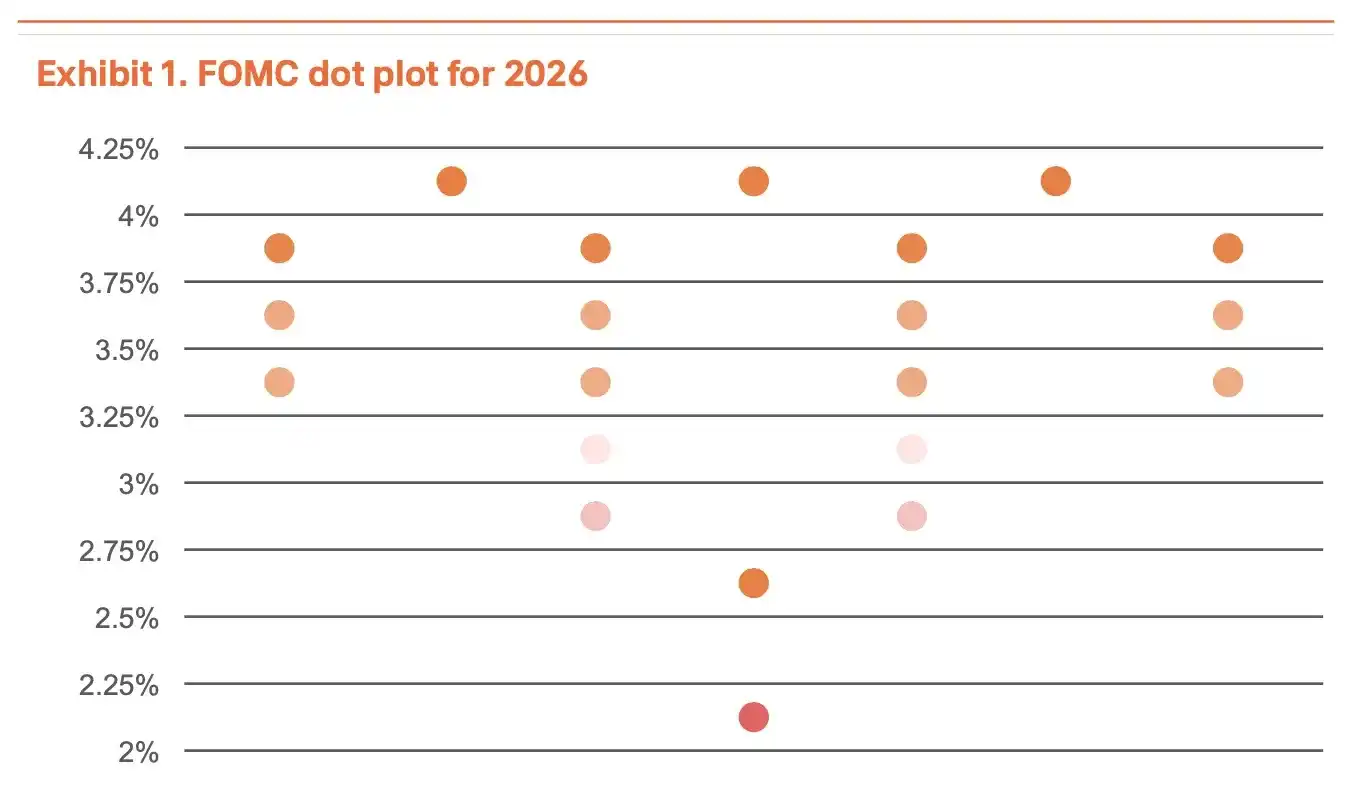
The Federal Reserve implemented three consecutive rate cuts from September to December 2025, totaling 75 basis points, with the current rate in the 3.50%—3.75% range. The December dot plot projects rates to fall to 3.4% by the end of 2026. While a single 50 basis point or larger cut is unlikely this year, the potential appointment of a more dovish successor by the Trump administration after Powell's term ends in May could ensure the continuation of the monetary easing trend.

Institutional Outflows and Continued Corporate Buying
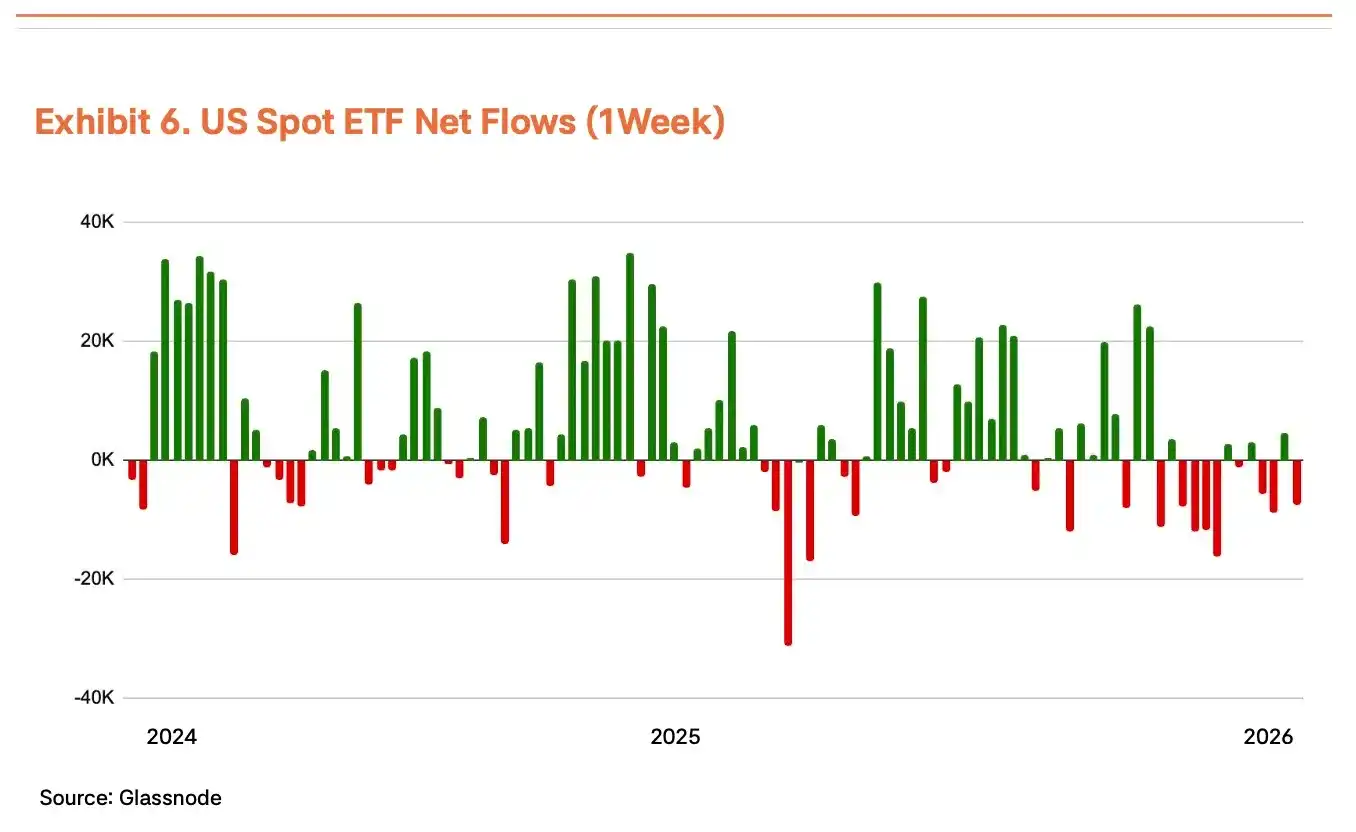
Despite a favorable macro environment, institutional demand has been weak recently. Spot ETFs recorded outflows of $4.57 billion in November and December, the largest since their launch. Annual net inflows were $21.4 billion, down 39% from last year's $35.2 billion. Although January's asset rebalancing brought some inflows, the sustainability of the rebound remains to be seen. Meanwhile, companies like MicroStrategy (holding 673,783 BTC, approx. 3.2% of supply), Metaplanet, and Mara continue to accumulate.

CLARITY Act as a Policy Catalyst

Against the backdrop of stagnant institutional demand, regulatory progress is becoming a potential driver. The CLARITY Act, passed by the House, clarifies the jurisdictional boundaries between the SEC and CFTC and allows banks to provide digital asset custody and staking services. Furthermore, the bill grants the CFTC regulatory authority over the digital commodity spot market, providing a clear legal framework for exchanges and brokers. The Senate Banking Committee is scheduled to review it on January 15th. If approved, it could prompt long-hesitant traditional financial institutions to formally enter the market.

Ample Liquidity, Bitcoin Performance Lags

Liquidity is another key variable besides regulation. Global M2 supply hit a record high in Q4 2024 and continues to grow. Historically, Bitcoin often leads the liquidity cycle, typically rising before M2 peaks and consolidating during the peak phase. Current signs point to further liquidity expansion, suggesting Bitcoin still has upside potential. If stock market valuations appear stretched, funds are likely to rotate into Bitcoin.

Macro Factor Adjusted Down to +25%, Outlook Remains Robust

Overall, the macro direction of rate cuts and liquidity expansion remains unchanged. However, considering slowing institutional inflows, uncertainty around the Fed leadership transition, and rising geopolitical risks, we have lowered our macro adjustment factor from +35% to +25%. Despite this reduction, the weight remains in positive territory. We believe regulatory progress and continued M2 expansion will provide core support for medium to long-term gains.

$84,000 Support and $98,000 Resistance

On-chain indicators provide supplementary signals for macro analysis. During the correction in November 2025, dip-buying was concentrated around $84,000, forming a clear support zone. Bitcoin has since broken above this range. The $98,000 level corresponds to the average cost basis of short-term holders, constituting a recent psychological and technical resistance.
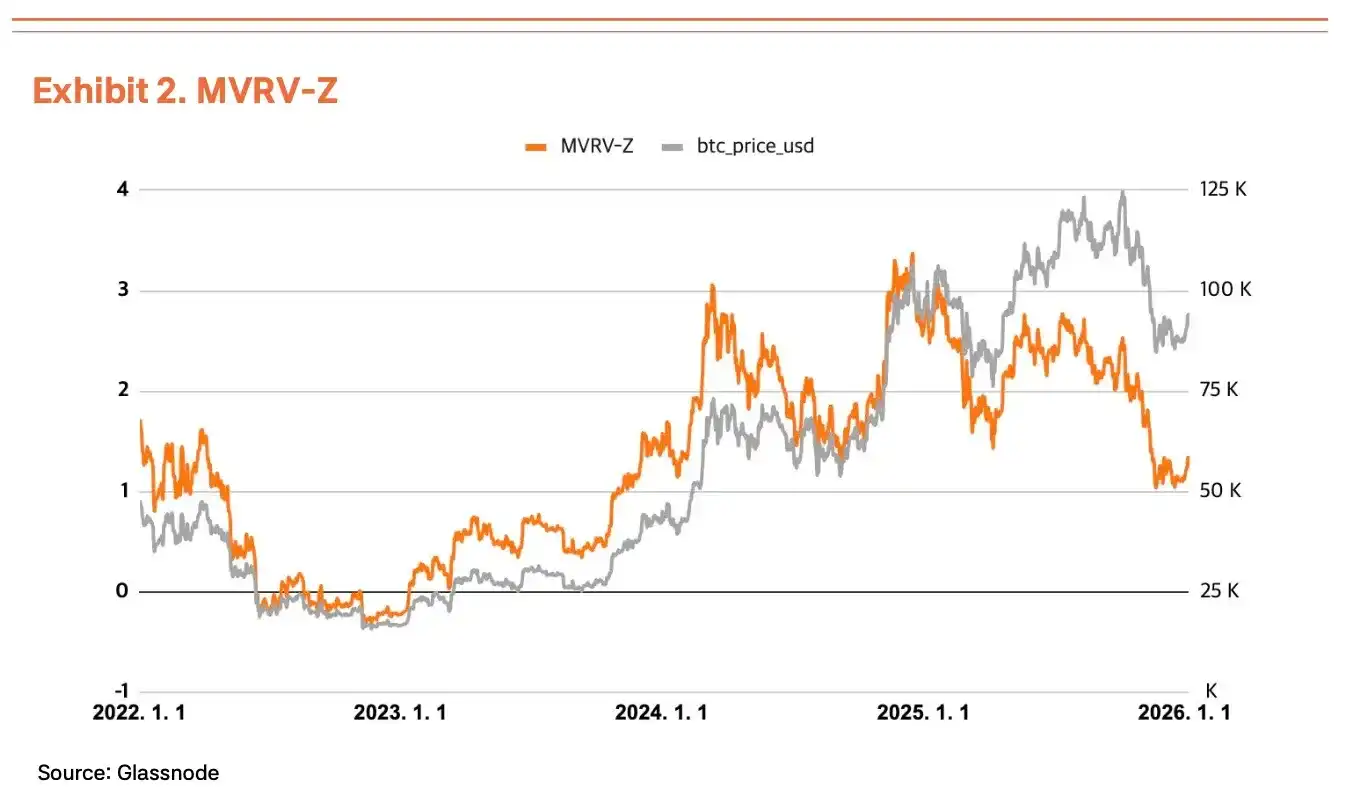
On-chain data shows market sentiment shifting from short-term panic to neutral. Key indicators like MVRV-Z (1.25), NUPL (0.39), and aSOPR (1.00) have moved out of the undervalued zone into an equilibrium range. This means the possibility of a panic-driven explosive rally is reduced, but the market structure remains healthy. Combined with the macro and regulatory backdrop, the statistical basis for medium to long-term price appreciation remains solid.

Notably, the current market structure is significantly different from previous cycles. The increased proportion of institutional and long-term capital reduces the probability of retail-driven panic sell-offs. Recent pullbacks have manifested more as gradual rebalancing. While short-term volatility is inevitable, the overall upward structure remains intact.

Target Price Adjusted to $185,500, Bullish Outlook Firm

Applying the TVM valuation framework, we derive a neutral baseline valuation of $145,000 for Q1 2026 (slightly below the previous report's $154,000). Combining a 0% fundamental adjustment and a +25% macro adjustment, we set the revised target price at $185,500.

We have adjusted the fundamental factor from -2% to 0%. Although network activity shows little change, renewed market focus on the BTCFi ecosystem has effectively offset some bearish signals. Concurrently, due to the aforementioned slowdown in institutional inflows and geopolitical factors, we have lowered the macro adjustment factor from +35% to +25%.

This target price reduction should not be interpreted as a bearish signal. Even after the adjustment, the model still shows approximately 100% potential upside. The lower baseline price primarily reflects recent volatility, while Bitcoin's intrinsic value will continue to appreciate over the medium to long term. We view the recent pullback as a healthy rebalancing process, and the medium to long-term bullish outlook remains unchanged.

Original Link

Related Questions

QWhat is the target price for Bitcoin set by Tiger Research for Q1 2026, and what is the expected upside from the current price?

AThe target price is $185,500, representing an expected upside of approximately 100% from the current price.

QWhat are the two key price levels identified by on-chain metrics that are currently acting as major support and resistance?

AOn-chain metrics identify $84,000 as a key support level and $98,000 as a major resistance level.

QWhat recent legislative development is cited as a potential catalyst for bringing large traditional financial institutions into the Bitcoin market?

AThe CLARITY Act, which clarifies regulatory boundaries between the SEC and CFTC and allows banks to offer digital asset custody and staking services, is cited as a key potential catalyst.

QHow did the report adjust its macro adjustment factor, and what was the primary reason for this change?

AThe report adjusted its macro factor down from +35% to +25%, primarily due to slowing institutional inflows, uncertainty around the Federal Reserve leadership change, and rising geopolitical risks.

QDespite recent outflows, which type of entities are cited as continuing to accumulate Bitcoin?

ADespite recent ETF outflows, corporations like MicroStrategy, Metaplanet, and Mara are cited as continuing their accumulation of Bitcoin.

Related Reads

Has the 'Digital Gold' Narrative for BTC Failed?

**Title: Has the "Digital Gold" Narrative for Bitcoin Failed?** The article argues that Bitcoin's "digital gold" narrative remains valid despite a recent sharp price decline (from a peak near $126k in Oct 2025 to briefly under $61k in Feb 2026). It presents a long-term investment framework based on three core points: **1. Viewing Bitcoin as an Asset:** Bitcoin is presented as a superior potential store of value compared to gold. Key arguments are its absolute scarcity (21 million cap), superior portability, and transparent auditability via its public ledger. While acknowledging its current use in early, volatile stages (~3-4% global adoption), the author draws parallels to the early, disruptive phases of the internet and e-commerce. **2. Understanding the Recent Downturn:** The current ~50% correction is framed as a predictable, consensus-driven cycle following its post-halving peak (the 2024 halving preceded the Oct 2025 high). A crucial factor is a historic "changing of hands": the influx of new institutional buyers via ETFs allowed early, low-cost holders (miners, OG believers) to take profits. The author notes that while severe, Bitcoin's historical drawdowns (e.g., 93% in 2011, 77% in 2021-22) have been progressively smaller, suggesting maturing holder structure and decreasing volatility over time. **3. The Long-Term Perspective:** The long-term thesis hinges on Bitcoin capturing a portion of gold's market value. With Bitcoin's market cap at ~$1.4 trillion (at $70k) versus gold's ~$20 trillion, significant upside potential exists if the "digital gold" narrative is partially realized. However, the author strongly cautions that short-term risks remain, the bottom is unpredictable, and high volatility is inherent. The real risk is not Bitcoin failing but poor personal position management (over-leverage, wrong capital) and a lack of deep understanding, which can force investors out during severe downturns. The conclusion uses Amazon's 95% crash post-2000 dot-com bubble and subsequent 42x recovery as an analogy. The ultimate question is not if Bitcoin's price will rise, but if an investor's strategy and conviction can withstand the volatility to see the long-term play out. The recent divergence (gold up, Bitcoin down) is posed not as a narrative failure, but as potential evidence of this ongoing, painful transition from a speculative asset to a mainstream allocation.

marsbit9h ago

Has the 'Digital Gold' Narrative for BTC Failed?

marsbit9h ago

Has BTC's 'Digital Gold' Narrative Failed?

The article discusses Bitcoin's "digital gold" narrative, its recent price drop, and long-term outlook through the perspective of "Jason". It argues the narrative is not a failure but that Bitcoin represents a superior, new asset class due to its fixed supply (21 million), portability, and auditability. The piece compares its current ~3-4% global adoption rate to early internet/e-commerce, suggesting significant growth potential. Regarding the 2025-2026 price decline (from ~$126k to briefly under $61k), the author views it as a predictable, consensus-driven sell-off within Bitcoin's ~4-year cycle post-halving, exacerbated by a major "handover" from early, low-cost holders to new institutional buyers via ETFs. A key observation is that historical peak-to-trough drawdowns have lessened over time (e.g., 93% in 2011 to ~50% in 2026), indicating maturing volatility as holder structure changes. For the long term, the author uses a simple framework: Bitcoin's total market cap (~$1.4T at $70k) is only about 7% of gold's (~$20T). Even capturing 30-50% of gold's value would imply substantial upside. However, the article strongly cautions against viewing this as investment advice, emphasizing extreme volatility and the critical importance of risk management, position sizing, and deep fundamental understanding to survive severe drawdowns. It concludes by drawing a parallel to Amazon's 95% crash in 2000 and subsequent 42x recovery, stressing that the key is surviving market cycles to realize long-term potential.

链捕手10h ago

Has BTC's 'Digital Gold' Narrative Failed?

链捕手10h ago

From Code to Cognition: A Ten-Thousand-Word Guide to the Evolution of the Robot Brain

"From Code to Cognition: The Evolution of Robot Brains" The journey of robotic intelligence has shifted dramatically from manually coded systems to AI-driven brains. For decades, robots relied on layered software stacks—perception, state estimation, planning, control—each handcrafted. While predictable, they lacked adaptability. The 2010s saw deep learning revolutionize perception (e.g., object detection) and control (via reinforcement learning), but learned skills remained narrow. The arrival of Large Language Models (LLMs) marked a turning point. LLMs acted as high-level planners, interpreting natural language instructions and generating sequences of actions for traditional robotic systems to execute. However, true integration came with Visual-Language-Action (VLA) models, which fused vision, language, and motion prediction into a single network. Pioneered by models like RT-2 and open-source projects like OpenVLA, VLAs enable robots to reason and act directly from visual input and commands. The most advanced humanoid robots now employ a "dual-brain" architecture: a slow-thinking, large VLA (System 2) for reasoning and planning, and a fast-reacting, small network (System 1) for high-frequency motion control, sometimes with an even lower-level System 0 for balance. This split balances cognition with the physics of real-time movement. Computation is split between onboard hardware (e.g., NVIDIA Jetson) for safety-critical control loops and cloud/edge servers for non-critical tasks like learning and interfaces. A crucial driver is the open-source ecosystem—models like GR00T and OpenVLA allow startups to build upon pre-trained brains and fine-tune them with their own data, accelerating development. Despite progress, current systems struggle with recovery from errors, sample inefficiency, and long-horizon tasks. This has spurred the rise of **World Models**—neural networks that predict the consequences of actions. By simulating possible futures before acting (like NVIDIA Cosmos or Meta V-JEPA), robots can plan, recover, and generalize better. This represents the next frontier: shifting intelligence from learned reactions to an internal model of physics and cause-and-effect. The field is rapidly evolving. While not yet at its "ChatGPT moment," the convergence of cheaper hardware, scalable simulation, and world models points toward robots that are increasingly capable, adaptive, and useful. The question is shifting from "what can robots do?" to "what *should* they do?"

marsbit10h ago

From Code to Cognition: A Ten-Thousand-Word Guide to the Evolution of the Robot Brain

marsbit10h ago

Trading

Spot
Futures
活动图片





