Tiger Research: How Is This Crypto Winter Different?

marsbitPublished on 2026-02-04Last updated on 2026-02-04

Abstract

Tiger Research analyzes the distinct nature of the current crypto market downturn, arguing it differs fundamentally from past "crypto winters." Previous cycles were triggered by internal industry crises—the Mt. Gox hack, ICO scams, and the FTX collapse—which shattered trust and drove talent away. In contrast, the recent market movement is driven by external factors: the approval of Bitcoin ETFs fueled the bull run, while tariff policies and interest rate shifts caused the decline. Post-regulation, the market has fragmented into three layers: a compliant zone (e.g., tokenized RWA, regulated exchanges), a non-compliant zone (speculative, experimental apps), and shared infrastructure (e.g., stablecoins, oracles). Capital no longer flows between these layers as before; ETF inflows remain largely confined to Bitcoin within the compliant zone and do not trickle down to altcoins. For the next bull market to emerge, two conditions are necessary: a new killer application must originate from the non-compliant zone (similar to how DeFi summer began), and the macro environment must become supportive (e.g., with lower interest rates). The era of a unified "crypto season" where all assets rally together is likely over due to this market segmentation.

Author: Ryan Yoon

Compiled by: Deep Tide TechFlow

Deep Tide Introduction: As the market enters a downward cycle, skepticism towards the crypto market is growing. Tiger Research believes this time is different from the past: previous winters were triggered by internal issues (Mt. Gox hack, ICO scams, FTX collapse), while this cycle's rise and fall are both driven by external factors (ETF approval brought the bull market, tariff policies and interest rates caused the decline).

Post-regulation, the market has split into three layers: the compliant zone, the non-compliant zone, and shared infrastructure. Capital no longer flows via 'trickle-down' effects as it did before. ETF capital stays with Bitcoin and does not flow into altcoins.

The next bull run requires two conditions: a killer app must emerge from the non-compliant zone + a supportive macro environment.

Full text below:

As the market enters a downward cycle, skepticism towards the crypto market is growing. The question now is, have we entered a crypto winter?

Core View

  • Crypto winters follow a sequence: Major event → Collapse of trust → Talent drain
  • Past winters were caused by internal problems; the current rise and fall are driven by external factors; it is neither winter nor spring
  • Post-regulation, the market has split into three layers: Compliant zone, Non-compliant zone, Shared infrastructure; The trickle-down effect has disappeared
  • ETF capital stays with Bitcoin; it does not flow out of the compliant zone
  • The next bull run requires a killer use case + a supportive macro environment

1. How did the previous crypto winters unfold?
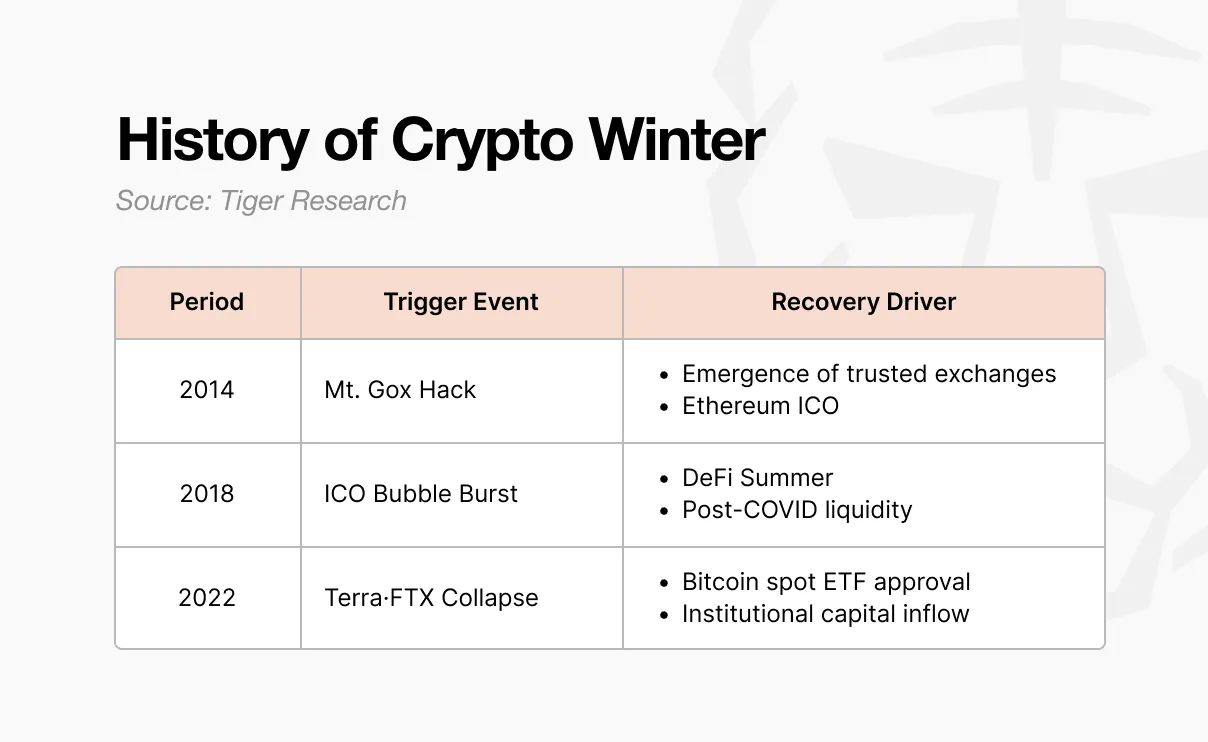
The first winter occurred in 2014. Mt. Gox was the exchange handling 70% of global Bitcoin trading volume at the time. Approximately 850,000 BTC disappeared in a hack, causing a collapse in market trust. New exchanges with internal controls and audit functions emerged, and trust began to recover. Ethereum also entered the world through ICOs, opening up new possibilities for vision and fundraising methods.

This ICO wave became the catalyst for the next bull market. When anyone could issue a token and raise funds, the 2017 boom was ignited. Projects raising billions with just a whitepaper flooded in, but most had no substance.

In 2018, regulatory measures poured out from South Korea, China, and the US, the bubble burst, and the second winter arrived. This winter did not end until 2020. Post-COVID, liquidity poured in, and DeFi protocols like Uniswap, Compound, and Aave gained attention, bringing capital back.

The third winter was the most severe. When Terra-Luna collapsed in 2022, Celsius, Three Arrows Capital, and FTX collapsed in turn. This wasn't just a simple price drop; the very structure of the industry was shaken. In January 2024, the US SEC approved the spot Bitcoin ETF, followed by the Bitcoin halving and Trump's pro-crypto policies, and capital began to flow in again.

2. The Crypto Winter Pattern: Major Event → Collapse of Trust → Talent Drain

All three winters followed the same sequence. A major event occurs, trust collapses, talent leaves.

It always starts with a major event. The Mt. Gox hack, ICO regulation, and the FTX bankruptcy following the Terra-Luna collapse. The scale and form of each event were different, but the result was the same. The entire market was thrown into shock.

Shock quickly spread into a collapse of trust. Those who had been discussing what to build next began to question whether cryptocurrency was truly meaningful technology. The collaborative atmosphere among builders disappeared, and they began to blame each other for who was responsible.

Doubt led to a talent drain. The builders who had been creating new momentum in blockchain fell into doubt. In 2014, they moved to fintech and big tech companies. In 2018, they moved to institutions and AI. They went to places that seemed more certain.

3. Is the current situation a crypto winter?

The pattern of past crypto winters is visible today.

  • Major Event:
  • Trump's tariff policies caused market turbulence
  • Shift in Federal Reserve interest rate policy
  • Overall crypto market decline
  • Collapse of Trust: Skepticism is spreading within the industry. The focus has shifted from what to build next to mutual blame.
  • Pressure of Talent Drain: The AI industry is growing rapidly. It promises faster exits and greater wealth than crypto.

However, it's hard to call this a crypto winter. Past winters erupted from within the industry. Mt. Gox was hacked, most ICO projects were exposed as scams, FTX collapsed. The industry itself lost trust.

Now it's different.

ETF approval started the bull market, tariff policies and interest rates drove the decline. External factors lifted the market, external factors also pushed it down.
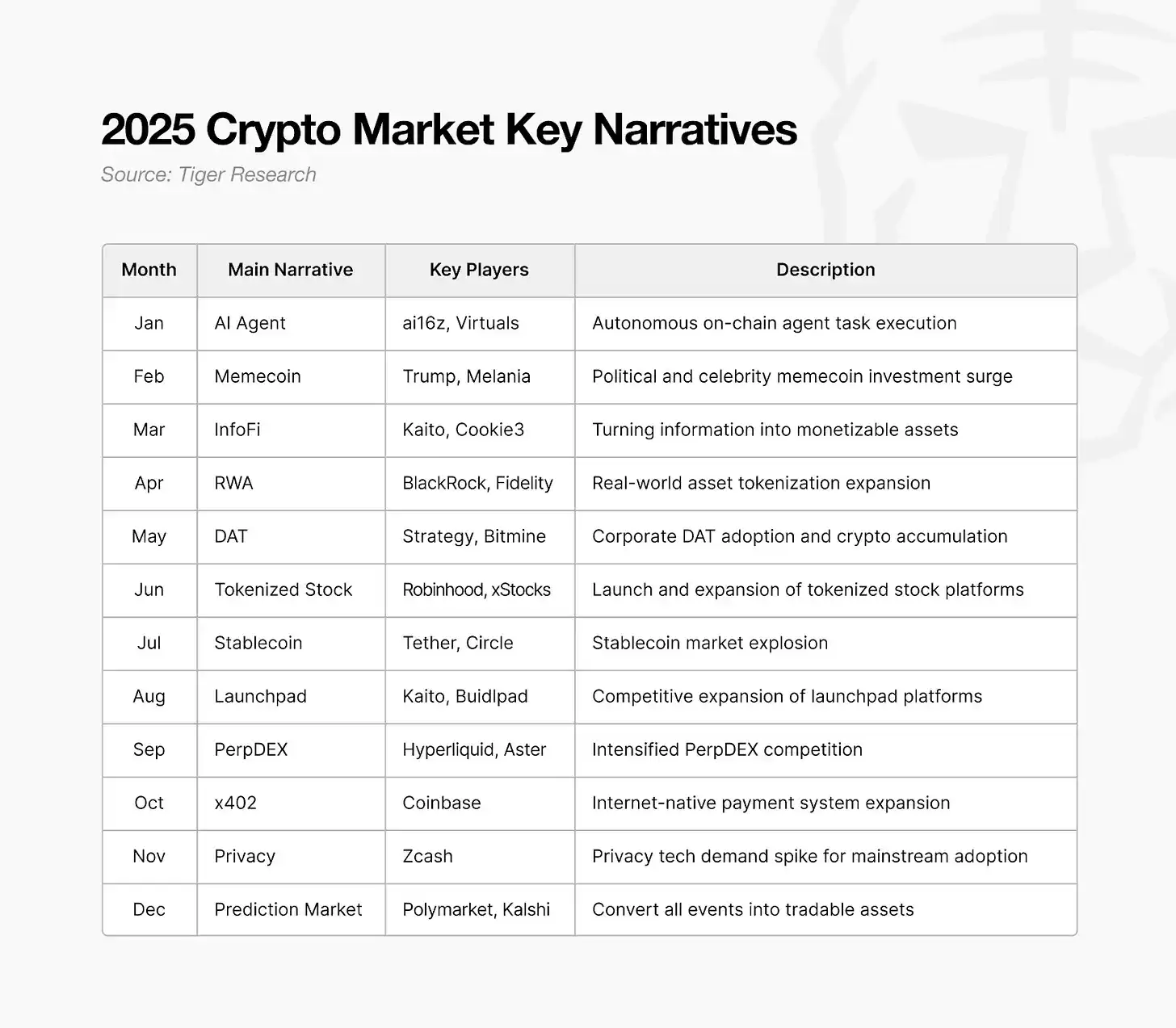
Builders are not leaving either.

RWA, perpDEX (perpetual decentralized exchanges), prediction markets, InfoFi, privacy. New narratives keep emerging, they are still being created. They haven't pulled the entire market like DeFi did, but they haven't disappeared either. The industry hasn't collapsed; the external environment has changed.

We didn't create spring, so there is no winter.

4. Changes in Market Structure Post-Regulation

Behind this is a major shift in market structure post-regulation. The market has split into three layers: 1) The Compliant Zone, 2) The Non-Compliant Zone, and 3) Shared Infrastructure.
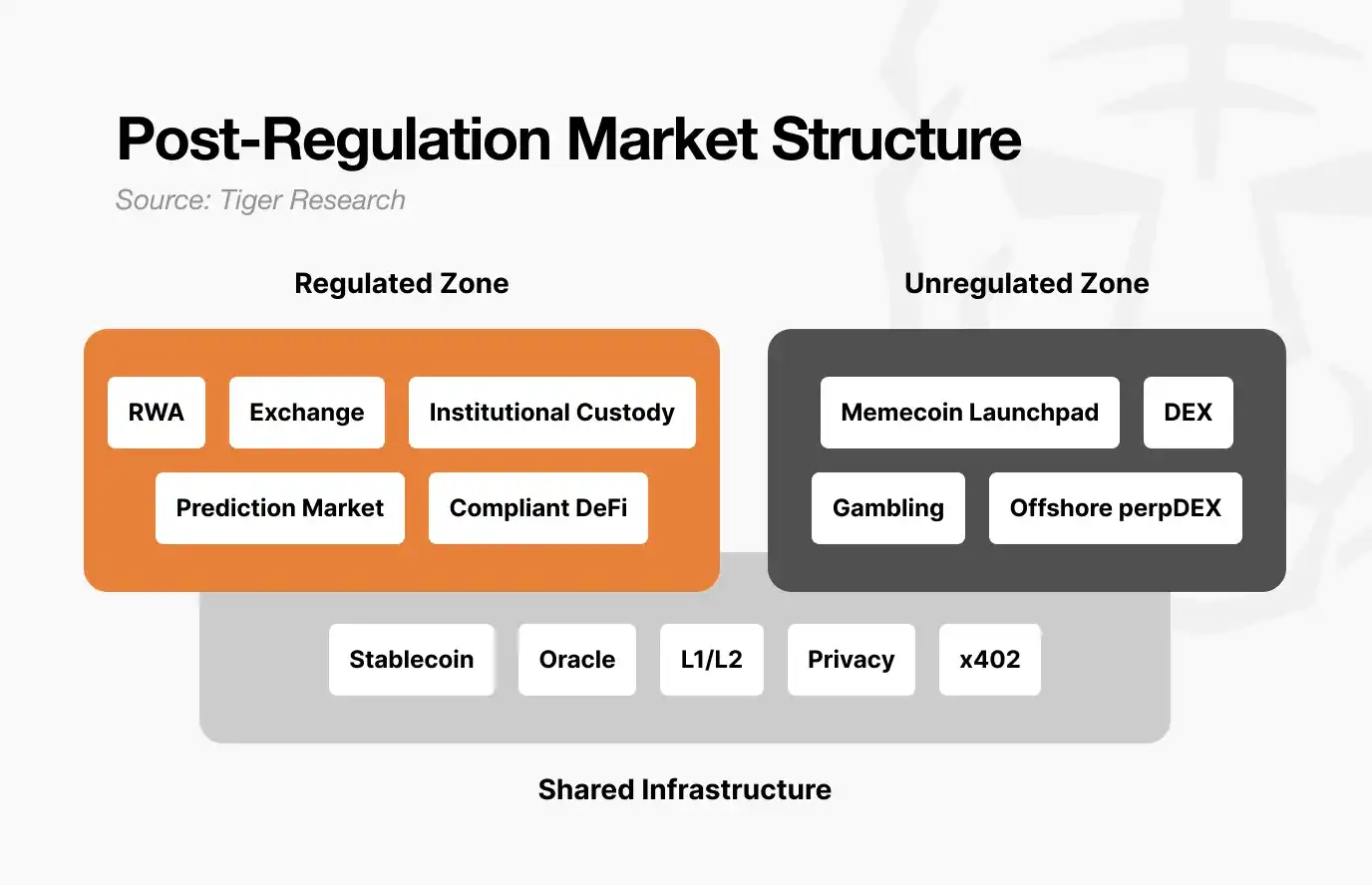
The Compliant Zone includes RWA tokenization, exchanges, institutional custody, prediction markets, and compliance-based DeFi. They undergo audits, make disclosures, and have legal protection. Growth is slow, but the capital scale is large and stable.

However, once in the compliant zone, it's hard to expect explosive returns like in the past. Volatility is lower, and potential upside is limited. But downside risk is also limited.

On the other hand, the Non-Compliant Zone will become more speculative in the future. The barrier to entry is low, and speed is fast. Scenarios of 100x in one day and -90% the next will happen more frequently.

However, this space is not meaningless. Industries born in the non-compliant zone are creative, and once validated, they move into the compliant zone. DeFi did this, prediction markets are doing it now. It acts as an experimental field. But the non-compliant zone itself will become increasingly separated from compliant zone businesses.

Shared Infrastructure includes stablecoins and oracles. They are used in both the compliant and non-compliant zones. The same USDC is used for institutional RWA payments and for Pump.fun trading. Oracles provide data for tokenized treasury validation and for anonymous DEX liquidations.

In other words, as the market splits, capital flows have also changed.

In the past, when Bitcoin rose, altcoins rose too through a trickle-down effect. Now it's different. Institutional capital entering through ETFs stays with Bitcoin, full stop. Compliant zone capital does not flow into the non-compliant zone. Liquidity only stays where value has been proven. And even Bitcoin has not yet proven its value as a safe-haven asset relative to risk assets.

5. Conditions for the Next Bull Run

Regulation is being sorted out. Builders are still building. So two things remain.

First, a new killer use case must emerge from the non-compliant zone. Something that creates value that didn't exist before, like DeFi Summer in 2020. AI agents, InfoFi, and on-chain social are candidates, but they haven't reached the scale to drive the entire market yet. The process where experiments in the non-compliant zone are validated and move into the compliant zone must be recreated. DeFi did this, prediction markets are doing it now.

Second, the macroeconomic environment. Even if regulation is sorted out, builders are building, and infrastructure is accumulating, if the macroeconomic environment is not supportive, the upside is limited. The 2020 DeFi Summer erupted when liquidity was released post-COVID. The post-ETF approval rise in 2024 also coincided with expectations of rate cuts. No matter how the crypto industry performs, it cannot control interest rates and liquidity. For what the industry builds to gain traction, the macroeconomic environment must turn.

A 'crypto season' where everything rises together like in the past is unlikely to reappear. Because the market has split. The compliant zone grows steadily, the non-compliant zone experiences big rises and falls.

The next bull run will come. But it won't come for everyone.

Related Questions

QWhat is the main difference between the current crypto market downturn and previous crypto winters according to Tiger Research?

AThe current downturn is driven by external factors (tariff policies and interest rates), while previous crypto winters were caused by internal industry issues like the Mt. Gox hack, ICO scams, and the FTX collapse.

QHow has the market structure changed post-regulation as described in the article?

AThe market has split into three layers: the compliant zone (regulated entities), the non-compliant zone (speculative and experimental projects), and shared infrastructure (used by both, like stablecoins and oracles).

QWhy does ETF capital no longer flow into altcoins as it did in the past?

AETF capital remains within the compliant zone and stays primarily in Bitcoin, as institutional investors focus on proven value rather than speculative altcoins, breaking the previous 'trickle-down' effect.

QWhat two conditions are necessary for the next crypto bull run according to the article?

AA killer application must emerge from the non-compliant zone (similar to DeFi Summer in 2020), and the macroeconomic environment must become supportive (e.g., lower interest rates and increased liquidity).

QWhat pattern did all three previous crypto winters follow?

AThey followed a sequence: a major event (e.g., Mt. Gox hack, ICO regulatory crackdown, Terra-Luna collapse) leading to a loss of trust, which then caused talent to leave the industry for more stable sectors.

Related Reads

Within Strategy's Framework, STRC's Dividend Yield Remains at 12% as Share Price Stays Below Par Value

Michael Saylor, Executive Chairman of Strategy (MSTR), confirmed that the dividend rate for its STRC perpetual preferred shares will remain at 12.00% through August 2026. The rate has increased from 9% at its July 2025 launch to the current high via a "ratchet" mechanism, which permanently raises the rate by 0.5% whenever the share price falls below $95. This mechanism is intended to push the price back toward its $100 par value and support Strategy's "at-the-market" (ATM) program for issuing new shares to fund Bitcoin purchases. However, the mechanism has not worked as intended. STRC shares closed at $89.46 on July 31, remaining about 10-11% below par value despite the record-high dividend. Competition from rival Strive's higher-yielding SATA securities has pressured demand. The persistent discount has forced Strategy to suspend new STRC issuances via its ATM program, limiting this funding channel for Bitcoin acquisitions. STRC's struggles reflect Bitcoin's own volatility, as the preferred shares historically move in tandem. Analysts have warned the ratchet structure carries long-term, one-way risk. A law firm is investigating Strategy's ability to maintain dividend payments if Bitcoin's price stays low. Retail investors own roughly 83% of outstanding STRC shares, a group seen as prone to panic selling during downturns. In response, Strategy has established financial reserves, including a liquidity cushion covering about 26 months of dividend/interest obligations, and a $2 billion share buyback program alongside a Bitcoin monetization framework, though the company emphasized it is not obligated to sell any Bitcoin.

cryptonews.ru3m ago

Within Strategy's Framework, STRC's Dividend Yield Remains at 12% as Share Price Stays Below Par Value

cryptonews.ru3m ago

Analyst: Bitcoin's Price Will Drop to $60k in August, Then Rebound to $70k

Financial analyst Andrey Poroshin has provided a new forecast for Bitcoin's price dynamics in August. Poroshin, an analyst at the Bitbanker exchange, expects the cryptocurrency market to experience a downturn this month, with prices retesting the $60,000 level due to a lack of supportive macroeconomic catalysts. He noted that the recent US Federal Reserve decision to hold interest rates did not significantly impact the market, while inflation remains above the 2% target. Poroshin stated that Bitcoin is ending July under pressure from moderate volatility and a lack of new macroeconomic stimuli, leading to continued market caution. According to his base scenario, Bitcoin will drop to a range of $60,000 to $62,000 before recovering to $70,000. He pointed out that even $70,000 remains below the cost of mining in the US, which has prompted some miners to shift towards AI data center operations. Poroshin cited the winding down of BitMEX's operations as a potential catalyst for a price rebound, suggesting the exit of weaker players often coincides with market reversals and reduced short-term selling pressure. He believes Bitcoin is currently less susceptible to geopolitical shocks, such as the Iran-US conflict, and does not expect significant market changes in August related to the pending CLARITY Act. Looking ahead, Poroshin forecasts that September will bring more active price fluctuations driven by potential Fed rate decisions and possible discussions or approval of the CLARITY Act.

cryptonews.ru3m ago

Analyst: Bitcoin's Price Will Drop to $60k in August, Then Rebound to $70k

cryptonews.ru3m ago

In Jinjiang, Fujian, a Storage Super Unicorn Lies Quiet

In Fujian's Jinjiang, a city known for sportswear, lies a quiet semiconductor giant: Fujian Jinhua Integrated Circuit Co. (JHICC). Once a promising domestic DRAM manufacturer alongside Yangtze Memory and ChangXin Memory Technologies (CXMT), its journey was derailed in 2018 when the U.S. placed it on an Entity List and filed criminal charges for alleged trade secret theft. This halted production for years. A turning point came in February 2024 when a U.S. federal court found JHICC not guilty. However, it had lost crucial time. While CXMT soared to become a top-valued A-share company in 2024, JHICC, with an estimated valuation of 80 billion RMB, was just restarting. Its current output is primarily customized DDR4 chips, not the advanced DDR5/HBM demanded for AI, but it still benefits from the broader memory chip upcycle. JHICC's story is tied to Chen Zhengkun, a veteran engineer who left Micron to lead the venture. Founded in 2016 with state-backed funding, JHICC partnered with Taiwan's UMC to develop DRAM technology. Rapid progress was cut short by the U.S. actions, which Micron initiated, partly due to its heavy reliance on the Chinese market. Post-sanctions, Chen's team worked to rebuild the production line with reduced reliance on U.S. technology. According to its records, JHICC achieved small-scale production and revenue growth under immense pressure. It now focuses on the stable "niche" DRAM market (e.g., TVs, routers) with a monthly capacity of ~40,000 wafers, aiming for 60,000 by 2026. It holds over 1,000 patents but remains on the Entity List. For Jinjiang, investing in JHICC was a bold industrial leap. The local government provided unwavering financial and logistical support during the crisis, helping the company survive. JHICC has become the anchor for a growing local semiconductor cluster. Though its scale lags behind domestic peers, JHICC's persistence symbolizes a hard-won foothold in a global market long dominated by Samsung, SK Hynix, and Micron. Having missed one boom, it seeks a place in the new AI-driven memory supercycle.

marsbit2h ago

In Jinjiang, Fujian, a Storage Super Unicorn Lies Quiet

marsbit2h ago

Trading

Spot
活动图片





