Tiger Research: How Crypto Giants Are Betting on AI Agent Payment Infrastructure

marsbitPublished on 2026-02-22Last updated on 2026-02-22

Abstract

Tiger Research explores how major tech companies and crypto sector are building payment infrastructure for AI Agents to enable fully autonomous transactions. Key points: - Payments are transitioning from human-initiated to AI Agent-executed, requiring new infrastructure. - Big Tech (e.g., Google's AP2) builds controlled, approval-based systems using existing platforms, prioritizing consumer protection and convenience but limiting interoperability. - Crypto solutions (ERC-8004 for NFT-based identity and x402 for smart contract payments) enable trustless, decentralized agent-to-agent transactions using stablecoins, emphasizing user sovereignty and permissionless access. - Google’s model operates within a restricted partner ecosystem, while crypto aims for open, programmable microtransactions. - Future may involve interoperability between closed and open systems rather than a winner-takes-all outcome.

This report is written by Tiger Research. To achieve true autonomous automation, native payment capabilities are essential. The market has already begun to actively position itself for this shift.

Core Points

  • The payer is shifting from humans to AI Agents, making payment infrastructure a core requirement for achieving true autonomy.
  • Big Tech companies (including Google AP2 and OpenAI Delegated Payment) are designing approval-based automated payment systems on top of existing platform infrastructure.
  • Cryptocurrency utilizes NFT-based identity and smart contracts through standards like ERC-8004 and x402 to achieve a disintermediated payment model.
  • Big Tech prioritizes convenience and consumer protection, while cryptocurrency emphasizes user sovereignty and broader Agent-level execution capabilities.
  • The key future question is: Will payments be controlled by platforms or executed by open protocols?

1. Payments Are No Longer Exclusive to Humans
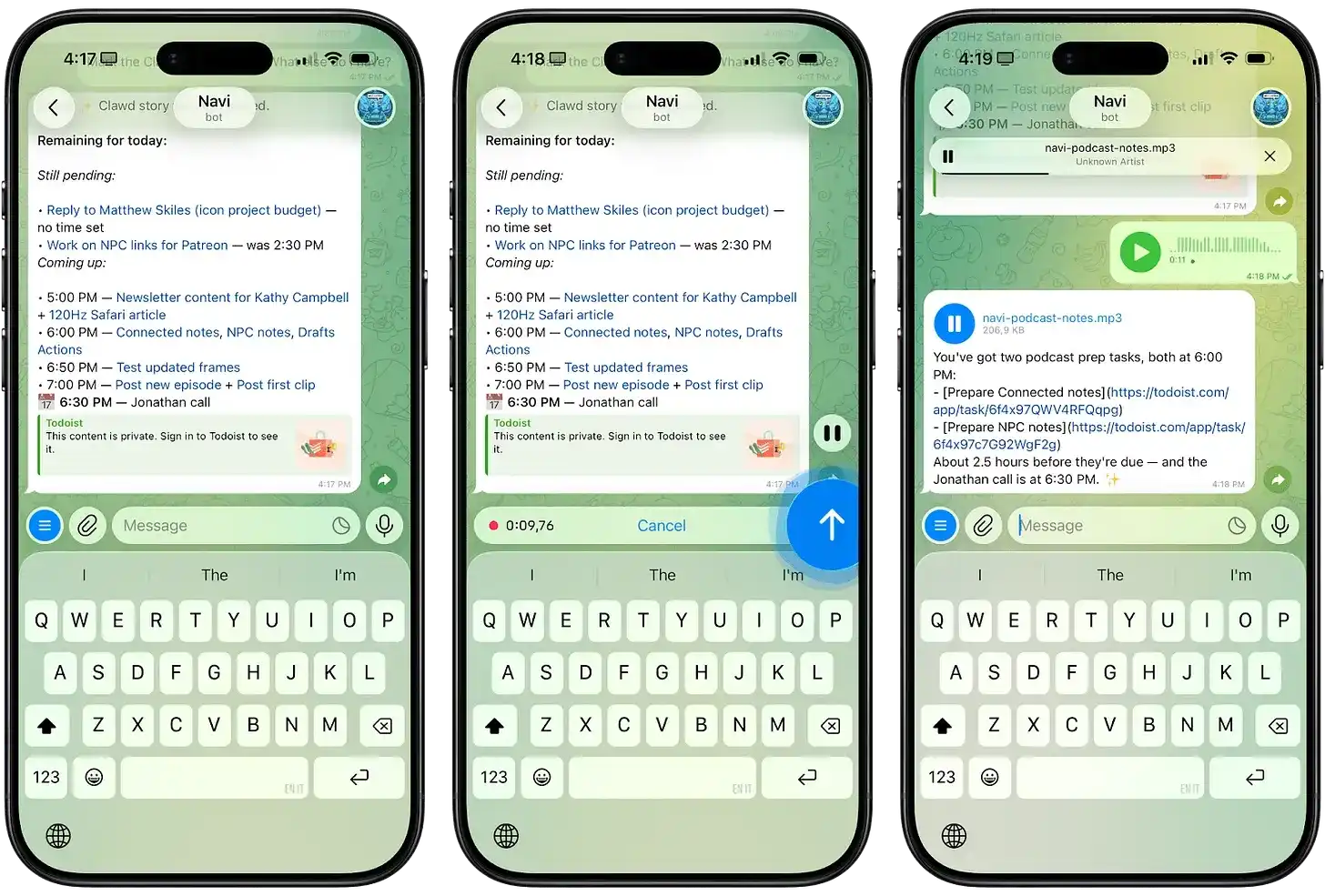
Source: macstories (Feder1C0 Viticci)

Recently, "OpenClaw" has garnered significant attention. Unlike AI systems like ChatGPT or Gemini, which primarily focus on retrieving and organizing information, OpenClaw allows AI Agents to execute tasks directly on the user's local PC or server.

Through instant messaging platforms like WhatsApp, Telegram, and Slack, users can issue commands, and the Agent then autonomously executes tasks, including email management, calendar coordination, and web browsing.

As it runs as open-source software and is not tied to a specific platform, OpenClaw functions more like a personal AI assistant. This architecture is favored for its flexibility and user-level control.

However, a critical limitation remains. For AI Agents to achieve full autonomy, they must be able to execute payments. Currently, Agents can search for products, compare options, and add items to a cart, but final payment authorization still requires human approval.

Historically, payment systems were designed around human actors. In an AI Agent-driven environment, this assumption no longer holds. If automation is to become fully autonomous, Agents must be able to independently evaluate, authorize, and complete transactions within defined constraints.

Anticipating this shift, both Big Tech companies and crypto-native projects have introduced technical frameworks over the past year aimed at enabling Agent-level payments.

2. Big Tech: Building Agent Payments on Existing Infrastructure

In January 2025, Google launched AP2 (Agent Payment Protocol 2.0), expanding its AI Agent payment infrastructure. While OpenAI and Amazon have also outlined related initiatives, Google is currently the only major company with a structured implementation framework.

AP2 divides the transaction process into three Mandate Layers. This structure allows for independent monitoring and auditing of each stage.

  • Intent Mandate: Records the action the user wants to perform.
  • Cart Mandate: Defines how a purchase should be executed under preset rules.
  • Payment Mandate: Executes the actual transfer of funds.
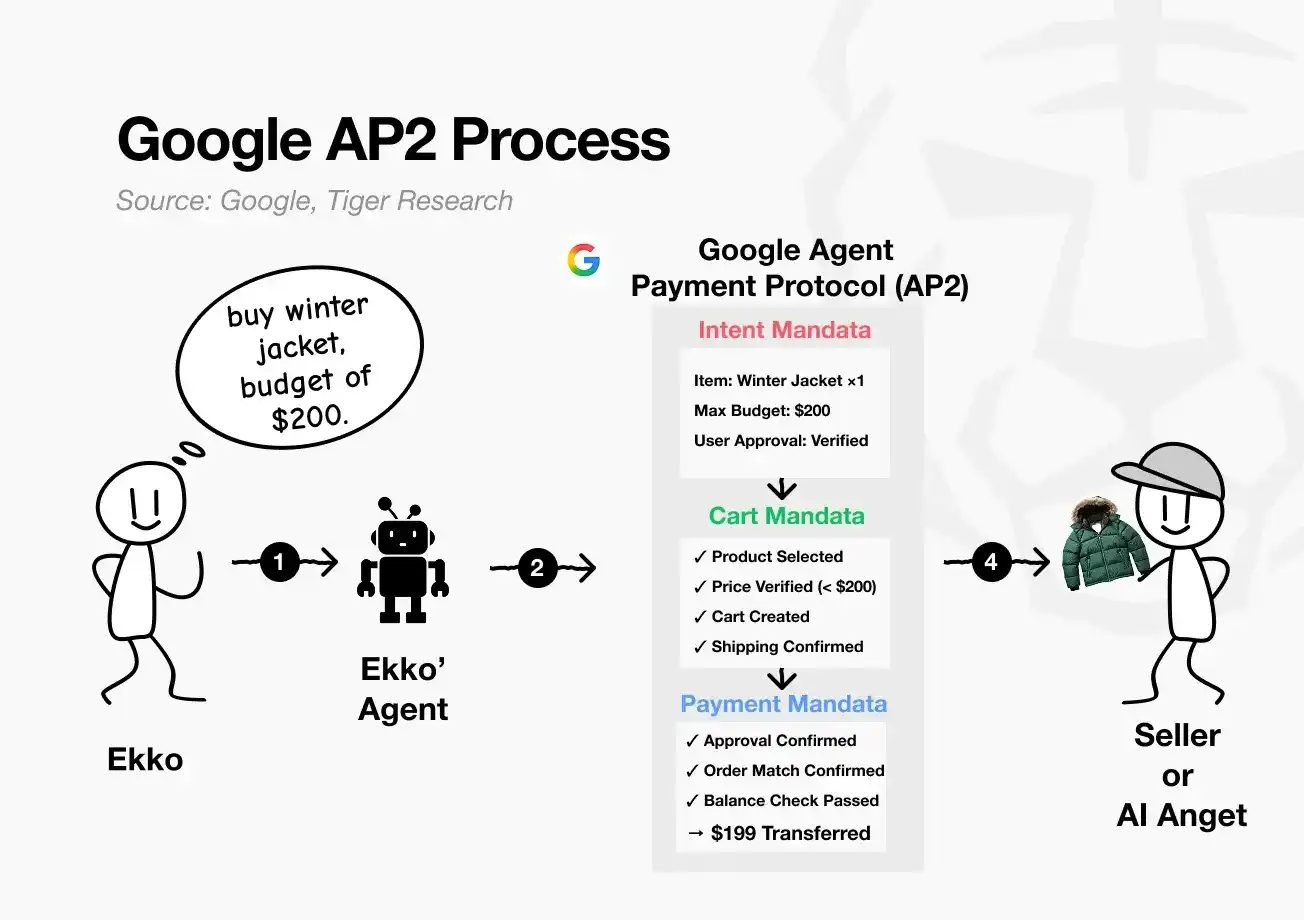
Example: Suppose Ekko asks an AI Agent on Google Shopping to "find and buy a winter jacket under $200".

  • Intent Mandate: Ekko instructs the AI Agent to buy "a winter jacket with a maximum budget of $200". This information is recorded on-chain as a digital contract, the Intent Mandate.
  • Cart Mandate: The AI Agent follows the intent, searches for matches among partner merchants, and adds eligible items to the cart. Verifies the price ($199, within budget ✓), confirms the shipping address.
  • Payment Mandate: Ekko reviews the selected item and clicks approve. The $199 is processed via Google Pay. Alternatively, the AI Agent can complete the payment automatically within preset parameters.

Throughout this process, the user does not need to input additional information. Google AP2 relies on existing user credentials (pre-registered cards and addresses), which lowers the barrier to entry and simplifies the adoption process.
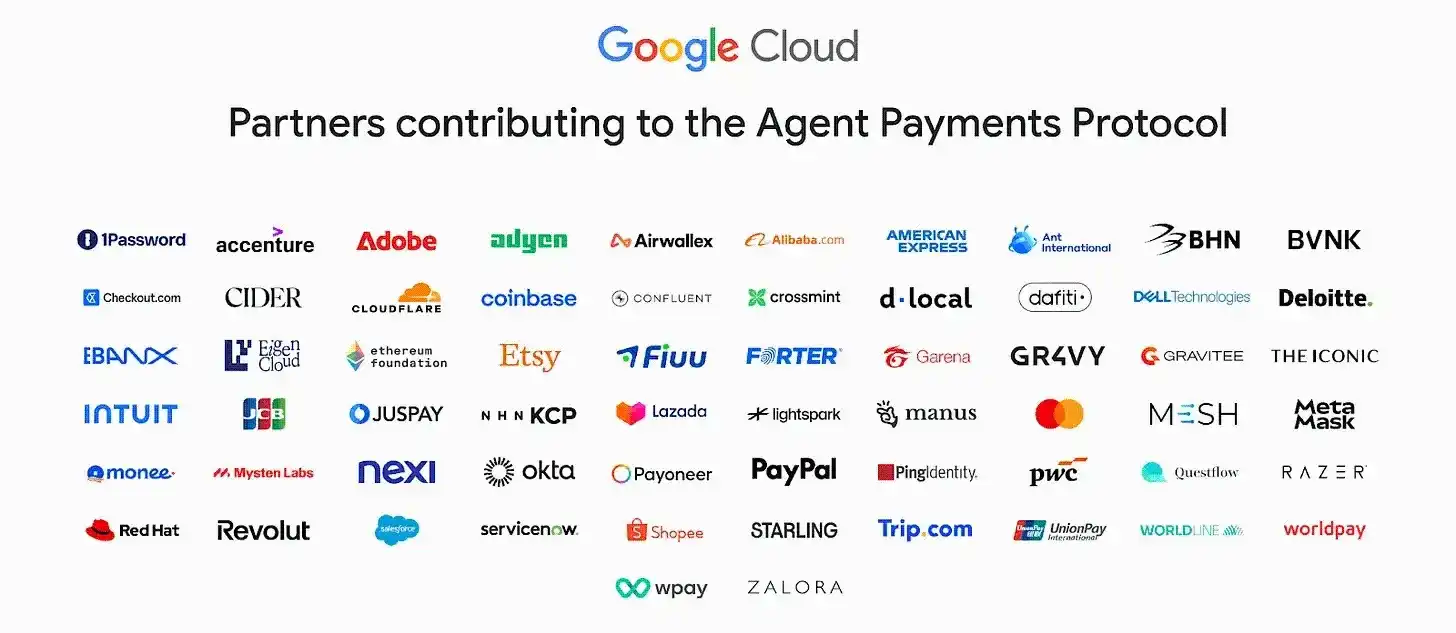
Source: Google

However, Google currently only supports Agent payments for companies within its partner network. Consequently, its usage is confined to a controlled ecosystem, limiting broader interoperability and open access.

3. Cryptocurrency: Self-Custody and Open Exchange

The crypto space is also developing payment infrastructure for AI Agents, but its approach differs significantly from Big Tech. Big platforms build trust within controlled ecosystems, while crypto starts from a different question: Can AI Agents be trusted without relying on centralized platforms?

Two core standards aim to address this goal: Ethereum's ERC-8004 and Coinbase's x402.
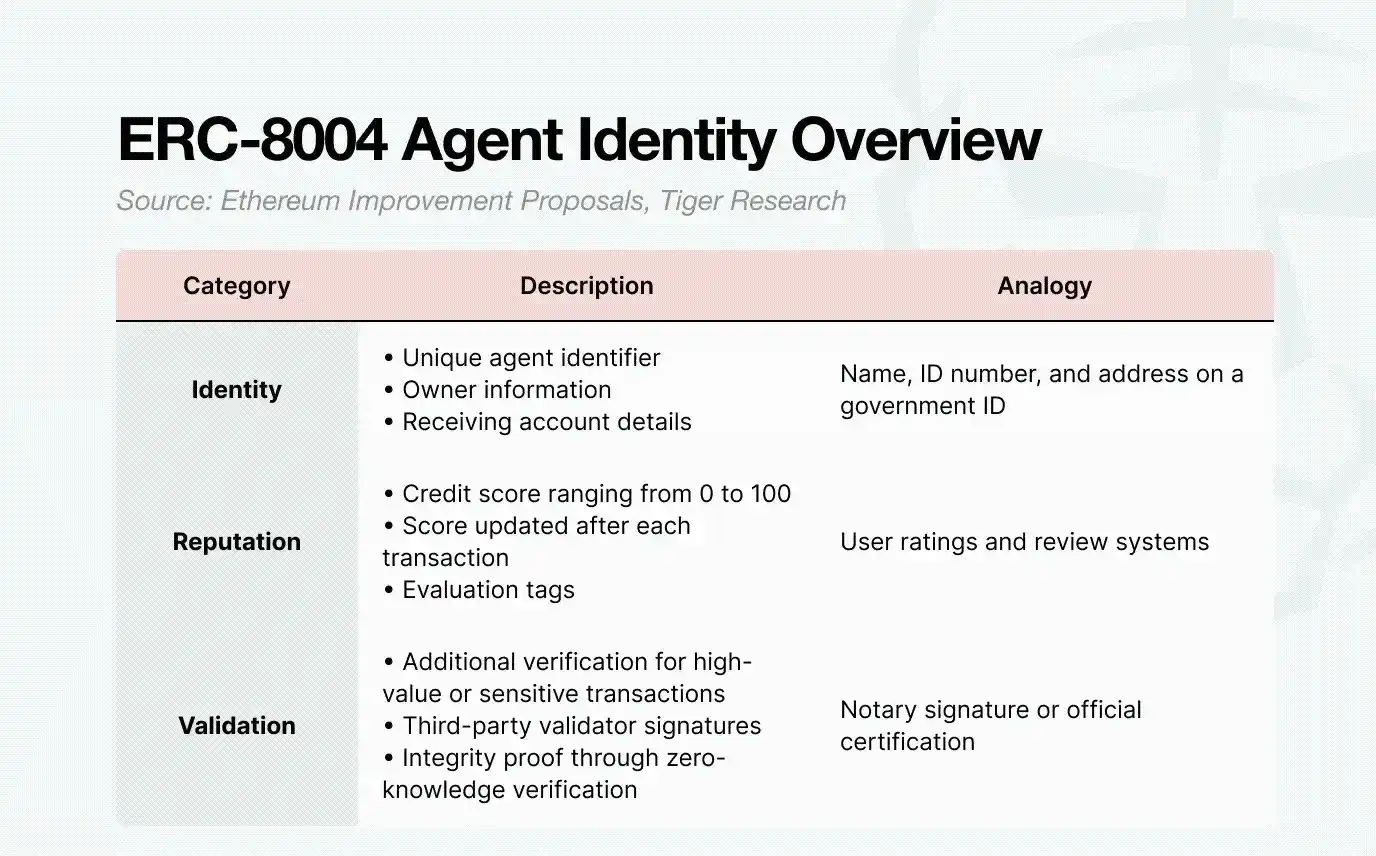
First is the identity layer. AI Agents operating on the blockchain must be identifiable. ERC-8004 serves this function. It is issued as an NFT, but not as an art collectible; rather, it is a credential NFT containing structured identity data. Each token consists of three parts:

  1. Identity
  2. Reputation
  3. Validation

These elements together form a verifiable on-chain identity certificate.

Regarding the payment mechanism, x402 acts as the payment pathway. Developed by Coinbase, x402 is a crypto-native payment standard for AI Agents. It enables Agents to conduct autonomous transactions using stablecoins. Its core feature is automated smart contract execution, where conditional logic is embedded directly into the code, and settlement occurs without human intervention once conditions are met.

When ERC-8004 (identity) is combined with x402 (payment), AI Agents can verify counterparties and execute transactions without relying on a centralized platform.
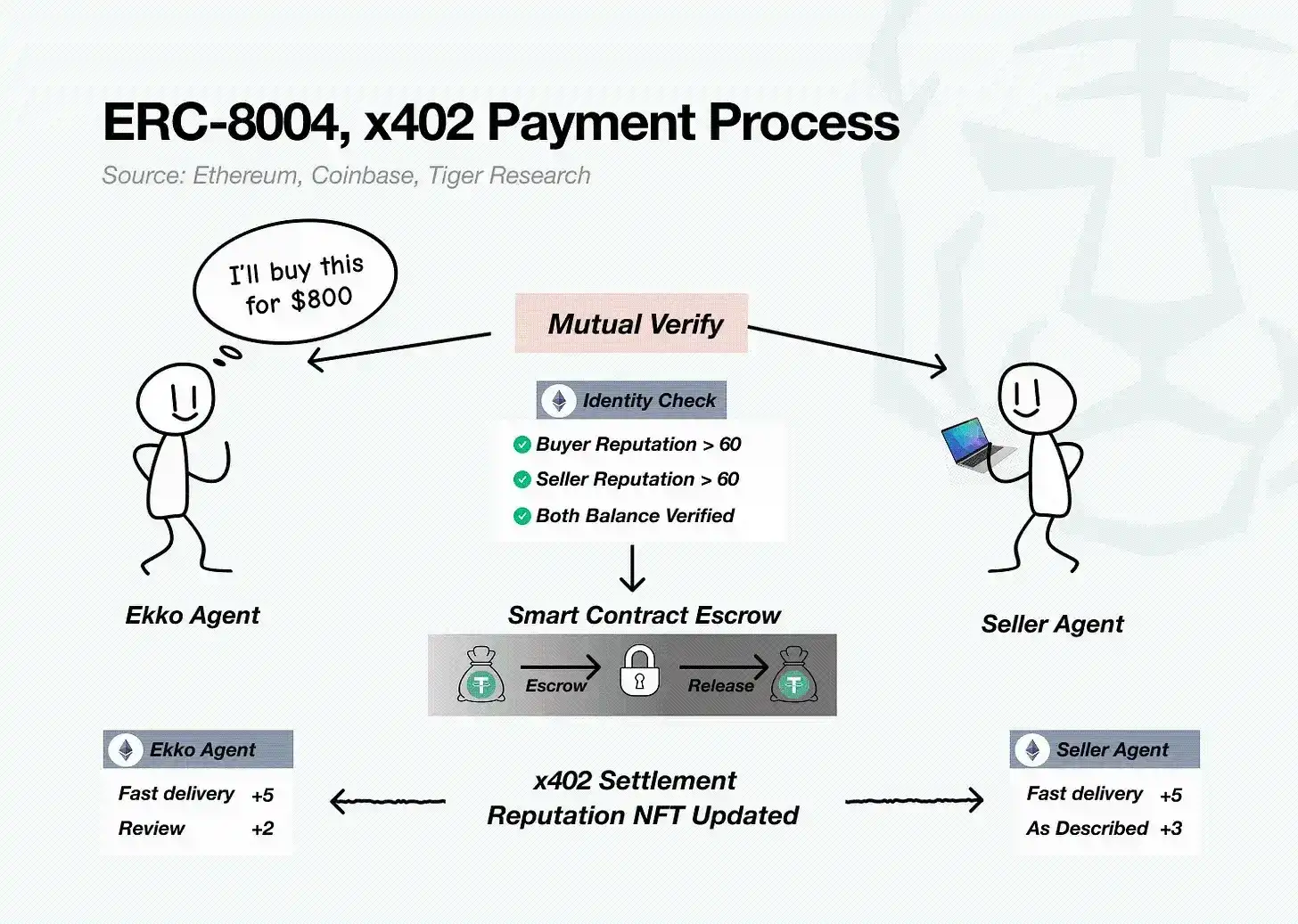
Example: Ekko instructs his Agent A to buy a used laptop with a maximum budget of $800. The seller's Agent B communicates directly with it.
  • Mutual Verification: Checks identity and reputation score via ERC-8004 NFT (e.g., Reputation 72, balance confirmed).
  • Smart Contract Escrow: $800 is transferred from the wallet into a smart contract escrow, locking the funds until delivery confirmation.
  • Settlement & Reputation Update: Upon transaction completion, x402 automatically settles, and the reputation records of both parties are automatically updated and written into their respective ERC-8004 NFTs.

Throughout this process, no intermediaries are involved. The two AI Agents transact directly through blockchain-based verification and settlement, embodying the crypto-native model of Agent-to-Agent (A2A) commerce.

4. Big Tech vs. Cryptocurrency: Differences in the AI Agent Operational Domain
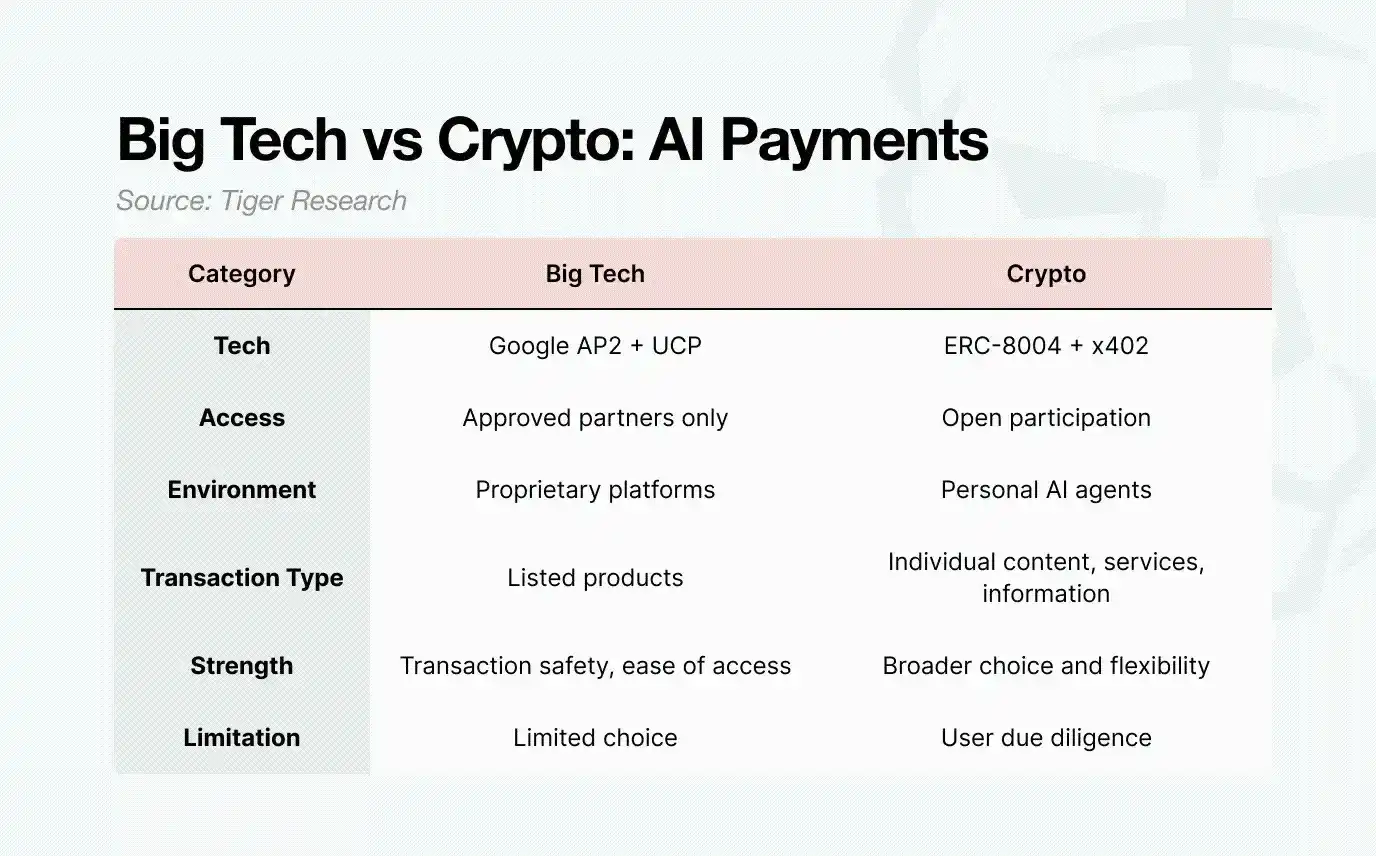
Google AP2 represents a controlled model designed for vetted partners. Google restricts market participants to protect consumers. Because AI Agent execution has probabilistic outcomes rather than being entirely deterministic, liability for transaction error may ultimately fall on the payment infrastructure provider. To reduce the probability of failure, Google has an incentive to narrow its ecosystem.

A restricted ecosystem increases stability but also limits the Agent's ability to operate autonomously and optimize choices across a broader market.

In contrast, ERC-8004 and x402 reflect a more open architecture. The crypto model is designed for permissionless access and interoperability.

While end-to-end execution is not yet perfect, the long-term vision is for Agents to independently manage daily consumption. Big platforms may attempt to integrate major retail channels, but open crypto standards have a structural advantage in handling small, high-frequency programmatic payments (micropayments). For example, if an Agent buys 1000 stock images at $0.01 each, the operational efficiency of the crypto-native path is higher.

Of course, the lack of a central authority involves trade-offs: identity evaluation standards must be established in a decentralized manner, and there is no single entity with ultimate responsibility for failures.

Summary

Both Big Tech and the crypto space are pursuing the same goal: enabling autonomous AI Agent commerce. The difference lies in the architecture: Big Tech favors closed, controlled systems, while crypto advances open, protocol-based models.

The future trend is more likely to be the interoperability of both approaches, rather than a zero-sum game.


Related Questions

QWhat is the key limitation preventing AI Agents from achieving full autonomy according to the article?

AThe key limitation is that AI Agents currently cannot execute payments independently; final payment authorization still requires human approval.

QHow does Google's AP2 (Agent Payment Protocol 2.0) structure the transaction process for AI Agent payments?

AGoogle's AP2 divides the transaction process into three mandate layers: Intent Mandate (recording the user's desired action), Cart Mandate (defining how the purchase should be executed under preset rules), and Payment Mandate (executing the actual transfer of funds).

QWhat are the two core standards in the cryptocurrency space for enabling AI Agent payments, and what are their respective roles?

AThe two core standards are ERC-8004, which provides a verifiable on-chain identity for AI Agents using NFT-based credentials, and x402, which serves as a payment standard allowing Agents to autonomously transact with stablecoins using smart contract execution.

QWhat is the primary difference in approach between big tech companies and the cryptocurrency sector regarding AI Agent payment infrastructure?

ABig tech companies prioritize controlled, closed ecosystems with consumer protection and convenience, while the cryptocurrency sector emphasizes user sovereignty, permissionless access, and open, interoperable protocols for broader Agent-level execution.

QHow do ERC-8004 and x402 work together to enable direct AI Agent-to-Agent (A2A) transactions without intermediaries?

AERC-8004 provides a verifiable on-chain identity and reputation for AI Agents, while x402 standard enables automated payment execution via smart contracts. Together, they allow Agents to mutually verify identities, lock funds in escrow, and autonomously settle transactions without relying on centralized platforms.

Related Reads

Will the Fed Definitely Raise Interest Rates in September? How Will Crypto and U.S. Stocks Withstand the Pressure?

The market's expectation for a September Fed rate hike surged dramatically in early August, jumping from under 50% to over 80% within a week. This shift followed a contentious July FOMC meeting, where a 9-3 vote to hold rates revealed growing dissent from hawkish members advocating for an immediate hike to combat persistent inflation. The primary catalyst for this repricing is rising oil prices, driven by renewed geopolitical tensions around the Strait of Hormuz, which threaten global supply. Energy costs directly influence inflation metrics, making the upcoming July CPI report (due August 12th) a critical data point. If it shows inflation reaccelerating, the probability of a September hike will solidify. For Bitcoin and crypto assets, this is typically bearish news. Bitcoin continues to behave as a high-beta, liquidity-sensitive risk asset. A rate hike raises the opportunity cost of holding non-yielding assets and could drive capital toward money markets, pressuring crypto prices in the short term. However, historical patterns suggest that if a hike is perceived as the end of a tightening cycle rather than the start, any negative price impact may be brief. U.S. stocks, particularly crypto-linked equities like Coinbase and growth-oriented tech stocks, are also vulnerable. Higher rates increase discount rates in valuation models, putting pressure on high-multiple companies. This coincides with a pivotal tech earnings season where investor focus has shifted from massive AI capital expenditure to tangible revenue and cash flow generation. Companies with negative cash flow and weak growth narratives could face heightened volatility if borrowing costs rise in September. In summary, a September Fed hike has evolved into a mainstream market scenario. Key factors to watch are oil prices, the July CPI report, and Fed communications, which will determine the final decision and its impact on volatile crypto and equity markets.

marsbit2m ago

Will the Fed Definitely Raise Interest Rates in September? How Will Crypto and U.S. Stocks Withstand the Pressure?

marsbit2m ago

A 'Overlooked' Market Event: Joint US-Japan-South Korea Intervention, Rare US Treasury Involvement, and Bessent's Quiet 'Market Rescue'?

Summary: The United States, Japan, and South Korea executed their largest coordinated foreign exchange intervention in nearly 30 years. The action targeted depreciation pressure on the Japanese yen and South Korean won. This move is seen as a significant effort by the US to stabilize the financial markets of its key allies and prevent the spillover of risks. Key details: * Japan reportedly intervened on July 30 using approximately 8.45 trillion yen (about $52.8 billion). South Korean authorities also intervened that day, selling dollars to support the won. * Notably, the US Treasury Department intervened directly in yen markets for the first time in roughly 30 years. The New York Fed, reportedly acting on behalf of the Treasury, sold euros to buy yen via Goldman Sachs and Morgan Stanley on July 31. Analysts view the use of the euro-yen pair as a way to alleviate yen pressure without adding selling pressure to the US dollar. * Prior to the action, the New York Fed conducted "rate checks" on both USD/JPY and EUR/JPY, a newer signaling tool that falls between verbal and physical intervention. The intervention is interpreted as going beyond traditional currency stabilization. Analysts, such as Michael Hartnett of Bank of America, suggest it resembles a "Price Keeping Operation" for the AI era. The core US objectives are perceived to be: 1. Preventing rapid yen depreciation from triggering a sharp rise in Japanese government bond yields. 2. Containing financial stress from spreading across Asian markets like South Korea and Japan. 3. Reducing the risk of disorderly capital flows impacting the US bond market. This coordinated action underscores the importance of Japan and South Korea as critical partners in the US semiconductor and AI supply chain. Stabilizing their financial markets is seen as vital to mitigating risks to the broader tech industry and the US market itself. The intervention coincides with market pressures, including the KOSDAQ index hitting a low since October 2022. While seen as a move to control volatility, some analysts caution it may not fundamentally reverse existing market trends.

marsbit6m ago

A 'Overlooked' Market Event: Joint US-Japan-South Korea Intervention, Rare US Treasury Involvement, and Bessent's Quiet 'Market Rescue'?

marsbit6m ago

Will the Federal Reserve Definitely Raise Interest Rates in September? How Will Cryptocurrencies and US Stocks Bear the Pressure?

In early August 2024, market expectations for a September Federal Reserve rate hike surged dramatically, from below 50% to over 80%, driven by renewed inflation concerns. This shift followed a contentious July FOMC meeting where a 9-3 vote to hold rates revealed a growing hawkish faction advocating for an immediate hike, citing prolonged above-target inflation. The key catalyst is escalating conflict near the Strait of Hormuz, which has pushed oil prices up approximately 20% in July, threatening to reignite inflation. The next critical data point is the July CPI report on August 12th; a hot reading could solidify hike expectations. For crypto assets, particularly Bitcoin, this represents near-term pressure. Bitcoin continues to exhibit high-beta, risk-on characteristics, making it sensitive to tightening liquidity and higher opportunity costs. However, historical precedent suggests that if a hike is perceived as the cycle's end rather than its start, the negative impact may be brief, with markets quickly pivoting to anticipate future rate cuts. U.S. stocks, especially crypto-linked equities like Coinbase and high-valuation tech stocks, face amplified volatility. Higher rates increase discount rates in valuation models, pressuring growth stocks. This coincides with a pivotal tech earnings season where investor focus has shifted from massive AI capital expenditures to demonstrable revenue and cash flow generation. Companies with negative cash flows and weak growth narratives could see severe pressure if a September hike materializes, as financing costs would rise. Key indicators to watch include oil prices, upcoming inflation data, and Fed commentary at events like the Jackson Hole symposium.

Odaily星球日报6m ago

Will the Federal Reserve Definitely Raise Interest Rates in September? How Will Cryptocurrencies and US Stocks Bear the Pressure?

Odaily星球日报6m ago

Trading

Spot
活动图片




