THIS is the stablecoin power angle that nobody is talking about

ambcryptoPublished on 2026-02-02Last updated on 2026-02-02

Abstract

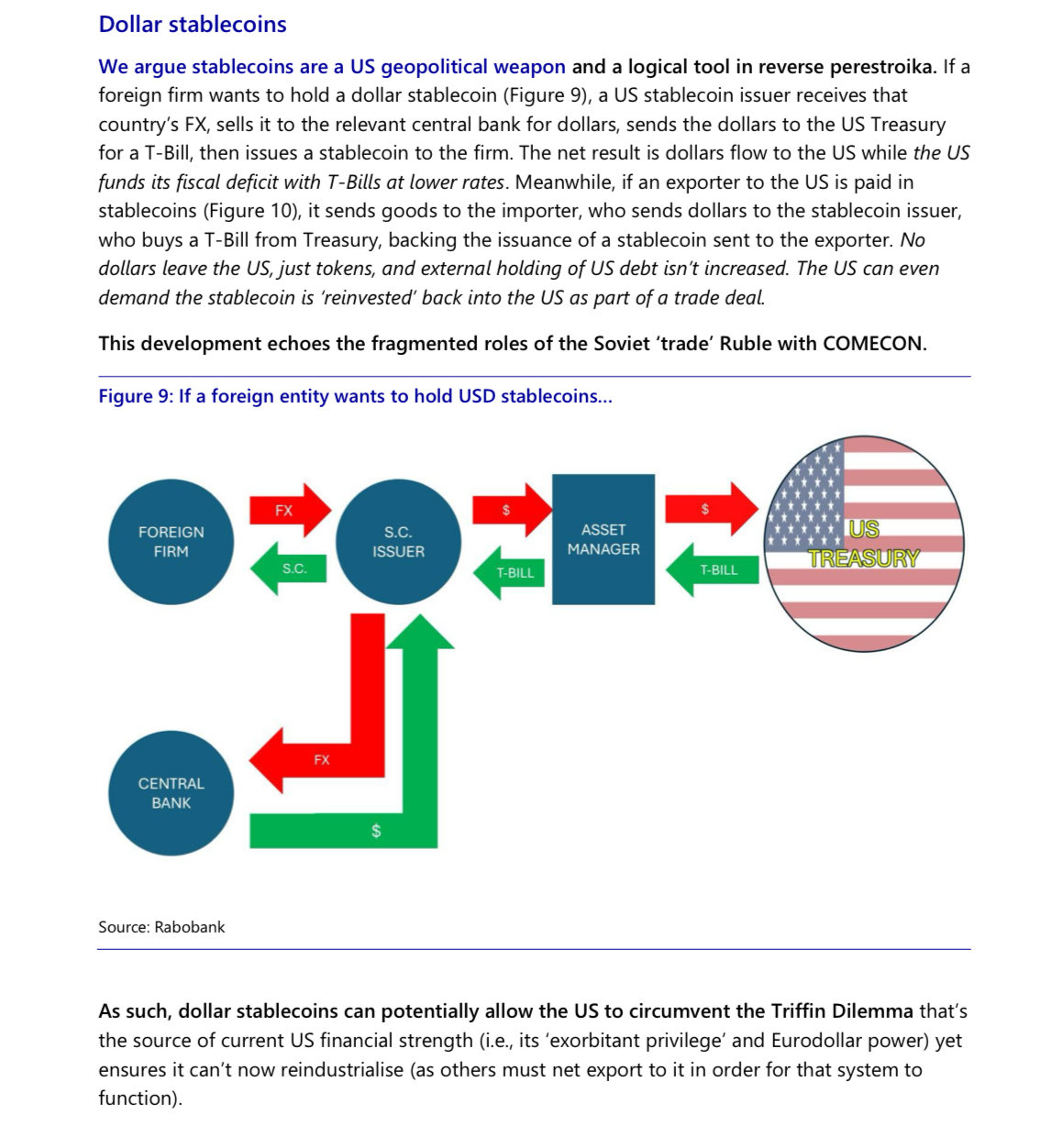
Dollar-backed stablecoins are increasingly serving as a tool for the U.S. to extend its monetary influence abroad without physically moving dollars overseas, according to a Rabobank report. When foreign entities demand dollar stablecoins, U.S. issuers convert this demand into Treasury bill purchases, helping fund U.S. deficits at lower rates while digital tokens circulate internationally. This mechanism allows dollars to remain within the U.S. financial system while still facilitating global trade. Non-USD stablecoins are also gaining traction, with their supply surging 260% over the past year to a combined market cap of $1.55 billion, though they remain small compared to dollar-pegged alternatives. A key application driving adoption is crypto-backed payment cards, which have grown into an $18 billion market. Monthly transaction volumes have increased from $100 million in early 2023 to over $1.5 billion, growing at an annual rate exceeding 100%. These cards operate on top of traditional networks like Visa and Mastercard, using stablecoins to settle transactions in the background while maintaining a familiar user experience. In summary, dollar-backed stablecoins are expanding U.S. monetary power digitally without exporting physical dollars, while crypto payment infrastructure accelerates their real-world use.

Dollar-backed stablecoins are now more than just a crypto payment tool. Recent reports say that they may also be helping the U.S. extend dollar influence abroad, in a way that keeps real capital at home.

Here’s what you need to know.

Stablecoins – A secret weapon?

A report by Rabobank has stated that dollar-backed stablecoins are spreading dollar influence, without letting real dollars leave the country.

Source: X

The idea is that when a foreign firm wants a dollar stablecoin, a U.S. issuer converts that demand into Treasury bill purchases. Dollars flow back to the U.S. government, helping fund deficits at lower rates, while the firm gets digital dollars instead of cash.

In trade, it goes a step further. U.S. importers can pay exporters in stablecoins, while the underlying dollars stay parked in Treasuries. Only tokens move across borders.

With comparisons to the Soviet-era trade ruble, dollars are exported digitally… all while keeping the power at home.

Non-dollar stablecoins step up

That growing influence hasn’t gone unnoticed, with non-USD-pegged alternatives gaining ground.

For long, more than 99% of stablecoins were pegged to the U.S. dollar. That number is now decreasing at the margins.

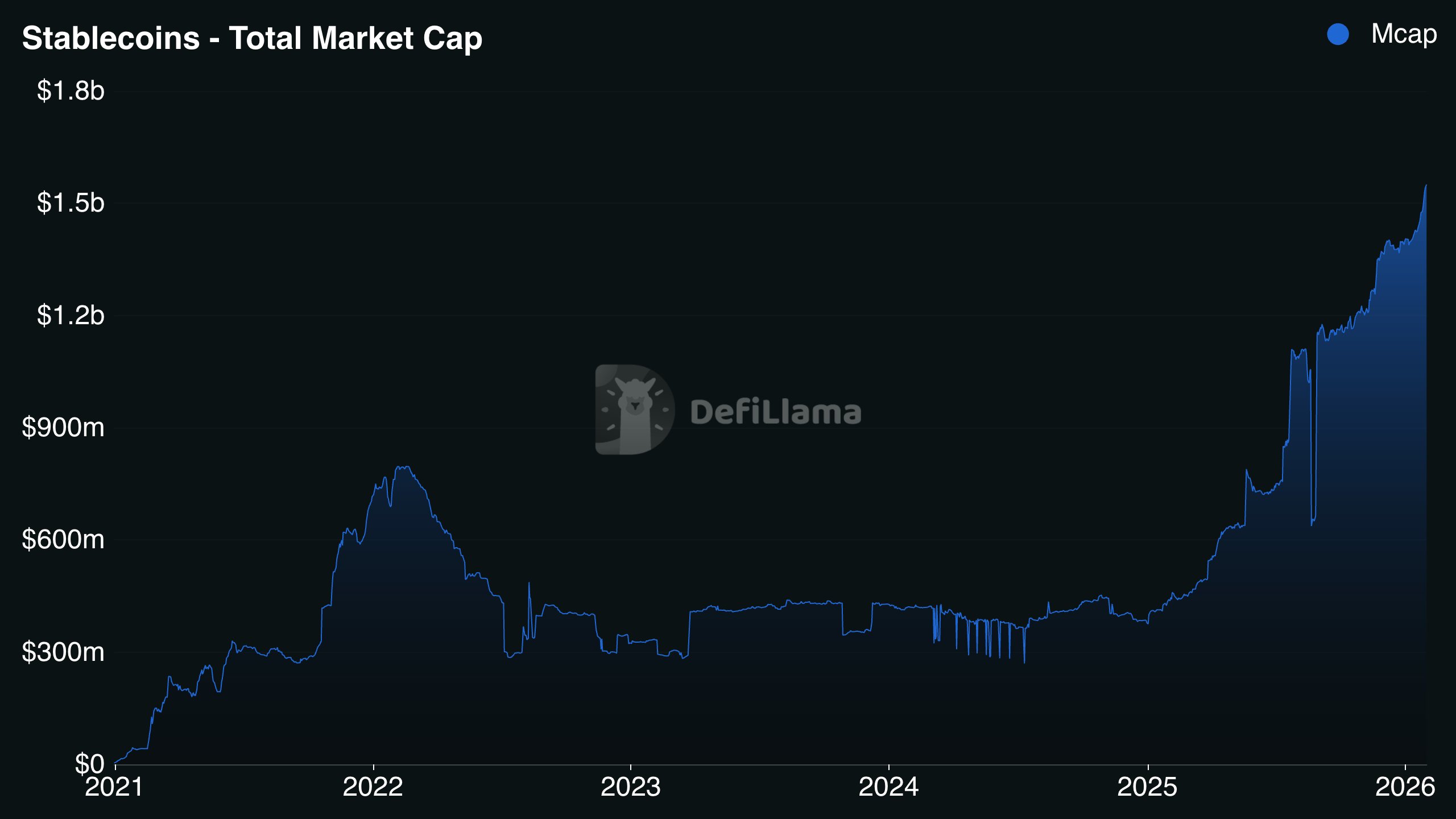
Over the past year, non-USD stablecoins have surged 260% in supply, pushing their combined market cap to about $1.55 billion.

Source: X

It’s still small next to dollar-backed giants, but it certainly matters.

All of this theory matters because…

…it’s already showing up in day-to-day payments. One of the fastest-growing payment modes for stablecoins right now is crypto cards.

Source: X

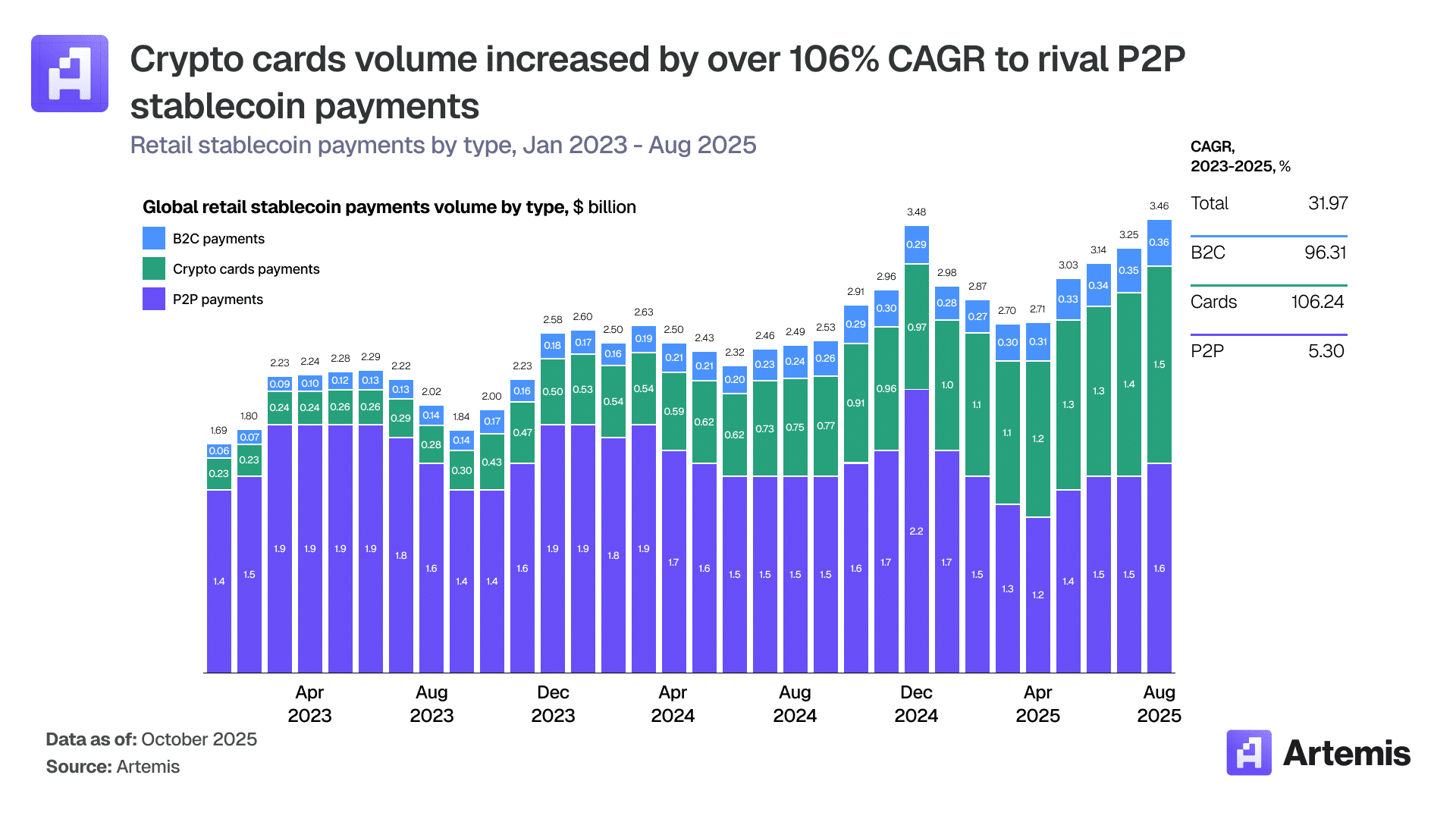
Once a niche product, crypto cards are now an $18 billion market.

Monthly volumes went from about $100 million in early 2023 to over $1.5 billion today, growing at a 100%+ annual rate.

Source: X

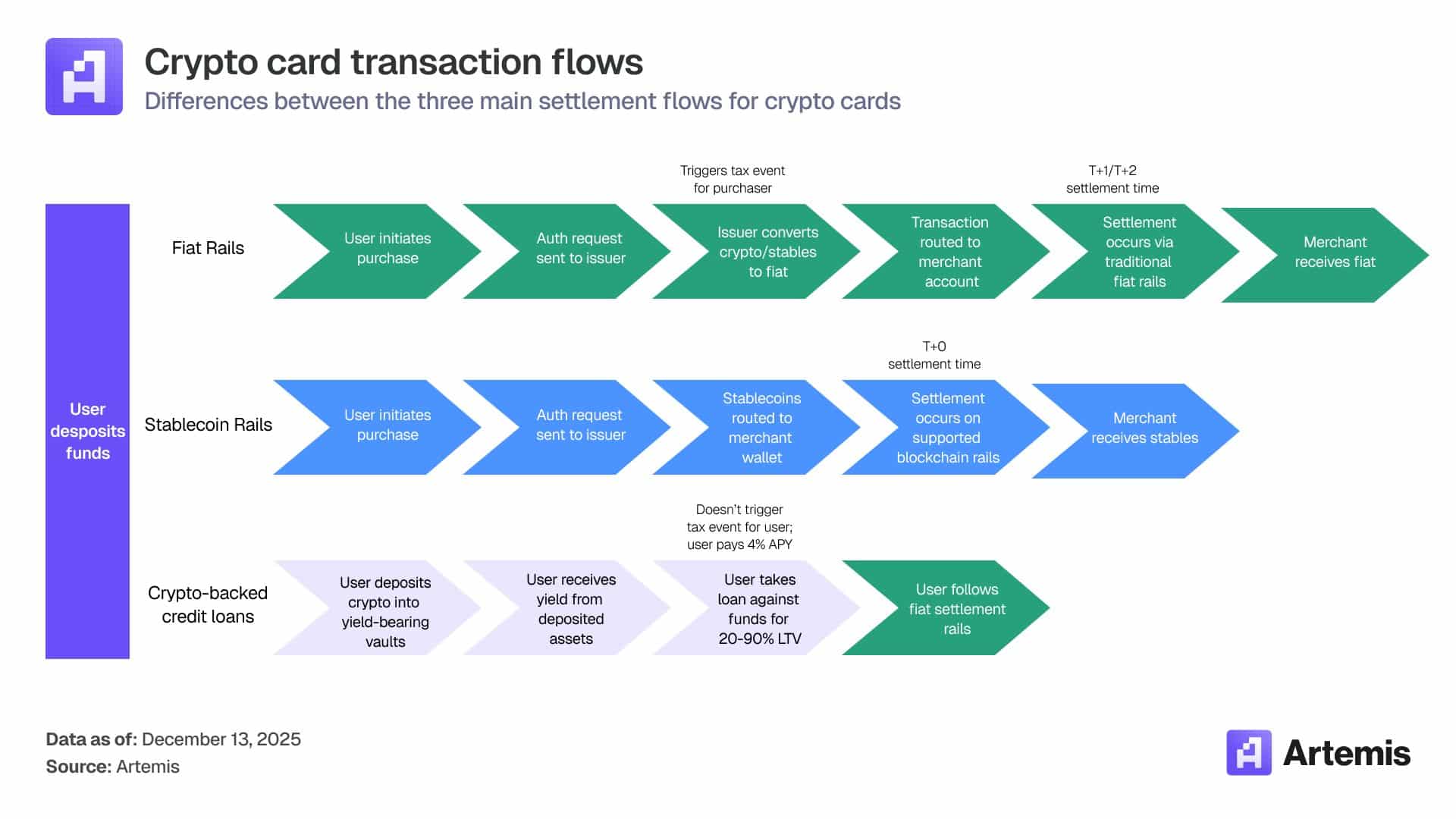
Importantly, these cards don’t replace Visa or Mastercard.

Rather, they sit on top of them. Stablecoins fund the transaction in the background, while card networks handle acceptance. For users and merchants, what looks like normal payments are actually digital dollars doing the work.


Final Thoughts

  • Dollar-backed stablecoins are exporting U.S. monetary power, without exporting actual dollars.
  • As crypto cards grow, digital dollars are moving fast.
Next: BONK drops 18% as memecoins slide – Is another leg down coming?
Share
  • Share
  • Tweet

Related Questions

QHow are dollar-backed stablecoins helping the U.S. extend dollar influence abroad without exporting real dollars?

ADollar-backed stablecoins allow foreign firms to obtain digital dollars while U.S. issuers convert that demand into Treasury bill purchases. This keeps actual dollars within the U.S., helping fund deficits at lower rates, while only tokens move across borders.

QWhat is the current market trend for non-USD-pegged stablecoins?

ANon-USD stablecoins have surged 260% in supply over the past year, reaching a combined market cap of approximately $1.55 billion, though they remain small compared to dollar-backed stablecoins.

QHow are crypto cards contributing to the growth of stablecoin payments?

ACrypto cards, now an $18 billion market, use stablecoins to fund transactions in the background while leveraging traditional card networks like Visa or Mastercard for acceptance. Monthly volumes grew from $100 million in early 2023 to over $1.5 billion, with a 100%+ annual growth rate.

QWhat role do U.S. Treasury bills play in the stablecoin ecosystem?

AWhen foreign demand for dollar stablecoins arises, U.S. issuers purchase Treasury bills with the incoming dollars, effectively recycling foreign demand into U.S. government debt and keeping capital domestically parked.

QWhy are non-USD stablecoins gaining traction despite the dominance of dollar-backed options?

ANon-USD stablecoins are growing as alternatives to reduce reliance on U.S. dollar influence, with a 260% supply increase reflecting heightened interest in diversified digital currency pegs.

Related Reads

Lowering Expectations for BTC's Next Bull Market

The author, Alex Xu, explains his decision to significantly reduce his Bitcoin holdings (from full to ~30% of his portfolio) during the current bull cycle, citing a lowered long-term outlook for BTC's price appreciation in the next cycle. He outlines six key reasons for this reduced expectation: 1. **Diminished Growth Drivers:** The narrative of exponential user adoption has largely played out with institutional ETF adoption. The next major growth phase—adoption by sovereign national reserves or central banks—seems unlikely in the near future. 2. **Personal Opportunity Cost:** More attractive investment opportunities have emerged in other assets, such as undervalued companies. 3. **Industry-Wide Contraction:** The broader crypto industry is struggling, with most Web3 business models (SocialFi, GameFi, DePIN) failing. This overall萧条 (depression) reduces the fundamental demand and consensus for Bitcoin. 4. **Strain on Major Buyer:** MicroStrategy, a major corporate buyer of BTC, faces rising financing expenses for its debt, which could slow its purchasing rate and create significant marginal pressure on the market. 5. **Increased Competition from Gold:** The emergence of "tokenized gold" has closed the functional gap (portability, divisibility) between physical gold and Bitcoin, offering a strong competitor in the non-sovereign store-of-value space. 6. **Security Budget Concerns:** The block reward halving continues to exacerbate the long-standing issue of funding Bitcoin's network security, with new fee source explorations like Ordinals and L2s largely failing. The author's decision to hold a significant (though reduced) position reflects a cautious, not bearish, outlook. He remains open to increasing his exposure if the fundamental reasons for his skepticism change or if new positive catalysts emerge.

marsbit8m ago

Lowering Expectations for BTC's Next Bull Market

marsbit8m ago

Can Iran 'Control' the Strait of Hormuz?

Iran has announced a comprehensive plan to assert control over the strategic Strait of Hormuz, a critical global oil shipping chokepoint. The proposed measures include requiring all vessels to obtain Iranian permission for passage, imposing fees for security, environmental protection, and navigation management—preferably paid in Iranian rials—and absolutely banning Israeli ships. Vessels from countries deemed hostile by Iran’s top security bodies may also be barred. Analysts suggest Iran’s motives are multifaceted: increasing pressure on the U.S. and Israel by leveraging control over oil transit to influence global prices and inflation; creating a new revenue stream, potentially exceeding $7.7 billion annually, to counter Western sanctions and support postwar reconstruction; and using transit permissions as bargaining chips in future negotiations, notably with the U.S. However, the plan faces significant practical and diplomatic challenges. Enforcing comprehensive interception and fee collection in the busy waterway, patrolled by international military forces, would be difficult. The U.S. has already countering with a blockade of Iranian ports and threats to intercept any ship paying fees, potentially strangling Iran’s oil exports and fee revenue. Broad international opposition, led by European and Gulf states, and legal controversies further complicate implementation. The proposal may ultimately serve more as a negotiating tactic than a feasible policy, with its execution remaining highly uncertain.

marsbit1h ago

Can Iran 'Control' the Strait of Hormuz?

marsbit1h ago

Trading

Spot
Futures
活动图片