
These Vibe Coding Crypto Mini-Games Are So Addictive

marsbitPublished on 2026-01-20Last updated on 2026-01-20

Abstract

The article explores the rising popularity of "vibe coding" in the cryptocurrency space, focusing on small, addictive games that deliver rapid dopamine hits through instant feedback. Initially skeptical of such trends, the author was convinced after trying games like *Rug Pull Simulator* (a token launch simulation), a meme-trading escape game, and *Vesting Victim* (an FDV guessing game). These games thrive on immediate, repetitive rewards—whether through strategic decision-making, timing the market, or testing valuation intuition—rather than long-term value or complex narratives. Vibe coding leverages AI tools to quickly turn ideas into playable demos, capitalizing on low development costs and high social media virality. It represents a shift toward instant gratification in a market where long-term promises have lost credibility, offering a form of "industrialized dopamine" that is highly engaging, if not necessarily profound. The author concludes by embracing these fast-paced, addictive experiences as a product of the current environment, even if they lack lasting impact.

Dopamine release can happen in as fast as 0.2 seconds.

That's why vibe coding is so hot in the crypto space right now.

For a long time, the market environment hasn't been great, and I had lost interest in new things, like some of the "little toys" made by vibe coding. Even the "Life K-Line" game, which was so popular it made it to CCTV, didn't change my disappointed view on industry innovation.

In my original perception, the things vibe coding produces now could only be at the level of games like "Emperor's Growth Plan" made by the Flatfish Studio—having little to do with "doing serious work." They create buzz, not accumulation; emotion, not value. I preferred to believe what those who would still impact the world twenty years after their death said, and I'd rather spend my time on products that might still be great two decades from now, not on this noise that looks like it could be washed away by the next wave of trends.

Until today, after Crypto Veda's explanations and my colleagues practically forcing it on me, I spent a few hours playing Rug Pull Simulator (Token Launch Simulator), the meme exit game Rug Pull Simulator (a coincidental同名 with the previous one) by GMGN boss Haze (Brother Chicken), and Tykoo Muscle Bro's FDV guessing game Vesting Victim—all products of this vibe coding wave.
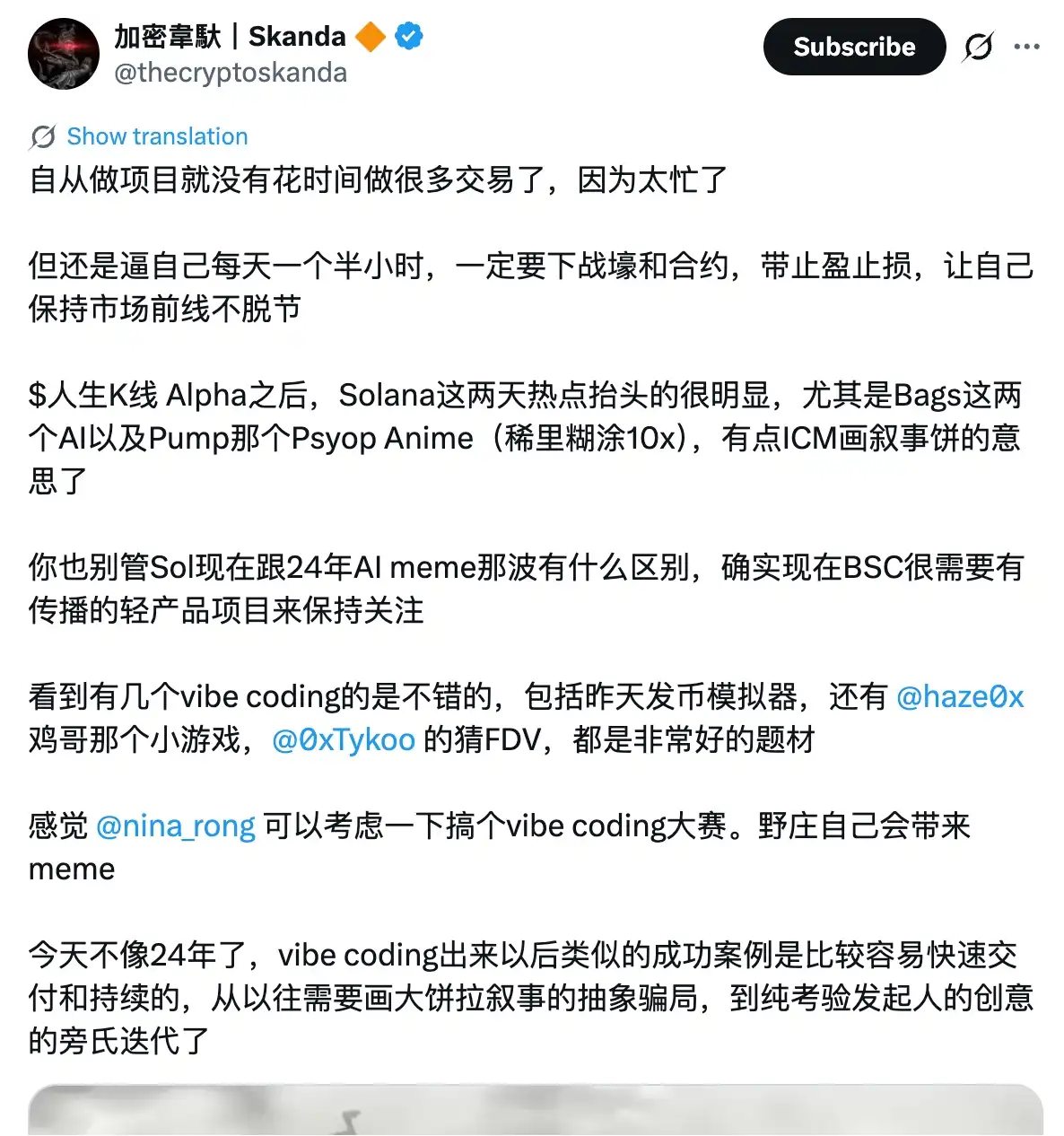
So addictive.

How to describe this kind of pleasure? It's like you've been watching long videos on Bilibili and suddenly try Douyin for the first time; or like being used to a slow-burning relationship and suddenly experiencing fast-food romance; or like someone long suppressed by life getting high on drugs for the first time.

Take the Token Launch Simulator, for example. You start from the perspective of a project side, which isn't exactly moral. You have a limited amount of startup capital, the product is still at the PPT stage, and you decide what to do next, how to play with your users and community.

One operational cycle is a month, and you can only do two things, so resources are limited. You invest your limited resources and money into product development, narrative spreading, community operations, etc. The game doesn't tell you which path is right. Then, uncertain events pop up one after another: sometimes funding comes through, sometimes regulators target you, sometimes the community suddenly spirals out of control, sometimes security risks explode.
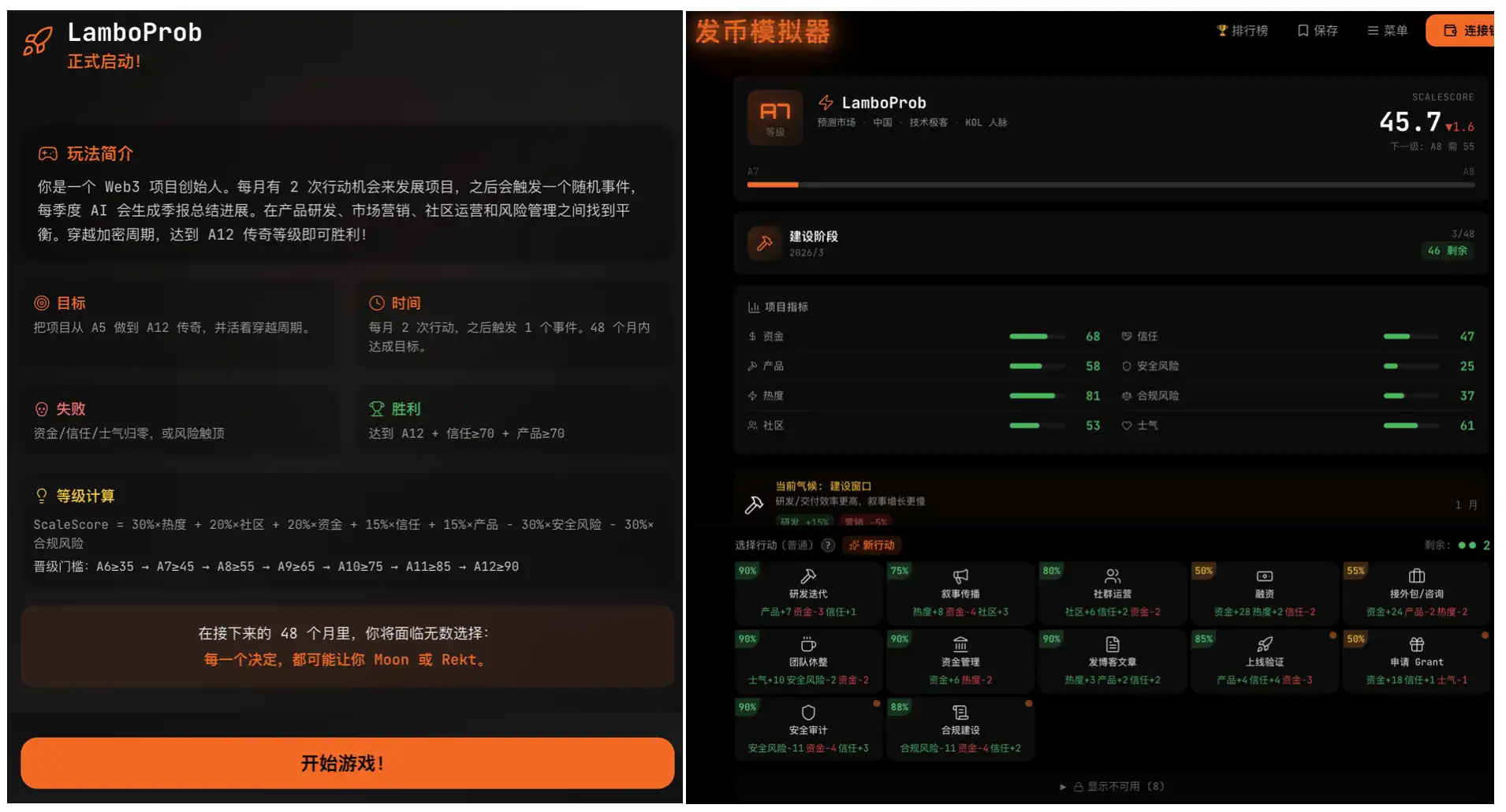
The pleasure emerges right here.

This pleasure doesn't come from eventually winning A9, A10 levels of wealth, but from the constant, continuous, never-ending immediate feedback. You just can't stop.

Another example is Brother Chicken's Rug Pull Simulator, a testing ground for trading memecoins, a speed-run version of GMGN's game. The pleasure lies in the rhythm of "exiting at the top." Buy low, spend marketing points to pump the price. If it pumps too fast, you fear a rug pull; if it's too slow, you get impatient. Successfully exit at the top, and profits are immediately credited—it feels like you've truly mastered the market's rhythm. Fail, and you can immediately try again.

Dopamine release in 0.2 seconds, faster than feedback in real trading.

Then there's Vesting Victim. While it doesn't have high-frequency clicking or the直观刺激 of price charts, it plays on your intuition about valuation. Based on a project's TVL, user count, funding situation, you judge its FDV, input the number, and the next second the system tells you the deviation. This "second-level verification" makes it impossible to stop. You unconsciously want to play another round—this time I'll guess more accurately—your nervous system directly receiving reward signals.
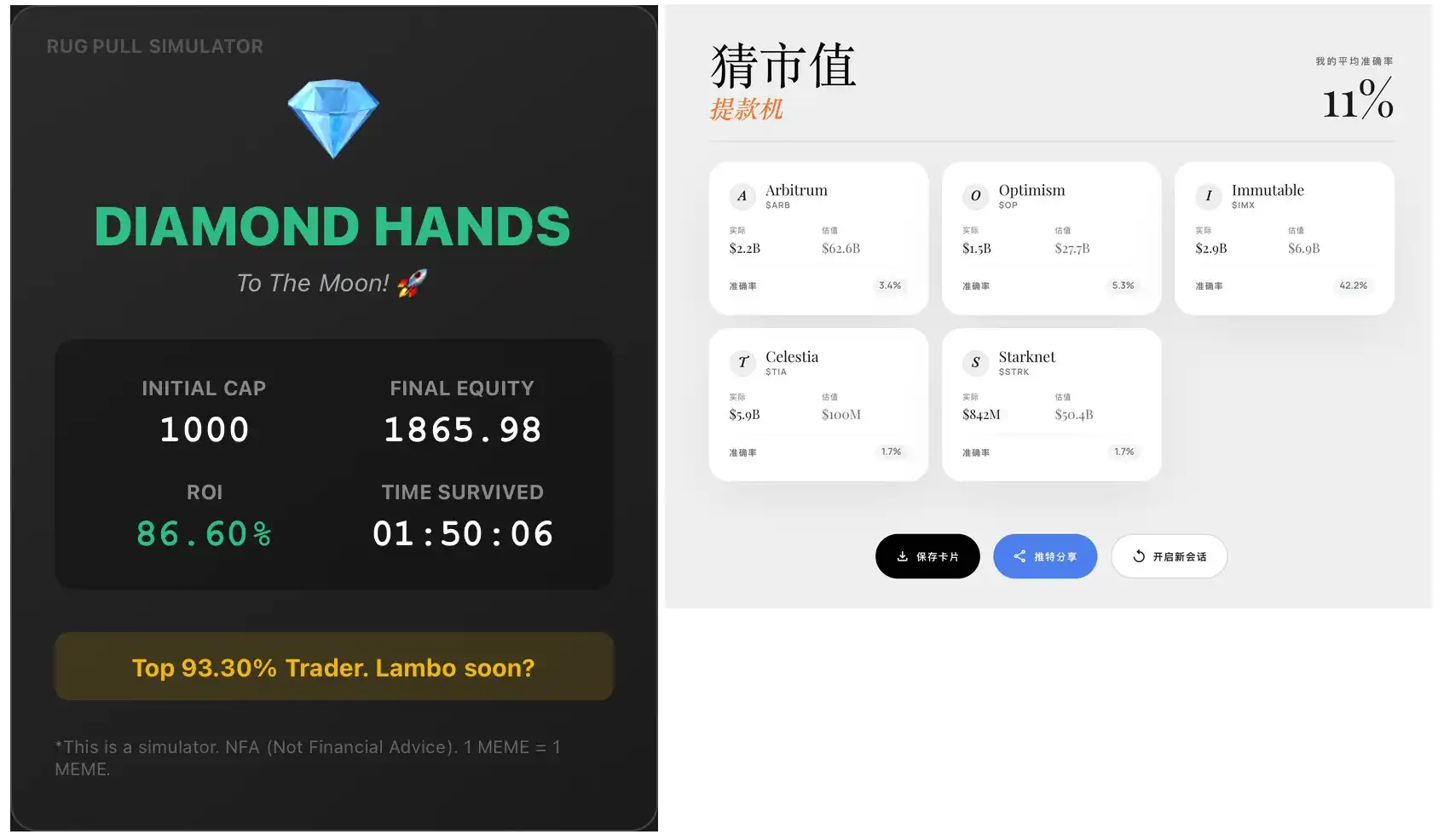
This is also the most addictive part of vibe coding. It doesn't need grand narratives or long-term investment. Copilot, Cursor, AI templates have drastically compressed the time from "an idea to a playable demo." It also doesn't rely on any future promises. No one expects today's vibe coding to produce great projects; being "fun today" is enough.

We just need to make choices in the present, get immediate feedback, and experience the pleasure of operations and results directly mapping onto our nerves. And this kind of pleasure is more direct, real, and easier to spread virally on social media than any complex economic model, long-term strategy, or whiteboard prediction.

The essence of vibe coding is, in a market where no one believes in long-term narratives anymore, monetizing attention with the lowest delivery cost.

It is, in a sense, the industrialization of dopamine—small doses, fast feedback, low addiction threshold, high repeat engagement; a form that is more brutal for project teams and more honest for users; and a natural product of today's market environment.

So when this era arrives, don't resist it, and stop lecturing about profound insights and morality. Let's indulge together in these fast-food toys, enjoy the pleasure of immediate feedback, enjoy the dopamine.

Even if it might never be great.

Related Questions

QWhat is the core appeal of Vibe Coding games in the crypto space according to the article?

AThe core appeal is the immediate, continuous feedback loop that triggers dopamine release in as fast as 0.2 seconds, offering a highly addictive and entertaining experience without the promise of long-term value or a grand narrative.

QName two specific Vibe Coding games mentioned in the article and describe their core mechanics.

A1. Rug Pull Simulator (by an unnamed team): Players assume the role of a project founder with limited resources, making monthly decisions on development, marketing, or community management, and dealing with random events. 2. Another Rug Pull Simulator (by Haze from GMGN): A memecoin trading sim where players buy low, use marketing points to pump the price, and attempt to sell at the top for instant profit.

QHow does the article describe the development process of Vibe Coding projects?

AThe article states that the development process is extremely compressed. Using tools like Copilot, Cursor, and AI templates, an idea can be turned into a playable demo very quickly, requiring no long-term investment or complex future promises.

QWhat does the article suggest is the 'essence' of Vibe Coding in the current market?

AThe essence of Vibe Coding is described as the industrialization of dopamine, using the lowest delivery cost to instantly monetize attention in a market where no one believes in long-term narratives anymore.

QWhat was the author's initial opinion on Vibe Coding, and how did it change?

AThe author initially viewed Vibe Coding products as mere noise, creating temporary hype and emotion rather than lasting value, comparable to simple games. Their opinion changed after trying the games themselves, finding the immediate feedback and addictive '爽感' (shuǎng gǎn - pleasurable feeling) to be incredibly compelling.

Related Reads

Google and Amazon Simultaneously Invest Heavily in a Competitor: The Most Absurd Business Logic of the AI Era Is Becoming Reality

In a span of four days, Amazon announced an additional $25 billion investment, and Google pledged up to $40 billion—both direct competitors pouring over $65 billion into the same AI startup, Anthropic. Rather than a typical venture capital move, this signals the latest escalation in the cloud wars. The core of the deal is not equity but compute pre-orders: Anthropic must spend the majority of these funds on AWS and Google Cloud services and chips, effectively locking in massive future compute consumption. This reflects a shift in cloud market dynamics—enterprises now choose cloud providers based on which hosts the best AI models, not just price or stability. With OpenAI deeply tied to Microsoft, Anthropic’s Claude has become the only viable strategic asset for Google and Amazon to remain competitive. Anthropic’s annualized revenue has surged to $30 billion, and it is expanding into verticals like biotech, positioning itself as a cross-industry AI infrastructure layer. However, this funding comes with constraints: Anthropic’s independence is challenged as it balances two rival investors, its safety-first narrative faces pressure from regulatory scrutiny, and its path to IPO introduces new financial pressures. Globally, this accelerates a "tri-polar" closed-loop structure in AI infrastructure, with Microsoft-OpenAI, Google-Anthropic, and Amazon-Anthropic forming exclusive model-cloud alliances. In contrast, China’s landscape differs—investments like Alibaba and Tencent backing open-source model firm DeepSeek reflect a more decoupled approach, though closed-source models from major cloud providers still dominate. The $65 billion bet is ultimately about securing a seat at the table in an AI-defined future—where missing the model layer means losing the cloud war.

marsbit12m ago

Google and Amazon Simultaneously Invest Heavily in a Competitor: The Most Absurd Business Logic of the AI Era Is Becoming Reality

marsbit12m ago

Computing Power Constrained, Why Did DeepSeek-V4 Open Source?

DeepSeek-V4 has been released as a preview open-source model, featuring 1 million tokens of context length as a baseline capability—previously a premium feature locked behind enterprise paywalls by major overseas AI firms. The official announcement, however, openly acknowledges computational constraints, particularly limited service throughput for the high-end DeepSeek-V4-Pro version due to restricted high-end computing power. Rather than competing on pure scale, DeepSeek adopts a pragmatic approach that balances algorithmic innovation with hardware realities in China’s AI ecosystem. The V4-Pro model uses a highly sparse architecture with 1.6T total parameters but only activates 49B during inference. It performs strongly in agentic coding, knowledge-intensive tasks, and STEM reasoning, competing closely with top-tier closed models like Gemini Pro 3.1 and Claude Opus 4.6 in certain scenarios. A key strategic product is the Flash edition, with 284B total parameters but only 13B activated—making it cost-effective and accessible for mid- and low-tier hardware, including domestic AI chips from Huawei (Ascend), Cambricon, and Hygon. This design supports broader adoption across developers and SMEs while stimulating China's domestic semiconductor ecosystem. Despite facing talent outflow and intense competition in user traffic—with rivals like Doubao and Qianwen leading in monthly active users—DeepSeek has maintained technical momentum. The release also comes amid reports of a new funding round targeting a valuation exceeding $10 billion, potentially setting a new record in China’s LLM sector. Ultimately, DeepSeek-V4 represents a shift toward open yet realistic infrastructure development in the constrained compute landscape of Chinese AI, emphasizing engineering efficiency and domestic hardware compatibility over pure model scale.

marsbit49m ago

Computing Power Constrained, Why Did DeepSeek-V4 Open Source?

marsbit49m ago

Trading

Spot
Futures
活动图片





