The Truth About the Neobanking Industry: Out of 368 Operating, Only 127 Hold Licenses. Behind the Funding Rounds Lie Countless Silent Deaths.

marsbitPublished on 2026-07-29Last updated on 2026-07-29

Abstract

"The Reality of Neobanking: Only 127 of 368 Operating Neobanks Have Full Licenses" by Francesco Andreoli, analyzed at neobankbeat.com, reveals the hidden structure and risks of the digital banking sector. While 368 verified neobanks serve ~1.46 billion users globally—with Asia (817M) and giants like WeBank (400M+) and Nubank (131M) leading—only 127 hold full banking licenses. This majority rely on rented infrastructure from BaaS providers, creating systemic risk where collapses (e.g., Wirecard, Synapse) leave customers unprotected compared to insured traditional banks. The industry's silent attrition is notable; firms disappear without notice. Geographically, momentum is shifting: 30% of post-2020 neobanks are web3-native (vs. 4% pre-2020). While AI is widely claimed, only 67 neobanks (18%) have verifiable, deployed AI models, with the most effective use often in emerging markets for credit scoring. The map shows 106 infrastructure providers supporting 368 consumer brands, indicating dangerous concentration. Two truths coexist: a revolutionary rise in financial access and a fragile foundation. Predictions include consolidation around licensing, potential AI lending failures in a downturn, and the next wave being infrastructure for AI agents, not humans.

Author: Francesco Andreoli, Consensys & MetaMask Developer Relations Lead

Compiled by: Jiahuan, ChainCatcher

Everyone is counting funding rounds, no one is counting funerals. So I counted both.

I started counting neobanks six months ago because I found no one could tell me exactly how many companies are in this industry. Analysts selling $4,000 PDFs don't know, the VCs putting money in don't know, the founders competing with each other don't know.

The answer, as of July 2026: 368 verified, still-operating neobanks. I track each one of them on neobankbeat.com, with all data open.

But the number that truly changed my view of this industry wasn't 368, but how many I had to delete to get there.
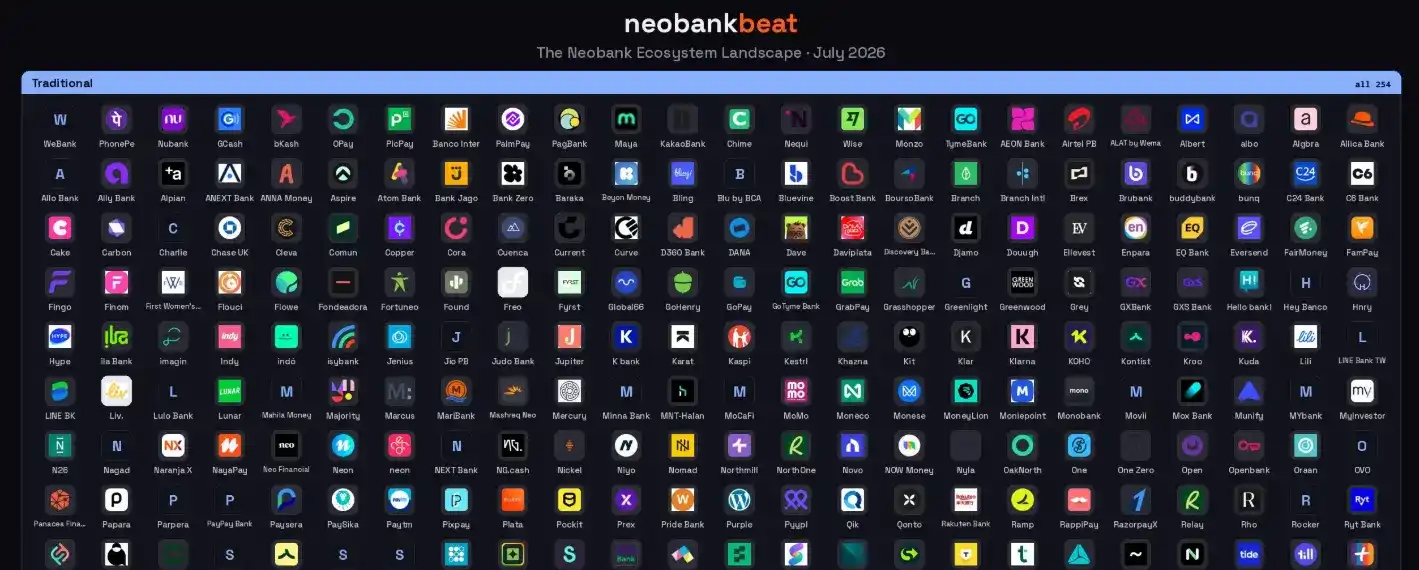
368 verified, still-operating neobanks

The rise is real. Let's start with that.

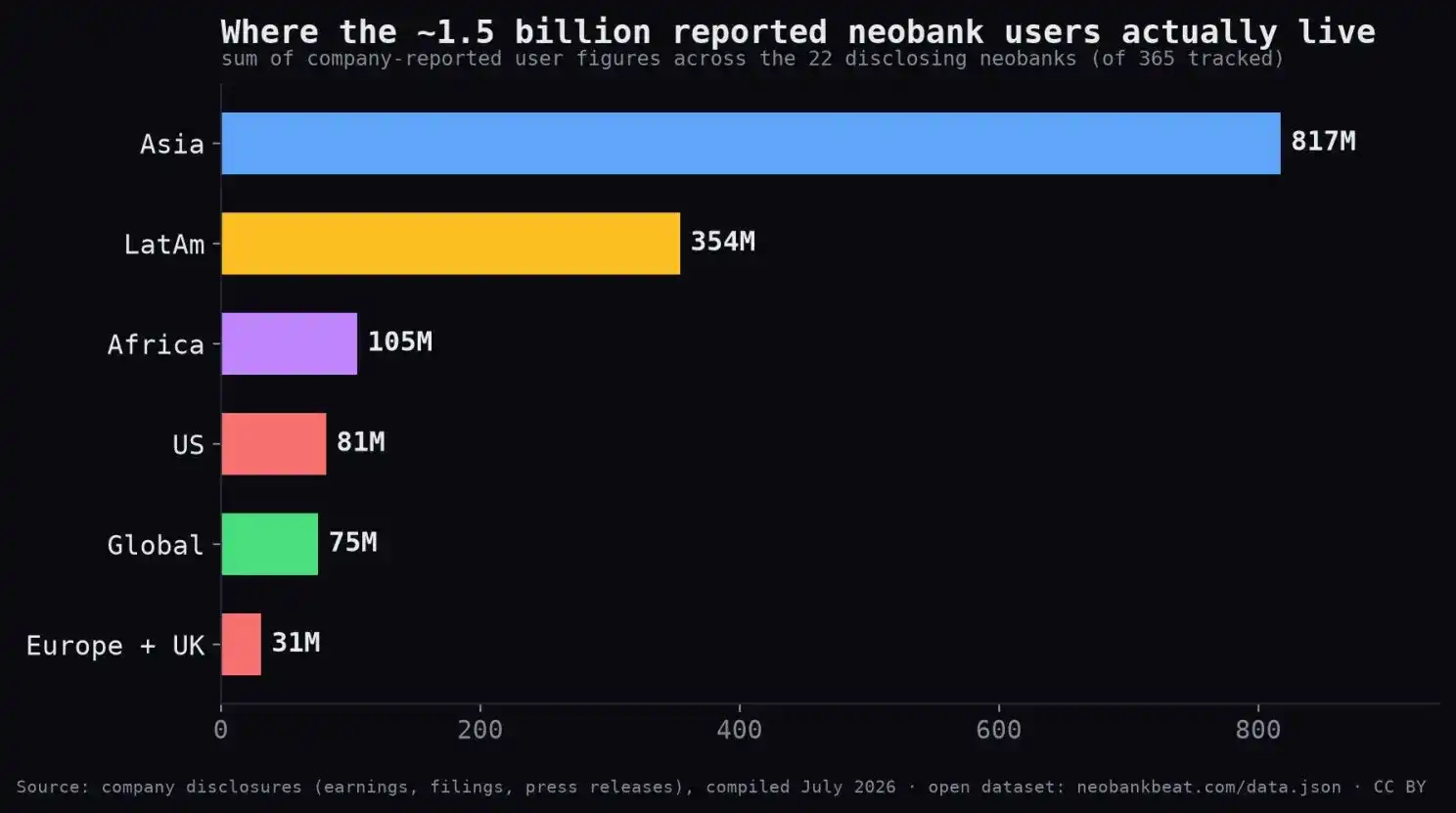
Summing up all the user numbers disclosed by the companies in the dataset, these neobanks we track serve approximately 1.46 billion people. This is not a forecast, nor a TAM chart figure, but the real reported client numbers.

And the geographical distribution will surprise anyone used to reading Western fintech media:

817 million of those users are in Asia. WeBank alone serves over 400 million people, more than all the neobanks in the US and Europe combined.

Nubank has 131 million customers, more than the total of all US neobanks.

Europe's champion, Revolut, has over 50 million users. That's impressive, but still a small fraction compared to the Asian numbers.
The marginal momentum of the industry is also shifting. Among neobanks founded and surviving since the 2020s, 30% are web3-native self-custody applications where user balances are not held by any company at all. Among the 2010s batch, this proportion is 4%. Whatever your thoughts on cryptocurrency, builders have voted with their feet.

So yes, the rise is real: 368 companies, three structurally distinct waves (254 traditional challenger banks, 58 fiat-crypto hybrid apps, 56 web3-native apps), underpinned by 106 infrastructure providers, backed by 219 investors. All mapped.

Now for the part no one puts in their pitch deck.

Only 127 out of the 368 hold full banking licenses.

Read that again. Two-thirds of the "banks" in your app store are not banks. Their right to exist is rented—from a sponsor bank, an e-money license, or some card issuer you've never heard of. And their customers almost never know which side of this line they are on.
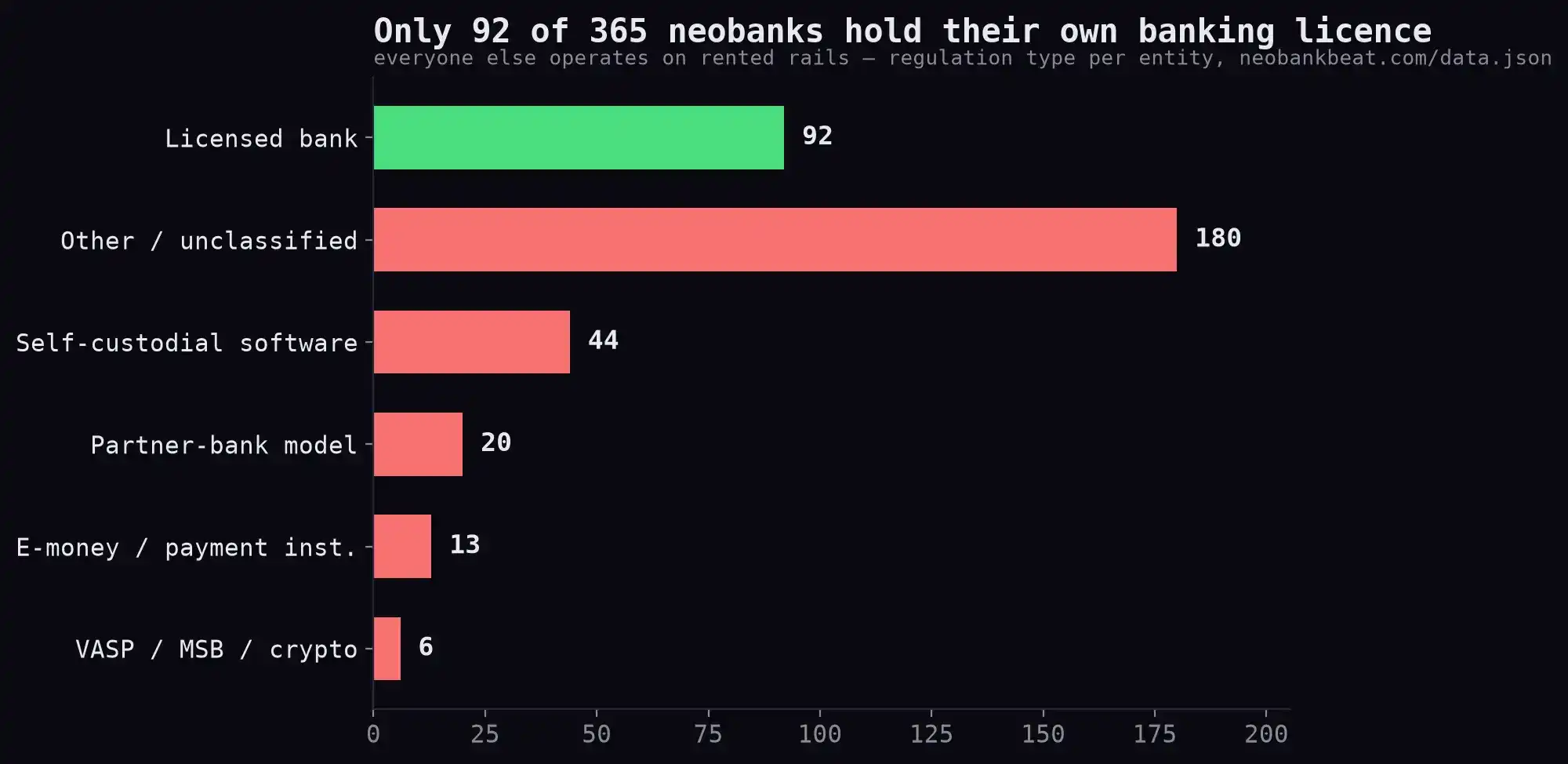
Banking Licenses

This is not a technical detail; it's the core structural risk of the entire industry, and it comes with a body count:

WaveCrest, 2018: Visa revoked a card issuer's license, and dozens of crypto card projects died overnight.

Wirecard, 2020: A payment processor collapsed with a €1.9 billion hole. Funds for a whole cohort of European "banks" were frozen, their only fault being built on top of it.

Synapse, 2024: A BaaS middleman collapsed, and average Americans found out "FDIC-insured" didn't mean what they thought, because what failed was the ledger recording who owned what.

Ready, 2026: Same movie, different cast.

When a real bank fails, deposit insurance pays out. When a neobank's infrastructure fails, customers get a number in the bankruptcy queue.

The deaths in this industry are silent. That is the real scandal.

One thing I didn't anticipate after maintaining this dataset: the deletions never stop.
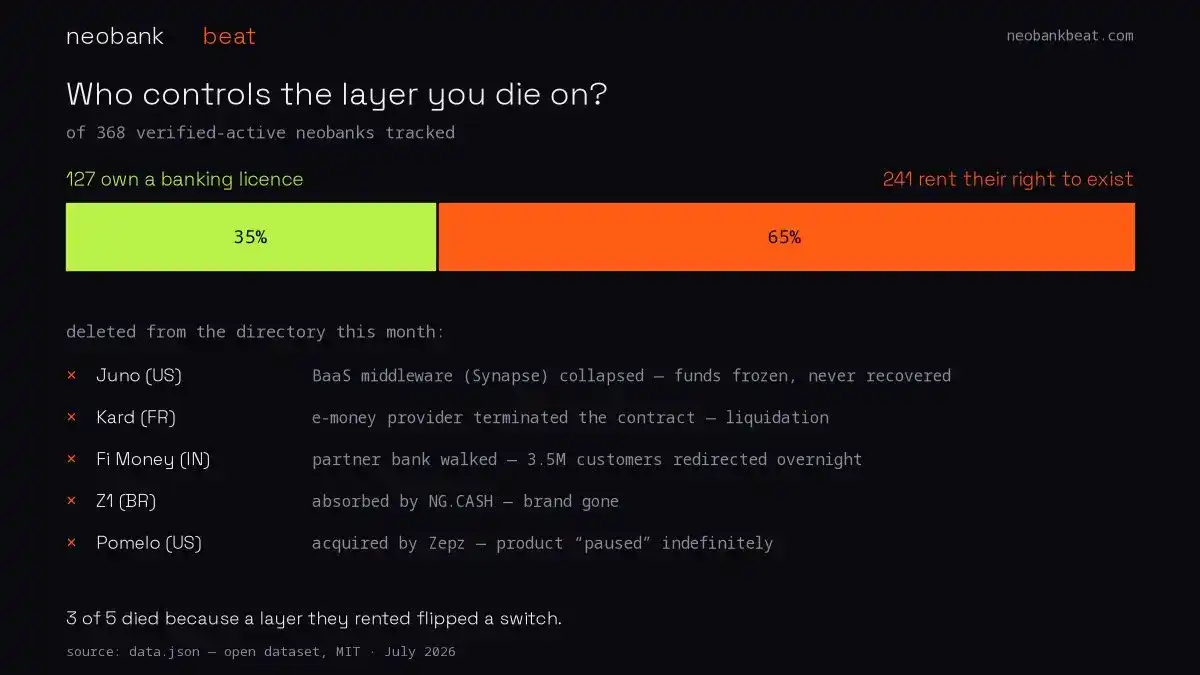
Who is in control?

Just this month, five entities vanished from the list—liquidated, absorbed, or quietly pivoted into something else. No press releases, no post-mortems. Neobanks don't die like FTX.

The app just stops updating, customer support stops responding, and one day the domain redirects to a partner's landing page. Hundreds of thousands of customers either migrate or simply evaporate.

No one writes obituaries for neobanks. Fintech media covers product launches and funding rounds because that's where the ad revenue and interview access are. So the graveyard remains invisible, and every new founder runs headlong into the same five traps, thinking they're the first to see them.

That's why we track exits as meticulously as entries. Failure data is more valuable than funding data. You learn nothing from press releases.

"But AI will solve the profitability model." Really?

Now every neobank pitch deck mentions AI. So we reviewed all 368, checking against financial filings, regulatory disclosures, and evidence of actual deployment—not marketing pages.

67 passed. 18%. The remaining 300+ are either still piloting, "exploring," or presenting a partner's model as their own.
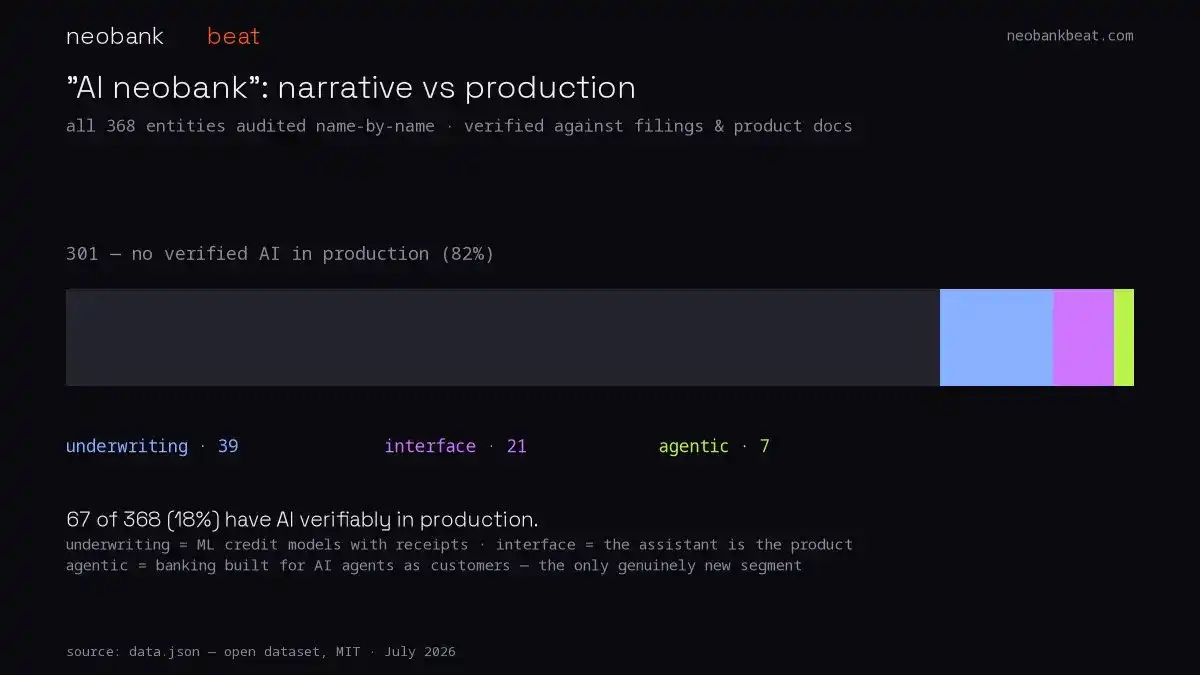
AI Neobanks?

The counterintuitive part: those doing AI best are often not the famous names, but emerging market lenders in Nigeria, the Philippines, Mexico, Bangladesh. Where credit bureaus are virtually non-existent, a model that can underwrite the unbanked isn't a nice-to-have feature—it's the entire reason the business can exist.

The West talks about AI banking. The Global South is actually building it because it has no other choice.

What This Map Actually Shows

Look at the infrastructure section on the map: 106 providers supporting 368 consumer-facing brands. Within this layer, a handful of sponsor banks, BaaS platforms, and card processors each carry dozens of logos on their shoulders. This concentration, invisible from the consumer side, is what breeds the next Synapse.

This is the most honest picture of the industry in 2026: a spectacular, world-changing rise where 1.5 billion people access banking through an app, many for the first time in their lives; all built on a critical layer most customers have never heard of, where two-thirds of the companies wouldn't survive one bad quarter from their landlord.

Both things are true. That's what makes it interesting.

Three Predictions I'm Willing to Admit I Could Be Wrong About

The license gap will narrow from both ends. Strong unlicensed players will acquire or obtain licenses. Weak ones will become 2027 deletions. The middle ground will disappear.

The first AI underwriting blowup will happen within two credit cycles. Most of those 67 deployed models have not experienced a real downturn in their current form. Some are about to learn what their training data was missing.

The next wave's customers are not human. Banking infrastructure serving AI agents—including agent-operated wallets, agent-issued cards, machine-to-machine payments—has only 7 companies working on it today. It looks like web3-native in 2021: tiny, weird, and structural.


Related Questions

QAccording to the article, what are the structural risks facing the neobanking industry related to banking licenses?

AThe article states that of the 368 operational neobanks, only 127 hold a full banking license. This means nearly two-thirds of them operate on 'rented' permission from a partner bank, e-money license, or card issuer. This creates a core structural risk: if these underlying infrastructure providers fail, the neobank clients are exposed. Their funds are not directly protected by deposit insurance like in a real bank failure, but instead become claimants in a bankruptcy process, as seen in cases like WaveCrest, Wirecard, and Synapse.

QHow does the geographical distribution of neobank users challenge the typical Western-centric financial tech narrative?

AThe geographical distribution is heavily skewed towards Asia and Latin America. The data shows that these neobanks serve approximately 1.46 billion users collectively. Of these, 817 million are in Asia. For example, WeBank (China) alone serves over 400 million, which is more than all neobanks in the US and Europe combined. Brazil's Nubank has 131 million customers, more than the total for all US neobanks. While Europe's Revolut has an impressive 50+ million users, it's a fraction of the scale seen in other regions.

QWhat does the article reveal about the state of AI implementation in neobanks versus the common perception?

AWhile AI is mentioned in nearly every neobank's business plan, the article's audit found that only 67 out of 368 (18%) have verifiable, live AI implementations based on financial reports and regulatory disclosures. The remaining 300+ are in pilot, exploration phases, or marketing partner solutions as their own. Ironically, the most effective AI implementations are often in emerging market lenders (e.g., in Nigeria, Philippines, Mexico, Bangladesh) where it's essential for credit scoring in the absence of traditional征信 systems, not just an added feature.

QWhat is the 'silent death' phenomenon in the neobank industry, and why is it significant?

AThe 'silent death' refers to the way many neobanks fail without public notice, post-mortems, or press coverage. They simply stop updating their apps, customer service becomes unresponsive, and eventually their domain redirects elsewhere. The article notes that five entities were removed from the tracking list in just one month. This is significant because the lack of visibility into failures means new founders repeatedly make the same mistakes, and the industry's mortality rate and associated risks remain largely hidden from public and investor view.

QWhat critical concentration risk exists within the neobanking infrastructure layer, according to the author's data?

AThe data reveals a high concentration risk in the infrastructure layer. There are 106 infrastructure providers (like Banking-as-a-Service platforms, card processors, and partner banks) supporting the 368 consumer-facing neobank brands. This means a small number of critical providers are responsible for the operational backbone of dozens of neobanks. This invisible concentration creates systemic risk, where a single point of failure at one provider (like Synapse in 2024) can simultaneously doom multiple consumer brands built on top of it.

Related Reads

In Conversation with Ray Dalio: We Are Currently in an AI Bubble, with 1% of My Portfolio in Bitcoin

Ray Dalio, founder of Bridgewater Associates, warns in an interview that the current AI boom shows classic bubble characteristics, which could lead to significant economic downturns as seen in past cycles like 1929 or 2000. He explains that speculative enthusiasm, fueled by debt and overvaluation, often precedes a crash when rising rates or taxation force asset sales, causing widespread losses and recession. Dalio also outlines his "Big Cycle" theory, describing an approximate 80-year pattern where widening wealth gaps, massive government deficits, and shifting geopolitical power (like China's rise) create internal conflict and global instability. He emphasizes that we are in a late-cycle, transitional phase where traditional powers like the US and UK face decline. For personal wealth protection, Dalio advises diversification beyond cash into assets like stocks, bonds, real estate, and particularly gold, which he prefers over Bitcoin. While he holds about 1% of his portfolio in Bitcoin as a non-printable hard asset, he views gold as more secure from technological or governmental threats. Regarding AI's impact, Dalio believes it will disproportionately benefit capital owners, worsening inequality by replacing both physical and cognitive labor. He suggests that human intuition and emotional intelligence, combined with AI, will be key for future workers. On taxation, Dalio argues that wealth taxes are impractical and risk triggering asset sell-offs, reducing productive investment. He points to the UK as a cautionary example of debt, low productivity, and political strife. Geopolitically, Dalio foresees a more regionalized world, with the US showing weakness in prolonged conflicts like with Iran, akin to past imperial declines. The ideal outcome, he suggests, is coexisting powerful blocs (e.g., Americas, China-Asia Pacific) without major war.

marsbit1h ago

In Conversation with Ray Dalio: We Are Currently in an AI Bubble, with 1% of My Portfolio in Bitcoin

marsbit1h ago

Daily 7.2 Trillion KRW: Foreign Capital's Record Net Buying on Friday! Wall Street Says Headwinds for Korean Stock Fund Flows Have Subsided

South Korean stock market sees a dramatic shift in fund flows. On July 31, foreign investors made a record net purchase of approximately KRW 7.2 trillion in KOSPI stocks, marking a fundamental reversal from the persistent large-scale net outflows seen in previous months. This contributed to a significant narrowing of foreign net selling in July to KRW 9.8 trillion, down sharply from KRW 48.4 trillion in June and KRW 44.5 trillion in May. Simultaneously, domestic institutional pressure eased. South Korean pension funds and asset managers turned to a net buying position in July, purchasing KRW 1.0 trillion worth of KOSPI shares, contrasting with net sales in May and June. Market volatility is expected to be dampened by new financial regulations. Effective July 31, the Financial Services Commission tightened access for retail investors to single-stock leveraged ETFs by raising the minimum cash deposit requirement. Trading volumes for these products subsequently dropped to about 50% of their monthly average. Citigroup Research maintains its year-end KOSPI target of 10,000 points. The firm cites several supportive factors: the substantial easing of headwinds from capital outflows, a robust fundamental outlook for the semiconductor sector, historically low market valuations, strong economic fundamentals, and the potential for policy support from financial authorities if needed.

marsbit1h ago

Daily 7.2 Trillion KRW: Foreign Capital's Record Net Buying on Friday! Wall Street Says Headwinds for Korean Stock Fund Flows Have Subsided

marsbit1h ago

Thanks to Dice Rolls, Bitcoin Keys Are Stored Offline, But Not Everyone Will Do It

The article discusses using dice rolls to generate secure Bitcoin wallet seeds, providing entropy independent of potentially flawed hardware random number generators. It explains that each fair dice roll offers about 2.585 bits of entropy, with around 50 rolls needed for a standard 12-word seed phrase and 99+ recommended for higher security. This method gained attention after a vulnerability was revealed in some Coldcard hardware wallets, where a faulty firmware RNG (dating back to 2021) compromised generated keys. The analysis notes that while a dice-generated main seed was safe from this specific flaw, other Coldcard functions (like creating paper wallets, backup keys, or passwords) could still be vulnerable if they used the defective RNG. The piece argues that while dice-based entropy is technically robust, the manual process is error-prone, tedious, and unrealistic for most new users, who might make mistakes in recording or inputting rolls. It concludes that while manual entropy generation should remain an option for advanced users, the long-term goal is to develop reliable, user-friendly hardware and software that securely generates randomness without requiring specialized knowledge. Coldcard users are advised to check their firmware version and replace any secondary secrets (like paper wallet keys) created with vulnerable devices, while also considering multi-signature setups with devices from different manufacturers for added security.

cryptonews.ru6h ago

Thanks to Dice Rolls, Bitcoin Keys Are Stored Offline, But Not Everyone Will Do It

cryptonews.ru6h ago

Trading

Spot
活动图片




