The Truth About the Crypto Money Printer: Want to Make Money in 2026? Keep an Eye on These Three Directions

比推Published on 2026-01-13Last updated on 2026-01-13

Abstract

The article "Crypto’s Revenue Recipe" analyzes the revenue generation landscape in the crypto industry, highlighting key trends and drivers based on data from 2025. Total crypto protocol revenue doubled to over $16 billion in 2025, with stablecoin issuers like Tether and Circle dominating, accounting for 60% of total revenue. However, perpetual DEXs (e.g., Hyperliquid, EdgeX) emerged significantly, contributing 7-8% of industry revenue. Three core drivers are identified for 2026: 1. **Carry**: Revenue from holding and transferring assets (e.g., stablecoin interest earnings), though vulnerable to Fed rate cuts. 2. **Execution**: Perpetual DEXs gain traction by enabling low-friction, high-frequency trading and liquidity provision, challenging stablecoin dominance. 3. **Distribution**: Token launch platforms (e.g., pump.fun) leverage frictionless asset creation and distribution to capture incremental revenue. The article emphasizes the shift towards value transfer to token holders, with 19% of protocol revenue distributed via staking, dividends, buybacks, or burns in 2025—a sign of growing "economic ownership" rather than mere governance. Projects like Hyperliquid and pump.fun are cited for prioritizing holder rewards. In 2026, value distribution is expected to become standard for protocols aiming for fundamental-based token valuation.

Author: Prathik Desai

Original Title: Crypto’s Revenue Recipe

Compiled and Edited by: BitpushNews


I've always loved the "seasonal" traditions of the crypto community. Like Uptober (October surge) or Recktober (October crash). Community members always love to throw around a ton of statistics around these times. After all, humans are naturally fond of trivia, aren't they?

And the trend analysis and reports that unfold around this data are even more interesting. You always hear arguments like: "This time, the ETF fund flows are completely different"; "Crypto industry funding has finally matured this year"; "BTC is ready for this year's pump", and so on.

Recently, while reading a report called State of DeFi 2025, I was drawn to a few charts about how crypto protocols generate "real revenue".

These charts show the top protocols with the highest revenue across the industry over the past year. They prove a fact that has been discussed repeatedly in the industry over the past year: the crypto industry is finally starting to find "generating revenue" to be a very sexy thing. But what exactly is reshaping this revenue landscape?

Hidden behind these charts is another little-known story worth digging into: where do these collected fees ultimately flow?

I dug deep into DefiLlama's fee and revenue data (revenue refers to the retained fees after deducting payments to liquidity providers and suppliers), trying to find the answer.

In the quantitative analysis of this article, I will try to add some dimensions to these numbers, to show you how money flows and where it goes in the crypto world.

2025: Revenue Doubles, Old Guard Dominance Remains

Last year, the total revenue generated by crypto protocols exceeded $16 billion, more than double the approximately $8 billion in 2024.

Value capture capabilities have been expanding throughout the crypto industry. Over the past 12 months, decentralized finance (DeFi) has seen the emergence of many new categories, such as decentralized exchanges (DEXs), token launch platforms (Launchpads), and perpetual futures exchanges (Perp DEXs).

However, the "profit centers" generating the highest revenue are still concentrated in those established categories – most notably stablecoin issuers.
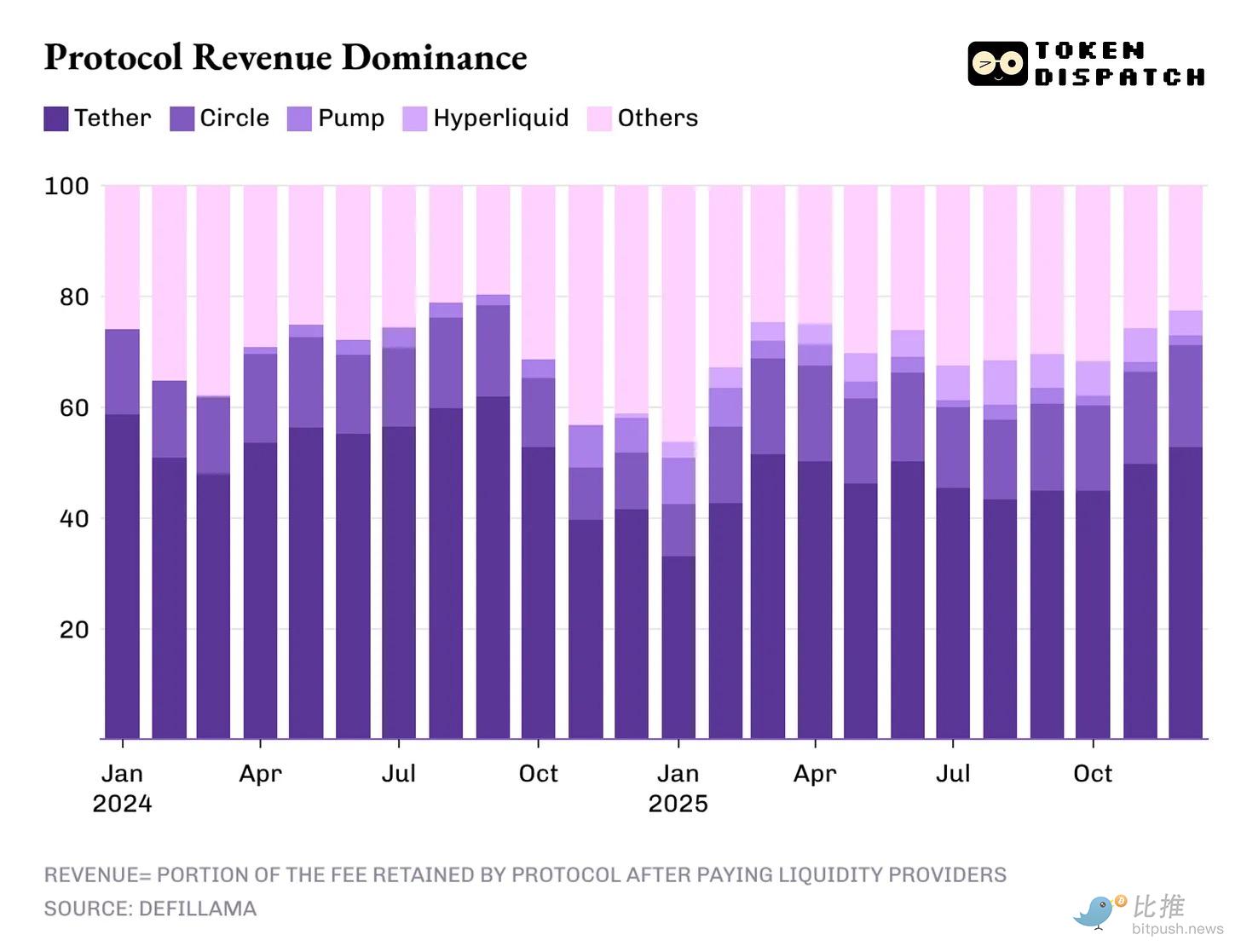
The two stablecoin giants Tether and Circle accounted for over 60% of the total annual crypto industry revenue. By 2025, this share only slightly decreased from about 65% the previous year to 60%.
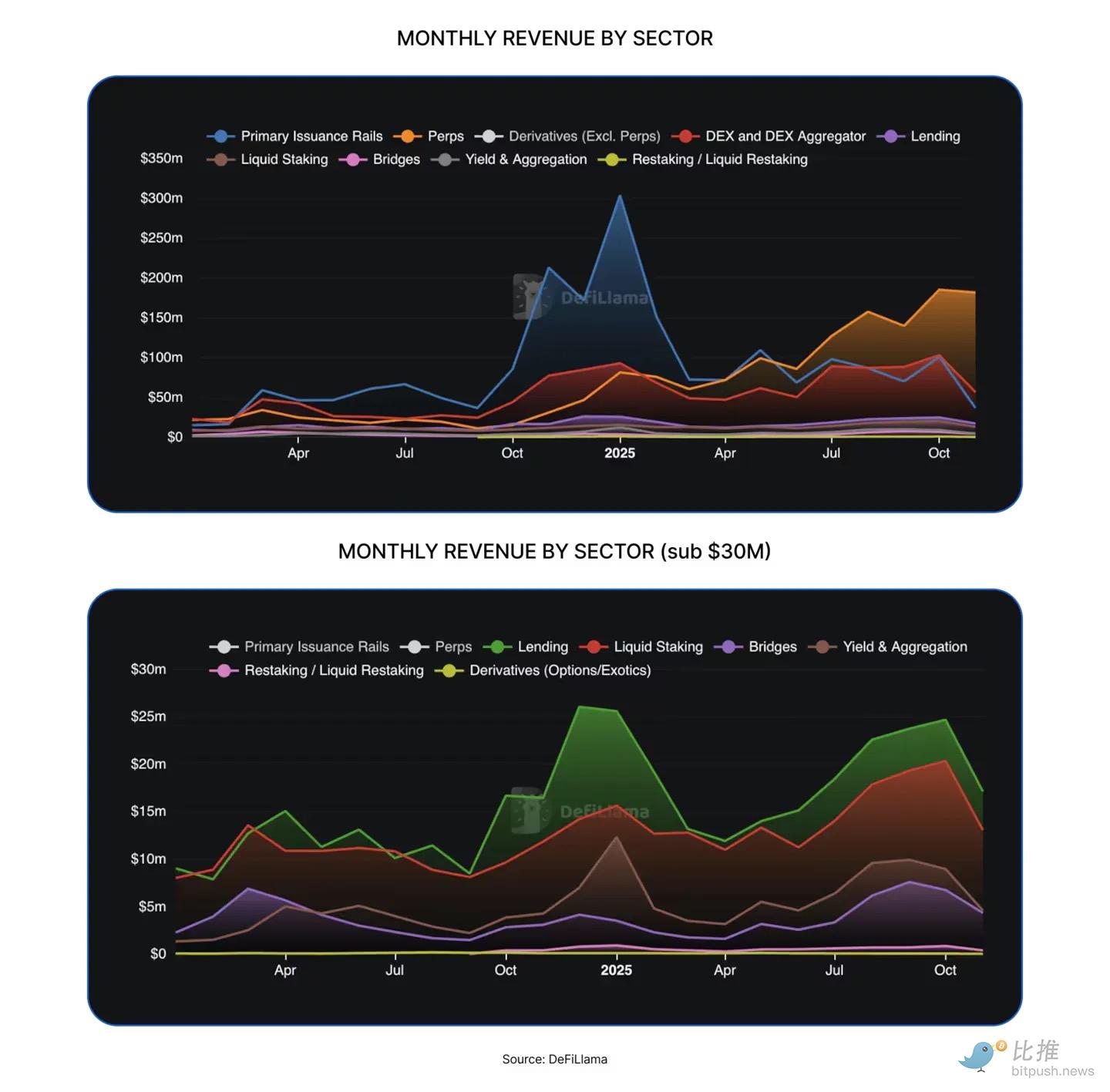
However, the achievements of perpetual futures exchanges (Perp DEXs) in 2025 should absolutely not be underestimated – remember, they were almost "non-existent" in 2024. Hyperliquid, EdgeX, Lighter, and Axiom together contributed 7% to 8% of the industry's total revenue, a share far exceeding the combined total of mature DeFi categories like lending, staking, cross-chain bridges, and DEX aggregators.

2026's Revenue Engines: Carry, Execution, and Distribution

So, what will drive revenue in 2026? I found the answer in three core elements that influenced last year's revenue concentration: Carry, Execution, and Distribution.

1. Carry Trade

Carry trade means that whoever holds and transfers funds can earn returns through this holding and transfer.

The revenue model of stablecoin issuers is both "structural" and "fragile".

  • Structural: Because it scales with the growth in supply and circulation. Every digital dollar they hold is backed by treasury bonds, which generate interest.

  • Fragile: Because the model relies on a macro variable that the issuer has almost no control over: the Federal Reserve's interest rates. And the "rate cut cycle" has just begun. As rates fall further this year, the revenue dominance of stablecoin issuers will weaken accordingly.

2. Execution

This is where DeFi protocols build perpetual futures (Perp DEXs), the most successful DeFi category of 2025.

The simplest way to understand why perpetual futures exchanges have been able to capture market share so quickly is to see how they help users execute actions. They build a venue that helps users enter or exit risk according to their needs at any time, with minimal friction. Even if market volatility is low, users can still hedge, trade on leverage, arbitrage, rotate capital, or simply open positions for research purposes to plan for the future.

Unlike spot DEXs, they allow users to conduct continuous, high-frequency trading without the inconvenience of moving the underlying assets.

While "execution" sounds simple and extremely fast, there's a lot beneath the surface. These futures exchanges must build a robust trading interface that doesn't crash under high load, host a matching and liquidation system that can stand firm in market chaos, and provide sufficient liquidity depth to retain traders. In perpetual futures exchanges, liquidity is the "secret sauce." Whoever can offer consistent and ample liquidity will attract the highest trading activity.

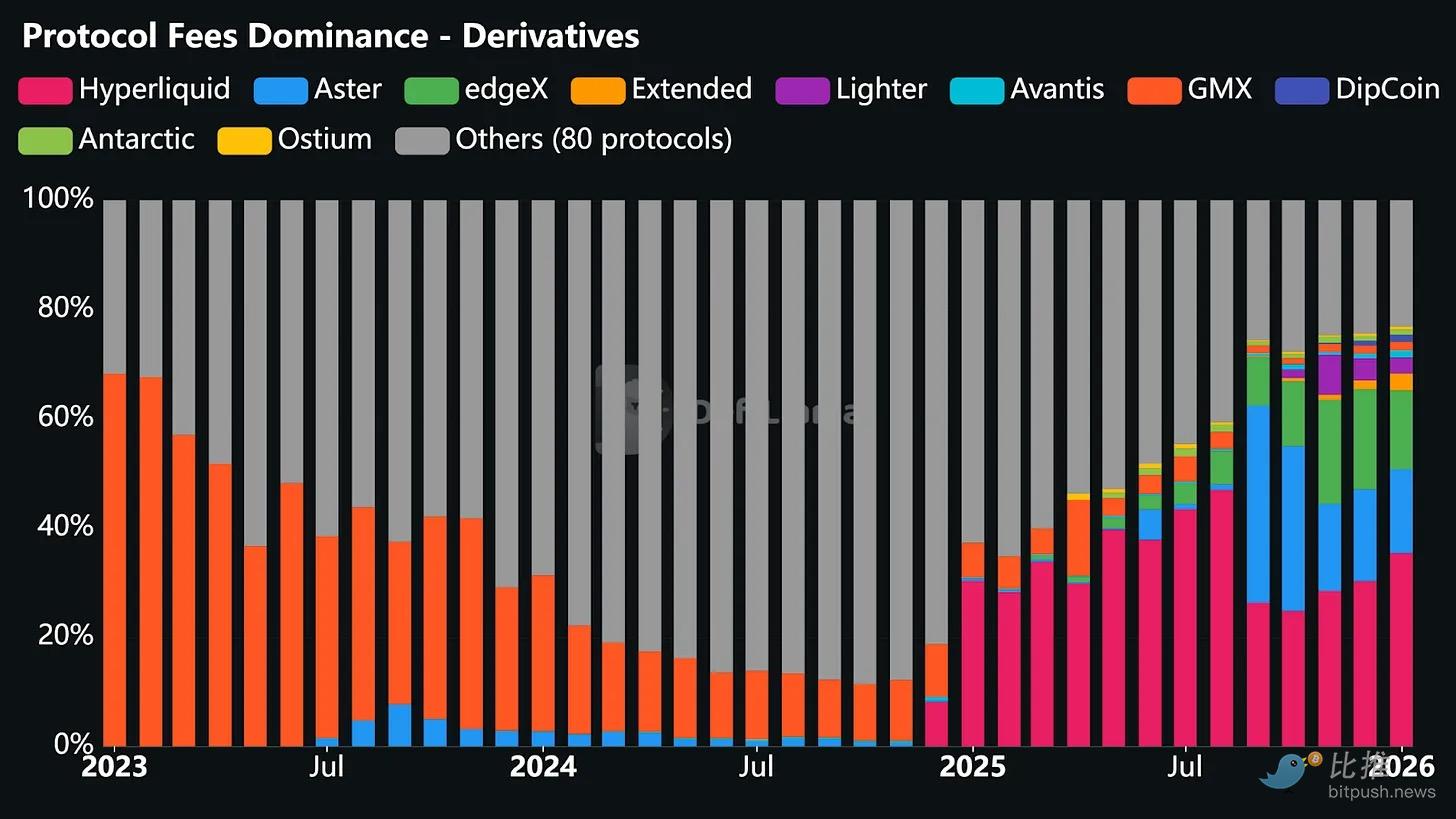
In 2025, Hyperliquid dominated the futures exchange track by attracting the largest number of market makers on its platform to provide ample liquidity. The result was that Hyperliquid dominated fee collection for 10 out of the 12 months last year.

Ironically, these DeFi category futures exchanges succeeded precisely because they don't require traders to understand blockchain and smart contracts, instead operating more like those familiar traditional exchanges.
Once the above issues are resolved, the exchange can generate revenue on "autopilot" by charging marginal fees on traders' high-frequency, high-volume trading activity. This continues even if spot prices are consolidating, simply because the options available to traders on the platform are so diverse.

This is precisely why I believe that, although futures exchanges' revenue share was only in the single digits last year, they are the only category that can remotely challenge the dominance of stablecoin issuers.

3. Distribution

The third factor – distribution – drives incremental revenue for crypto projects (like token issuance infrastructure). Think pump.fun and LetsBonk.

This isn't much different from what we see in Web2 companies. While Airbnb and Amazon don't own any inventory, their powerful distribution capabilities have helped them transcend the role of "aggregators" and reduce the marginal cost of adding new supply.

Crypto distribution infrastructure similarly does not own the assets (like Memecoins, tokens, and micro-communities) created through its platform. However, by making the user journey frictionless, automating the listing process, providing ample liquidity, and simplifying trading, it becomes the default place for people to create crypto assets.

In 2026, two questions may determine the trajectory of these revenue drivers: Will the revenue share of stablecoins fall below the 60% range as rate cuts eat into carry trades? Can futures exchanges break through their 7-8% stronghold as the execution layer consolidates?

Transforming "Revenue" into "Ownership"

The three factors of carry, execution, and distribution reveal how crypto revenue is generated. But that's only part of the story. Equally important (if not more so) is: what proportion of the gross fee is allocated to token holders before the protocol retains net revenue?

Value transfer achieved through token buybacks, token burns, and fee sharing marks a token as an "economic ownership claim," not just a "governance medal."
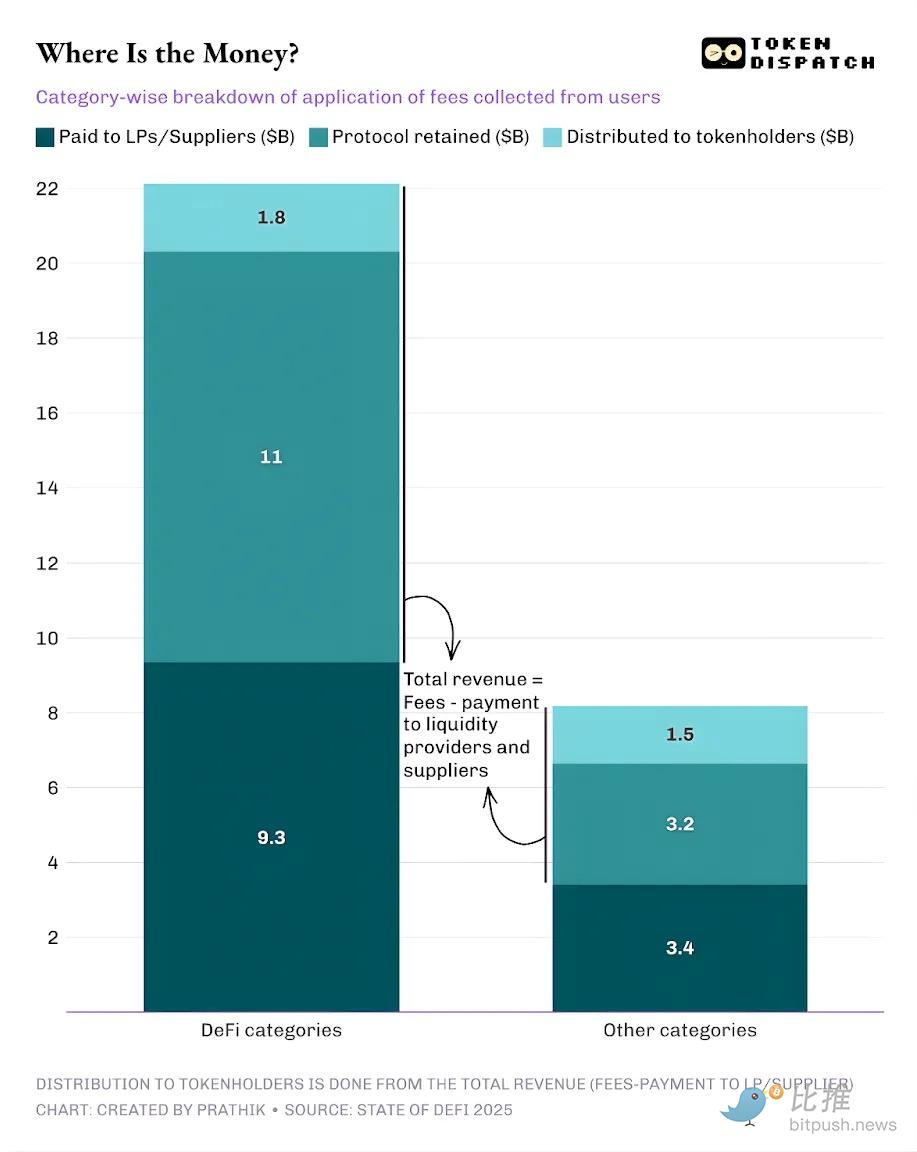
In 2025, users of DeFi and other protocols paid approximately $30.3 billion in fees. Of this, $17.6 billion was retained by the protocols as revenue after payments to liquidity providers and suppliers. About $3.36 billion of the total revenue was returned to token holders through staking rewards, fee sharing, buybacks, and token burns.

This means: 58% of fees were converted into protocol revenue, and about 19% of that revenue was captured by token holders.

This is a significant shift from the last cycle. We are seeing more and more protocols trying to make tokens behave like claims on operating performance. This gives investors a tangible incentive to hold long-term and be bullish on the projects they believe in.

I wrote about how Hyperliquid and pump.fun did this last year here: Burn Baby Burn.

The crypto world is far from perfect, and most protocols still don't distribute any earnings to token holders. But when you zoom out, you see the needle has moved considerably, a signal that times are changing.
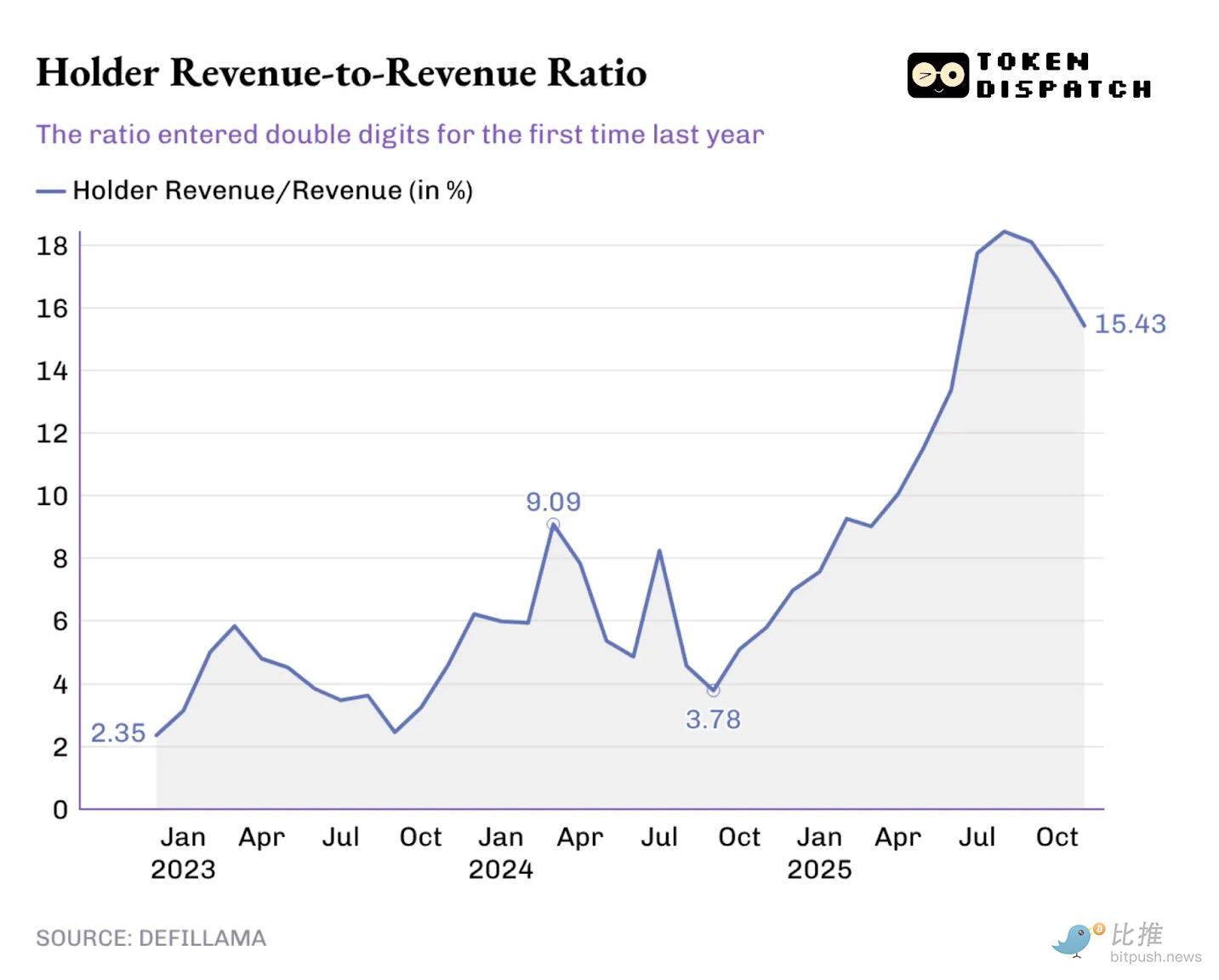
2026 Outlook: A Return to Fundamentals

Over the past year, the proportion of holder yield to total protocol revenue has been steadily climbing. It broke the previous all-time high of 9.09% early last year and even peaked at over 18% in August 2025.

This impact is directly reflected in token trading. If I hold a token that never rewards me, my trading decisions can only be based on the media narrative surrounding it. But when I hold a token that pays me (whether through buybacks or dividends), I start to treat it as an interest-bearing asset. Even if it's not as safe and reliable, it still changes how the market prices that token. Its valuation is pulled towards "fundamentals," rather than just dancing to the tune of media narratives.

When investors look back at 2025 to try to understand where money will flow in 2026, they will heavily consider "incentive mechanisms." The teams that prioritized value transfer did indeed stand out last year.

  • Hyperliquid built a culture of giving back approximately 90% of its revenue to users through its "Hyperliquid Aid Fund".

  • Among token launch platforms, pump.fun reinforced the idea of rewarding the platform's active community. It has already offset 18.6% of the circulating supply of its native token $PUMP through daily buybacks.
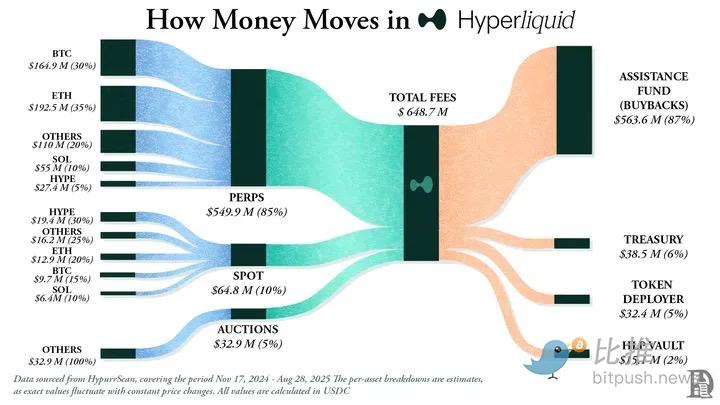
In 2026, "value transfer" is expected to cease being a niche choice and become "table stakes" for any protocol that wants its token to trade on fundamentals. Last year, the market learned to separate protocol revenue from token holder value. Once token holders have seen tokens operate like ownership claims, going back to the old model would seem utterly irrational.

Conclusion

I don't think the State of DeFi 2025 revealed anything brand new about crypto industry revenue – "revenue discovery" has been a widespread focus in the industry for the past few months. The real value of this report is that it illuminates reality with data, and when we examine these numbers further, we can see the paths most likely to achieve revenue success in the crypto world.

By deeply examining the revenue concentration trends of various protocols, the report clearly points to one fact: whoever masters the "pipeline" – whether it's carry yield, trade execution, or traffic distribution – will earn the most revenue.

Looking ahead to 2026, I expect more projects to start converting protocol fees into sustainable, disciplined yield distribution mechanisms, returning value to token holders. This trend will be even more pronounced, especially against the backdrop of a global interest rate cut cycle reducing the appeal of carry trades.


Twitter:https://twitter.com/BitpushNewsCN

Bitpush TG Discussion Group:https://t.me/BitPushCommunity

Bitpush TG Subscription: https://t.me/bitpush

Original article link:https://www.bitpush.news/articles/7602420

Related Questions

QWhat are the three key drivers of crypto revenue in 2026 according to the article?

AThe three key drivers of crypto revenue in 2026 are Carry (the spread trade, primarily from stablecoin issuers), Execution (from perpetual decentralized exchanges), and Distribution (from token launch infrastructure).

QWhich two stablecoin issuers dominated the crypto industry's total revenue in 2025?

ATether and Circle dominated the crypto industry's total revenue in 2025, accounting for over 60% of it.

QWhat percentage of the total fees collected by protocols in 2025 were ultimately captured by token holders?

AApproximately 19% of the total revenue (which was 58% of the fees) was captured by token holders through staking rewards, fee sharing, buybacks, and token burns.

QWhy is the revenue model of stablecoin issuers described as both 'structural' and 'fragile'?

AIt is structural because it scales with the growth in supply and circulation, as each digital dollar is backed by interest-generating government bonds. It is fragile because it relies on a macro variable the issuers cannot control: the interest rates set by the Federal Reserve.

QWhat significant shift in token holder incentives does the article highlight as a trend for 2026?

AThe article highlights that value transfer to token holders (through mechanisms like buybacks and dividends) will become 'table stakes' or a basic requirement for any protocol that wants its token to be valued based on fundamentals rather than just narrative.

Related Reads

South Korean Exchanges 'Battle' Regulators, Challenging the Boundaries of Enforcement and Legislation

South Korea's cryptocurrency industry is engaged in a rare, direct confrontation with regulators. The Financial Intelligence Unit (FIU), the primary anti-money laundering (AML) watchdog, has recently imposed heavy penalties on major exchanges like Upbit and Bithumb for alleged violations involving unregistered overseas VASPs and AML procedures. However, exchanges are now actively challenging these actions in court and through industry associations. In a significant shift, the Seoul Administrative Court ruled in favor of Upbit's operator, Dunamu, overturning part of an FIU-ordered business suspension. The court found the FIU's penalty criteria and justification insufficiently clear. Similarly, the court suspended the enforcement of a six-month business suspension against Bithumb pending a final ruling, citing potential irreversible harm to the exchange. Beyond legal battles, the industry is contesting proposed legislative amendments. The Digital Asset eXchange Alliance (DAXA) strongly opposes a draft rule that would mandate Suspicious Transaction Reports (STRs) for all crypto transfers over 10 million KRW (~$6,800). DAXA argues this "poison pill" clause violates legal principles and would overwhelm the STR system, increasing reports from 63,000 to an estimated 5.45 million annually for major exchanges, thereby crippling effective AML monitoring. This conflict highlights a structural tension in South Korea's crypto governance: comprehensive digital asset laws are still developing, while regulators rely heavily on AML enforcement. The industry's move from passive compliance to active legal and legislative challenges signifies a new phase, pressing for clearer rules and more proportionate enforcement. While short-term disputes may intensify, this clash could ultimately lead to a more mature and sustainable regulatory framework for South Korea's vibrant crypto market.

marsbit48m ago

South Korean Exchanges 'Battle' Regulators, Challenging the Boundaries of Enforcement and Legislation

marsbit48m ago

After 50x Storage Surge, Justin Sun Always Looks to the Next Decade

Sun Yuchen, known for his controversial stunts like a $30 million lunch with Warren Buffett (canceled due to a kidney stone) and eating a $6.2 million duct-taped banana, is often overshadowed by a significant fact: his decade-long track record of spotting major investment trends. In 2016, he famously advised young people to invest in Bitcoin, Nvidia, Tesla, and Tencent instead of buying property. A hypothetical $20,000 investment in Nvidia and Tesla from that list would now be worth over 50 million RMB. His latest major call was on November 6, 2025, predicting a "50x storage opportunity" tied to the AI boom, which materialized with Sandisk's stock surging nearly 50-fold by 2026. Looking ahead, Sun now focuses on the next frontier: Physical AI. He identifies four key areas: 1. **Embodied AI/Robotics**: He sees this reaching its "iPhone moment," with companies like UBTech and Galaxy General leading in commercialization. 2. **Drones**: Viewed as the first commercially viable form of Physical AI, revolutionizing sectors from warfare (e.g., AeroVironment's Switchblade) to logistics. 3. **Spatial Computing**: Beyond VR, it's about AI understanding physical space, a foundational technology for robotics and autonomous systems, exemplified by Apple's Vision Pro. 4. **Space Exploration**: After a 2025 suborbital flight with Blue Origin, Sun advocates for space as the ultimate frontier, discussing blockchain's potential role in space asset management and data transactions. His investment philosophy involves betting on entire, inevitable trends rather than single companies. For robotics, he sees Tesla (the body/manufacturer) and Nvidia (the brain/AI platform) as complementary plays. In defense drones, he highlights companies making tanks obsolete (AeroVironment) and those augmenting fighter jets (Kratos). For space, he participated in Blue Origin's flight and anticipates SpaceX's potential IPO to redefine the sector's valuation. Sun Yuchen's vision frames the next two decades not as a revolution in information flow (like the internet), but in the fundamental operation of the physical world through AI-powered robots, autonomous systems, and spatial intelligence, ultimately extending human and AI activity into space. While many still focus on conventional assets, he continues to look toward the next technological horizon.

marsbit1h ago

After 50x Storage Surge, Justin Sun Always Looks to the Next Decade

marsbit1h ago

The Billionaires Behind the Most Expensive Midterm Election in History

"The Most Expensive Midterm Elections and Their Billionaire Backers" This analysis details the unprecedented scale of spending in the 2026 midterm elections, highlighting the key billionaire donors shaping the political landscape. Jeff Yass, founder of Susquehanna International Group, has contributed over $81 million, ranking third among individual donors behind George Soros ($102.6M) and Elon Musk ($84.8M). Yass is a major donor to Trump's MAGA Inc. and supports school choice and various candidates. Overall, federal committees have raised over $4.7 billion this cycle, with political ad spending projected to reach $10.8 billion. Republican-aligned groups are significantly out-raising their Democratic counterparts. "Dark money" from undisclosed sources continues to grow. The core stakes involve control of Congress and policy direction for Trump's final term. Donors are also motivated by specific issues: Sergey Brin and Chris Larsen are funding opposition to a proposed California wealth tax and supporting crypto-friendly policies. Other top donors include OpenAI's Greg Brockman and his wife Anna ($50M total to MAGA Inc. and an AI-focused PAC), Richard Uihlein ($45.3M to conservative causes), venture capitalists Marc Andreessen and Ben Horowitz (each over $44M to crypto/AI PACs and MAGA Inc.), Miriam Adelson ($42.6M to GOP leadership PACs), Paul Singer ($33.9M), and Diane Hendricks ($25.8M to MAGA Inc.). The article notes that the peak fundraising period is still ahead, with major primaries approaching.

marsbit1h ago

The Billionaires Behind the Most Expensive Midterm Election in History

marsbit1h ago

The Largest IPO in History Is Approaching, Surpassing SpaceX, 28 Years of AI Self-Iteration, Countdown to Intelligence Explosion

"Anthropic Nears Trillion-Dollar IPO, Fueled by Explosive Growth and 2028 'Intelligence Explosion' Warning Anthropic is considering a deal valuing the AI company near $1 trillion, potentially leading to one of the largest IPOs ever and surpassing SpaceX. Its revenue has skyrocketed, with Annual Recurring Revenue (ARR) reaching $45 billion in May 2026—a 500% increase in just five months. This vertical growth curve is attributed to its key products, Claude Code and Cowork, dominating AI coding and enterprise collaboration. Beyond commercial success, co-founder Jack Clark issued a pivotal warning in an interview: there is a greater than 50% chance that by the end of 2028, AI systems will achieve recursive self-improvement—the ability to autonomously build a 'better version' of themselves, initiating an 'intelligence explosion.' This prophecy underpins the company's astronomical valuation, as the market prices in the potential for transformative and disruptive AI. Further signaling its ambition, Anthropic formed a $1.5 billion joint venture with Goldman Sachs and Blackstone, aiming to disrupt traditional consulting firms like McKinsey by deploying Claude AI for complex strategic work. This move tests AI's capacity to replace high-level cognitive labor, a precursor to its predicted autonomous evolution. The narrative presents a dual future: unprecedented economic opportunity alongside significant risks like economic restructuring and security threats. Anthropic's meteoric rise and Clark's 2028 prediction frame the coming years as a countdown to a potential technological singularity."

marsbit2h ago

The Largest IPO in History Is Approaching, Surpassing SpaceX, 28 Years of AI Self-Iteration, Countdown to Intelligence Explosion

marsbit2h ago

Trading

Spot
Futures
活动图片





