The Silver Crisis: When the Paper System Begins to Fail

深潮Published on 2025-12-13Last updated on 2025-12-13

Abstract

Silver Crisis: When the Paper System Begins to Fail In December, silver became the most volatile asset in the precious metals market, surging from $40 to over $64 per ounce—a year-to-date increase of nearly 110%, far outpacing gold. While the rally appears fundamentally justified—driven by Fed rate cut expectations, industrial demand from solar/EV/AI sectors, and declining global inventories—it masks deeper structural risks. Unlike gold, which is backed by central bank purchases, silver lacks institutional support and has minimal official reserves. Its market is shallow, with a daily trading volume of only $5 billion (vs. gold’s $150 billion), dominated by paper derivatives like futures and ETFs. This makes it vulnerable to volatility and manipulation. The real driver of the rally is a futures squeeze. The market has entered a persistent “backwardation” (futures prices exceeding spot prices), indicating either extreme bullishness or deliberate market manipulation. Physical delivery demands have surged, with COMEX and Shanghai exchange inventories dropping sharply. The system—where paper claims vastly exceed physical silver—is under stress. JPMorgan, a historically dominant player in silver markets, controls ~43% of COMEX silver inventory and acts as custodian for major silver ETFs. Its influence over physical supply and delivery eligibility adds to market fragility. The silver crisis reflects a broader shift: investors are losing faith in financialized paper as...

Author: Xiaobing | Deep Tide TechFlow

In December's precious metals market, the protagonist wasn't gold; silver was the most dazzling light.

From $40, it surged to $50, $55, $60, piercing through one historical price point after another at an almost uncontrollable pace, leaving the market little room to breathe.

On December 12th, spot silver once hit a historical high of $64.28 per ounce before sharply reversing and falling. Year-to-date, silver has accumulated a gain of nearly 110%, far exceeding gold's 60% increase.

This appears to be an "extremely rational" rise, which also makes it seem particularly dangerous.

The Crisis Behind the Rise

Why is silver rising?

Because it seems worthy of rising.

From the explanations of mainstream institutions, it all seems rational sense.

The Fed's interest rate cut expectations reignited the precious metals rally; recent weak employment and inflation data led the market to bet on further rate cuts by early 2026. Silver, as a high-beta asset, reacted more violently than gold.

Industrial demand is also adding fuel to the fire. The explosive growth in solar energy, electric vehicles, data centers, and AI infrastructure has fully manifested silver's dual attributes (precious metal + industrial metal).

Persistently declining global inventories are adding insult to injury. Mexican and Peruvian mine production fell short of expectations in Q4, and silver ingot stocks in major exchange warehouses are lower year after year.

......

If one only looks at these reasons, the rise in silver prices is a "consensus," even a belated value re-rating.

But the danger of the story lies in this:

Silver's rise seems rational, but it's not solid.

The reason is simple: Silver is not gold. It lacks the consensus gold has; it is missing "national team" support.

Gold remains robust because central banks worldwide are buying. Over the past three years, global central banks have purchased over 2,300 tons of gold, which sits on national balance sheets as an extension of sovereign credit.

Silver is different. Global central bank gold reserves exceed 36,000 tons, while official silver reserves are almost zero. Without central bank backstop, silver lacks any systemic stabilizer during extreme market volatility, making it a typical "island asset."

The difference in market depth is even more stark. Gold's daily trading volume is about $150 billion; silver's is only $5 billion. If gold is the Pacific Ocean, silver is, at best, Poyang Lake.

It has a small market cap, fewer market makers, insufficient liquidity, and limited physical reserves. Most crucially, the primary form of silver trading is not physical metal but "paper silver"—futures, derivatives, and ETFs dominate the market.

This is a dangerous structure.

Shallow water capsizes easily; large funds entering can churn the entire surface.

And this is precisely what happened this year: A wave of funds suddenly rushed in, rapidly pushing up a market that wasn't deep to begin with, lifting prices off the ground.

Futures Squeeze

What derailed silver prices wasn't the seemingly rational fundamental reasons above; the real price war is in the futures market.

Normally, the spot price of silver should be slightly higher than the futures price. This makes sense—holding physical silver incurs storage and insurance costs, while a futures contract is just paper, naturally cheaper. This price difference is generally called "backwardation" (现货升水).

But starting in the third quarter of this year, this logic reversed.

Futures prices began systematically exceeding spot prices, and the gap kept widening. What does this mean?

Someone is frantically pushing up prices in the futures market. This "contango" (期货升水) phenomenon usually only appears in two situations: either the market is extremely bullish on the future, or someone is forcing a squeeze (逼仓).

Considering that the improvement in silver fundamentals is gradual—solar and new energy demand doesn't exponentially explode in a few months, and mine output doesn't suddenly dry up—the aggressive performance in the futures market更像 the latter: Funds are pushing up futures prices.

A more dangerous signal comes from anomalies in the physical delivery market.

Operational history data from the world's largest precious metals trading market, COMEX (Commodity Exchange Inc.), shows that physical delivery of precious metals futures contracts is less than 2%, with the remaining 98% settled in US dollars cash or through contract rollovers.

However, over the past few months, physical silver deliveries on COMEX have surged, far exceeding historical averages. More and more investors are losing trust in "paper silver"; they are demanding actual silver bars.
Silver ETFs have seen a similar phenomenon. While large amounts of funds flowed in, some investors began redeeming, demanding physical silver instead of fund shares. This "run-like" redemption is putting pressure on the ETFs' silver bar reserves.

<极狐 style="font-size:16px">This year, runs have occurred in succession in the three major silver markets: New York COMEX, London LBMA, and the Shanghai Metal Exchange.

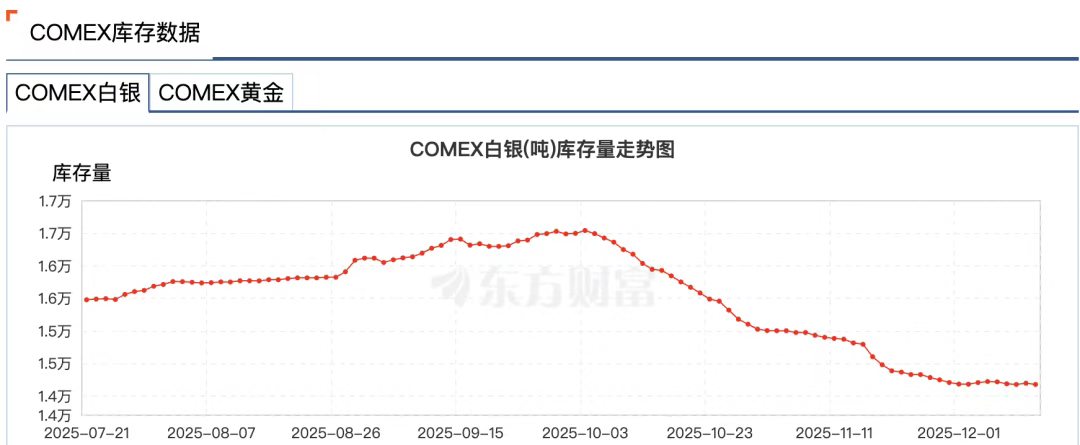
Wind data shows that in the week of November 24th, silver inventories on the Shanghai Gold Exchange fell by 58.83 tons to 715.875 tons, hitting a new low since July 3, 2016. CME COMEX silver inventories plummeted from 16,500 tons in early October to 14,100 tons, a drop of 14%.

The reason isn't hard to understand: under the US interest rate cut cycle, people are unwilling to settle in dollars. Another hidden worry is that exchanges might not have enough silver available for delivery.

The modern precious metals market is a highly financialized system. Most "silver" is just book entries, with real silver bars being repeatedly pledged, leased, and derived globally. One ounce of physical silver might correspond to a dozen different entitlement certificates simultaneously.

Veteran trader Andy Schectman cited London as an example: LBMA has only 140 million ounces of floating supply, but daily trading volume reaches 600 million ounces. On top of this 140 million ounces, there exist paper claims exceeding 2 billion ounces.

This "fractional reserve system" works well in normal times, but once everyone wants physical metal, the entire system faces a liquidity crisis.

When the shadow of a crisis looms, a strange phenomenon似乎总是出现在金融市场, commonly called "pulling the plug."

On November 28th, CME was down for nearly 11 hours due to "data center cooling issues," a record-long outage, preventing COMEX gold and silver futures from updating normally.

Notably, the outage occurred at a critical moment as silver broke through historical highs. Spot silver breached $56 that day, and silver futures broke through $57.

Market rumors speculated that the outage was to protect commodity market makers exposed to extreme risk and potentially facing large losses.

Later, data center operator CyrusOne stated that this major interruption stemmed from human operational error, further fueling various "conspiracy theories."

In short, this futures squeeze-dominated market注定 results in剧烈 volatility in the silver market. Silver has essentially transformed from a traditional safe-haven asset into a high-risk speculative target.

Who is the Market Maker?

In this squeeze drama, one name cannot be bypassed: JPMorgan Chase.

The reason is simple: it is internationally recognized as the silver market maker.

For at least eight years, from 2008 to 2016, JPMorgan manipulated gold and silver market prices through its traders.

The method was simple and crude: placing large orders to buy or sell silver contracts on the futures market to create false supply and demand impressions, inducing other traders to follow the momentum, and then canceling the orders at the last second, profiting from the price fluctuations.

This practice, known as spoofing,最终 led to JPMorgan receiving a $920 million fine in 2020, once setting a record for a single CFTC fine.

But the real textbook-level market manipulation goes beyond that.

On one hand, JPMorgan depressed silver prices through massive short selling and spoofing in the futures market. On the other hand, it massively acquired physical metal at the low prices it itself created.

Starting around the 2011 silver price high near $50, JPMorgan began hoarding silver in its COMEX warehouses, consistently adding positions while other large institutions reduced theirs, at one point accounting for 50% of total COMEX silver inventory.
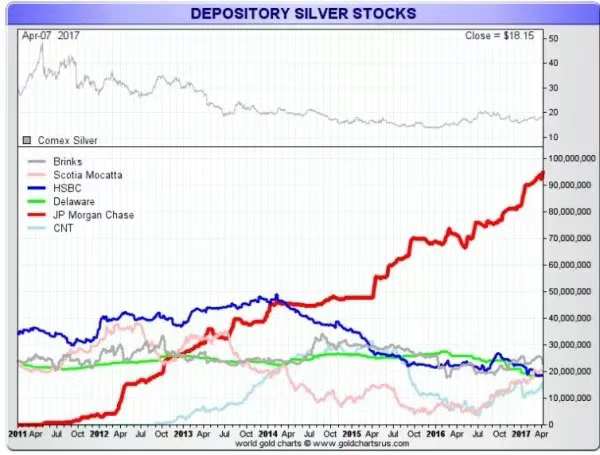
This strategy exploited the structural缺陷 of the silver market: Paper silver prices dictate physical silver prices, and JPMorgan could influence paper prices while being one of the largest physical silver holders.

So what role does JPMorgan play in this round of silver squeeze?

On the surface, JPMorgan seems to have "turned over a new leaf." Following the 2020 settlement, it underwent systematic compliance reforms, including hiring hundreds of new compliance officers.

There is currently no evidence表明 JPMorgan participated in the short squeeze行情. But in the silver market, JPMorgan still holds significant influence.

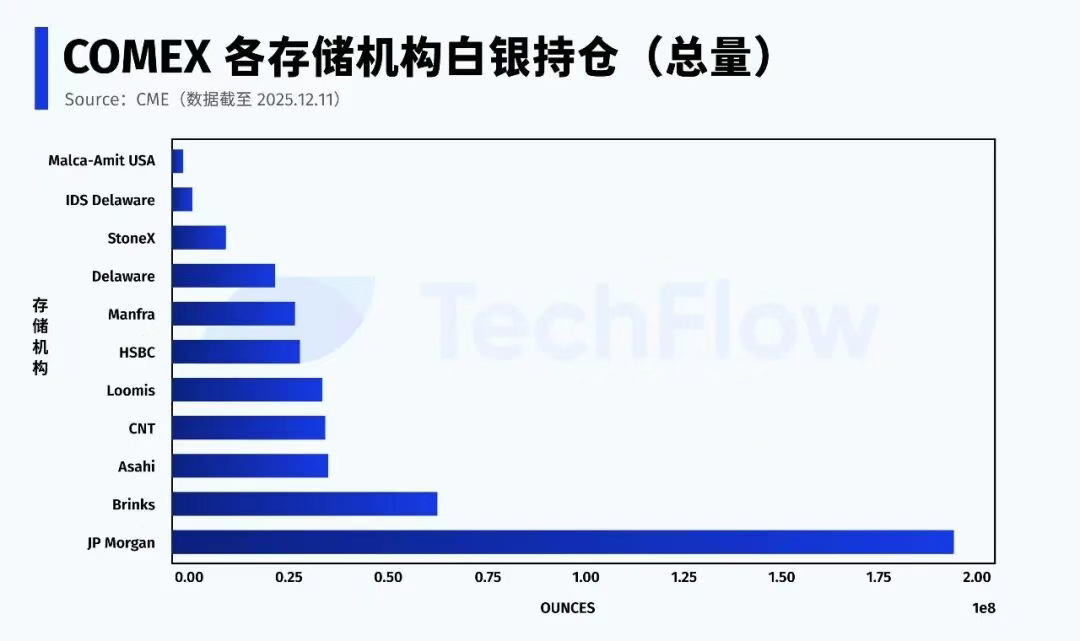
According to the latest CME data from December 11th, JPMorgan holds approximately 196 million ounces of silver within the COMEX system (proprietary + brokerage), accounting for nearly 43% of the exchange's total inventory.
Furthermore, JPMorgan has a special身份: the custodian for the silver ETF (SLV). As of November 2025, it custodies 517 million ounces of silver, worth $32.1 billion.

More crucially, in the Eligible silver category (silver that qualifies for delivery but hasn't been registered as deliverable), JPMorgan controls over half the volume.

In any round of silver squeeze行情, the market truly博弈 over two points: First, who can produce physical silver; Second, whether, and when, this silver is allowed into the delivery pool.

Unlike its past role as a major silver short, JPMorgan now sits at the "silver gate."

Currently, Registered (deliverable) silver accounts for only about 30% of total inventory. When the majority of Eligible silver is highly concentrated in a few institutions, the stability of the silver futures market effectively depends on the behavioral choices of very few key players.

The Paper System Gradually Failing

If one had to describe the current silver market in one sentence, it would be:

The rally continues, but the rules have changed.

The market has undergone an irreversible shift; trust in the silver "paper system" is crumbling.

Silver is not an isolated case; the same change is happening in the gold market.

Gold inventories in New York futures exchanges continue to decline, Registered gold repeatedly touches lows, forcing exchanges to transfer bars from originally non-deliverable "Eligible" gold to complete matches.

Globally, capital is quietly undergoing a migration.

Over the past decade-plus, the direction of mainstream asset allocation was highly financialized—ETFs, derivatives, structured products, leverage tools. Everything could be "securitized."

Now, more and more capital is withdrawing from financial assets,转而 seeking physical assets that don't rely on financial intermediaries or credit背书,典型的 being gold and silver.

Central banks are continuously and massively increasing gold holdings, almost无一例外 opting for physical form. Russia has banned gold exports; even Western countries like Germany and the Netherlands have demanded the repatriation of gold reserves stored overseas.

Liquidity is giving way to certainty.

When gold supply cannot meet the huge physical demand, capital begins to look for substitutes, and silver naturally becomes the first choice.

The essence of this physicalization movement is the re-contesting of monetary pricing power against the backdrop of a weak US dollar and deglobalization.

According to a Bloomberg report in October, global gold is moving from West to East.

Data from US CME and the London Bullion Market Association (LBMA) show that since late April, over 527 tons of gold have flowed out of the vaults of New York and London, the two largest Western markets. Meanwhile, gold imports have increased in major Asian gold-consuming countries like China. China's gold imports in August hit a four-year high.

In response to market changes, in late November 2025, JPMorgan moved its precious metals trading desk from the US to Singapore.

Behind the surge in gold and silver lies the return of the concept of the "gold standard." It might not be realistic short-term, but one thing is certain: Whoever holds more physical metal holds greater pricing power.

When the music stops, only those holding real gold and silver can sit down safely.

Related Questions

QWhat are the main factors driving the recent surge in silver prices according to mainstream analysis?

AAccording to mainstream analysis, the surge in silver prices is driven by the Federal Reserve's interest rate cut expectations, which reignited the precious metals market, as well as strong industrial demand from solar energy, electric vehicles, data centers, and AI infrastructure. Additionally, global inventories have been consistently declining due to lower-than-expected mine output from Mexico and Peru.

QWhy is the structure of the silver market considered dangerous compared to gold?

AThe silver market is considered dangerous because it lacks the 'national team' support that gold has, as central banks hold almost no official silver reserves. It has a much smaller market depth with a daily trading volume of only $5 billion compared to gold's $150 billion. The market is dominated by 'paper silver' products like futures and ETFs, making it highly susceptible to volatility and liquidity crises when large funds enter.

QWhat is a 'short squeeze' in the futures market, and how is it related to the current silver price movement?

AA 'short squeeze' occurs when traders who have bet on falling prices (short sellers) are forced to buy back contracts at higher prices to limit losses, further driving up prices. In the silver market, this is evidenced by the unusual 'futures premium' where futures prices are systematically higher than spot prices, suggesting that funds are aggressively pushing up futures prices rather than the movement being solely based on gradual fundamental improvements.

QWhat role does JPMorgan play in the silver market, and why is it significant?

AJPMorgan is a dominant player in the silver market, holding approximately 43% of COMEX silver inventories and acting as the custodian for the iShares Silver Trust (SLV) ETF, which holds over 517 million ounces of silver. It controls more than half of the 'Eligible' silver (metal that qualifies for delivery but isn't yet registered). This positions JPMorgan as a key 'gatekeeper' that significantly influences the availability of physical silver for delivery, thereby impacting market stability.

QWhat broader trend does the current situation in the silver market represent regarding financial assets?

AThe situation represents a broader trend of a 'physicalization' movement, where trust in the 'paper' financial system (ETFs, derivatives) is eroding. Investors and central banks are increasingly moving away from highly financialized assets and seeking safety in physical assets like gold and silver that do not rely on financial intermediaries or credit backing. This shift is a response to de-globalization and a contest for monetary pricing power in a weaker dollar environment, emphasizing that 'whoever holds more physical metal holds greater pricing power.'

Related Reads

Trading

Spot
Futures

Hot Articles

What is SONIC

Sonic: Pioneering the Future of Gaming in Web3 Introduction to Sonic In the ever-evolving landscape of Web3, the gaming industry stands out as one of the most dynamic and promising sectors. At the forefront of this revolution is Sonic, a project designed to amplify the gaming ecosystem on the Solana blockchain. Leveraging cutting-edge technology, Sonic aims to deliver an unparalleled gaming experience by efficiently processing millions of requests per second, ensuring that players enjoy seamless gameplay while maintaining low transaction costs. This article delves into the intricate details of Sonic, exploring its creators, funding sources, operational mechanics, and the timeline of significant events that have shaped its journey. What is Sonic? Sonic is an innovative layer-2 network that operates atop the Solana blockchain, specifically tailored to enhance the existing Solana gaming ecosystem. It accomplishes this through a customised, VM-agnostic game engine paired with a HyperGrid interpreter, facilitating sovereign game economies that roll up back to the Solana platform. The primary goals of Sonic include: Enhanced Gaming Experiences: Sonic is committed to offering lightning-fast on-chain gameplay, allowing players and developers to engage with games at previously unattainable speeds. Atomic Interoperability: This feature enables transactions to be executed within Sonic without the need to redeploy Solana programmes and accounts. This makes the process more efficient and directly benefits from Solana Layer1 services and liquidity. Seamless Deployment: Sonic allows developers to write for Ethereum Virtual Machine (EVM) based systems and execute them on Solana’s SVM infrastructure. This interoperability is crucial for attracting a broader range of dApps and decentralised applications to the platform. Support for Developers: By offering native composable gaming primitives and extensible data types - dining within the Entity-Component-System (ECS) framework - game creators can craft intricate business logic with ease. Overall, Sonic's unique approach not only caters to players but also provides an accessible and low-cost environment for developers to innovate and thrive. Creator of Sonic The information regarding the creator of Sonic is somewhat ambiguous. However, it is known that Sonic's SVM is owned by the company Mirror World. The absence of detailed information about the individuals behind Sonic reflects a common trend in several Web3 projects, where collective efforts and partnerships often overshadow individual contributions. Investors of Sonic Sonic has garnered considerable attention and support from various investors within the crypto and gaming sectors. Notably, the project raised an impressive $12 million during its Series A funding round. The round was led by BITKRAFT Ventures, with other notable investors including Galaxy, Okx Ventures, Interactive, Big Brain Holdings, and Mirana. This financial backing signifies the confidence that investment foundations have in Sonic’s potential to revolutionise the Web3 gaming landscape, further validating its innovative approaches and technologies. How Does Sonic Work? Sonic utilises the HyperGrid framework, a sophisticated parallel processing mechanism that enhances its scalability and customisability. Here are the core features that set Sonic apart: Lightning Speed at Low Costs: Sonic offers one of the fastest on-chain gaming experiences compared to other Layer-1 solutions, powered by the scalability of Solana’s virtual machine (SVM). Atomic Interoperability: Sonic enables transaction execution without redeployment of Solana programmes and accounts, effectively streamlining the interaction between users and the blockchain. EVM Compatibility: Developers can effortlessly migrate decentralised applications from EVM chains to the Solana environment using Sonic’s HyperGrid interpreter, increasing the accessibility and integration of various dApps. Ecosystem Support for Developers: By exposing native composable gaming primitives, Sonic facilitates a sandbox-like environment where developers can experiment and implement business logic, greatly enhancing the overall development experience. Monetisation Infrastructure: Sonic natively supports growth and monetisation efforts, providing frameworks for traffic generation, payments, and settlements, thereby ensuring that gaming projects are not only viable but also sustainable financially. Timeline of Sonic The evolution of Sonic has been marked by several key milestones. Below is a brief timeline highlighting critical events in the project's history: 2022: The Sonic cryptocurrency was officially launched, marking the beginning of its journey in the Web3 gaming arena. 2024: June: Sonic SVM successfully raised $12 million in a Series A funding round. This investment allowed Sonic to further develop its platform and expand its offerings. August: The launch of the Sonic Odyssey testnet provided users with the first opportunity to engage with the platform, offering interactive activities such as collecting rings—a nod to gaming nostalgia. October: SonicX, an innovative crypto game integrated with Solana, made its debut on TikTok, capturing the attention of over 120,000 users within a short span. This integration illustrated Sonic’s commitment to reaching a broader, global audience and showcased the potential of blockchain gaming. Key Points Sonic SVM is a revolutionary layer-2 network on Solana explicitly designed to enhance the GameFi landscape, demonstrating great potential for future development. HyperGrid Framework empowers Sonic by introducing horizontal scaling capabilities, ensuring that the network can handle the demands of Web3 gaming. Integration with Social Platforms: The successful launch of SonicX on TikTok displays Sonic’s strategy to leverage social media platforms to engage users, exponentially increasing the exposure and reach of its projects. Investment Confidence: The substantial funding from BITKRAFT Ventures, among others, emphasizes the robust backing Sonic has, paving the way for its ambitious future. In conclusion, Sonic encapsulates the essence of Web3 gaming innovation, striking a balance between cutting-edge technology, developer-centric tools, and community engagement. As the project continues to evolve, it is poised to redefine the gaming landscape, making it a notable entity for gamers and developers alike. As Sonic moves forward, it will undoubtedly attract greater interest and participation, solidifying its place within the broader narrative of blockchain gaming.

1.1k Total ViewsPublished 2024.04.04Updated 2024.12.03

What is SONIC

What is $S$

Understanding SPERO: A Comprehensive Overview Introduction to SPERO As the landscape of innovation continues to evolve, the emergence of web3 technologies and cryptocurrency projects plays a pivotal role in shaping the digital future. One project that has garnered attention in this dynamic field is SPERO, denoted as SPERO,$$s$. This article aims to gather and present detailed information about SPERO, to help enthusiasts and investors understand its foundations, objectives, and innovations within the web3 and crypto domains. What is SPERO,$$s$? SPERO,$$s$ is a unique project within the crypto space that seeks to leverage the principles of decentralisation and blockchain technology to create an ecosystem that promotes engagement, utility, and financial inclusion. The project is tailored to facilitate peer-to-peer interactions in new ways, providing users with innovative financial solutions and services. At its core, SPERO,$$s$ aims to empower individuals by providing tools and platforms that enhance user experience in the cryptocurrency space. This includes enabling more flexible transaction methods, fostering community-driven initiatives, and creating pathways for financial opportunities through decentralised applications (dApps). The underlying vision of SPERO,$$s$ revolves around inclusiveness, aiming to bridge gaps within traditional finance while harnessing the benefits of blockchain technology. Who is the Creator of SPERO,$$s$? The identity of the creator of SPERO,$$s$ remains somewhat obscure, as there are limited publicly available resources providing detailed background information on its founder(s). This lack of transparency can stem from the project's commitment to decentralisation—an ethos that many web3 projects share, prioritising collective contributions over individual recognition. By centring discussions around the community and its collective goals, SPERO,$$s$ embodies the essence of empowerment without singling out specific individuals. As such, understanding the ethos and mission of SPERO remains more important than identifying a singular creator. Who are the Investors of SPERO,$$s$? SPERO,$$s$ is supported by a diverse array of investors ranging from venture capitalists to angel investors dedicated to fostering innovation in the crypto sector. The focus of these investors generally aligns with SPERO's mission—prioritising projects that promise societal technological advancement, financial inclusivity, and decentralised governance. These investor foundations are typically interested in projects that not only offer innovative products but also contribute positively to the blockchain community and its ecosystems. The backing from these investors reinforces SPERO,$$s$ as a noteworthy contender in the rapidly evolving domain of crypto projects. How Does SPERO,$$s$ Work? SPERO,$$s$ employs a multi-faceted framework that distinguishes it from conventional cryptocurrency projects. Here are some of the key features that underline its uniqueness and innovation: Decentralised Governance: SPERO,$$s$ integrates decentralised governance models, empowering users to participate actively in decision-making processes regarding the project’s future. This approach fosters a sense of ownership and accountability among community members. Token Utility: SPERO,$$s$ utilises its own cryptocurrency token, designed to serve various functions within the ecosystem. These tokens enable transactions, rewards, and the facilitation of services offered on the platform, enhancing overall engagement and utility. Layered Architecture: The technical architecture of SPERO,$$s$ supports modularity and scalability, allowing for seamless integration of additional features and applications as the project evolves. This adaptability is paramount for sustaining relevance in the ever-changing crypto landscape. Community Engagement: The project emphasises community-driven initiatives, employing mechanisms that incentivise collaboration and feedback. By nurturing a strong community, SPERO,$$s$ can better address user needs and adapt to market trends. Focus on Inclusion: By offering low transaction fees and user-friendly interfaces, SPERO,$$s$ aims to attract a diverse user base, including individuals who may not previously have engaged in the crypto space. This commitment to inclusion aligns with its overarching mission of empowerment through accessibility. Timeline of SPERO,$$s$ Understanding a project's history provides crucial insights into its development trajectory and milestones. Below is a suggested timeline mapping significant events in the evolution of SPERO,$$s$: Conceptualisation and Ideation Phase: The initial ideas forming the basis of SPERO,$$s$ were conceived, aligning closely with the principles of decentralisation and community focus within the blockchain industry. Launch of Project Whitepaper: Following the conceptual phase, a comprehensive whitepaper detailing the vision, goals, and technological infrastructure of SPERO,$$s$ was released to garner community interest and feedback. Community Building and Early Engagements: Active outreach efforts were made to build a community of early adopters and potential investors, facilitating discussions around the project’s goals and garnering support. Token Generation Event: SPERO,$$s$ conducted a token generation event (TGE) to distribute its native tokens to early supporters and establish initial liquidity within the ecosystem. Launch of Initial dApp: The first decentralised application (dApp) associated with SPERO,$$s$ went live, allowing users to engage with the platform's core functionalities. Ongoing Development and Partnerships: Continuous updates and enhancements to the project's offerings, including strategic partnerships with other players in the blockchain space, have shaped SPERO,$$s$ into a competitive and evolving player in the crypto market. Conclusion SPERO,$$s$ stands as a testament to the potential of web3 and cryptocurrency to revolutionise financial systems and empower individuals. With a commitment to decentralised governance, community engagement, and innovatively designed functionalities, it paves the way toward a more inclusive financial landscape. As with any investment in the rapidly evolving crypto space, potential investors and users are encouraged to research thoroughly and engage thoughtfully with the ongoing developments within SPERO,$$s$. The project showcases the innovative spirit of the crypto industry, inviting further exploration into its myriad possibilities. While the journey of SPERO,$$s$ is still unfolding, its foundational principles may indeed influence the future of how we interact with technology, finance, and each other in interconnected digital ecosystems.

54 Total ViewsPublished 2024.12.17Updated 2024.12.17

What is $S$

What is AGENT S

Agent S: The Future of Autonomous Interaction in Web3 Introduction In the ever-evolving landscape of Web3 and cryptocurrency, innovations are constantly redefining how individuals interact with digital platforms. One such pioneering project, Agent S, promises to revolutionise human-computer interaction through its open agentic framework. By paving the way for autonomous interactions, Agent S aims to simplify complex tasks, offering transformative applications in artificial intelligence (AI). This detailed exploration will delve into the project's intricacies, its unique features, and the implications for the cryptocurrency domain. What is Agent S? Agent S stands as a groundbreaking open agentic framework, specifically designed to tackle three fundamental challenges in the automation of computer tasks: Acquiring Domain-Specific Knowledge: The framework intelligently learns from various external knowledge sources and internal experiences. This dual approach empowers it to build a rich repository of domain-specific knowledge, enhancing its performance in task execution. Planning Over Long Task Horizons: Agent S employs experience-augmented hierarchical planning, a strategic approach that facilitates efficient breakdown and execution of intricate tasks. This feature significantly enhances its ability to manage multiple subtasks efficiently and effectively. Handling Dynamic, Non-Uniform Interfaces: The project introduces the Agent-Computer Interface (ACI), an innovative solution that enhances the interaction between agents and users. Utilizing Multimodal Large Language Models (MLLMs), Agent S can navigate and manipulate diverse graphical user interfaces seamlessly. Through these pioneering features, Agent S provides a robust framework that addresses the complexities involved in automating human interaction with machines, setting the stage for myriad applications in AI and beyond. Who is the Creator of Agent S? While the concept of Agent S is fundamentally innovative, specific information about its creator remains elusive. The creator is currently unknown, which highlights either the nascent stage of the project or the strategic choice to keep founding members under wraps. Regardless of anonymity, the focus remains on the framework's capabilities and potential. Who are the Investors of Agent S? As Agent S is relatively new in the cryptographic ecosystem, detailed information regarding its investors and financial backers is not explicitly documented. The lack of publicly available insights into the investment foundations or organisations supporting the project raises questions about its funding structure and development roadmap. Understanding the backing is crucial for gauging the project's sustainability and potential market impact. How Does Agent S Work? At the core of Agent S lies cutting-edge technology that enables it to function effectively in diverse settings. Its operational model is built around several key features: Human-like Computer Interaction: The framework offers advanced AI planning, striving to make interactions with computers more intuitive. By mimicking human behaviour in tasks execution, it promises to elevate user experiences. Narrative Memory: Employed to leverage high-level experiences, Agent S utilises narrative memory to keep track of task histories, thereby enhancing its decision-making processes. Episodic Memory: This feature provides users with step-by-step guidance, allowing the framework to offer contextual support as tasks unfold. Support for OpenACI: With the ability to run locally, Agent S allows users to maintain control over their interactions and workflows, aligning with the decentralised ethos of Web3. Easy Integration with External APIs: Its versatility and compatibility with various AI platforms ensure that Agent S can fit seamlessly into existing technological ecosystems, making it an appealing choice for developers and organisations. These functionalities collectively contribute to Agent S's unique position within the crypto space, as it automates complex, multi-step tasks with minimal human intervention. As the project evolves, its potential applications in Web3 could redefine how digital interactions unfold. Timeline of Agent S The development and milestones of Agent S can be encapsulated in a timeline that highlights its significant events: September 27, 2024: The concept of Agent S was launched in a comprehensive research paper titled “An Open Agentic Framework that Uses Computers Like a Human,” showcasing the groundwork for the project. October 10, 2024: The research paper was made publicly available on arXiv, offering an in-depth exploration of the framework and its performance evaluation based on the OSWorld benchmark. October 12, 2024: A video presentation was released, providing a visual insight into the capabilities and features of Agent S, further engaging potential users and investors. These markers in the timeline not only illustrate the progress of Agent S but also indicate its commitment to transparency and community engagement. Key Points About Agent S As the Agent S framework continues to evolve, several key attributes stand out, underscoring its innovative nature and potential: Innovative Framework: Designed to provide an intuitive use of computers akin to human interaction, Agent S brings a novel approach to task automation. Autonomous Interaction: The ability to interact autonomously with computers through GUI signifies a leap towards more intelligent and efficient computing solutions. Complex Task Automation: With its robust methodology, it can automate complex, multi-step tasks, making processes faster and less error-prone. Continuous Improvement: The learning mechanisms enable Agent S to improve from past experiences, continually enhancing its performance and efficacy. Versatility: Its adaptability across different operating environments like OSWorld and WindowsAgentArena ensures that it can serve a broad range of applications. As Agent S positions itself in the Web3 and crypto landscape, its potential to enhance interaction capabilities and automate processes signifies a significant advancement in AI technologies. Through its innovative framework, Agent S exemplifies the future of digital interactions, promising a more seamless and efficient experience for users across various industries. Conclusion Agent S represents a bold leap forward in the marriage of AI and Web3, with the capacity to redefine how we interact with technology. While still in its early stages, the possibilities for its application are vast and compelling. Through its comprehensive framework addressing critical challenges, Agent S aims to bring autonomous interactions to the forefront of the digital experience. As we move deeper into the realms of cryptocurrency and decentralisation, projects like Agent S will undoubtedly play a crucial role in shaping the future of technology and human-computer collaboration.

545 Total ViewsPublished 2025.01.14Updated 2025.01.14

What is AGENT S

Discussions

Welcome to the HTX Community. Here, you can stay informed about the latest platform developments and gain access to professional market insights. Users' opinions on the price of S (S) are presented below.

活动图片