The Mag7 Myth Shatters: 9 Consecutive Drops, Amazon Follows Microsoft into Bear Market

marsbitPublished on 2026-02-14Last updated on 2026-02-14

Abstract

Amazon's stock has experienced a nine-day losing streak, its longest in nearly two decades, officially entering a bear market after falling more than 23% from its recent high. It becomes the second member of the "Magnificent Seven" (Mag7) to do so, following Microsoft, which entered a bear market in late January and is down 27.8%. Meta is also nearing bear market territory, down 19.6% from its peak, as investor confidence is shaken by aggressive AI spending plans. The four major cloud hyperscalers—Amazon, Microsoft, Meta, and Alphabet—are projected to spend a combined $650 billion on capital expenditures in AI by 2026, with Amazon leading at $200 billion. This massive spending is raising significant concerns among investors about returns on investment and its impact on free cash flow. For Amazon, this level of expenditure could push its free cash flow into negative territory this year, potentially forcing it to raise more capital from debt markets. Analysts note a rotation within the Mag7, with investors moving away from companies like Microsoft and Nvidia to favor others like Alphabet, whose vertically integrated tech infrastructure helps alleviate some spending concerns. The next key catalyst for AI-related stocks is expected to be Nvidia's earnings report on February 25th, which will indicate whether the AI boom is sustaining.

Author: Zhao Ying, Bao Yilong, Wall Street Insights

Amazon's stock has fallen for nine consecutive days, marking its longest losing streak in nearly 20 years.

After entering a technical bear market on Thursday, becoming the second Mag7 company to fall into a bear market, Amazon's stock continued to decline on Friday.

Investors are strongly resisting the aggressive AI spending plans of tech giants, leading to significant declines in these star stocks.

On Friday, Amazon's stock closed at $198.79, down more than 23% from its recent high, officially crossing the bear market threshold the previous day, Thursday.

Among the four major hyperscale cloud service providers, Amazon has the highest planned capital expenditure for 2026, reaching $200 billion.

Amazon, Microsoft, Meta, and Alphabet are expected to collectively spend $650 billion on capital expenditures in the AI field by 2026.

Meta could be the next Mag7 member to fall into a bear market. As of Friday's close, it was down 19.6% from last year's high, just 0.4% away from the bear market threshold of a 20% decline. Although Meta's Q4 revenue and profits exceeded Wall Street expectations, increased AI spending and margin pressures have dampened investor confidence.

Microsoft was the first Mag7 member to enter a bear market. The company's stock fell into a bear market on January 29, after the Azure cloud business growth reported the previous day fell short of investor expectations. As of Friday's close, Microsoft's stock was down 27.8% from its recent high.
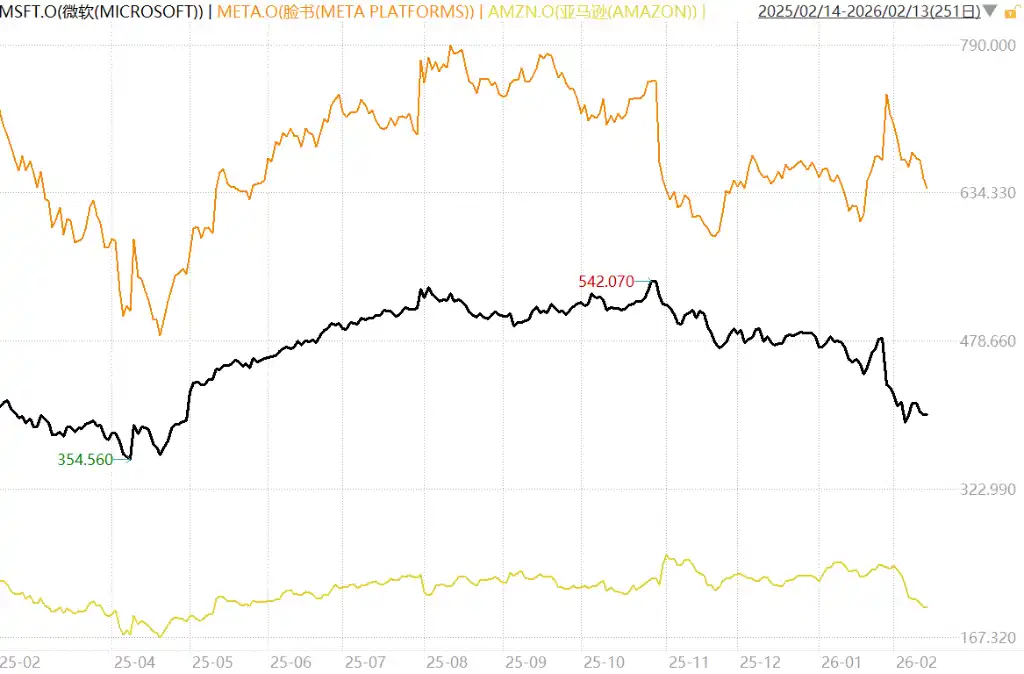
(Chart of Amazon, Microsoft, and Meta's performance over the past year)

Investors Rotate Within Mag7, Free Cash Flow Pressure Highlights

Mike Treacy, Vice President of Risk at Apex Fintech Solutions, stated that the recent sell-off highlights the growing divergence among Mag7 members.

Since last fall, investors have shifted away from OpenAI-related deals involving Microsoft, NVIDIA, and Oracle, favoring the Alphabet and Broadcom ecosystems instead.

Treacy pointed out that Alphabet's vertically integrated technology stack has somewhat offset concerns about excessive spending, shielding the stock from the worst of the tech sell-off. Alphabet's stock closed Thursday down 9.2% from its recent high.

Treacy noted that Google's self-sufficiency should command a premium relative to other companies that may be adversely affected by a single link in the industry chain.

Amazon, Microsoft, and Meta's stocks have been hit harder because investors lack confidence that these companies' AI spending will yield sufficient returns on investment.

For Amazon, the increased level of expenditure could lead to negative free cash flow this year, meaning the company may need to start raising more funds in the debt market.

Treacy believes that the next major catalyst for AI trades will be NVIDIA's earnings report on February 25. This report will show whether the AI boom is cooling down or if NVIDIA has successfully captured the tens of billions of dollars its largest clients are investing into the field.

Related reading: Trading Moment: AI Panic Escalates Ahead of CPI, Bitcoin Grinds Bottom, May Struggle to Repeat "Spring Festival Rally"


Related Questions

QWhat is the main reason for the recent decline in Mag7 stocks, particularly Amazon and Microsoft?

AInvestors are strongly resisting the aggressive AI spending plans of tech giants, leading to significant sell-offs in these star stocks.

QWhich Mag7 company was the first to enter a bear market, and when did it happen?

AMicrosoft was the first Mag7 member to enter a bear market, with its stock falling into bear territory on January 29.

QHow much is Amazon's planned capital expenditure for 2026, and what is the total AI-related capital expenditure expected from the four major cloud service providers?

AAmazon plans a capital expenditure of $200 billion for 2026. The four major cloud service providers (Amazon, Microsoft, Meta, and Alphabet) are expected to spend a total of $650 billion in AI-related capital expenditures by 2026.

QWhich Mag7 company is at risk of being the next to fall into a bear market, and how close is it to the 20% decline threshold?

AMeta is at risk of being the next Mag7 member to fall into a bear market. As of Friday's close, it was down 19.6% from last year's high, just 0.4% away from the bear market threshold of a 20% decline.

QWhat potential financial pressure does Amazon face due to its increased capital expenditure in AI?

AThe increase in capital expenditure levels could lead Amazon's free cash flow to turn negative this year, meaning the company may need to raise more capital by entering the debt market.

Related Reads

Stuck Polymarket: The Real Test After Riding the Traffic Boom Has Arrived

Polymarket, a leading prediction market platform, is facing significant technical challenges as its growth outpaces its current infrastructure on Polygon. Users are experiencing laggy transactions, unresponsive orders, and delayed confirmations, severely impacting the trading experience. In response, DeFi Engineering VP Josh Stevens outlined a comprehensive engineering overhaul. The plan includes reducing on-chain data delays, fixing order cancellation issues, rebuilding the central limit order book (CLOB), improving website performance, and developing a unified SDK and API. A major revelation was the ongoing "chain migration," indicating a potential move away from Polygon. The core issue is that Polymarket has evolved from a simple prediction market into a high-frequency trading platform, making Polygon's limitations—such as block space, gas fees, and block time—a ceiling for further growth. The migration is not just a simple chain switch but a fundamental rebuild of its trading system to support more complex products like perpetual contracts (Perps). This announcement has sparked competition among chains like Solana, Sui, and Algorand, all vying to host Polymarket. For Polygon, losing this key application, which contributes significantly to its gas fee revenue, would be a major setback. The real test for Polymarket is no longer attracting users but proving it can provide a stable, reliable trading environment that retains them.

Odaily星球日报57m ago

Stuck Polymarket: The Real Test After Riding the Traffic Boom Has Arrived

Odaily星球日报57m ago

Lowering Expectations for BTC's Next Bull Market

The author, Alex Xu, explains his decision to significantly reduce his Bitcoin holdings (from full to ~30% of his portfolio) during the current bull cycle, citing a lowered long-term outlook for BTC's price appreciation in the next cycle. He outlines six key reasons for this reduced expectation: 1. **Diminished Growth Drivers:** The narrative of exponential user adoption has largely played out with institutional ETF adoption. The next major growth phase—adoption by sovereign national reserves or central banks—seems unlikely in the near future. 2. **Personal Opportunity Cost:** More attractive investment opportunities have emerged in other assets, such as undervalued companies. 3. **Industry-Wide Contraction:** The broader crypto industry is struggling, with most Web3 business models (SocialFi, GameFi, DePIN) failing. This overall萧条 (depression) reduces the fundamental demand and consensus for Bitcoin. 4. **Strain on Major Buyer:** MicroStrategy, a major corporate buyer of BTC, faces rising financing expenses for its debt, which could slow its purchasing rate and create significant marginal pressure on the market. 5. **Increased Competition from Gold:** The emergence of "tokenized gold" has closed the functional gap (portability, divisibility) between physical gold and Bitcoin, offering a strong competitor in the non-sovereign store-of-value space. 6. **Security Budget Concerns:** The block reward halving continues to exacerbate the long-standing issue of funding Bitcoin's network security, with new fee source explorations like Ordinals and L2s largely failing. The author's decision to hold a significant (though reduced) position reflects a cautious, not bearish, outlook. He remains open to increasing his exposure if the fundamental reasons for his skepticism change or if new positive catalysts emerge.

marsbit1h ago

Lowering Expectations for BTC's Next Bull Market

marsbit1h ago

Trading

Spot
Futures
活动图片




