The Hidden Realities and Concerns Behind Web3 Unicorn Phantom

marsbitPublished on 2025-12-23Last updated on 2025-12-23

Abstract

The Web3 unicorn Phantom, valued at $3 billion, has navigated a challenging 2025 in the crypto wallet market. While its user base grew to nearly 20 million monthly active users and assets under custody surpassed $25 billion, its market share in embedded swaps plummeted from 10% to just 0.5%, as users migrated to exchange-linked wallets offering lower fees and stronger incentives. Phantom, which started on Solana and expanded multi-chain, remains heavily dependent on the Solana ecosystem, with 97% of its swap transactions occurring there. This has posed risks as Solana's TVL declined over 34% from its peak. In response, Phantom has aggressively pursued new product lines to diversify revenue and usage. Key launches include its native stablecoin CASH, which surpassed $100 million in supply; a Phantom-branded debit card for spending crypto in the U.S.; the acquisition of trading tools like Solsniper; integration of a prediction market with Kalshi; and the release of a free SDK, Phantom Connect, for easier dApp onboarding. CEO Brandon Millman emphasizes focusing on product over token launches or an IPO, aiming to make crypto a tool for everyday payments. However, the path is competitive, with MetaMask having already launched a similar card in more regions. The success of Phantom's debit card and the sustainability of its stablecoin remain to be proven as it battles to define the future of independent non-custodial wallets.

Author: zhou, ChainCatcher

The cryptocurrency wallet market in 2025 is witnessing a fierce battle for market share.

As the meme coin frenzy subsides, high-frequency trading users are increasingly migrating to exchange-affiliated wallets that offer lower fees and stronger incentives. In the face of the closed-loop ecosystems of exchanges, the survival space for independent players is continuously shrinking.

Against this backdrop, Phantom's performance has drawn attention. Earlier this year, it raised $150 million in funding, pushing its valuation to $3 billion. Since the fourth quarter, the project has successively launched its own stablecoin CASH, a prediction market platform, and a crypto debit card, attempting to find new growth points beyond trading business.

$3 Billion Valuation: From Solana Origins to Multi-Chain Expansion

Looking back at Phantom's development history, in 2021, the Solana ecosystem had just exploded, and on-chain infrastructure was still incomplete. Traditional crypto wallets like MetaMask primarily supported Ethereum-based chains, with insufficient compatibility for other chains, resulting in certain user experience shortcomings.

Typically, when creating a wallet, users must manually write down a 12 or 24-word seed phrase. If the key is lost, assets become permanently irrecoverable, which many potential users find cumbersome and risky.

The three founders of Phantom had previously worked for years at 0x Labs (an Ethereum DeFi infrastructure project). They seized this opportunity, choosing to start with Solana to create a wallet with a simple interface and intuitive operation. Their core innovation lies in optimizing the backup process: providing various simple methods such as email login, biometric recognition, and encrypted cloud backup to assist and replace manual copying of seed phrases, significantly lowering the entry barrier for beginners.

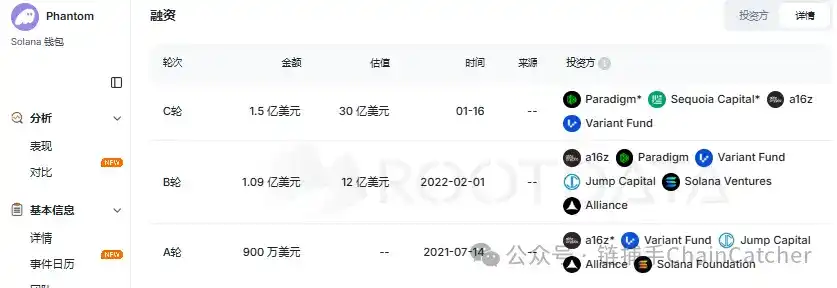
In April 2021, the Phantom browser extension was launched, and within months, its user base exceeded one million, becoming the preferred choice for Solana users. According to RootData, in July of the same year, Phantom, still in its testing phase, received a $9 million Series A funding round led by a16z; in January 2022, Paradigm led a $109 million Series B round, valuing it at $1.2 billion; until early 2025, Paradigm and Sequoia again led a $150 million funding round, pushing its valuation to $3 billion.
As it scaled, Phantom subsequently began expanding its multi-chain footprint, supporting multiple public chains including Ethereum, Polygon, Bitcoin, Base, and Sui, attempting to shed the label of "Solana-specific wallet." However, Phantom still does not natively support BNB Chain, and previously, users have complained that Phantom supports ETH but not BNB Chain, causing issues with claiming airdrops.

Highs and Lows of 2025

2025 has been a year of extremes for Phantom: on one hand, rapid breakthroughs in user and product aspects; on the other, trading volume share being significantly eroded by exchange-affiliated wallets.

Specifically, user growth is a bright spot. Phantom's monthly active users grew from 15 million at the beginning of the year to nearly 20 million by year-end, ranking among the fastest-growing independent wallets, especially with significant user increases in emerging markets like India and Nigeria.

Meanwhile, Phantom's custodial assets under management exceeded $25 billion. At its peak, it generated $44 million in weekly revenue, and its annual revenue once surpassed that of MetaMask. Currently, Phantom's cumulative revenue is close to $570 million.

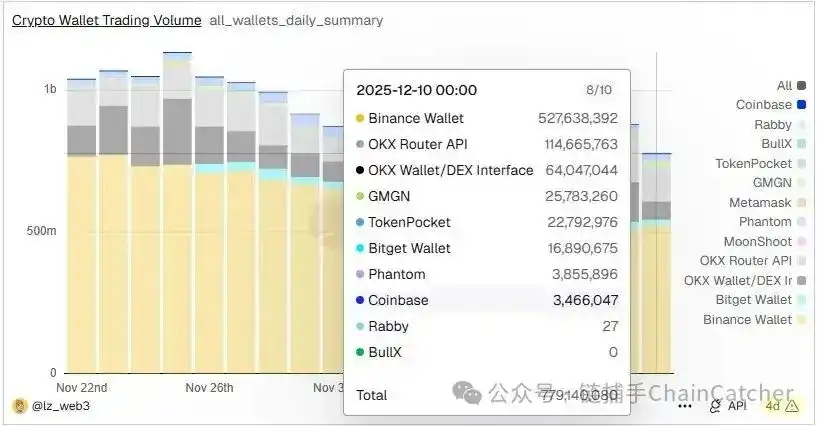
However, concerns on the trading volume side are equally prominent. According to Dune Analytics data, Phantom's share in the global embedded swap market dropped from nearly 10% at the beginning of the year to 2.3% in May, and further shrank to only 0.5% by year-end. Exchange-affiliated wallets, leveraging fee advantages, faster listing speeds, and high airdrop subsidies, have attracted a large number of high-frequency trading users. Currently, Binance Wallet holds nearly 70%, while OKX (wallet + routing API) combined holds over 20%.
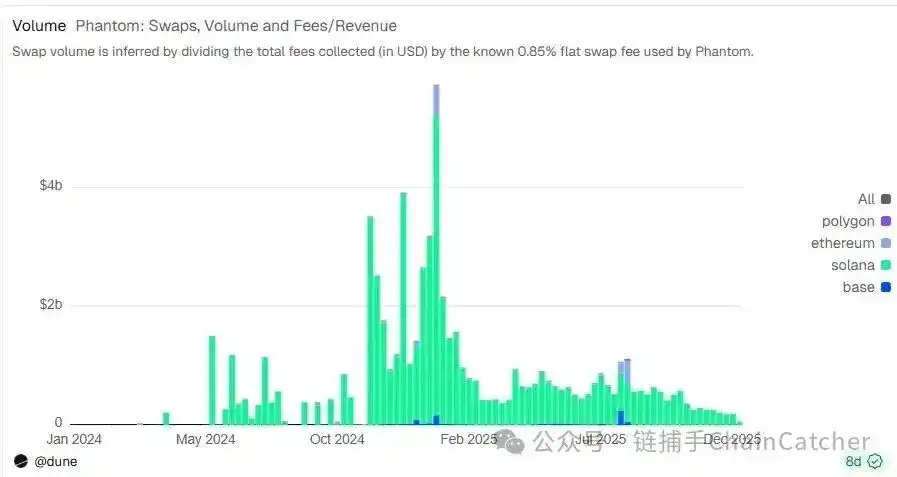
A greater market concern for Phantom lies in its deep binding with Solana. Data shows that 97% of Phantom's swap transactions occur on Solana, while Solana's Total Value Locked (TVL) has fallen more than 34% from its peak of $13.22 billion on September 14, now down to a six-month low of $8.67 billion. This directly drags down Phantom's core trading metrics.
Facing these pressures, Phantom is betting resources on new products, attempting to open up a second growth curve.

In terms of product dimensions, Phantom has launched a series of differentiated features:

  • In July, integrated Hyperliquid perpetual contracts, driving approximately $1.8 billion in trading volume in just about 16 days after launch, generating nearly $930,000 in revenue through rebate mechanisms (builder codes);
  • In August, acquired meme coin monitoring tool Solsniper and NFT data platform SimpleHash, further consolidating coverage of niche trading needs.
  • The native stablecoin CASH, launched at the end of September, quickly saw its supply exceed $100 million, with a November peak of over 160,000 transactions. Its core competitiveness lies in fee-free P2P transfers and accompanying lending rewards;
  • The Phantom Cash debit card, first launched in the US in December, allows users to directly spend on-chain stablecoins with the card, and is compatible with mainstream mobile payments like Apple Pay and Google Pay;
  • On December 12, announced the launch of a prediction market platform, integrating the Kalshi prediction market within the wallet, currently open to eligible users;
  • Simultaneously launched the free SDK "Phantom Connect," allowing users to seamlessly access different web3 applications with the same account, further lowering the onboarding barriers for developers and users.

Among these, the debit card and CASH stablecoin are the most watched. Phantom is attempting to use them to solve the "last mile" problem of spending crypto assets.

Phantom CEO Brandon Millman has publicly stated that in the short term, there will be no token issuance, no IPO, and no building of their own chain. All efforts are focused on refining the product to turn the wallet into a financial tool usable by ordinary people. He believes that the endgame of the wallet race is not about who has the largest trading volume, but about who first brings crypto into daily payments.

However, the path to the "last mile" of cryptocurrency payments is not easy, and Phantom is not the first independent non-custodial wallet to launch a debit card.

Prior to this, MetaMask had already partnered with Mastercard, Baanx, and CompoSecure in Q2 2025 to launch the MetaMask Card, supporting real-time conversion of cryptocurrency to fiat for spending, and rolling out in multiple regions including the EU, UK, and Latin America. MetaMask's card has broader coverage and an earlier start, but is limited by the Ethereum and Linea networks, with higher fees and slower speeds, leading to user feedback that it is "convenient but rarely used."

In comparison, Phantom's debit card started later, currently only available in limited quantities in the US, and its actual adoption remains to be seen. Theoretically, leveraging Solana's low-fee advantage, it might be more competitive in fee-sensitive emerging markets, but it still has a clear gap compared to MetaMask Card in terms of global coverage and merchant acceptance.

Regarding stablecoins, if CASH cannot form a sustained network effect, it may follow the path of other wallet-native stablecoins that started high but fell quickly, such as MetaMask's native stablecoin mUSD, whose supply quickly surpassed the $100 million mark after launch but dropped to about $25 million in less than two months.

Conclusion

As the meme frenzy recedes, trading volume is no longer a reliable moat, and independent wallets must return to the essence of financial services.

Overall, Phantom integrates Hyperliquid perpetual contracts and the Kalshi prediction market on the trading end to retain advanced users; on the consumption end, it bets on the CASH stablecoin and debit card, attempting to truly bring on-chain assets into daily life.

This dual-drive strategy of "trading derivatives + consumption payments" is Phantom's self-redemption under the挤压 (squeeze) of the Matthew effect in the wallet赛道 (race). It is not only searching for a second growth curve but also defining the endgame for independent wallets.


Related Questions

QWhat are the main challenges Phantom is facing in the 2025 crypto wallet market?

APhantom faces challenges including market share in embedded swap transactions (dropping to 0.5% by year-end), intense competition from exchange-linked wallets like Binance Wallet and OKX, and its heavy reliance on the Solana ecosystem, which has seen a significant TVL decline.

QHow did Phantom initially differentiate itself from traditional crypto wallets like MetaMask?

APhantom differentiated itself by simplifying the user experience, offering email login, biometric authentication, and encrypted cloud backups to replace manual seed phrase recording, lowering the entry barrier for new users.

QWhat new products has Phantom launched to diversify beyond its core wallet business?

APhantom launched its native stablecoin CASH, a prediction market platform with Kalshi, an encrypted debit card for spending crypto assets, and acquired tools like Solsniper and SimpleHash. It also integrated Hyperliquid for perpetual contracts and released the Phantom Connect SDK.

QWhy is Phantom's deep integration with Solana considered a potential risk?

A97% of Phantom's swap transactions occur on Solana, and Solana's TVL has dropped over 34% from its peak to a six-month low, directly impacting Phantom's core transaction metrics and exposing it to ecosystem-specific volatility.

QHow does Phantom's approach to crypto payments compare with MetaMask's efforts?

APhantom's debit card, launched later and currently limited to the US, leverages Solana's low fees but has less global coverage than MetaMask Card. MetaMask's card, available in multiple regions, suffers from higher fees and slower speeds due to its Ethereum/Linea foundation.

Related Reads

Global Market Share Survey: Japanese Firms Lead in Semiconductor Materials

Global Market Share Survey: Japanese Firms Lead in Semiconductor Materials According to the 2025 "Major Goods and Services Market Share Survey" by Nikkei, Japanese companies maintain strong positions in semiconductor-related materials. In silicon wafers, Shin-Etsu Chemical ranks first with a 26.3% share, followed by SUMCO at 17.8%. Together, they hold 44.1% of the market, widening their lead over competitors from Taiwan, Germany, and South Korea. In photoresists, Tokyo Ohka Kogyo, JSR, and Shin-Etsu Chemical occupy the top three spots, with a combined share of 60.5%. Despite their strength in materials, Japanese firms have a weaker presence in core semiconductor segments like DRAM and NAND flash memory, where South Korean and U.S. companies dominate. For instance, SK Hynix and Samsung lead in DRAM, while China’s CXMT doubled its share to 6% in 2025. The semiconductor market is projected to grow rapidly, with WSTS forecasting a 90% increase to $1.5112 trillion by 2026. Major players like Samsung, SK Hynix, and Micron are making massive investments to expand capacity. To maintain their edge in materials, Japanese companies must similarly commit to large-scale, risk-taking investments. In contrast, Japan’s automotive sector shows stagnation. Toyota remains the global leader but with only a slight share increase to 12.3%, while Japanese brands are absent from the top five in the EV market. In shipbuilding, Imabari Shipbuilding rose to third place globally with a 7.2% share, benefiting from large container ship deliveries. However, Chinese and South Korean firms dominate the sector, holding the top two positions. Japan aims to revitalize its shipbuilding industry through government and corporate efforts, targeting a near doubling of output by 2035. Addressing labor shortages and adopting advanced technologies like physical AI will be critical for competitiveness.

marsbit17m ago

Global Market Share Survey: Japanese Firms Lead in Semiconductor Materials

marsbit17m ago

STRC Major De-pegging's First Financial Report, How Will Strategy Repair Its Capital Flywheel?

Bitcoin treasury company Strategy released its Q2 2026 earnings report on July 31. Despite a 6.9% year-over-year revenue increase to $122 million, the company recorded a net loss of $8.22 billion, largely due to $8.32 billion in unrealized losses from Bitcoin price fluctuations. As of quarter-end, Strategy holds 843,775 BTC with an average cost of $75,000 per coin, and Bitcoin per share increased. The report highlights a critical shift in Strategy's capital model following the de-pegging of its key financing tool, STRC (Strategic Coin), which fell below its $100 target. Management's top priority is restoring STRC to its target value, aiming for a recovery by September 8. They rule out discounted STRC issuances and plan to maintain its dividend yield at 12%, instead focusing on bolstering its $3.75 billion cash reserve. Strategy has moved from a one-way "buy-and-hold" Bitcoin strategy to active capital management. This new approach, part of its "Digital Credit Capital Framework," involves flexibly managing its balance sheet across four elements: BTC, USD cash, common stock (MSTR), and digital credit securities like STRC. This allows for BTC monetization (having sold $218.4 million in BTC so far), strategic repurchases of discounted securities, and debt optimization, as seen with a $1.5 billion convertible bond buyback. The company's future hinges on two key tests: successfully re-pegging STRC to restore market confidence in its digital credit system, and a long-term recovery in Bitcoin's price to ultimately support its growth thesis.

marsbit1h ago

STRC Major De-pegging's First Financial Report, How Will Strategy Repair Its Capital Flywheel?

marsbit1h ago

STRC's First Financial Report Post-Depegging, How is Strategy Restoring the Capital Flywheel?

On July 31, 2026, Bitcoin treasury company Strategy released its Q2 financial report. Despite a 6.9% year-over-year increase in revenue to $122 million, the company recorded a substantial net loss of $8.22 billion, primarily due to $8.32 billion in unrealized losses from Bitcoin holdings. While Strategy's core Bitcoin strategy remains intact—its holdings grew 11% to 843,775 BTC—the company is undergoing a fundamental shift in its capital model. Following the de-pegging of its key financing tool, the STRCoin (STRC), from its $100 target in May, Strategy has pivoted from a one-directional "raise funds, buy Bitcoin" cycle to a more dynamic, multi-asset capital management approach. A key part of this new framework is the "Monetization Program," through which Strategy has sold approximately $218.4 million worth of BTC to bolster liquidity. The company's top priority is repairing STRC's peg, committing not to issue discounted shares until it returns to its target range. It has initiated a $1 billion buyback program for discounted digital credit securities, having repurchased $28.9 million face value of STRC so far. Management aims to restore the peg around September 8, 2026. Strategy now actively manages a matrix of assets: Bitcoin (for accumulation or strategic sales), USD cash reserves (now at $3.75 billion), common stock (MSTR), and digital credit securities like STRC. This allows for tactical moves like repurchasing discounted debt or equity to capture value. The future success of Strategy's "capital flywheel" hinges on two factors: the short-term ability to successfully re-peg STRC to restore market confidence in its digital credit system, and the long-term price trajectory of Bitcoin, upon which its entire investment thesis ultimately depends.

Odaily星球日报1h ago

STRC's First Financial Report Post-Depegging, How is Strategy Restoring the Capital Flywheel?

Odaily星球日报1h ago

Trading

Spot
活动图片