The Financial Circle is Embracing Knowledge Payment

marsbitPublished on 2026-01-13Last updated on 2026-01-13

Abstract

Financial professionals in China are increasingly turning to knowledge monetization platforms. Notable figures like Hong Hao and Li Bei are achieving significant revenue: Hong Hao's knowledge community generated over 12.5 million RMB in two months after raising its annual fee to 1499 RMB, while Li Bei sold 200 spots for a 12,888 RMB course in just two days, earning 2.57 million RMB. This trend reflects a strategic use of "leverage"—a concept emphasizing scalable, near-zero marginal cost products like media content—to complement traditional labor and capital leverage. Both individuals leverage their macroeconomic expertise and personal branding to attract broad audiences, blending analysis with engaging content like predictions and personal anecdotes. However, their approaches differ: Hong Hao uses his platform to bolster his investment credibility amid uncertain fund performance, while Li Bei employs courses to retain clients and stabilize her asset management firm amid competitive pressures. Ultimately, this shift addresses dual needs: investors seek reliable information and emotional reassurance in noisy markets, while managers aim to cultivate loyal clients directly. As generating alpha becomes harder, selling the "map"—through subscriptions and courses—is emerging as a lucrative alternative.

Author: Shen Hui, Yuanchuan Investment Review

Hong Hao's knowledge planet officially announced a price increase, tagged at 1499 yuan/year, equivalent to a bottle of Moutai.

Before the price hike, the annual fee was 899 yuan. Based on 14,000 recharges, in just two months, Hong Hao's GMV on the knowledge planet reached 12.586 million yuan.

Similarly, Hong Hao's friend Li Bei also ventured into knowledge payment. A course worth 12,888 yuan, with 200 spots, sold out in two days. That is to say, in just two days, Li Bei's course sales revenue reached 2.57 million yuan.

As is well known, media is a notoriously bad business. This conclusion is easily drawn from the media sector's consistently poor performance among the 31 primary sectors of Shenwan. However, in this sunset industry, private domains and selling courses stand out as exceptions, attracting countless financial professionals to bend their backs.

Former Guohai Fixed Income Chief Jin Yi's Douyin account "Bai Nian Talks Politics and Economics" gained 1.6 million followers in three months, with membership for one-on-one consulting services from Chief Jin priced at 4,283 yuan per month; Tan Jun is about to launch the "Industry Decision-Maker Internal Reference Circle," limited to 30 seats, priced at 159,880 yuan; the more upscale-sounding "Bull Bear Beast Club" offers paid members not only access to Fu Peng's financial intelligence courses but also the opportunity to ski with him in Changbai Mountain.

Compared to their American counterparts, who show a stronger willingness to pay, financial consumers in the U.S. are different. The big short seller Michael Burry simply closed his hedge fund and switched to launching an electronic newsletter on Substack priced at $379 per year, attracting 187,000 subscribers in just two months—shorting Nvidia isn't as easy as making money.

Suddenly, financial big shots are jumping in, not competing on who has more investment ideas, but on who has more subscribers. Is investing too hard to make money, or is the business of headcounts too easy?

Three Types of Leverage

Silicon Valley investor Naval Ravikant mentioned that to achieve financial freedom, one needs to use three types of leverage:

  • The first is labor leverage, which means being the boss and having others work for you;
  • The second is capital leverage, like Warren Buffett using capital leverage to expand influence and make money with money;
  • The third, which he considers the most important leverage, is "products with zero marginal cost of reproduction," mainly including code and media.

In Naval's view, the wealth of the new generation of millionaires is created through code and media.

Joe Rogan relies on podcasts to earn $50-100 million annually [1]. Using this new type of leverage, simply by increasing paid memberships and online course sales, one can amplify the results of their labor hundreds or thousands of times. Its advantage is that the cost of reproduction is almost zero, and anyone with a computer and internet access can easily earn passive income.

And Hong Hao and Li Bei恰恰同时拥有这三种杠杆。

Li Bei founded Banxia in 2017, and by 2022, its scale had exceeded 10 billion yuan. She had already achieved financial freedom through labor and capital leverage. As she herself said, she doesn't lack the tens of millions of yuan generated annually from knowledge payment. But it cannot be denied that these tens of millions are far more certain in the short term than waiting for a reversal in China's real estate market.

Compared to Li Bei's colorful业余生活 of baking, gardening, and playing tennis, Hong Hao's recent experiences have been more turbulent.

Earlier, Hong Hao was the Chief Global Strategist at CICC and had worked at Citigroup and Morgan Stanley. In 2022, after leaving Bank of Communications International, he switched between buy-side and sell-side roles,先后 joining Srui Group and Huafu International. He is now the Managing Partner and Chief Investment Officer of Lianhua Capital.

However, Hong Hao's performance has always been a mystery.

In August 2023, he launched the Lotus-AAA fund with Srui and Lianhua Capital. Except for a single-month surge of 8.98% in September 2024, its performance had been lukewarm before. Perhaps because the fund's operation time was too short, when展示业绩, backtested simulated historical performance dating back to September 2002 was also included. At least the chart shows that Hong Hao似乎真有20年累计高达718.77%的投资收益。
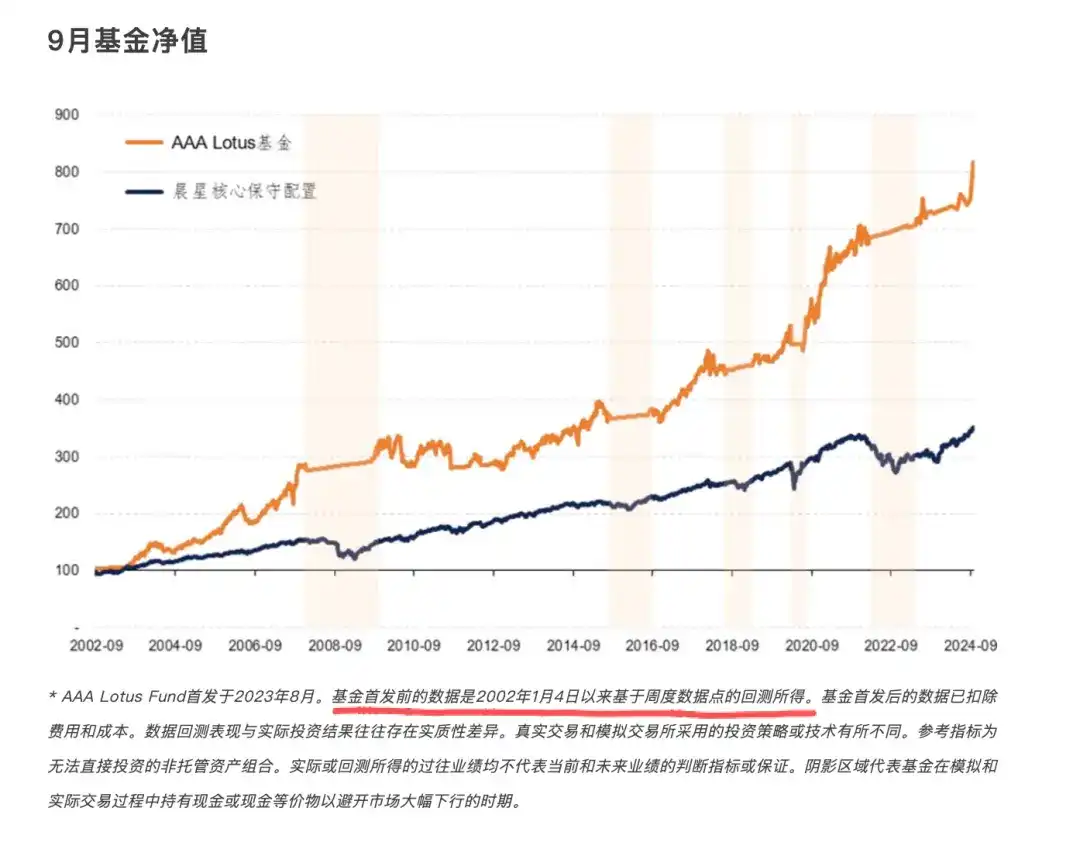
You can question Hong Hao's actual performance, but you cannot question his chart-making ability

Hong Hao and Li Bei are skilled at building IPs and generating traffic. Their熟练运用 of the third type of leverage gives them stronger money-making abilities than their peers in knowledge payment.

In terms of赛道选择, the macro sector where Hong Hao and Li Bei operate naturally reaches a wider audience. Not everyone cares about what Nvidia's open-sourced VLA model is called, but everyone cares whether gold will continue to rise in the future and whether the stock market in the Year of the Red Horse and Red Goat will have the Nine Purple Fire luck.

In terms of表达方式, compared to being lulled to sleep by the ambiguous views of economic grandmasters at roundtable forums, people prefer to listen with wide-eyed interest to Hong Hao predicting the fifth wave of the bull market and Li Bei analyzing the escape from the micro-cap fire. Even if they are evasive, they might意外收获 "MaiMaiMai" (BuyBuyBuy/SellSellSell)的艺术表达—after all, if they win, it's buy buy buy; if they lose, it's sell sell sell.

In terms of写作文体开发, Hong Hao is good at mixing classical Chinese and obscure characters into macro analysis, mysteriously citing various sources, giving people a reading experience that is hard to understand yet greatly震撼. Hong Hao once explained that the best article sounds like废话 but has some unexpected consequences [2]. Li Bei, on the other hand, can skillfully combine her emotional journey with macro analysis, occasionally posting相亲贴 (matchmaking posts), providing some low-participation-threshold topics.

Precisely because people love macro literature掺杂 with "fortune-telling" and "gossip," Hong Hao and Li Bei have captured the huge流量 in the financial circle, also creating a broader entry point for their transition into knowledge payment.

It's All Business

Fund managers are usually cautious about using the third type of leverage.

Because once a fund manager starts writing articles or selling courses, they are seen as not focusing on their main job, diverting time that should be devoted to investment research. Moreover, transitioning to media won't gain more professional recognition, just as people always criticize financial influencers—if their investment ability is strong enough, why would they take time out to teach others how to make money?

Whether it's Hong Hao creating a星球 (knowledge planet) or Li Bei selling courses, their purpose in涉足知识付费 is not simply to transition into self-media.

Compared to Li Bei, Hong Hao transitioned to investment relatively late, and he can't even show a three-year continuous net value curve. Therefore, he更需要 to constantly market the accuracy of his predictions on social media to背书 his investment ability.

On November 28 last year, Business Weekly brought Hong Hao, Li Bei, and Fu Peng together at a roundtable. When the three discussed gold, Fu Peng's views were ambiguous, Li Bei was clearing positions and bearish,只有洪灏公布了详细的卖点—selling all when the gold price reaches $4500/ounce.

This led to质疑, because the price of the main Comex gold futures contract had never reached $4500/ounce at that time. Non-main contracts had briefly reached it, but it was almost impossible for large institutional funds like Hong Hao's to exit at the peak in such low-liquidity contracts.

Hong Hao did not公开详细的黄金交易平仓单, but instead marketed on his星球 "Ten Thousand Witness the Miracle of Predicting Silver." He publicly predicted:

Silver hasn't finished its run; how deep the cup is, how high the target is. If 4500 is a fair price for gold, then for others, we need to use our imagination. New highs are for buying; those who fear heights are destined for hardship.

As written in "The Crowd," he who掌握了影响群众想象力的艺术, also掌握了统治他们的艺术.
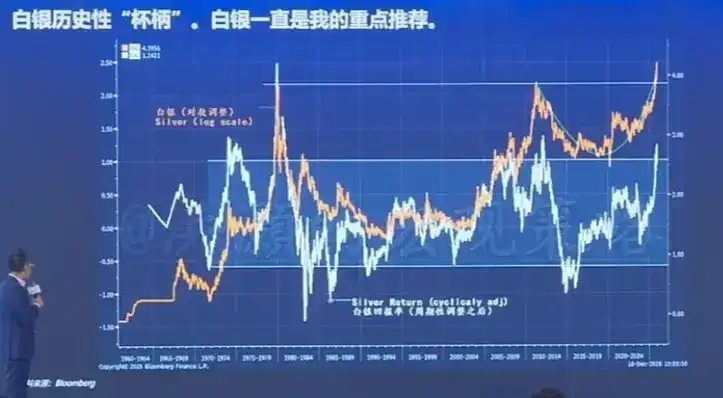
Hong Hao believes silver has formed a giant 60-year "cup and handle" pattern

Ultimately, Lianhua Capital is still not well-known. Posting粉丝的好评 (fan praise) on the星球, creating涨价预期 (price increase expectations) for the星球, and selling more "星球茅台" (Planet Moutai) can孵化 more future私募客户 (private fund clients). Compared to collecting management fees and performance fees, it has higher short-term economic benefits.

After all, outputting a "bullish on silver" view is easy—like the two sides of a coin, you can brag if it goes up—while "heavily betting on silver" involves multi-dimensional博弈 with the market, human nature, rules, and scale.

Compared to Hong Hao, Li Bei faces a different situation. After Banxia crossed the 10-billion-yuan threshold, its performance growth weakened, and it dropped out of the camp of billion-yuan私募 early this year. In an environment where Bridgewater China remains strong and quantitative macro opponents are formidable, the urgent task is to stabilize old clients and avoid redemptions.

Li Bei's approach is to免费赠送 online courses to all Banxia investors and offline courses to investors who have held the fund for more than 2 years or invested more than 5 million yuan. Thus, before the course starts on January 24th, investors wanting to redeem get a赎回冷静期 (redemption cooling-off period).

In November, Minghong's macro product sold out upon launch; in December, Two Sigma's "CTA + Index Enhanced"复合策略 product, with a 2 billion yuan quota, was instantly snapped up across three major channels. This type of multi-strategy product from quantitative私募无形之中 forms a substitute for Li Bei's macro strategy.

Moreover, subjective私募 are gradually declining on the distribution side, and mainstream channels are somewhat avoiding them. In the future, subjective managers will inevitably need to invest more energy in direct sales.

A clever way is to first筛出 (screen out) the customer base with payment ability from fans with a price of 12,888 yuan, and then use slogans like "easily achieving long-term annualized returns of over 10% by taking the course" to锁定 (lock in) those customers who are dissatisfied with wealth management returns and渴望致富 (eager to get rich).

Fans with purchasing power and purchasing desire, after attending Li Bei's offline classes for答疑解惑 (Q&A), can naturally be converted into私募 clients with极少的 time cost and极高的 conversion rate.

Astute managers not only skillfully use the third type of leverage but also善于叠加 use all three types of leverage.

Epilogue

When discussing knowledge payment becoming a trend in the asset management industry, many people think of two aspects:

  • First, the pressure from salary cuts in the financial industry prompts practitioners to seek other sources of income;
  • Second, switching from investment to media is like降维打击 (attacking from a higher dimension). Precisely because of this, financial self-media is the首选副业 (preferred side job) for most financial practitioners.

But looking deeper, this actually stems from the bidirectional需求 of investors and managers—investors need reliable sources of information, and managers need loyal clients.

It's like Jensen Huang gave a speech at CES, and the next day there were dozens of interpretations利好 (beneficial) to which market sectors. It seems information is equalized, but in reality, it adds countless噪音 (noises). The advancement of AI allows more noise to be produced at low cost. For both investors and managers, attention and trust are the scarcest resources.

Who wouldn't want to spend some money to buy a professional fund manager's knowledge planet to gain an information edge, or even follow their operations? Many people know that Hong Hao's predictions will eventually翻车 (fail), but what they are buying is not a 100% win rate, but rather, in the chaotic market, through his repeated analysis and confirmation, they can obtain an emotional anchor and comfort.

Some subjective fund managers are also gradually realizing that they are no longer the first choice for institutions, distribution channels, or high-net-worth clients. So they can only work harder to reach more precise clients through私域 (private domains) and courses. Some skilled subjective私募 have even screened their clients into executives or industry experts of invested companies—making money for clients while also obtaining the most前沿 (cutting-edge) industry information差 (information gap) from them.

I asked him why he doesn't ask sell-side analysts. He replied that sell-side can only be bullish on their own industry and mislead him, while invested clients can tell him the most real and objective views on the industry.

When gold becomes harder to dig and shovels are in excess, having a矿藏地图 (mineral deposit map) is the important thing, and the person selling the map becomes the one who makes the most money.


Related Questions

QWhat are the three types of leverage mentioned in the article for achieving wealth freedom, and which one is considered the most important?

AThe three types of leverage are: 1) Labor leverage (having people work for you), 2) Capital leverage (using money to make more money, like Warren Buffett), and 3) 'Products with zero marginal cost of replication,' which includes code and media. The third type is considered the most important.

QHow much revenue did Hong Hao generate from his knowledge planet in two months before the price increase?

AHong Hao generated 12.586 million RMB in GMV from his knowledge planet in two months before the price increase, based on 14,000 subscribers at the previous annual fee of 899 RMB.

QWhat is the primary business reason suggested for why financial figures like Hong Hao and Li Bei are turning to knowledge付费?

AThe primary business reason is to leverage their influence (the third type of leverage) to generate significant revenue with low marginal effort, while also using it as a tool for client acquisition, credibility building, and stabilizing their core asset management businesses in a challenging market.

QAccording to the article, what is the underlying need from both investors and managers that knowledge付费 addresses?

AThe underlying need is a two-way demand: investors need reliable sources of information to cut through market noise, and asset managers need loyal, long-term clients in an environment where they are no longer the default choice for many institutions and distributors.

QWhat specific tactic does the article mention Li Bei using to potentially discourage investor redemptions from her fund?

ALi Bei offered free online courses to all her fund's investors and free offline courses to those who had held the fund for over 2 years or invested more than 5 million RMB, creating a 'cooling-off period' for redemption decisions before the course started.

Related Reads

Will the Fed Still Cut Interest Rates? Tonight's Data Is Crucial

The core debate surrounding the Federal Reserve's potential interest rate cuts is intensifying amid geopolitical conflict and rebounding inflation. The key question is whether high energy prices will cause persistent inflation or weaken consumer demand enough to force the Fed to cut rates. Citigroup presents a bullish case for cuts, arguing that oil supply disruptions from the Strait of Hormuz are temporary and will not lead to lasting inflationary pressure. They point to receding bond yields and oil prices as evidence the market is pricing in a short-lived shock. Citi's data also shows tightening financial conditions, a stabilizing labor market, and healthy tax returns, supporting their view that the path to lower rates remains open. Conversely, Deutsche Bank offers a starkly contrasting, more hawkish outlook. They argue the Fed's current policy is already neutral and expect rates to remain unchanged indefinitely. Their view is based on stalled disinflation progress and a shift toward more hawkish rhetoric from key Fed officials like Waller, who cited risks from prolonged Middle East conflict and tariffs. Other officials, including Williams and Hammack, signaled rates would likely stay on hold for a "considerable time." The market pricing has shifted dramatically, now forecasting zero cuts in 2026. The imminent release of the March retail sales "control group" data is highlighted as a critical test. This metric, which excludes gas station sales, will reveal if high gasoline prices are eroding consumer spending in other areas. A weak reading could support the case for imminent rate cuts, while a strong one would bolster the argument for the Fed to hold steady. This data is pivotal for determining the near-term policy path.

marsbit20m ago

Will the Fed Still Cut Interest Rates? Tonight's Data Is Crucial

marsbit20m ago

The Second Half of Macro Influencer Fu Peng's Career

Fu Peng, a prominent Chinese macroeconomist and former chief economist of Northeast Securities, has joined Hong Kong-based digital asset management firm Bitfire Group (formerly New Huo Group) as its chief economist. This move, announced in April 2026, triggered an 11% surge in Bitfire's stock price. Fu, known for his accessible macroeconomic commentary and large social media following, will focus on integrating digital assets into global asset allocation frameworks, particularly combining FICC (fixed income, currencies, and commodities) with cryptocurrencies for institutional clients. His career includes roles at Lehman Brothers and Solomon International, with significant influence gained through public communication. However, in late 2024, Fu faced temporary social media bans after a controversial private speech at HSBC on China's economic challenges, though he denied regulatory sanctions. He later left Northeast Securities citing health reasons. Bitfire, a licensed virtual asset manager serving high-net-worth clients, seeks to build trust and attract traditional capital through Fu’s expertise and credibility. The partnership represents a strategic shift for both: Fu enters the crypto sector after a traditional finance peak, while Bitfire aims to leverage his macro framework for institutional adoption. Outcomes remain uncertain regarding capital inflows and compatibility within corporate structure.

marsbit1h ago

The Second Half of Macro Influencer Fu Peng's Career

marsbit1h ago

Trading

Spot
Futures

Hot Articles

What is SONIC

Sonic: Pioneering the Future of Gaming in Web3 Introduction to Sonic In the ever-evolving landscape of Web3, the gaming industry stands out as one of the most dynamic and promising sectors. At the forefront of this revolution is Sonic, a project designed to amplify the gaming ecosystem on the Solana blockchain. Leveraging cutting-edge technology, Sonic aims to deliver an unparalleled gaming experience by efficiently processing millions of requests per second, ensuring that players enjoy seamless gameplay while maintaining low transaction costs. This article delves into the intricate details of Sonic, exploring its creators, funding sources, operational mechanics, and the timeline of significant events that have shaped its journey. What is Sonic? Sonic is an innovative layer-2 network that operates atop the Solana blockchain, specifically tailored to enhance the existing Solana gaming ecosystem. It accomplishes this through a customised, VM-agnostic game engine paired with a HyperGrid interpreter, facilitating sovereign game economies that roll up back to the Solana platform. The primary goals of Sonic include: Enhanced Gaming Experiences: Sonic is committed to offering lightning-fast on-chain gameplay, allowing players and developers to engage with games at previously unattainable speeds. Atomic Interoperability: This feature enables transactions to be executed within Sonic without the need to redeploy Solana programmes and accounts. This makes the process more efficient and directly benefits from Solana Layer1 services and liquidity. Seamless Deployment: Sonic allows developers to write for Ethereum Virtual Machine (EVM) based systems and execute them on Solana’s SVM infrastructure. This interoperability is crucial for attracting a broader range of dApps and decentralised applications to the platform. Support for Developers: By offering native composable gaming primitives and extensible data types - dining within the Entity-Component-System (ECS) framework - game creators can craft intricate business logic with ease. Overall, Sonic's unique approach not only caters to players but also provides an accessible and low-cost environment for developers to innovate and thrive. Creator of Sonic The information regarding the creator of Sonic is somewhat ambiguous. However, it is known that Sonic's SVM is owned by the company Mirror World. The absence of detailed information about the individuals behind Sonic reflects a common trend in several Web3 projects, where collective efforts and partnerships often overshadow individual contributions. Investors of Sonic Sonic has garnered considerable attention and support from various investors within the crypto and gaming sectors. Notably, the project raised an impressive $12 million during its Series A funding round. The round was led by BITKRAFT Ventures, with other notable investors including Galaxy, Okx Ventures, Interactive, Big Brain Holdings, and Mirana. This financial backing signifies the confidence that investment foundations have in Sonic’s potential to revolutionise the Web3 gaming landscape, further validating its innovative approaches and technologies. How Does Sonic Work? Sonic utilises the HyperGrid framework, a sophisticated parallel processing mechanism that enhances its scalability and customisability. Here are the core features that set Sonic apart: Lightning Speed at Low Costs: Sonic offers one of the fastest on-chain gaming experiences compared to other Layer-1 solutions, powered by the scalability of Solana’s virtual machine (SVM). Atomic Interoperability: Sonic enables transaction execution without redeployment of Solana programmes and accounts, effectively streamlining the interaction between users and the blockchain. EVM Compatibility: Developers can effortlessly migrate decentralised applications from EVM chains to the Solana environment using Sonic’s HyperGrid interpreter, increasing the accessibility and integration of various dApps. Ecosystem Support for Developers: By exposing native composable gaming primitives, Sonic facilitates a sandbox-like environment where developers can experiment and implement business logic, greatly enhancing the overall development experience. Monetisation Infrastructure: Sonic natively supports growth and monetisation efforts, providing frameworks for traffic generation, payments, and settlements, thereby ensuring that gaming projects are not only viable but also sustainable financially. Timeline of Sonic The evolution of Sonic has been marked by several key milestones. Below is a brief timeline highlighting critical events in the project's history: 2022: The Sonic cryptocurrency was officially launched, marking the beginning of its journey in the Web3 gaming arena. 2024: June: Sonic SVM successfully raised $12 million in a Series A funding round. This investment allowed Sonic to further develop its platform and expand its offerings. August: The launch of the Sonic Odyssey testnet provided users with the first opportunity to engage with the platform, offering interactive activities such as collecting rings—a nod to gaming nostalgia. October: SonicX, an innovative crypto game integrated with Solana, made its debut on TikTok, capturing the attention of over 120,000 users within a short span. This integration illustrated Sonic’s commitment to reaching a broader, global audience and showcased the potential of blockchain gaming. Key Points Sonic SVM is a revolutionary layer-2 network on Solana explicitly designed to enhance the GameFi landscape, demonstrating great potential for future development. HyperGrid Framework empowers Sonic by introducing horizontal scaling capabilities, ensuring that the network can handle the demands of Web3 gaming. Integration with Social Platforms: The successful launch of SonicX on TikTok displays Sonic’s strategy to leverage social media platforms to engage users, exponentially increasing the exposure and reach of its projects. Investment Confidence: The substantial funding from BITKRAFT Ventures, among others, emphasizes the robust backing Sonic has, paving the way for its ambitious future. In conclusion, Sonic encapsulates the essence of Web3 gaming innovation, striking a balance between cutting-edge technology, developer-centric tools, and community engagement. As the project continues to evolve, it is poised to redefine the gaming landscape, making it a notable entity for gamers and developers alike. As Sonic moves forward, it will undoubtedly attract greater interest and participation, solidifying its place within the broader narrative of blockchain gaming.

1.1k Total ViewsPublished 2024.04.04Updated 2024.12.03

What is SONIC

What is $S$

Understanding SPERO: A Comprehensive Overview Introduction to SPERO As the landscape of innovation continues to evolve, the emergence of web3 technologies and cryptocurrency projects plays a pivotal role in shaping the digital future. One project that has garnered attention in this dynamic field is SPERO, denoted as SPERO,$$s$. This article aims to gather and present detailed information about SPERO, to help enthusiasts and investors understand its foundations, objectives, and innovations within the web3 and crypto domains. What is SPERO,$$s$? SPERO,$$s$ is a unique project within the crypto space that seeks to leverage the principles of decentralisation and blockchain technology to create an ecosystem that promotes engagement, utility, and financial inclusion. The project is tailored to facilitate peer-to-peer interactions in new ways, providing users with innovative financial solutions and services. At its core, SPERO,$$s$ aims to empower individuals by providing tools and platforms that enhance user experience in the cryptocurrency space. This includes enabling more flexible transaction methods, fostering community-driven initiatives, and creating pathways for financial opportunities through decentralised applications (dApps). The underlying vision of SPERO,$$s$ revolves around inclusiveness, aiming to bridge gaps within traditional finance while harnessing the benefits of blockchain technology. Who is the Creator of SPERO,$$s$? The identity of the creator of SPERO,$$s$ remains somewhat obscure, as there are limited publicly available resources providing detailed background information on its founder(s). This lack of transparency can stem from the project's commitment to decentralisation—an ethos that many web3 projects share, prioritising collective contributions over individual recognition. By centring discussions around the community and its collective goals, SPERO,$$s$ embodies the essence of empowerment without singling out specific individuals. As such, understanding the ethos and mission of SPERO remains more important than identifying a singular creator. Who are the Investors of SPERO,$$s$? SPERO,$$s$ is supported by a diverse array of investors ranging from venture capitalists to angel investors dedicated to fostering innovation in the crypto sector. The focus of these investors generally aligns with SPERO's mission—prioritising projects that promise societal technological advancement, financial inclusivity, and decentralised governance. These investor foundations are typically interested in projects that not only offer innovative products but also contribute positively to the blockchain community and its ecosystems. The backing from these investors reinforces SPERO,$$s$ as a noteworthy contender in the rapidly evolving domain of crypto projects. How Does SPERO,$$s$ Work? SPERO,$$s$ employs a multi-faceted framework that distinguishes it from conventional cryptocurrency projects. Here are some of the key features that underline its uniqueness and innovation: Decentralised Governance: SPERO,$$s$ integrates decentralised governance models, empowering users to participate actively in decision-making processes regarding the project’s future. This approach fosters a sense of ownership and accountability among community members. Token Utility: SPERO,$$s$ utilises its own cryptocurrency token, designed to serve various functions within the ecosystem. These tokens enable transactions, rewards, and the facilitation of services offered on the platform, enhancing overall engagement and utility. Layered Architecture: The technical architecture of SPERO,$$s$ supports modularity and scalability, allowing for seamless integration of additional features and applications as the project evolves. This adaptability is paramount for sustaining relevance in the ever-changing crypto landscape. Community Engagement: The project emphasises community-driven initiatives, employing mechanisms that incentivise collaboration and feedback. By nurturing a strong community, SPERO,$$s$ can better address user needs and adapt to market trends. Focus on Inclusion: By offering low transaction fees and user-friendly interfaces, SPERO,$$s$ aims to attract a diverse user base, including individuals who may not previously have engaged in the crypto space. This commitment to inclusion aligns with its overarching mission of empowerment through accessibility. Timeline of SPERO,$$s$ Understanding a project's history provides crucial insights into its development trajectory and milestones. Below is a suggested timeline mapping significant events in the evolution of SPERO,$$s$: Conceptualisation and Ideation Phase: The initial ideas forming the basis of SPERO,$$s$ were conceived, aligning closely with the principles of decentralisation and community focus within the blockchain industry. Launch of Project Whitepaper: Following the conceptual phase, a comprehensive whitepaper detailing the vision, goals, and technological infrastructure of SPERO,$$s$ was released to garner community interest and feedback. Community Building and Early Engagements: Active outreach efforts were made to build a community of early adopters and potential investors, facilitating discussions around the project’s goals and garnering support. Token Generation Event: SPERO,$$s$ conducted a token generation event (TGE) to distribute its native tokens to early supporters and establish initial liquidity within the ecosystem. Launch of Initial dApp: The first decentralised application (dApp) associated with SPERO,$$s$ went live, allowing users to engage with the platform's core functionalities. Ongoing Development and Partnerships: Continuous updates and enhancements to the project's offerings, including strategic partnerships with other players in the blockchain space, have shaped SPERO,$$s$ into a competitive and evolving player in the crypto market. Conclusion SPERO,$$s$ stands as a testament to the potential of web3 and cryptocurrency to revolutionise financial systems and empower individuals. With a commitment to decentralised governance, community engagement, and innovatively designed functionalities, it paves the way toward a more inclusive financial landscape. As with any investment in the rapidly evolving crypto space, potential investors and users are encouraged to research thoroughly and engage thoughtfully with the ongoing developments within SPERO,$$s$. The project showcases the innovative spirit of the crypto industry, inviting further exploration into its myriad possibilities. While the journey of SPERO,$$s$ is still unfolding, its foundational principles may indeed influence the future of how we interact with technology, finance, and each other in interconnected digital ecosystems.

54 Total ViewsPublished 2024.12.17Updated 2024.12.17

What is $S$

What is AGENT S

Agent S: The Future of Autonomous Interaction in Web3 Introduction In the ever-evolving landscape of Web3 and cryptocurrency, innovations are constantly redefining how individuals interact with digital platforms. One such pioneering project, Agent S, promises to revolutionise human-computer interaction through its open agentic framework. By paving the way for autonomous interactions, Agent S aims to simplify complex tasks, offering transformative applications in artificial intelligence (AI). This detailed exploration will delve into the project's intricacies, its unique features, and the implications for the cryptocurrency domain. What is Agent S? Agent S stands as a groundbreaking open agentic framework, specifically designed to tackle three fundamental challenges in the automation of computer tasks: Acquiring Domain-Specific Knowledge: The framework intelligently learns from various external knowledge sources and internal experiences. This dual approach empowers it to build a rich repository of domain-specific knowledge, enhancing its performance in task execution. Planning Over Long Task Horizons: Agent S employs experience-augmented hierarchical planning, a strategic approach that facilitates efficient breakdown and execution of intricate tasks. This feature significantly enhances its ability to manage multiple subtasks efficiently and effectively. Handling Dynamic, Non-Uniform Interfaces: The project introduces the Agent-Computer Interface (ACI), an innovative solution that enhances the interaction between agents and users. Utilizing Multimodal Large Language Models (MLLMs), Agent S can navigate and manipulate diverse graphical user interfaces seamlessly. Through these pioneering features, Agent S provides a robust framework that addresses the complexities involved in automating human interaction with machines, setting the stage for myriad applications in AI and beyond. Who is the Creator of Agent S? While the concept of Agent S is fundamentally innovative, specific information about its creator remains elusive. The creator is currently unknown, which highlights either the nascent stage of the project or the strategic choice to keep founding members under wraps. Regardless of anonymity, the focus remains on the framework's capabilities and potential. Who are the Investors of Agent S? As Agent S is relatively new in the cryptographic ecosystem, detailed information regarding its investors and financial backers is not explicitly documented. The lack of publicly available insights into the investment foundations or organisations supporting the project raises questions about its funding structure and development roadmap. Understanding the backing is crucial for gauging the project's sustainability and potential market impact. How Does Agent S Work? At the core of Agent S lies cutting-edge technology that enables it to function effectively in diverse settings. Its operational model is built around several key features: Human-like Computer Interaction: The framework offers advanced AI planning, striving to make interactions with computers more intuitive. By mimicking human behaviour in tasks execution, it promises to elevate user experiences. Narrative Memory: Employed to leverage high-level experiences, Agent S utilises narrative memory to keep track of task histories, thereby enhancing its decision-making processes. Episodic Memory: This feature provides users with step-by-step guidance, allowing the framework to offer contextual support as tasks unfold. Support for OpenACI: With the ability to run locally, Agent S allows users to maintain control over their interactions and workflows, aligning with the decentralised ethos of Web3. Easy Integration with External APIs: Its versatility and compatibility with various AI platforms ensure that Agent S can fit seamlessly into existing technological ecosystems, making it an appealing choice for developers and organisations. These functionalities collectively contribute to Agent S's unique position within the crypto space, as it automates complex, multi-step tasks with minimal human intervention. As the project evolves, its potential applications in Web3 could redefine how digital interactions unfold. Timeline of Agent S The development and milestones of Agent S can be encapsulated in a timeline that highlights its significant events: September 27, 2024: The concept of Agent S was launched in a comprehensive research paper titled “An Open Agentic Framework that Uses Computers Like a Human,” showcasing the groundwork for the project. October 10, 2024: The research paper was made publicly available on arXiv, offering an in-depth exploration of the framework and its performance evaluation based on the OSWorld benchmark. October 12, 2024: A video presentation was released, providing a visual insight into the capabilities and features of Agent S, further engaging potential users and investors. These markers in the timeline not only illustrate the progress of Agent S but also indicate its commitment to transparency and community engagement. Key Points About Agent S As the Agent S framework continues to evolve, several key attributes stand out, underscoring its innovative nature and potential: Innovative Framework: Designed to provide an intuitive use of computers akin to human interaction, Agent S brings a novel approach to task automation. Autonomous Interaction: The ability to interact autonomously with computers through GUI signifies a leap towards more intelligent and efficient computing solutions. Complex Task Automation: With its robust methodology, it can automate complex, multi-step tasks, making processes faster and less error-prone. Continuous Improvement: The learning mechanisms enable Agent S to improve from past experiences, continually enhancing its performance and efficacy. Versatility: Its adaptability across different operating environments like OSWorld and WindowsAgentArena ensures that it can serve a broad range of applications. As Agent S positions itself in the Web3 and crypto landscape, its potential to enhance interaction capabilities and automate processes signifies a significant advancement in AI technologies. Through its innovative framework, Agent S exemplifies the future of digital interactions, promising a more seamless and efficient experience for users across various industries. Conclusion Agent S represents a bold leap forward in the marriage of AI and Web3, with the capacity to redefine how we interact with technology. While still in its early stages, the possibilities for its application are vast and compelling. Through its comprehensive framework addressing critical challenges, Agent S aims to bring autonomous interactions to the forefront of the digital experience. As we move deeper into the realms of cryptocurrency and decentralisation, projects like Agent S will undoubtedly play a crucial role in shaping the future of technology and human-computer collaboration.

539 Total ViewsPublished 2025.01.14Updated 2025.01.14

What is AGENT S

Discussions

Welcome to the HTX Community. Here, you can stay informed about the latest platform developments and gain access to professional market insights. Users' opinions on the price of S (S) are presented below.

活动图片