The End of DeFi Lego: Vaults Are Left with Nothing but Deposits

marsbitPublished on 2026-01-29Last updated on 2026-01-29

Abstract

This article argues that the era of "DeFi Lego" – the complex, interlocking composability of decentralized finance protocols – is ending. The primary user behavior has collapsed into a single action: depositing stablecoins into yield-bearing vaults for a return. Major exchanges like Binance, OKX, and HTX are forging their own paths by subsidizing and promoting their own stablecoin products (e.g., USD1, USDG) to capture user value directly. On-chain, the yield landscape has become homogenized, with vaults competing almost solely on the APY they offer for USDT and USDC deposits. Users no longer care about the underlying protocols (Morpho, Aave, etc.) or their governance tokens; they are primarily attracted by high yields and the branding of the platforms offering them (e.g., Kraken, Coinbase). This shift has led to several consequences: governance tokens are losing value, DeFi ecosystem has become a flattened landscape of competing vaults rather than a collaborative system, and the end-user experience is now a simple flow of converting fiat to stablecoins on a CEX, finding the highest-yielding vault, and spending via crypto debit cards. The article concludes that DeFi must learn from traditional finance (TradFi), which successfully serves human needs and builds network effects. To survive, DeFi protocols must move beyond being mere back-end yield generators and find ways to re-engage users, rebuild trust, and create value beyond just high APYs.

Author: Zuo Ye

Binance partners with USD1, exchanges no longer measure the effect of listing based on "trading volume." Binance is selling the largest real user base in the crypto space to projects. WLFI aims to promote the direct adoption of USD1, using it like USDT for interest accrual, pricing, and payments.

This is not an isolated case. OKX subsidizes USDG, Sun Ge's HTX subsidizes U—major exchanges are all finding their own ways out.

On-chain is different. Yield distribution has been homogenized into USDT and USDC. Collaboration between Vaults is decreasing and becoming less transparent, even less than partnerships with mainstream products.

This is happening at a time when even Bitwise is establishing Vaults to manage assets, upgrading the concept of non-custodial wallets to non-custodial vaults, and Kraken is leveraging Euler/Morpho/Aave to build an 8% APY wealth management product.

Does DeFi Lego only have theoretical value left, and how can pure channel value withstand the impact of exchanges?

DeFi Oddity: Scale Grows, Yields Decline

"Network effects are about human connections; tokens are just units of measurement.

In the future, tokens will no longer point to the crypto industry; history will more often use the AI industry as their载体.

When USDe and Binance jointly offered a 12% APY, many thought USDe would move from on-chain to mainstream exchanges and eventually become a real off-chain payment network.

After the October 11th event, Binance essentially abandoned Ethena as a partner,转而 supporting U and WLFI's USD1. Ethena turned to the Hyperliquid ecosystem and survives as a white-label platform.

The real revelation is that if on-chain stablecoins cannot reach truly mainstream industries, then more complex DeFi products must reach users through intermediary industries.

This is why Vault & Yield are hot now, but C-end users no longer choose to hold UNI and Aave. Their understanding of DeFi has collapsed into one thing—deposits.

  • Ideal user flow based on DeFi Summer: Participate in BTC/ETH network nodes, obtain tokens -> Participate in DeFi protocols -> Use DeFi Lego blocks
  • Actual user flow based on the 2026现状: Exchange for USDC via CEX or bank card -> Find Vaults with higher APY -> Spend using Neobank's U card

Yes, users will use Vaults directly, not caring whether the Vault is backed by Morpho or Euler, or even which Vault it is. They care more about Kraken and Coinbase's promotional partnerships.

Among 522 protocols, 709 assets, and 3489 active Pools, the nested relationships between protocols, assets, and Pools are no longer important. This is the end of DeFi Lego.
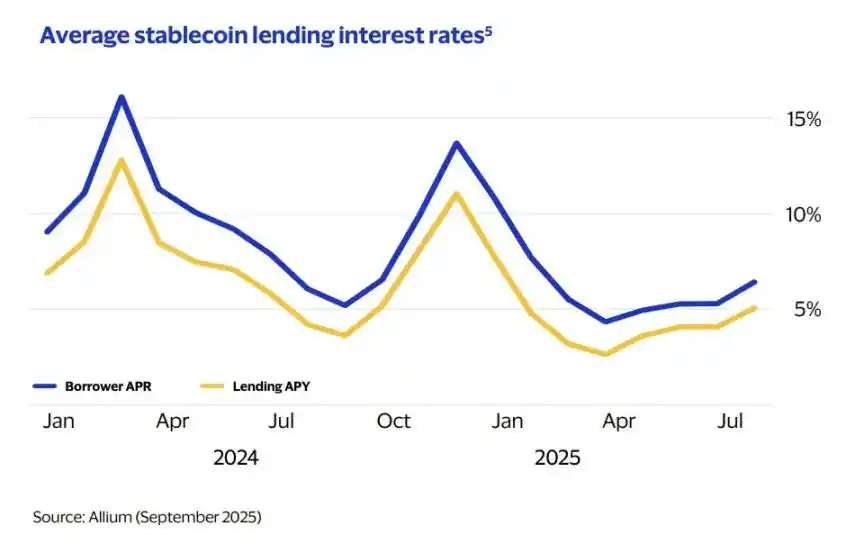
Caption: Average Borrowing Interest Rate

Image Source: @visa

The most直观 example of this end is that stablecoin Borrow APR has fallen to 6.4%. Considering the cumulative lending volume has grown to $670 billion over the past five years,庞大 scale but stable interest rates will become the norm.

The end of DeFi Lego has caused DeFi project governance tokens to completely lose value. The function of governance tokens is not in voting value but in long-term坚定 holding. 1 person creates BNB, 100 people hold BNB, 1000 people trade BNB, 10000 people will believe BNB has value.

The unit of measurement for vaults is not the power consumption of public chains, nor the governance standards of DeFi protocols themselves, but the standard dollar recognized by other vaults. In a sense, USDC/USDT directly取代了 the function of cross-chain bridges.

If USDT/USDC themselves become channels, then Pools/Vaults will not emphasize接入 specific cross-chain bridges and assets; they only need to support stablecoins to meet most people's needs.

People and their value are排斥ed out of the DeFi operating system. Human consumption value is the sole demand for economic operation, and stablecoins ultimately become the sole demand of Vaults.

Even Vaults themselves, as interest-bearing assets for stablecoins, also need users' USDT/USDC. But these stablecoins are not invested in other DeFi protocols, or even in the repurchase of treasury bonds; they lie idle in limited steps waiting for withdrawal.

Referring to the fact that the interest rates on large deposit products of some domestic rural commercial banks have fallen below 1%, we can expect to see the奇景 of stablecoin projects charging users fees in 2026.

Ultimately, all DeFi protocols become homogenized deposit products. Whether it's traditional spot DEX, lending, or Perp DEX, Cap even directly launches Stabledrop, with more airdrop value exchanged for stablecoin assets rather than the project's own tokens.

If you carefully map the current shape of DeFi, it would be a semi-finished product with a "big head, big tail, and hollow middle"—countless DeFi Vaults compete for user deposits, but Vaults no longer intertwine to increase leverage. They even wary of each other to avoid deposit outflows, and the underlying assets are all U.S. bonds,最终 flowing to numerous Neobanks.

Caption: DeFi Circulation Pattern

Image Source: @visa @artemis @DefiLlama

Neobanks collectively rushing towards U cards has caused their monthly transaction volume to soar from $100 million in 2023 to $1.5 billion. The main users of current Neobanks are still the on-chain群体, proving their considerable spending power, but the decline of DeFi is also a major reason for capital outflow.

This leads to a one-way interaction between users and protocols, but Vaults are彻底扁平化. The few connections are private activities, and users only perceive disputes and fear afterwards, just like the old story of xUSD.

From the history of DeFi and stablecoins, the real scenarios are only three tracks: trading, yield, and consumption. Trading is divided among CEX, Spot DEX, and Perp DEX. DeFi has completely shifted to a Vault model focused on yield. Consumption is split between USDT represented by Tron and emerging NeoBanks.

Frankly, when retail deposits flow into Vaults, stock tokens, Perps, prediction markets, and Meme coins, the disappearance of the altseason is理所应当. In a world where retail has nothing to buy or sell, only deposits have not brought prosperity to DeFi.

TradFi启示: Satisfy People, Don't Persuade Them

Learn from AI, then learn from banking; earn money uprightly.

It can be very clearly stated that current stablecoin yields are Features of individual protocols, not a赛道!

A赛道 requires protocols to push the entire industry forward through competition, like Perp DEX or the AI race. But current DeFi Vaults are all acting as entry points without the配合 of process and exit. They are all competitors with no coordination.

Refer to Taobao's Double Eleven event—the details are becoming increasingly变态; even Alibaba's Qianwen might not be able to calculate the best strategy.

Vaults are the same. The strategies set by various Curators are becoming more complex. Users can do nothing but deposit. When a Vault has problems, users can only face off against the professional litigators from law firms.

From the development needs of DeFi, once ordinary users can only consume passively and cannot participate in the production环节, so-called institutionalization occurs, and ordinary retail investors turn to more alternative, freer financial markets.

  • Retail疯狂 bought GME to battle Wall Street
  • Retail疯狂 bought Meme, rejecting altcoins

A clear trend is that while DeFi is developing towards institutionalization, traditional banking is actively seeking transformation, embracing newer market demands. The most typical example is Revolut's valuation reaching $75 billion.
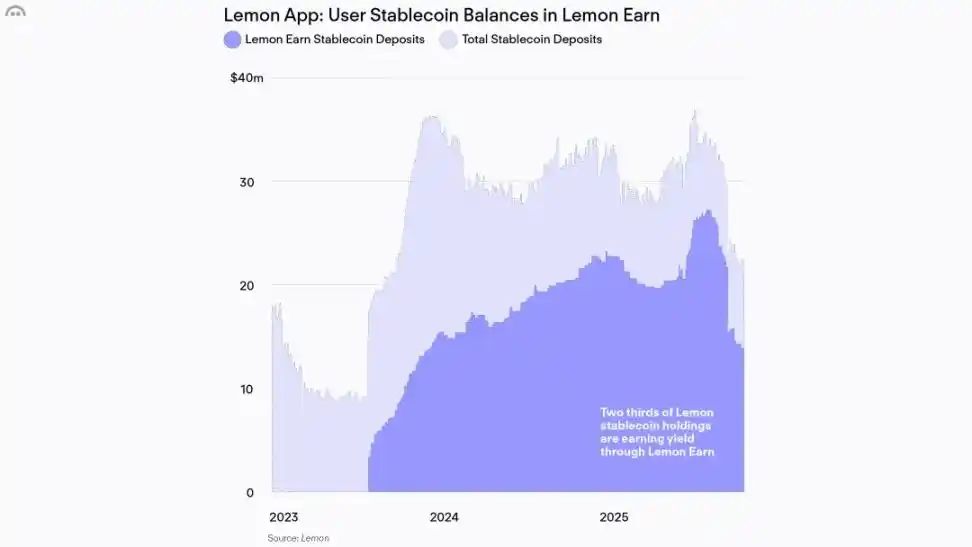
Caption: Off-chain Users Are Worthless

Image Source: @lemonapp_ar

In contrast, the token market cap of Aave, the largest DeFi bank, is only $2.5 billion. Measured by deposits, it would even be among the top 20 banks in the U.S. This is not an isolated case; most DeFi Vault products themselves are worthless.

Refer to Aave's approach in Latin America, embedding itself into younger, more financially underserved populations. Taking the Argentine wealth management product Lemon as an example, it brought 130,000 wealth management users to Aave, but only $40 million in deposits were imported.

Compare this to Aave's on-chain addresses: only 170,000 addresses support its $32 billion TVL. This itself shows that the network effect of retail investors can greatly support project valuation. If only pursuing the scale effect of capital, there is certainly no future for DeFi tokens.

Moreover, as the voice of Vaults within lending protocols increases, the brand value of the traditional protocols themselves decreases. Morpho introduced Sky Vault Curators to "balance" the dominance of Stakehouse. The essence of Aave V4 is also modularization. Eventually, the entire DeFi will become a backend product.

The launch of Aave's mobile app signals anxiety, not greater ease.

In this context, it is not shameful for DeFi to learn from banking. According to a McKinsey report, the global banking industry achieved $1.2 trillion in profits in 2024 alone.

But a crisis has emerged. In 2018, 25% of users would directly choose their开户 bank when spending, but by 2025, this number had dropped to 4%.扪心自问, which Vault has a loyalty rate of 25%?

The疯狂 competition over APY is the consequence of恶性 competition among Vaults. In traditional banking, large banks serve large clients, and small banks serve small clients. Especially younger generations need to gradually build credit scores to gain access to services from high-level banks.

Now is the time for DeFi Vaults to regain the trust of retail investors. Alliances with CEXs are also a beginning. Various Vaults constantly compete for the entry effect of CEXs, making CEXs the upstream of Vaults.

Although they need to actively share profits with CEXs, Vaults can thereby reach tens of millions of real users. Users are not completely passive either;经过 CEXs, they will also seek higher and safer yields, forming a new interaction model.

Conclusion

Products should serve the network, not roles.

When retail investors no longer participate in protocol governance (voting, holding, trading), their remaining awareness of the protocol will also be lost, ultimately leading to the absence of people on-chain.

Now that Vault & Yield has become the mainstream on-chain model, how to rediscover human value in a network without Tokens? DeFi needs to放下身段 and learn from the ever-present TradFi.


Related Questions

QWhat is the main argument presented in the article regarding the current state of DeFi?

AThe article argues that the era of 'DeFi Lego' is over, where protocols were interconnected like building blocks. Instead, DeFi has collapsed into a simplified model where users only care about depositing stablecoins into Vaults to earn yield, with protocols becoming homogenized and their governance tokens losing value. The interaction between protocols has diminished, and the primary flow of value is now from users to centralized exchanges (CEXs) and then into these yield-bearing Vaults.

QAccording to the article, how has the user journey in crypto changed from the 'DeFi Summer' ideal to the current reality in 2026?

AThe ideal user journey during DeFi Summer was: participate in BTC/ETH network nodes to earn tokens -> participate in DeFi protocols -> use various DeFi Lego building blocks'. The current reality in 2026 is: acquire USDC through a CEX or bank card -> find a Vault with a higher APY -> spend using a Neobank's crypto card. Users now interact directly with Vaults as end products, indifferent to the underlying protocols.

QWhat role do centralized exchanges (CEXs) like Binance play in the new DeFi yield landscape described in the article?

ACEXs like Binance have become crucial upstream gateways and partners for DeFi Vaults. They are no longer just measuring listing effects by trading volume but are monetizing their large user bases by selling access to projects. They promote and subsidize specific stablecoins (e.g., Binance with USD1, OKX with USDG), effectively acting as the primary user acquisition channel for Vaults, which then have to share profits with the exchanges.

QWhy does the article suggest that DeFi protocols need to 'learn from TradFi' (Traditional Finance)?

AThe article suggests learning from TradFi because traditional banking, despite its flaws, successfully serves human needs and builds customer relationships over time through trust and graduated services (e.g., building credit scores). In contrast, DeFi Vaults are engaged in a恶性竞争 (vicious competition) purely on APY, leading to user disengagement, a lack of loyalty, and the loss of the 'human network effect' that gives protocols long-term value. DeFi needs to focus on serving people, not just moving capital.

QWhat is the significance of Neobanks and 'U cards' in the current crypto ecosystem as per the article?

ANeobanks and their crypto debit cards (U cards) represent the 'consumption' end of the crypto value flow. Their monthly transaction volume has skyrocketed from $100 million in 2023 to $1.5 billion, indicating strong spending power from crypto users. This trend highlights that the final use case for many users is to off-ramp their yields into spendable currency, further emphasizing that DeFi's current role is primarily as a backend yield generator for stablecoins, which are then spent in the real world.

Related Reads

Trading

Spot
Futures

Hot Articles

What is BNB WHALES

Understanding BNB Whales: A Deep Dive into the Cryptocurrency Landscape Introduction to BNB Whales In the vibrant world of cryptocurrencies, new projects regularly emerge, often promising innovative solutions and unique experiences. One such project is BNB Whales, launched in 2023 and built on the BNB Smart Chain (BEP20). BNB Whales sets out to establish a distinctive presence within the cryptocurrency ecosystem, focusing on creating an engaging platform that combines the benefits of blockchain technology with social and gaming interactions. This article aims to delve deeper into BNB Whales, exploring its core components, mechanics, and developmental trajectory. What are BNB Whales? BNB Whales is a cryptocurrency initiative that seeks to provide a diverse range of features and opportunities for its users in the burgeoning Web3 environment. Utilizing the BEP20 standard, the project operates with a total token supply of 100 trillion (100,000,000,000,000,000). Despite this significant figure, it is noteworthy that no tokens are currently in circulation, indicating that the project may still be in its early developmental stages. The primary goal of BNB Whales is to create a platform where users can participate in various interactive activities while benefiting from the security and transparency afforded by blockchain technology. By fostering a unique and engaging environment, BNB Whales aims to build a strong community of users who are invested in the project and its development. Who is the Creator of BNB Whales? The identity of the creator of BNB Whales remains undisclosed at this time, presenting a challenge for those looking to understand the project's founding principles and visionary insights. This absence of publicly available information regarding the project's leadership may raise questions among potential investors and users about its governance and accountability structure. Who are the Investors of BNB Whales? As BNB Whales continues to evolve, information concerning specific investors or support from investment foundations is currently unavailable. The project’s official documentation, including its whitepaper, does not disclose either individual or institutional financial backers. The lack of transparency in this regard can sometimes raise questions about the legitimacy and sustainability of new projects within the cryptocurrency ecosystem. How Does BNB Whales Work? BNB Whales operates on the BNB Smart Chain utilizing the BEP20 standard, which is known for its efficiency and low transaction fees, attracting a variety of developers and projects. The unique aspect of BNB Whales lies in its focus on creating a community-driven platform. While precise operational details are scarce, the project emphasizes interaction and engagement, potentially incorporating gamified elements into its offerings. The emphasis on community is pivotal, as it aligns with prevailing trends in the cryptocurrency space, where user input and participation often dictate a project's success. Further innovation may be anticipated, but at present, the specific mechanisms and features that differentiate BNB Whales from other crypto initiatives remain to be fully elucidated. Without detailed information regarding its functionality, it is challenging to evaluate the project's differentiators comprehensively. Timeline of BNB Whales The development of BNB Whales has unfolded across key milestones, marking its journey in the cryptocurrency landscape. Below is a timeline of significant events pertaining to the project: 2023: Launch of BNB Whales, marking the project's entry into the market. 2023: Publication of the project's whitepaper, which lays out the overarching goals and operational framework. Ongoing: BNB Whales continues to develop its features, aiming to build a robust user base and expand its offerings. Key Points About BNB Whales Platform: BNB Smart Chain (BEP20) Total Supply: 100 trillion tokens (100,000,000,000,000,000) Circulating Supply: 0 tokens (indicating a nascent stage) Project Goal: To foster an engaging cryptocurrency platform for interaction and community building. Creator: Unknown Investors: Not disclosed Operational Status: Active with ongoing development and expansion Conclusion As BNB Whales navigates the competitive cryptocurrency landscape, it offers a glimpse into the potential of community-driven projects built on the foundations of blockchain technology. By focusing on engagement and interaction, the initiative stands at the forefront of innovation in the Web3 space. However, the project's success ultimately hinges on the clarity of its operational mechanics, the disclosure of its governance, and the establishment of a solid user community. For potential users and investors alike, BNB Whales represents a case study in the evolving nature of cryptocurrency projects—one that illustrates both the exciting possibilities and the complexities associated with new initiatives. As the landscape continues to evolve, it will be essential to monitor BNB Whales' progress and its impact on the broader cryptocurrency ecosystem.

3.1k Total ViewsPublished 2024.04.01Updated 2024.12.03

What is BNB WHALES

What is PONKE BNB

Ponke BNB: A New Approach in the Cryptocurrency Space Introduction Ponke BNB, a newcomer in the cryptocurrency arena, was launched in 2024 and operates on the BNB Smart Chain (BEP20) platform. This innovative project seeks to build a distinctive and engaged community, focusing on sustainable reward generation. As the cryptocurrency landscape evolves, Ponke BNB aims to address critical issues surrounding reward sustainability, making it a project worth observing for enthusiasts and investors alike. What is Ponke BNB? At its core, Ponke BNB is a cryptocurrency designed specifically for the BNB Smart Chain ecosystem. Boasting an immense total supply of 370,000,000,000,000,000 tokens, it is worth noting that currently, there are no tokens in circulation. The guiding mission of Ponke BNB is to foster a sustainable reward system that mitigates the challenges associated with rewards depletion, a common pitfall in many cryptocurrencies today. The mechanics of Ponke BNB's functionality centre around encouraging user participation, while simultaneously providing rewards that can stand the test of time. The unique structure of its reward system is aimed at ensuring longevity and stability, addressing essential market concerns. Who is the Creator of Ponke BNB? Despite extensive exploration, the identity of Ponke BNB's creator remains unknown. There is a notable absence of publicly available information regarding the project’s founder or its development team. This anonymity, while not uncommon in the cryptocurrency space, raises some questions about transparency and accountability in project management. Who are the Investors of Ponke BNB? Similar to the lack of clarity surrounding its creator, there is no public information available regarding any investment foundations or organizations that support Ponke BNB. This absence of investor data can often breed uncertainty among prospective investors, who typically prefer a clear understanding of the backing behind cryptocurrencies they consider engaging with. How Does Ponke BNB Work? Ponke BNB stands out through its inventive two-layered sustainable reward generating system. This system is built to tackle the issue of rewards depletion effectively. By engaging users and creating a vibrant community, Ponke BNB seeks to provide a stable and enjoyable environment, which emphasizes user interaction and rewards. The operation framework of Ponke BNB encourages participation through various activities and challenges that are designed to incentivise users while ensuring that the reward system remains sustainable. It aims to stimulate the community and promote an engaging atmosphere where members can feel valued and appreciated. Timeline of Ponke BNB The evolution of Ponke BNB can be summarized through a few key milestones: 2024: The inception of Ponke BNB on the BNB Smart Chain (BEP20) platform marked a significant entry into the cryptocurrency market. 2024: The release of the project’s whitepaper and official website provided comprehensive insights into Ponke BNB’s goals and objectives, forming the foundation for its community-driven approach. Key Features of Ponke BNB Ponke BNB is built on several key features that set it apart from other cryptocurrency projects: Sustainable Reward System The two-layered reward system is designed to foster engagement, prevent depletion of rewards, and ensure the longevity of returns for participants in the Ponke BNB ecosystem. Community Engagement The project places a strong emphasis on active community engagement, driving participation through activities designed to create a social and collaborative environment. This community-centric approach empowers users to have a hand in shaping the project's future directions. BNB Smart Chain Integration Operating on the BEP20 platform, Ponke BNB is reinforced by the security and efficiency offered by the BNB Smart Chain. Users benefit from fast and cost-effective transactions, positioning Ponke BNB well within the broader cryptocurrency ecosystem. Conclusion In summary, Ponke BNB is an emergent cryptocurrency project aiming to carve a niche for itself in the growing digital currency landscape. With its focus on a sustainable reward system and community engagement, it presents a fresh outlook in an otherwise volatile sector. While uncertainties linger concerning the project's creators and investors, Ponke BNB continues to strive for transparency and innovation. As the cryptocurrency market continues to develop, Ponke BNB’s principles of sustainability and community-driven dynamics place it in a promising light for future observers and participants alike.

3.0k Total ViewsPublished 2024.04.01Updated 2024.12.03

What is PONKE BNB

What is BNB CARD

Understanding BNB Card: Revolutionizing Digital Identity in Web3 In the rapidly evolving landscape of blockchain technology and cryptocurrency, the BNB Card or $BNBCARD stands out as a noteworthy project. This community-driven utility meme token leverages the BNB Smart Chain (BSC), aiming to integrate meme culture with innovative digital identity solutions. As more users dive into the realms of decentralization, it is crucial to dissect what BNB Card offers, its operational nuances, and its potential market impact. What is BNB Card ($BNBCARD)? At its core, BNB Card represents a meme token with substantial utility. It is designed to empower users by enabling the creation of personalized digital identity cards that are both expressive and functional. The project encapsulates several key features: Customizable ID Cards: Users have the ability to design Binance-themed digital ID cards, providing them with a platform for self-expression and enhanced community interaction. Decentralized Framework: Developed on the BSC, BNB Card emphasizes key attributes such as security, transparency, and user sovereignty. The decentralized nature of the framework allows for transactions that are both efficient and secure. Community-Centric Model: The emphasis on grassroots participation rather than laboratory-driven financial models creates an engaging environment for its users. By leveraging the inherent virality of meme culture, BNB Card fosters a robust community movement. The primary goal of BNB Card is to democratize digital identity tools in Web3, offering accessible solutions that benefit the users without the encumbrances typically associated with traditional identity management systems. Creator and Investors When exploring the identity behind BNB Card, it is important to note that no singular creator is explicitly credited. Instead, the project appears to be community-driven, suggesting a collective effort inspired by the notion of Binance's “Early Builder Card.” This organic development approach is common among projects within the meme token spectrum, where development is often influenced by the community's passion rather than a central authority. In terms of investment, the absence of publicly disclosed institutional backers further highlights the project's grassroots foundation. It thrives on organic community support, reflecting a usual characteristic of meme-driven projects that often engage their audience through social channels rather than formal investment routes. How It Works BNB Card employs several mechanisms that delineate its functioning and innovative spirit: Token Utility: The BNBCARD token allows users access to a suite of ID creation tools while also providing a platform for community governance. The token serves as the linchpin that enables these functionalities. Blockchain Integration: By utilizing the BSC, BNB Card ensures compatibility with Ethereum Virtual Machine (EVM)-based applications. This integration provides users with the benefits of low transaction fees while enhancing accessibility. DIY Ecosystem: Central to BNB Card’s appeal is its do-it-yourself (DIY) approach to digital identity card generation. This participatory element encourages users to engage in creative expression, fostering an inclusive culture that thrives on contribution and collaboration. Timeline Chronology is vital to understanding BNB Card's trajectory. Important milestones in the project’s history include: March 18, 2025: BNB Card was listed on LBank, marking a significant step in its exchange journey and opening doors for liquidity and user accessibility. March 19, 2025: A pivotal moment occurred as the token experienced an astronomical surge of 26,000% within 24 hours, garnering attention for its potential and the community’s enthusiasm. Ongoing Developments: The project is continuously expanding its partnerships with decentralized exchanges (DEXs) like PancakeSwap, further enhancing liquidity and user engagement. Innovation and Differentiation Understanding what sets BNB Card apart involves deeper exploration into its innovative framework: Meme-Utility Hybrid: BNB Card successfully merges the playful allure of meme culture with practical applications in digital identity management. This niche approach effectively caters to a broad demographic, appealing to both tech-savvy users and those new to crypto. Decentralized Governance: Operating devoid of centralized control allows the project to harness community input directly. The collective decision-making process buoyed by community involvement empowers users, ensuring their voices contribute to the development and direction of the project. Scalability: BNB Card stands to benefit immensely from the 2025 roadmap upgrades to the BNB Chain, which include enhancements such as increased transaction speeds and the integration of artificial intelligence tools. These improvements position the project advantageously within a highly competitive environment. Conclusion BNB Card is emblematic of a new wave of digital identity solutions within the Web3 ecosystem. By blending fun, community engagement, and practical utility, it invites users to participate actively in shaping their digital personas. As the project navigates the dynamic cryptocurrency landscape, its success will likely hinge on maintaining strong community support while adapting to technological advancements and user needs. The integration of decentralization with meme culture serves not only as a means for user-driven engagement but also as a foundation for the evolving narrative surrounding digital identity in the age of blockchain. In summation, BNB Card not only exemplifies the convergence of creativity and utility within the crypto space but also underscores the importance of community in steering the future of decentralized technologies.

3.4k Total ViewsPublished 2025.03.26Updated 2025.03.26

What is BNB CARD

Discussions

Welcome to the HTX Community. Here, you can stay informed about the latest platform developments and gain access to professional market insights. Users' opinions on the price of BNB (BNB) are presented below.

活动图片












