The "Bitcoin Whale" Closes Position Held for Two Months, Realizing a Profit of $11.6 Million

cryptonews.ruPublished on 2026-08-25Last updated on 2026-08-25

Abstract

Blockchain analytics platform Lookonchain identified two addresses likely belonging to the same trader, which simultaneously closed long Bitcoin positions held for nearly two months, securing a combined profit of $11.6 million. The exit coincided with Bitcoin's sharp rally above $81,000 on August 25th, a move linked by BitMEX co-founder Arthur Hayes to new U.S. Treasury bond-buying programs signaling a fresh bull market. The surge to $81,000 was fueled by $225 million in short liquidations within 10 minutes, creating a squeeze that propelled prices. While some large holders took profits after months of paper losses earlier in the year, others continued accumulating, betting on further upside. With Bitcoin having one of its strongest quarters since 2021, the market now watches whether the $80,000 level will hold as support or if profit-taking pressure will emerge. Macro voices like Hayes suggest Treasury liquidity could drive Bitcoin toward six figures, making the coming days crucial to see if such whale exits are isolated or the start of a broader trend.

Blockchain analytics platform Lookonchain identified two addresses (0x5FA and 0x237) that may belong to the same trader. Both wallets simultaneously closed long Bitcoin positions, concluding a trade this investor had held for nearly two months.

The total profit amounted to $11.6 million, although the exact entry price and position size remain unknown. The timing evidently coincided with Bitcoin's sharp price surge of $20,000 to the $81,000 mark on August 25th (a gain of over 25% during the position's holding period).

Bitcoin's breakthrough past the $80,000 level occurred on the same day that BitMEX co-founder Arthur Hayes, in a new article, stated that the expansion of the US Treasury's bond buyback program marked the beginning of a new bull market for this asset—this thesis precisely aligns with the period during which this major investor held his position.

A Rally Built on Liquidations

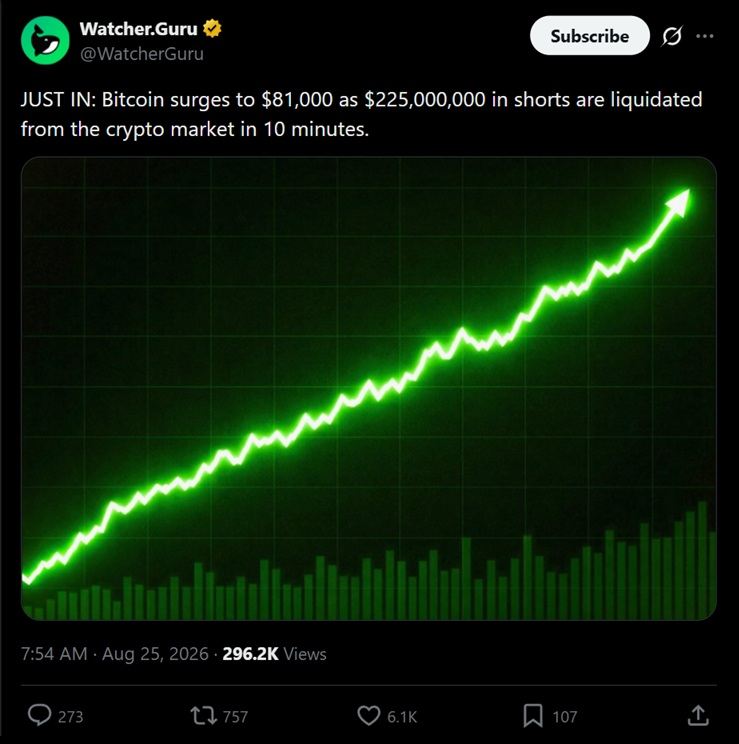
The whale's exit is just one of several events that contributed to Bitcoin's five-figure price increase. Data shows that the surge of $BTC to $81,000 occurred against a backdrop of $225 million in short position liquidations on the crypto market within 10 minutes—a chain reaction that can easily push prices upward.
Furthermore, some large holders took advantage of this rally to lock in profits after several months of paper losses for much of this year, given that Bitcoin traded significantly below $70,000 for a substantial part of this period. Others continued to accumulate positions, betting that the rally still had potential.

The third quarter has been one of Bitcoin's strongest since 2021, and the price action in the latter half of August played a significant role. Whether the wallet activity described above reflects "smart money" anticipating a local peak, or simply traders disciplinedly taking profits after a two-month hold, may become clearer in the coming weeks.

Bitcoin Price Levels Must Stabilize

The next few days will be crucial for the market, as both retail traders and institutional investors eagerly await whether the $80,000 mark will hold as a new support level, or if the aggressive short liquidations that fueled the latest rally will give way to profit-taking pressure. Furthermore, concerns about large-scale quantitative easing loom larger on the horizon, which could impact Bitcoin's price dynamics.

Finally, given the growing voices of Hayes and other macroeconomic experts arguing that Treasury liquidity dynamics could push $BTC into six figures, the coming days should show whether such whale exits are an exception or the beginning of a broader trend.

end-content

Related Questions

QWhat event did the blockchain analytics platform Lookonchain identify regarding two specific wallet addresses?

ALookonchain identified that two wallet addresses (0x5FA and 0x237), which likely belong to the same trader, simultaneously closed long Bitcoin positions they had held for nearly two months.

QAccording to the article, what was the result of the Bitcoin whale closing its position?

AThe result was a profit of $11.6 million. The closing coincided with a sharp $20,000 surge in Bitcoin's price to $81,000 on August 25th, representing a gain of over 25% during the holding period.

QHow did the article link the Bitcoin price rally to market liquidations?

AThe article stated that the spike in Bitcoin's price to $81,000 occurred alongside the liquidation of $225 million worth of short positions on the crypto market within a 10-minute window, which acted as a chain reaction pushing prices upward.

QWhat is the critical question for the market in the near term, as mentioned in the article?

AThe critical question is whether the $80,000 level will hold as a new support level or if the aggressive short liquidations that fueled the recent rally will give way to profit-taking pressure.

QWhich prominent figure's market thesis is mentioned in the article as aligning with the whale's trading period?

AThe article mentions BitMEX co-founder Arthur Hayes. His thesis, published in a new article on the same day Bitcoin broke $80,000, stated that the expansion of the US Treasury's bond buyback program marked the beginning of a new bull market for Bitcoin.

Related Reads

Demand Test: Bitcoin Whales Earn Record $1.2 Billion, Ethereum Holders Return to Profitability

In just three days after Bitcoin's price recovery, new Bitcoin whales have realized over $1.2 billion in profit, marking the largest profit-taking event for this cohort on record according to CryptoQuant. The peak occurred on August 20 with roughly $614 million, setting a daily record. Analysts note this selling pressure began after Bitcoin rose above the realized price of short-term whales, which was around $68,900. With Bitcoin trading near $77,700 on August 23, these whales were sitting on an average profit of about 12.8%. The market recovery allowed investors who were previously at breakeven or at a loss to lock in gains. CryptoQuant described the situation as a key test for Bitcoin demand; sustained prices above whale cost-basis with normalized profit-taking could signal strong new demand, while continued selling pressure could turn the rally into a mere break-even exit. Simultaneously, large Ethereum holders have also returned to an unrealized profit zone following its rally, as noted by CryptoQuant analyst Darkfost. Current profit levels, however, remain relatively low and are not seen as creating significant selling pressure. The Unrealized Profit/Loss Ratio for different whale cohorts stands at 0.075 (for 1k-10k ETH holders), 0.16 (10k-100k ETH), and 0.38 (over 100k ETH). This marks a significant improvement from June, when these whales were in substantial unrealized loss, with Ethereum having risen over 65% since then. The increased profitability is viewed as a positive sentiment signal for the Ethereum market.

cryptonews.ru12m ago

Demand Test: Bitcoin Whales Earn Record $1.2 Billion, Ethereum Holders Return to Profitability

cryptonews.ru12m ago

Kinetiq Team Announces Elysium L2 Network for Hyperliquid

On August 24, the liquid staking protocol Kinetiq announced Elysium, a new L2 network for the Hyperliquid ecosystem. It aims to increase HyperEVM's throughput and simplify the launch of spot markets, tokens, and DeFi applications. Elysium will use $HYPE for gas fees and plans direct integration with HyperCore's trading engine, giving apps access to its liquidity and orderbook data. Technical details and partners will be revealed later, with a launch date set for "soon." A primary reason for Elysium's development is to overcome HyperEVM's limitations, such as low throughput and rising fees during high load. Kinetiq claims the L2 will start with significantly higher block production and transaction speeds, later aiming to approach HyperCore's performance. This targets applications needing frequent state updates like high-frequency spot trading and AMMs, and will provide them deeper access to HyperCore orderbook data. The network also proposes to streamline the process of launching new assets within Hyperliquid, allowing a token to progress from AMM liquidity to HyperCore's spot orderbook and eventually to perp markets via HIP-3 in a unified flow. Regarding revenue, Kinetiq's model allocates 50% of sequencer fees to buy back and burn $KNTQ, 25% to developers using Elysium's block space, and 25% to the Kinetiq treasury. Elysium marks Kinetiq's expansion beyond its core liquid staking product, kHYPE.

cryptonews.ru14m ago

Kinetiq Team Announces Elysium L2 Network for Hyperliquid

cryptonews.ru14m ago

Trading

Spot
活动图片