The Biggest Misjudgment of 2025: Bitcoin Peaked in Q4, and 'HODLing' No Longer Works

marsbitPublished on 2026-01-12Last updated on 2026-01-12

Abstract

In his 2025 review, the author admits a major misjudgment: Bitcoin likely peaked in Q4, defying his prediction and confirming the persistent four-year cycle. He reflects on other forecasts: retail investors largely avoided crypto for assets like gold and AI stocks, memecoin and AI agent supercycles failed to materialize, and NFTs are declared dead. Key insights include: 1. Spot ETFs acted as a market floor, not a ceiling, absorbing massive sell-offs from long-term holders. Bitcoin’s correlation with traditional risk assets dropped, potentially bullish long-term. 2. Airdrops thrived with $4.5B distributed, but success now requires focused, high-conviction plays due to sybil detection and valuation pressures. 3. Protocol fee switches set a price floor via buybacks but don’t guarantee sustained price appreciation, as seen with UNI’s volatility. 4. Stablecoins gained mainstream traction for payments, but trading the narrative (e.g., Circle’s IPO) proved difficult. The real opportunity lies in bypassing traditional payment rails. 5. DeFi is more centralized than CeFi, with dominant players like Aave and Chainlink. Conflicts between equity and token holders highlight governance challenges. The overarching theme: Everything is a trade. The HODL culture is dead, replaced by short exit windows and a lack of long-term conviction.

A year ago, I wrote "Truth and Lies in the 2025 Crypto Market".

Back then, everyone was sharing higher Bitcoin price targets. I wanted to find a different framework to discover where the masses might be wrong and position myself differently. The goal was simple: find ideas that already existed but were ignored, disliked, or misunderstood.
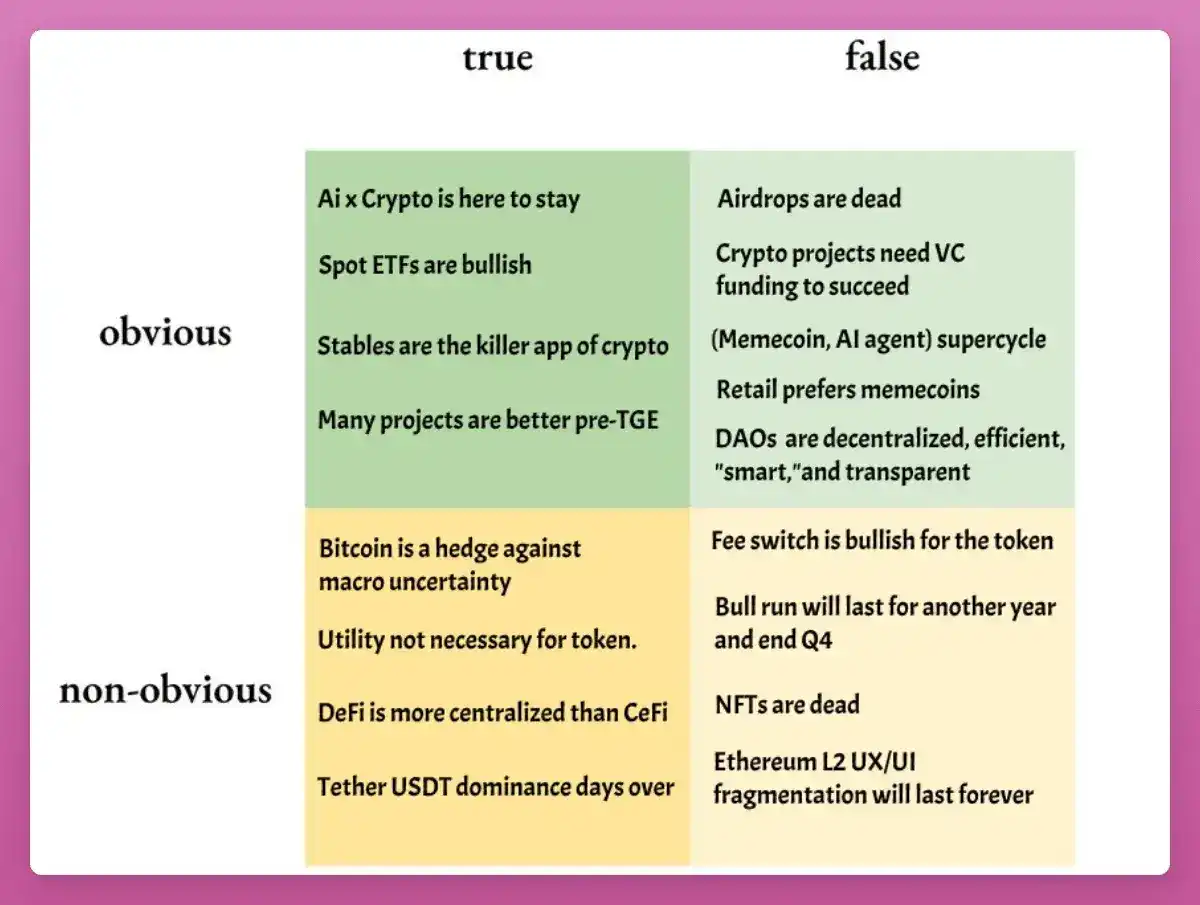
Before sharing the 2026 edition, here is a clear review of what truly mattered in 2025. What we got right, what we got wrong, and what we should learn from it. If you don't examine your own thinking, you're not investing; you're guessing.

Quick Summary

"BTC Peaking in Q4": Most people expected it, but it seemed too good to be true. Turns out they were right, and I was wrong (and paid the price). Unless BTC skyrockets from here and breaks the 4-year cycle pattern, I'll concede this one. "Retail Prefers Memecoins": The fact is

retail doesn't prefer cryptocurrency at all. They bought gold, silver, AI stocks, and anything that wasn't crypto. The supercycle for memecoins or AI Agents also did not materialize.

"AI x Crypto Remains Strong": Mixed bag. Projects continued to deliver, the x402 standard evolved, and funding continued. But tokens failed to sustain any rallies.

"NFTs Are Dead": Yes.

These are easy to review. The real insights lie in the following five larger themes.

1. Spot ETFs Are the Floor, Not the Ceiling

Since March 2024, long-term Bitcoin holders (OGs) have sold approximately 1.4 million BTC, worth about $121.17 billion.

Imagine the bloodbath in the crypto market without ETFs: Despite the price drop, BTC ETF inflows remained positive ($26.9 billion).

The gap of about $95 billion is precisely why BTC underperformed almost all macro assets. There's nothing wrong with BTC itself; you don't even need to dig deep into unemployment or manufacturing data to explain it—it's just the "great rotation" by whales and "4-year cycle believers".
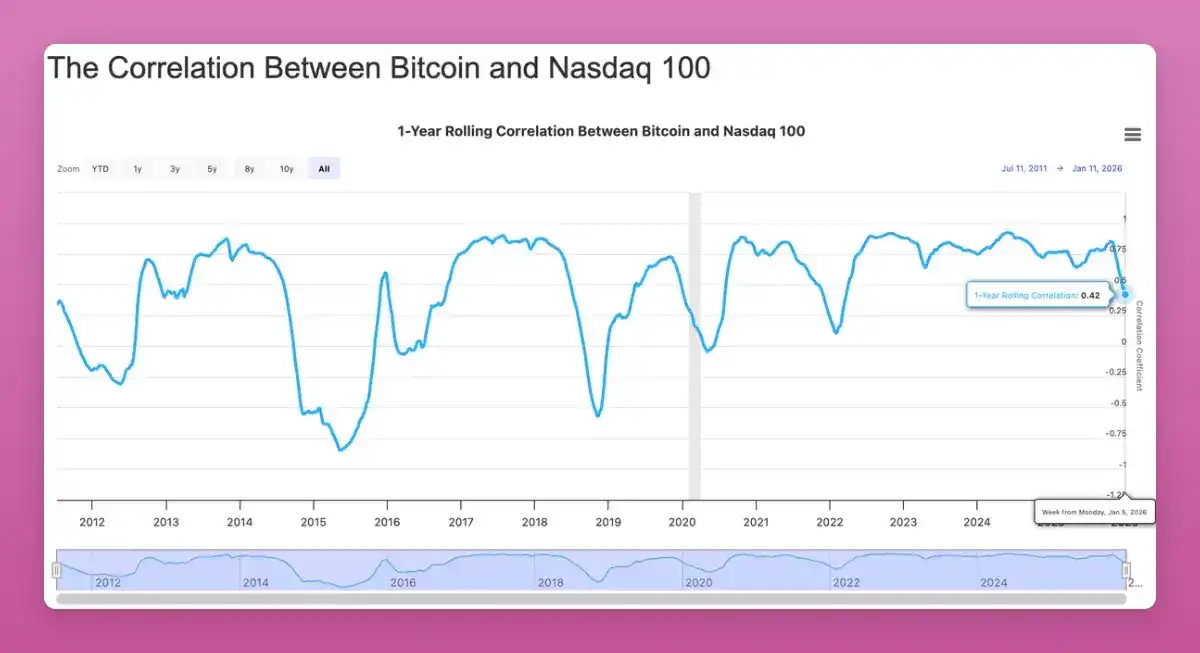
More importantly, Bitcoin's correlation with traditional risk assets like Nasdaq fell to its lowest since 2022 (-0.42). While everyone hoped for a breakout to the upside, this is bullish long-term as an uncorrelated portfolio asset sought by institutions.
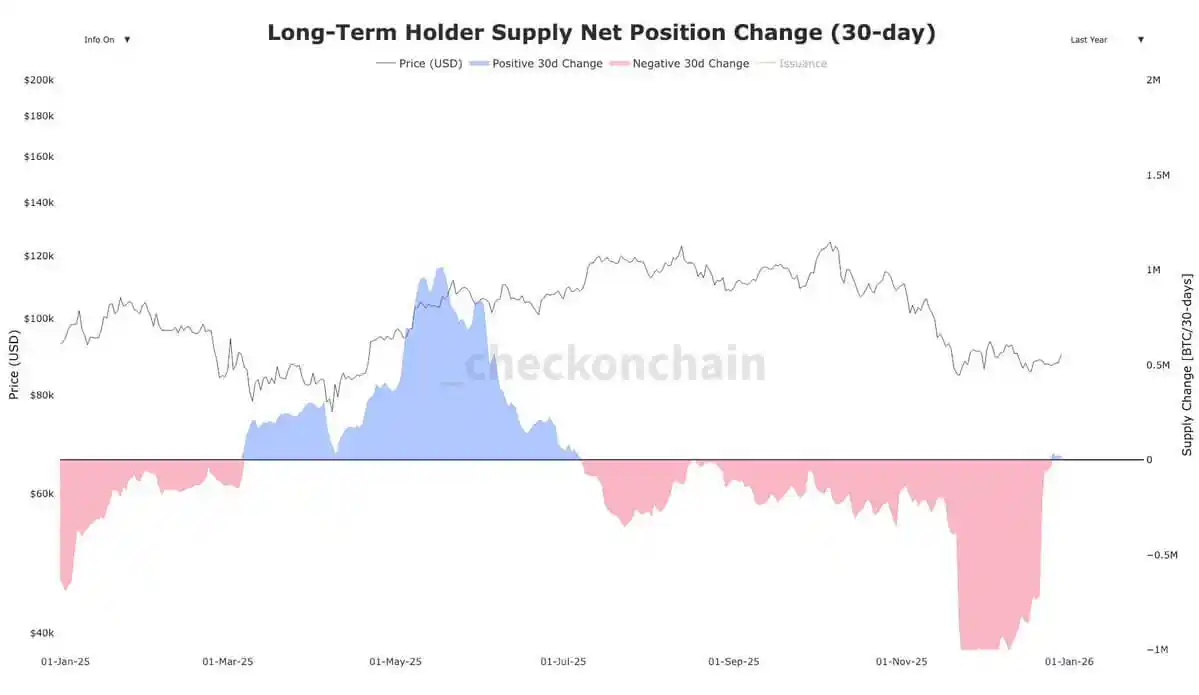
There are signs the supply shock is over. Therefore, I dare to predict a BTC price of $174,000 for 2026 (equivalent to 10% of gold's market cap).

2. Airdrops Clearly "Did Not" Disappear

Crypto Twitter (CT) once again claimed airdrops were dead. But in 2025, we saw nearly $4.5 billion in major airdrop distributions:

Story Protocol (IP): ~$1.4B

Berachain (BERA): ~$1.17B

Jupiter (JUP): ~$7.91M

Animecoin (ANIME): ~$7.11M

The change lies in: points fatigue, stronger Sybil detection, and lower valuations. You also need to "claim and sell" to maximize profits.

2026 will be a big year for airdrops, with heavyweights like Polymarket, Metamask, Base(?) preparing to launch tokens. This isn't the year to stop clicking buttons, but to stop betting blindly. Airdrop "farming" requires concentrated efforts on high-conviction bets.

3. Fee Switches Are Not Price Appreciation Engines, But a Floor

My prediction was: fee switches don't automatically drive token prices higher. Most protocols don't enough generate revenue to support their massive market caps.

"Fee switches don't affect how high a token can go; they set a 'price floor'."

Look at projects ranked by "holder revenue" on DeFillama: Except for $HYPE, all high revenue-share tokens outperformed ETH (though ETH is now the benchmark everyone challenges).
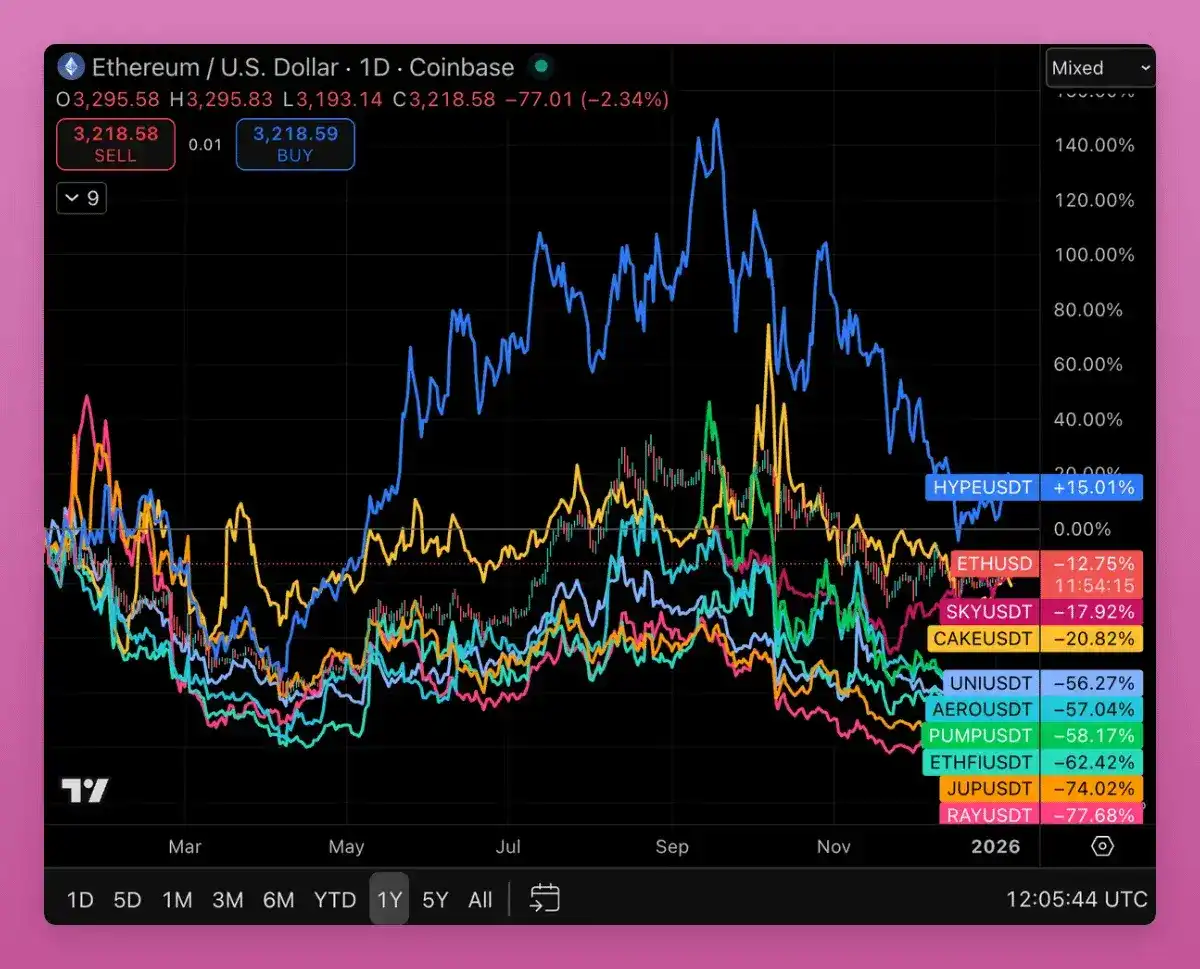
The surprise was $UNI. Uniswap finally flipped the switch and even burned $100 million worth of tokens. UNI initially surged 75% but then gave back all its gains.
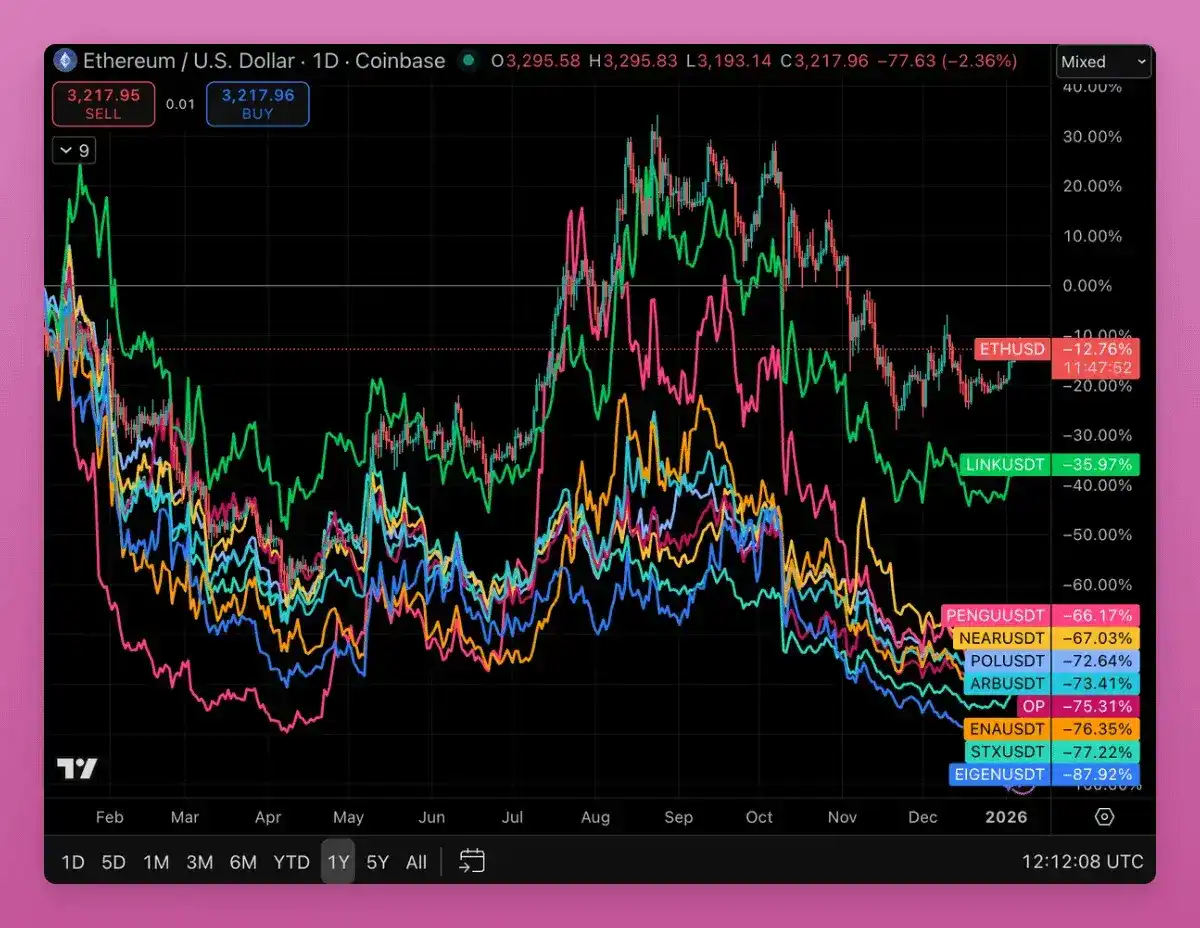
Three revelations:

Token buybacks set a price floor, not a ceiling.

Everything this cycle is a trade (see UNI pump and dump).

Buybacks are only one side of the story; sell pressure (unlocks) must be considered, as most tokens remain low-float.

4. Stablecoins Capture Mindshare, But "Proxy Trading" Is Hard to Profit From

Stablecoins are going mainstream. When I rented a motorbike in Bali, the owner even requested payment in USDT on TRON.
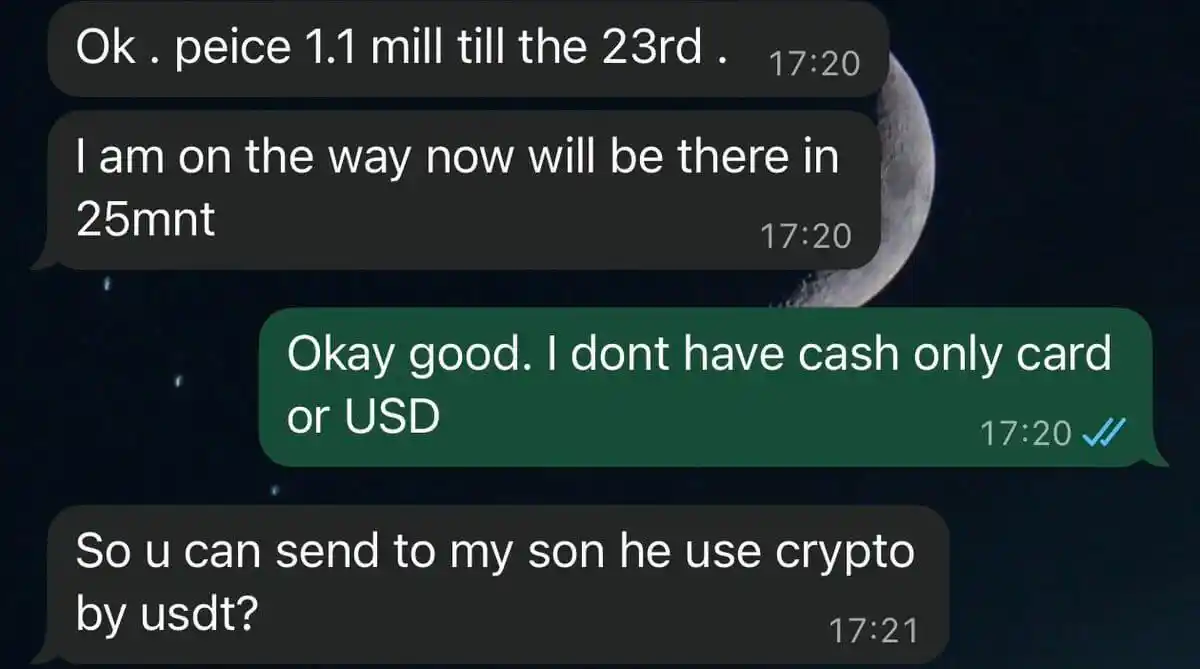
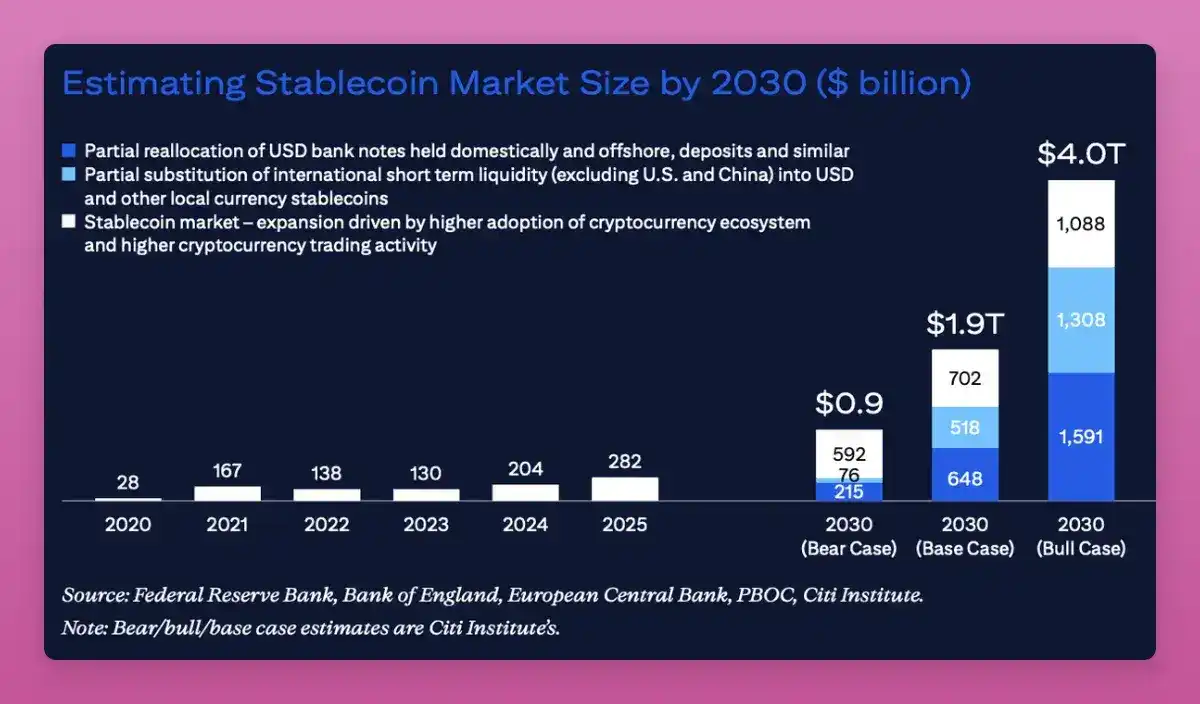
Although USDT's dominance fell from 67% to 60%, its market cap still grew. Citibank predicts the stablecoin market cap could reach $1.9 to $4 trillion by 2030.
In 2025, the narrative shifted from "trading" to "payment infrastructure". However, trading the stablecoin narrative wasn't easy: Circle's IPO gave back all its gains after a surge, and other proxy assets underperformed.
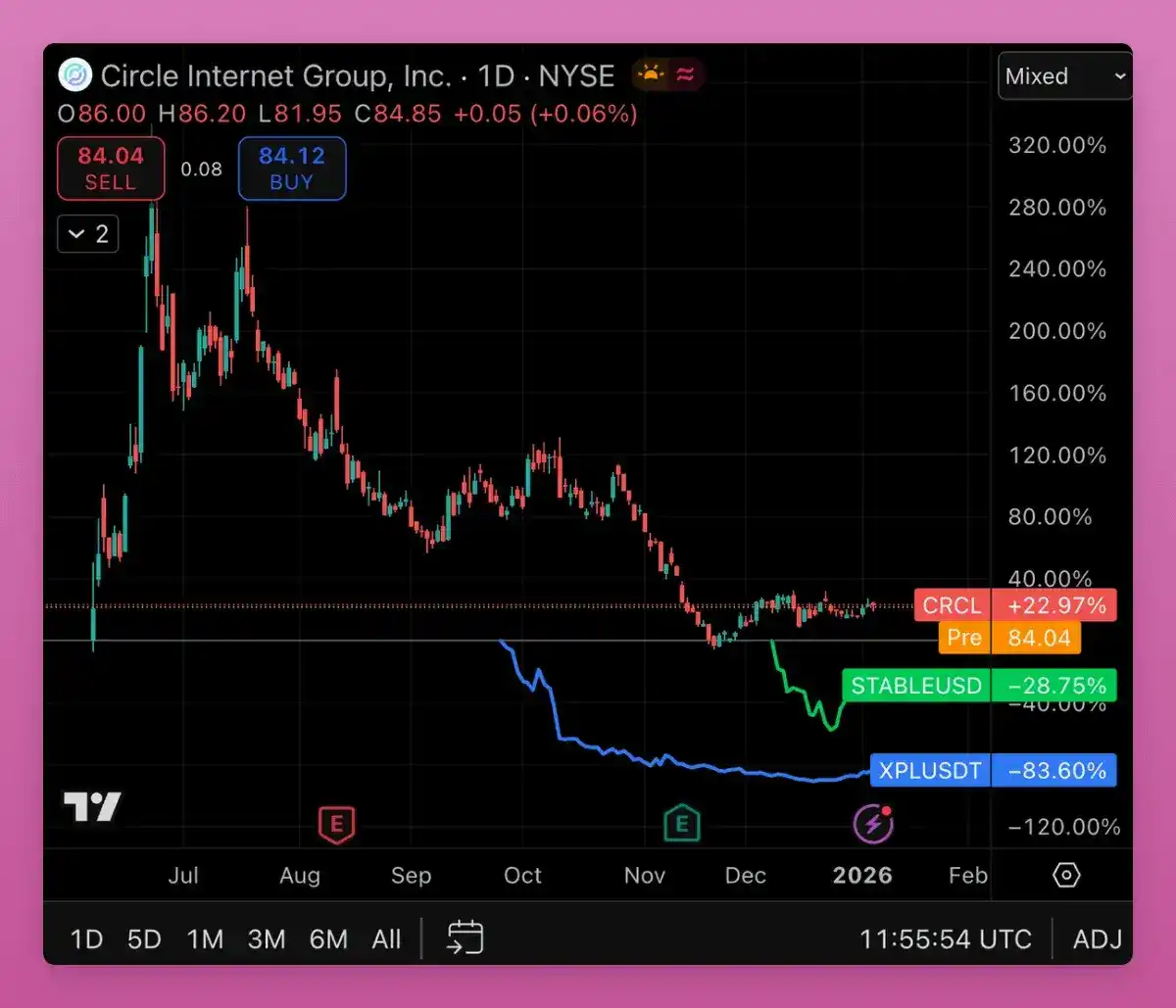
One truth of 2025 is: everything is just a trade.
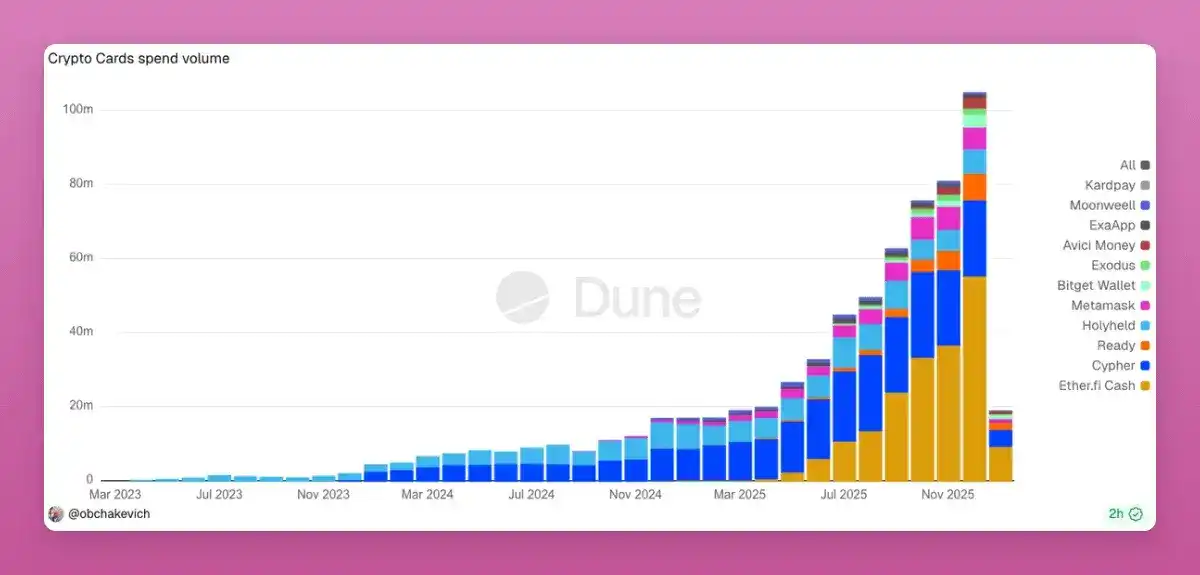
Currently, crypto payment cards are exploding due to their convenience in bypassing strict bank AML requirements. Every card swipe is an on-chain transaction. If direct peer-to-peer payments bypassing Visa/Mastercard emerge in 2026, that would be a 1000x opportunity.

5. DeFi Is More Centralized Than CeFi

Here's a bold take: DeFi's business and TVL are more concentrated than Traditional Finance (CeFi).

Aave commands over 60% of the lending market share (compared to JPMorgan's 12% in the US).

L2 protocols are mostly multi-billion dollar unregulated Multisigs.

Chainlink controls almost all value oracles in DeFi.

In 2025, the conflict between "centralized equity holders" and "token holders/DAO" became apparent. Who truly owns the protocol, IP rights, and revenue streams? Internal disputes at Aave showed token holders have fewer rights than we thought.

If the "Labs" ultimately win, many DAO tokens will become uninvestable. 2026 will be a key year for aligning the interests of equity and token holders.

Conclusion

2025 proved one thing: Everything is a trade. Exit windows are extremely short. No token has long-term conviction.

The result is that 2025 marked the death of HODL culture, DeFi turned into Onchain Finance, and with improving regulation, DAOs are shedding their "pseudo-decentralized" disguise.


Related Questions

QAccording to the article, why did Bitcoin's performance lag behind almost all macro assets in 2025?

ABecause long-term holders (OGs) sold approximately 1.4 million BTC, worth about $121.17 billion, creating a $95 billion gap that was only partially offset by $26.9 billion in ETF inflows. This 'great rotation' by large holders and '4-year cycle believers' was the primary reason, not underlying issues with Bitcoin itself.

QWhat was the author's key realization about 'fee switches' for protocol tokens in 2025?

AThe author realized that fee switches do not automatically drive token prices higher. Instead of being an engine for price appreciation, they set a price floor. The revenue most protocols generate is insufficient to support their large market caps, and token buybacks establish a lower bound, not an upper limit for the price.

QWhat major shift in the stablecoin narrative occurred in 2025, and what was the associated investment challenge?

AThe narrative shifted from 'trading' to 'payment infrastructure,' with stablecoins gaining mainstream adoption for payments. However, the investment challenge was that trading the stablecoin narrative was difficult; proxy assets like Circle's IPO saw initial surges but then gave back all their gains, illustrating that 'everything is just a trade' with very short exit windows.

QHow does the article argue that DeFi is more centralized than CeFi (Traditional Finance)?

AThe article argues that DeFi is more centralized based on extreme market concentration: Aave holds over 60% of the lending market (vs. JPMorgan's 12% in the US), L2 protocols are often multi-billion dollar unregulated multisigs, and Chainlink controls nearly all value oracles for DeFi. Furthermore, conflicts between centralized equity holders and token holders/DAOs revealed that token holders have fewer rights than assumed.

QWhat does the article identify as the most significant cultural shift in crypto during 2025?

AThe most significant cultural shift identified was the death of the HODL (long-term holding) culture. The year proved that 'everything is a trade,' exit windows are extremely short, and no token possesses long-term conviction, marking the end of the strategy of simply holding assets for the long term.

Related Reads

Three Scenarios for BTC's Future Direction and a Duel Between Two Strong Forces | Special Invited Analysis

**Title: Three Scenarios for BTC's Future Trajectory and a Key Duel | Invited Analysis** The market remains at a critical juncture. Over the past week, Bitcoin (BTC) consolidated broadly between $79,500 and $80,600, validating previous technical analysis. The current focus is on whether this marks the start of a new uptrend or a pause within a larger correction. **BTC Multi-Cycle Analysis & Three Possible Scenarios** BTC's daily chart structure, following its peak at $126,200 in October 2025, presents three primary technical scenarios based on Elliott Wave theory: 1. **Bullish Scenario (End of Correction):** The corrective A-B-C wave from $126,200 ended at the $60,000 low in February 2026. The current price action is the start of a major Wave I uptrend. A subsequent Wave II pullback would not break below $60,000. 2. **Bearish Scenario 1 (Complex Correction):** The correction is unfolding as an A-B-C-D-E pattern. The current move from $60,000 is a D-wave rally. After its completion, a final E-wave decline could potentially breach the $60,000 level. 3. **Bearish Scenario 2 (Larger Correction):** The entire move down from $126,200 to $60,000 was a large A-wave. The current rally is a B-wave correction within a larger A-B-C structure, to be followed by a C-wave decline below $60,000. *Analysis suggests Scenario 2 is less probable due to time disproportions between waves. The battle is effectively between the Bullish Scenario (1) and Bearish Scenario (3).* **Key BTC Levels & Weekly Strategy** On the 4-hour chart, BTC trades above a crucial consolidation zone ("Central Pivot C"). * **Key Resistance:** $83,500-$84,500; $89,000-$90,500. * **Key Support:** $78,500-$79,500 (pivot upper bound); $73,500-$75,000; $69,500-$70,500. **Weekly Outlook:** The market direction hinges on BTC's ability to hold above or break below the $78,500-$79,500 support zone. * **Mid-term Strategy:** Neutral/Wait-and-see stance due to unclear direction. * **Short-term Tactics:** Two contingency plans using 30% max capital: * **Plan A (Bullish):** Look for long entries if price holds above $78,500-$79,500 with confirming signals. Initial stop-loss below $78,500. * **Plan B (Bearish):** Consider short positions if price breaks below $73,500-$75,000 with confirming signals. Initial stop-loss above $76,500. **HYPE Analysis & Strategy** HYPE's daily chart shows a seven-segment structure from its January low of $20.46, forming a "rising pivot" zone. * **Key Level to Watch:** $45.76 (previous high). A break above would confirm the bullish structure remains intact. * **Short-term Strategy:** Focus on pivot zone boundaries ($38.41 upper, $34.44 lower). * **Long:** Consider on support near $38.41 with bullish confirmation signals. * **Short:** Consider on a break below $34.44 with bearish confirmation signals. * Position size must be below 30% with strict stop-loss discipline. **Risk Management Reminder:** Always set an initial stop-loss upon entry. Move stop-loss to breakeven at +1% profit, then trail it upwards to lock in profits dynamically. All views are based on technical analysis for informational purposes only and do not constitute investment advice. The market is inherently risky.

Odaily星球日报10m ago

Three Scenarios for BTC's Future Direction and a Duel Between Two Strong Forces | Special Invited Analysis

Odaily星球日报10m ago

Sequoia Interview with Hassabis: Information is the Essence of the Universe, AI Will Open Up Entirely New Scientific Branches

Demis Hassabis, co-founder and CEO of Google DeepMind and Nobel laureate, discusses the path to AGI and its profound implications in a Sequoia Capital interview. He outlines his lifelong dedication to AI, tracing his journey from game development (e.g., *Theme Park*)—a perfect AI testing ground—to neuroscience and finally founding DeepMind in 2009. He emphasizes the critical lesson of being "5 years, not 50 years, ahead of time" for successful entrepreneurship. Hassabis reiterates DeepMind's two-step mission: first, solve intelligence by building AGI; second, use AGI to tackle other complex problems. He highlights the transformative potential of "AI for Science," particularly in biology where tools like AlphaFold have revolutionized protein folding. He envisions AI-powered simulations drastically shortening drug discovery from years to weeks and enabling personalized medicine. Furthermore, he predicts AI will spawn new scientific disciplines, such as an engineering science for understanding complex AI systems (mechanistic interpretability) and novel fields enabled by high-fidelity simulators for complex systems like economics. He posits a fundamental worldview where information, not just matter or energy, is the essence of the universe, making AI's information-processing core uniquely suited to understanding reality. He defends classical Turing machines as potentially sufficient for modeling complex phenomena, including quantum systems, as demonstrated by AlphaFold. On consciousness, Hassabis suggests first building AGI as a powerful tool, then using it to explore deep philosophical questions. He believes components like self-awareness and temporal continuity are necessary for consciousness but that defining it fully remains an open challenge. He predicts AGI could arrive around 2030 and, once achieved, would be used to probe the deepest questions of science and reality, much as envisioned in David Deutsch's *The Fabric of Reality*.

链捕手28m ago

Sequoia Interview with Hassabis: Information is the Essence of the Universe, AI Will Open Up Entirely New Scientific Branches

链捕手28m ago

Morgan Stanley 2026 Semiconductor Report: Buy Packaging, Buy Testing, Buy China Chips, Avoid Traditional Tracks

Morgan Stanley 2026 Semiconductor Report: Buy Packaging, Buy Testing, Buy Chinese Chips; Avoid Traditional Segments. The core theme is the shift in AI compute supply from NVIDIA dominance to a three-track system of GPU + ASIC + China-local chips. The key opportunity is capturing share in this expansion, while non-AI semiconductors face marginalization due to resource reallocation to AI. Key investment conclusions, in order of priority: 1. **Advanced Packaging (CoWoS/SoIC) - Highest Conviction**: TSMC is the primary beneficiary of explosive demand, driven by massive cloud capex. Its pricing power and AI revenue share are rising significantly. 2. **Test Equipment - Undervalued & High-Growth Certainty**: Chip complexity is causing test times to double generationally, structurally driving handler/socket/probe card demand. Companies like Hon Hai Precision (Foxconn), WinWay, and MPI offer compelling value. 3. **China AI Chips (GPU/ASIC) - Long-Term Irreversible Trend**: Export controls are accelerating domestic substitution. Companies like Cambricon, with firm customer orders and SMIC's 7nm capacity support, are positioned to benefit from lower TCO (30-60% vs NVIDIA) and growing local cloud demand. 4. **Avoid Non-AI Semiconductors (Consumer/Auto/Industrial)**: These segments face a weak, structurally hindered recovery due to AI's resource "crowding-out" effect on capacity and supply chains. 5. **Memory - Severe Internal Divergence**: Strongly favor HBM (Hynix primary beneficiary) and NOR Flash (Macronix). Be cautious on interpreting price rises in DDR4/NAND as true demand recovery. The report emphasizes a 2026-2027 time window, stating the AI capital expenditure cycle is far from over. Key macro variables include persistent export controls and AI's systemic "crowding-out" effect on traditional semiconductor supply chains.

marsbit1h ago

Morgan Stanley 2026 Semiconductor Report: Buy Packaging, Buy Testing, Buy China Chips, Avoid Traditional Tracks

marsbit1h ago

Circle:Sluggish Market? The Top Stablecoin Stock Continues to Expand

Circle, the issuer of the stablecoin USDC, reported its Q1 2026 earnings on May 11th, Eastern Time. Against a backdrop of weak crypto market sentiment, USDC's average circulation in Q1 was $752 billion, with a modest 2% sequential increase to $770 billion by quarter-end. New minting volumes declined due to the poor crypto market, but remained high, indicating demand expansion beyond crypto trading. USDC's market share remained stable at 28% of the total stablecoin market, while competition from Tether's USDT persists. A key highlight was "Other Revenue," which reached $42 million, more than doubling year-over-year, though sequential growth slowed to 13%. This revenue stream, including fees from services like Web3 software, the Cipher payment network (CPN), and the Arc blockchain, is critical for diversifying away from interest income. Circle's internally held USDC share increased to 18%, helping to improve gross margin by 130 basis points to 41.4% by reducing external sharing costs. However, profitability was pressured as total revenue growth slowed, primarily due to the significant weight of interest income, which is tied to USDC规模 and Treasury rates. Adjusted EBITDA was $133 million with a 19.2% margin. Management maintained its full-year 2026 guidance for adjusted operating expenses ($570-$585 million) and other revenue ($150-$170 million). The long-term target for USDC's CAGR remains 40%, though near-term volatility is expected. The article concludes that while Circle's current valuation of $28 billion appears reasonable after a recent recovery, further upside depends on the pace of stable币 adoption and potential positive sentiment from the advancement of regulatory clarity acts like CLARITY.

链捕手1h ago

Circle:Sluggish Market? The Top Stablecoin Stock Continues to Expand

链捕手1h ago

Tech Stocks' Narrative Is Increasingly Relying on Anthropic

The narrative of tech stocks is increasingly relying on Anthropic. Anthropic, the AI company behind Claude, has become central to the financial stories of major tech giants. Elon Musk dissolved xAI, merging it into SpaceX as SpaceXAI, and secured an exclusive deal to rent the massive "Colossus 1" supercomputing cluster to Anthropic. In return, Anthropic expressed interest in future space-based compute collaborations. Google and Amazon are also deeply invested. Google plans to invest up to $40 billion and provide significant compute power, while Amazon holds a 15-16% stake. Both companies reported massive quarterly profit surges largely due to valuation gains from their Anthropic holdings. Crucially, Anthropic has committed to multi-billion dollar cloud compute contracts with both Google Cloud and AWS. This creates a clear divide: the "A Camp" (Anthropic-Google-Musk) versus the "O Camp" (OpenAI-Microsoft). The A Camp's strategy intertwines equity, compute orders, and profits, making Anthropic a "systemic financial node." Its performance directly impacts its partners' financials and stock prices. In contrast, OpenAI, while leading in user traffic, faces commercialization challenges, lower per-user revenue, and a recently restructured relationship with Microsoft. The AI industry is shifting from a race for raw compute (symbolized by Nvidia) to a focus on monetizable applications, where Anthropic currently excels. However, this concentration of market hope on one company amplifies systemic risk. The rise of powerful open-source models like DeepSeek-V4 poses a significant threat, as they could undermine the value proposition of closed-source models like Claude. The article suggests ongoing geopolitical efforts to suppress such competitors will be a long-term strategic focus for Anthropic's allies.

marsbit1h ago

Tech Stocks' Narrative Is Increasingly Relying on Anthropic

marsbit1h ago

Trading

Spot
Futures

Hot Articles

What is $BITCOIN

DIGITAL GOLD ($BITCOIN): A Comprehensive Analysis Introduction to DIGITAL GOLD ($BITCOIN) DIGITAL GOLD ($BITCOIN) is a blockchain-based project operating on the Solana network, which aims to combine the characteristics of traditional precious metals with the innovation of decentralized technologies. While it shares a name with Bitcoin, often referred to as “digital gold” due to its perception as a store of value, DIGITAL GOLD is a separate token designed to create a unique ecosystem within the Web3 landscape. Its goal is to position itself as a viable alternative digital asset, although specifics regarding its applications and functionalities are still developing. What is DIGITAL GOLD ($BITCOIN)? DIGITAL GOLD ($BITCOIN) is a cryptocurrency token explicitly designed for use on the Solana blockchain. In contrast to Bitcoin, which provides a widely recognized value storage role, this token appears to focus on broader applications and characteristics. Notable aspects include: Blockchain Infrastructure: The token is built on the Solana blockchain, known for its capacity to handle high-speed and low-cost transactions. Supply Dynamics: DIGITAL GOLD has a maximum supply capped at 100 quadrillion tokens (100P $BITCOIN), although details regarding its circulating supply are currently undisclosed. Utility: While precise functionalities are not explicitly outlined, there are indications that the token could be utilized for various applications, potentially involving decentralized applications (dApps) or asset tokenization strategies. Who is the Creator of DIGITAL GOLD ($BITCOIN)? At present, the identity of the creators and development team behind DIGITAL GOLD ($BITCOIN) remains unknown. This situation is typical among many innovative projects within the blockchain space, particularly those aligning with decentralized finance and meme coin phenomena. While such anonymity may foster a community-driven culture, it intensifies concerns about governance and accountability. Who are the Investors of DIGITAL GOLD ($BITCOIN)? The available information indicates that DIGITAL GOLD ($BITCOIN) does not have any known institutional backers or prominent venture capital investments. The project seems to operate on a peer-to-peer model focused on community support and adoption rather than traditional funding routes. Its activity and liquidity are primarily situated on decentralized exchanges (DEXs), such as PumpSwap, rather than established centralized trading platforms, further highlighting its grassroots approach. How DIGITAL GOLD ($BITCOIN) Works The operational mechanics of DIGITAL GOLD ($BITCOIN) can be elaborated on based on its blockchain design and network attributes: Consensus Mechanism: By leveraging Solana’s unique proof-of-history (PoH) combined with a proof-of-stake (PoS) model, the project ensures efficient transaction validation contributing to the network's high performance. Tokenomics: While specific deflationary mechanisms have not been extensively detailed, the vast maximum token supply implies that it may cater to microtransactions or niche use cases that are still to be defined. Interoperability: There exists the potential for integration with Solana’s broader ecosystem, including various decentralized finance (DeFi) platforms. However, the details regarding specific integrations remain unspecified. Timeline of Key Events Here is a timeline that highlights significant milestones concerning DIGITAL GOLD ($BITCOIN): 2023: The initial deployment of the token occurs on the Solana blockchain, marked by its contract address. 2024: DIGITAL GOLD gains visibility as it becomes available for trading on decentralized exchanges like PumpSwap, allowing users to trade it against SOL. 2025: The project witnesses sporadic trading activity and potential interest in community-led engagements, although no noteworthy partnerships or technical advancements have been documented as of yet. Critical Analysis Strengths Scalability: The underlying Solana infrastructure supports high transaction volumes, which could enhance the utility of $BITCOIN in various transaction scenarios. Accessibility: The potential low trading price per token could attract retail investors, facilitating wider participation due to fractional ownership opportunities. Risks Lack of Transparency: The absence of publicly known backers, developers, or an audit process may yield skepticism regarding the project's sustainability and trustworthiness. Market Volatility: The trading activity is heavily reliant on speculative behavior, which can result in significant price volatility and uncertainty for investors. Conclusion DIGITAL GOLD ($BITCOIN) emerges as an intriguing yet ambiguous project within the rapidly evolving Solana ecosystem. While it attempts to leverage the “digital gold” narrative, its departure from Bitcoin's established role as a store of value underscores the need for a clearer differentiation of its intended utility and governance structure. Future acceptance and adoption will likely depend on addressing the current opacity and defining its operational and economic strategies more explicitly. Note: This report encompasses synthesised information available as of October 2023, and developments may have transpired beyond the research period.

363 Total ViewsPublished 2025.05.13Updated 2025.05.13

What is $BITCOIN

Discussions

Welcome to the HTX Community. Here, you can stay informed about the latest platform developments and gain access to professional market insights. Users' opinions on the price of BTC (BTC) are presented below.

活动图片












