Tether Urged To Transfer $344M In Frozen USDT To Terror Victims

bitcoinistPublished on 2026-05-16Last updated on 2026-05-16

Abstract

A US federal court in Manhattan is being asked to order Tether to transfer $344 million in frozen USDT to victims of Iran-linked terrorist attacks. The plaintiffs, including a Jerusalem family affected by a 1997 Hamas bombing, hold unpaid court judgments against Iran. They target two Tron blockchain wallets, frozen earlier this year by the US Treasury's OFAC as linked to Iran's Islamic Revolutionary Guard Corps. Their lawsuit argues that because Tether, as a centralized issuer, can freeze wallets, it can also be compelled by court order to move the equivalent funds to satisfy the judgments. This case could set a significant legal precedent for centralized stablecoin issuers and is part of a broader legal campaign targeting frozen crypto assets linked to sanctioned entities.

A Jerusalem family that lost relatives in a 1997 Hamas suicide bombing is among the plaintiffs pushing a US federal court to order Tether to hand over hundreds of millions in frozen digital currency.

The case, filed in Manhattan, could set a significant legal precedent for how courts treat centralized stablecoin issuers.

A Decades-Old Debt

The plaintiffs are survivors and family members of victims from Iran-linked terrorist attacks. They hold court judgments against Iran that were awarded years ago — judgments that have never been paid.

Now they are targeting a pile of frozen cryptocurrency as a way to collect what they are owed.

Attorney Charles Gerstein filed the lawsuit Thursday in the US District Court for the Southern District of New York.
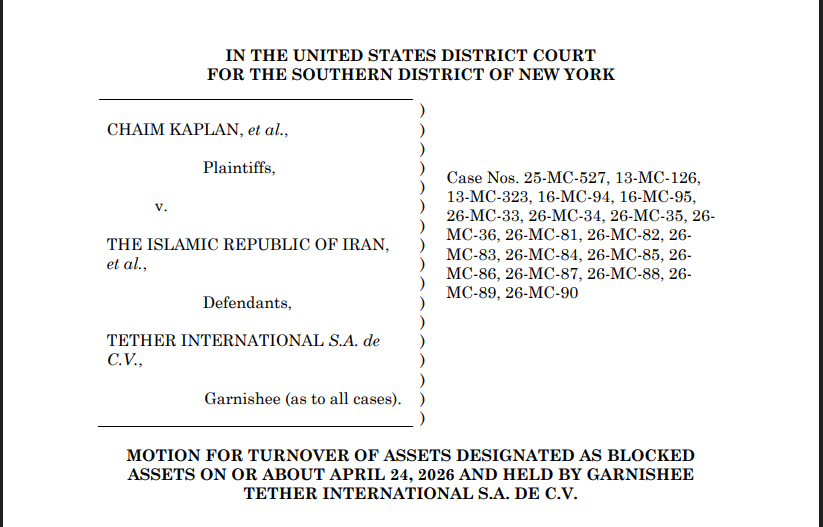
Filing against Tether submitted by Attorney Charles Gerstein.

His clients say they have a legal claim to two Tron blockchain wallet addresses holding roughly 344 million USDT. Those wallets were frozen earlier this year by the US Treasury Department’s Office of Foreign Assets Control, which identified them as linked to Iran’s Islamic Revolutionary Guard Corps.

The plaintiffs are not asking Tether to simply release those specific wallets. According to reports, they want a court order directing Tether to transfer an equivalent amount of USDT to their legal team’s wallet address.
Why Tether Can Be Compelled

Unlike Bitcoin or Ethereum, USDT is controlled by a central company. Tether can freeze wallets, block transactions, and move funds when ordered to do so. That centralized structure is at the heart of Gerstein’s legal argument.

Because a prior order already froze the wallets — something only possible because Tether has direct operational control — he contends the company can also be ordered to move the funds.

BTCUSD trading at $78,115 on the 24-hour chart: TradingView

The ownership question, he argues, is already largely settled: OFAC has already declared the wallets to be IRGC-controlled assets, which clears a path for seizure under US terrorism statutes.

Broader Legal Campaign

This is not Gerstein’s only case of this kind. Based on reports, he has filed similar actions involving North Korea-linked cyber operations against the Arbitrum platform. He is also handling a separate case involving Railgun DAO, a privacy-focused crypto protocol.

The Manhattan filing is part of what appears to be a coordinated legal push to test whether courts can compel crypto platforms with centralized control to act on frozen assets held in sanctioned wallets.

Featured image from CEPA, chart from TradingView

Related Questions

QWhat is the plaintiffs' primary demand to Tether in this case?

AThe plaintiffs are asking the US federal court to order Tether to transfer approximately $344 million worth of frozen USDT (an equivalent amount to the funds in two sanctioned wallet addresses) to a wallet address controlled by their legal team.

QWhat is the legal basis for Attorney Charles Gerstein's argument that Tether can be compelled to move the funds?

AThe argument hinges on Tether's centralized control over USDT. Gerstein contends that because Tether can and has frozen the specific wallets (as ordered by OFAC), demonstrating direct operational control, the company can similarly be ordered by a court to move the funds.

QWhat entity froze the Tron blockchain wallets containing the 344 million USDT, and why were they frozen?

AThe wallets were frozen earlier this year by the US Treasury Department's Office of Foreign Assets Control (OFAC), which identified them as assets linked to Iran's Islamic Revolutionary Guard Corps (IRGC).

QWho are the plaintiffs in this lawsuit against Tether?

AThe plaintiffs are survivors and family members of victims from Iran-linked terrorist attacks, including a Jerusalem family that lost relatives in a 1997 Hamas suicide bombing. They hold unpaid court judgments against Iran.

QWhat potential legal significance does this case hold beyond the immediate dispute?

AThe case could set a significant legal precedent for how US courts treat centralized stablecoin issuers, testing whether courts can compel such platforms to act on frozen assets held in wallets linked to sanctioned entities under terrorism statutes.

Related Reads

Fei-Fei Li's Team Clarifies the Concept of 'World Models', Sora Merely a Renderer

"World Models" has become a widely used yet confusing term in AI. To address this, a team led by Fei-Fei Li and World Labs proposed a functional taxonomy based on the Partially Observable Markov Decision Process framework. This taxonomy categorizes systems called "world models" into three distinct projections: Renderers, Simulators, and Planners. Renderers, like OpenAI's Sora and other video generation models, focus on producing photorealistic visual outputs for human perception. They prioritize visual fidelity over physical accuracy. Simulators, such as NVIDIA Omniverse, aim to compute precise future environmental states for computational tasks like engineering analysis or digital twins. Planners, like Vision-Language-Action models, take in observations and goals to output executable actions for robots or agents. The article clarifies that most current "world models," including Sora, are primarily Renderers. They generate convincing visuals but lack the core ability to simulate state transitions based on actions, a key requirement for a true world model in classic reinforcement learning definitions. This conceptual confusion has practical implications, leading to potential misalignment in technology selection, investment, and public understanding of AI capabilities. Clear categorization is crucial. It helps enterprises avoid costly mistakes (e.g., using a renderer for robot training), allows investors to accurately assess markets, and enables researchers to build comparable benchmarks. While future systems may integrate these functions, recognizing current boundaries is essential for honest assessment and progress.

marsbit1h ago

Fei-Fei Li's Team Clarifies the Concept of 'World Models', Sora Merely a Renderer

marsbit1h ago

Trading

Spot
Futures
活动图片





