Tether Ramps Up Wallet Freezes, Blocking Over $500M In USDT

bitcoinistPublished on 2026-05-10Last updated on 2026-05-10

Abstract

Tether has significantly increased its wallet freezing activity, blocking over $514 million in USDT across 370 addresses on the Tron and Ethereum networks in just the past 30 days. Data from BlockSec shows the vast majority of these freezes (328 addresses, $506 million) occurred on Tron. The pace is accelerating, with the 2025 annual total of $1.26 billion across 4,163 addresses at risk of being surpassed this year. Once frozen, wallets are rarely reinstated, and more than half of the associated funds are typically permanently destroyed. A growing portion of these enforcement actions are coordinated with law enforcement. Recent examples include freezing $344 million linked to suspected sanctions evasion with Iran and $61 million tied to "pig butchering" scams. Cumulatively from 2023-2025, Tether has frozen roughly $3.3 billion across 7,268 addresses, far exceeding actions by competitors like Circle. This surge has sparked broader debate within crypto about the power issuers and projects hold to freeze or recover funds, highlighting how compliance and central controls remain integral behind the scenes of decentralized ecosystems.

Once frozen, a Tether-blacklisted wallet almost never comes back. Only 3.6% of addresses placed on the blocklist in 2025 were later removed, according to BlockSec data.

More than half of the funds tied to those wallets were permanently destroyed using the contracts’ “destroyBlackFunds” function — a detail that underscores just how final these enforcement actions tend to be.

Freezes Surge Across Tron And Ethereum

In the past 30 days alone, Tether froze over $514 million in USDT across 370 addresses on the Ethereum and Tron networks.

BlockSec’s USDT Freeze Tracker shows 328 of those addresses were on Tron, with about $506 million locked there. Ethereum accounted for 42 addresses and $8.73 million. The gap between the two networks points to Tron as the main front in Tether’s enforcement push.
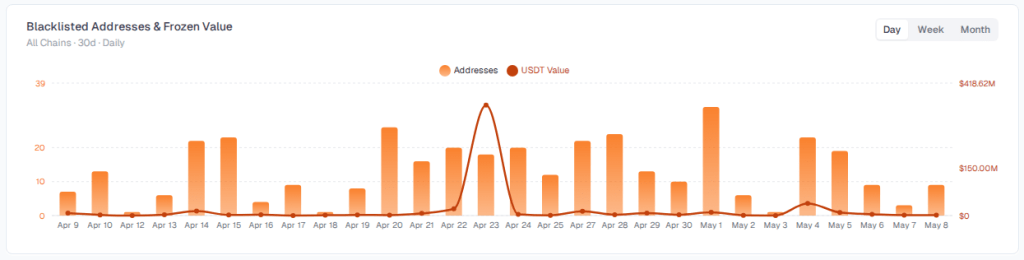
Source: BlockSec

The pace is picking up. All of 2025 saw Tether blacklist 4,163 addresses and freeze a combined $1.26 billion. At the current rate, that annual total could be surpassed well before December.

A broader study covering 2023 through 2025 put the cumulative figure at roughly $3.3 billion across 7,268 addresses — far ahead of rival stablecoin issuer Circle over the same period.

Law Enforcement Plays A Growing Role

Some of the largest recent freezes were tied directly to government investigations. In April, Tether coordinated with the US Treasury’s Office of Foreign Assets Control to lock more than $344 million in USDT across two Tron addresses.

Bitcoin is currently trading at $80,349. Chart: TradingView

Officials said those wallets were linked to suspected sanctions evasion involving Iran. Months earlier, in February, Tether assisted authorities in seizing over $61 million connected to pig butchering scams — a form of fraud where victims are manipulated into sending large sums under false pretenses.

Tether had previously disclosed that it froze around $4.2 billion in tokens over three years due to links with illicit activity, with $3.5 billion of that amount locked since 2023 as law enforcement agencies stepped up crypto-related investigations.

Broader Questions Around Freeze Powers

The surge in blacklisting has sparked debate beyond stablecoins. Some decentralized finance projects have used upgradeable contracts and admin controls to halt or recover funds after major exploits, raising questions about who holds those powers and when they should be used.

For stablecoins like USDT, issuers retain direct control over minting and burning. Data shows these freeze mechanisms are now a routine part of fraud, sanctions, and scam investigations — used not occasionally, but consistently and at scale.

Featured image from Halo, chart from TradingView

Related Questions

QWhat percentage of Tether-blacklisted wallets in 2025 were later removed, and what happens to the funds?

AOnly 3.6% of Tether-blacklisted addresses in 2025 were later removed. More than half of the funds tied to those wallets were permanently destroyed using the 'destroyBlackFunds' contract function.

QHow much USDT did Tether freeze in the past 30 days, and which blockchain network was most impacted?

AIn the past 30 days, Tether froze over $514 million in USDT across 370 addresses. The Tron network was the most impacted, with 328 addresses and about $506 million frozen, compared to 42 addresses and $8.73 million on Ethereum.

QWhat was the cumulative amount of USDT frozen by Tether from 2023 through 2025, and how does it compare to its rival Circle?

AFrom 2023 through 2025, Tether froze roughly $3.3 billion in USDT across 7,268 addresses. This amount is far ahead of what its rival stablecoin issuer, Circle, froze over the same period.

QWhat were two notable law enforcement-related Tether freezes mentioned in the article?

ATwo notable law enforcement-related freezes were: 1) In April, Tether coordinated with the U.S. Treasury's OFAC to freeze over $344 million in USDT linked to suspected sanctions evasion involving Iran. 2) In February, Tether assisted in seizing over $61 million connected to pig butchering scams.

QWhat broader debate has the surge in Tether blacklisting sparked, according to the article?

AThe surge in Tether blacklisting has sparked a broader debate about who holds freeze powers and when they should be used, extending beyond stablecoins to decentralized finance projects that use upgradeable contracts and admin controls to halt or recover funds after major exploits.

Related Reads

Standing in the Light: A Comprehensive Guide to the Optical Module and CPO Supply Chain

"Standing in the Light: Understanding the Optical Module and CPO Industry Chain" This article analyzes the critical role of optical communication technology, specifically optical modules and Co-Packaged Optics (CPO), as the "nervous system" for modern AI data centers. With exponential growth in AI computational demands (e.g., NVIDIA's Vera Rubin architecture), traditional electrical interconnects using copper cables face severe bottlenecks in bandwidth, power consumption, and signal integrity over distance. The core function of an optical module is to act as a "translator," converting electrical signals from chips into optical signals for transmission over fiber (and vice-versa). Key internal components include lasers, modulators, photodetectors, drivers, and DSP chips. The industry is currently transitioning from 800G to 1.6T modules. However, the future lies in CPO. This next-generation technology integrates the optical engine directly with the switch ASIC/XPU on the same package substrate, drastically reducing power consumption (by ~3.5x according to NVIDIA), overcoming bandwidth density limits, and minimizing signal attenuation compared to traditional pluggable modules. Key challenges for CPO include advanced packaging capacity (dominated by TSMC), thermal management, repairability, and standardization. The article details the broader technology landscape, including Near-Packaged Optics (NPO, a pragmatic intermediate step), Linear-drive Pluggable Optics (LPO), Optical I/O (OIO for chip-level integration), and Optical Circuit Switches (OCS). A comprehensive CPO industry chain is mapped, highlighting shifting power dynamics: * **Architecture Definers:** NVIDIA, Broadcom, and Marvell now hold greater influence. * **Advanced Packaging & Manufacturing:** TSMC is central; Fabrinet is a key EMS player. * **Lasers ("The Heart"):** A strategic bottleneck. EML lasers are led by Lumentum and Coherent (both receiving major NVIDIA investments). CW lasers, favored for CPO/silicon photonics, see strong Chinese players like Source Photonics and Sicoya. * **Silicon Photonics Chips:** The mainstream path for CPO engines, with key players like Broadcom, Intel, Marvell, and China's Accelink. * **Fiber Connectivity Components:** A major new, high-growth market created by CPO, including Fiber Array Units (FAU), Polarization-Maintaining Fiber (PMF), and MPO connectors. Companies like Tianfu Communication and US Conec are leaders. * **Fiber & Cable:** Experiencing a super-cycle (e.g., Corning, Yangtze Optical Fiber). * **PCB/Substrates:** Requiring advanced materials (e.g., Shengyi Tech). * **DSP & SerDes:** Functions are integrated into switch ASICs in the CPO era (e.g., Broadcom, Astera Labs). * **Optical Module Makers:** Transitioning from standalone module suppliers to providers of optical engines and NPO/LPO solutions while riding the current pluggable boom (e.g., Zhongji Innolight, Eoptolink). The investment timeline is segmented: Short-term (2026-2027) features the "last feast" for pluggable modules and CPO's initial rollout. Medium-term (2027-2029) will see CPO expand and NPO peak. Long-term (2029-2032+) involves CPO/OIO penetration into intra-rack scaling. In conclusion, optical interconnects are fundamental to AI infrastructure. The competitive landscape sees US firms leading in architecture and high-end chips, TSMC in advanced packaging, and Chinese firms holding strong positions in modules, connectivity components, CW lasers, and fiber/cable. The future belongs to companies that can navigate the technological shift from "selling shovels" (modules) to "building highways" (CPO/OIO infrastructure).

marsbit3m ago

Standing in the Light: A Comprehensive Guide to the Optical Module and CPO Supply Chain

marsbit3m ago

Trading

Spot
Futures
活动图片