Tether Ramps Up Wallet Freezes, Blocking Over $500M In USDT

bitcoinistPublished on 2026-05-10Last updated on 2026-05-10

Abstract

Tether has significantly increased its wallet freezing activity, blocking over $514 million in USDT across 370 addresses on the Tron and Ethereum networks in just the past 30 days. Data from BlockSec shows the vast majority of these freezes (328 addresses, $506 million) occurred on Tron. The pace is accelerating, with the 2025 annual total of $1.26 billion across 4,163 addresses at risk of being surpassed this year. Once frozen, wallets are rarely reinstated, and more than half of the associated funds are typically permanently destroyed. A growing portion of these enforcement actions are coordinated with law enforcement. Recent examples include freezing $344 million linked to suspected sanctions evasion with Iran and $61 million tied to "pig butchering" scams. Cumulatively from 2023-2025, Tether has frozen roughly $3.3 billion across 7,268 addresses, far exceeding actions by competitors like Circle. This surge has sparked broader debate within crypto about the power issuers and projects hold to freeze or recover funds, highlighting how compliance and central controls remain integral behind the scenes of decentralized ecosystems.

Once frozen, a Tether-blacklisted wallet almost never comes back. Only 3.6% of addresses placed on the blocklist in 2025 were later removed, according to BlockSec data.

More than half of the funds tied to those wallets were permanently destroyed using the contracts’ “destroyBlackFunds” function — a detail that underscores just how final these enforcement actions tend to be.

Freezes Surge Across Tron And Ethereum

In the past 30 days alone, Tether froze over $514 million in USDT across 370 addresses on the Ethereum and Tron networks.

BlockSec’s USDT Freeze Tracker shows 328 of those addresses were on Tron, with about $506 million locked there. Ethereum accounted for 42 addresses and $8.73 million. The gap between the two networks points to Tron as the main front in Tether’s enforcement push.
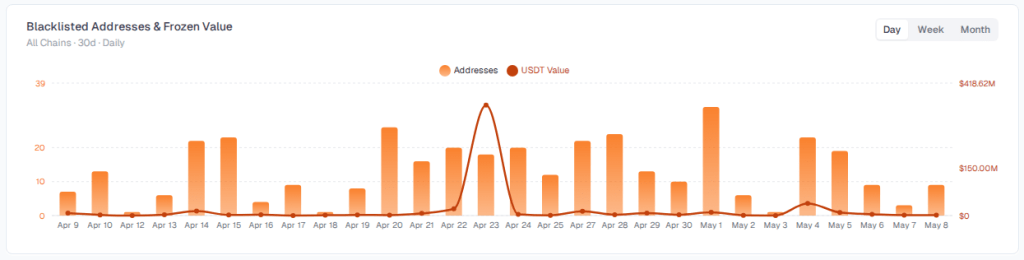
Source: BlockSec

The pace is picking up. All of 2025 saw Tether blacklist 4,163 addresses and freeze a combined $1.26 billion. At the current rate, that annual total could be surpassed well before December.

A broader study covering 2023 through 2025 put the cumulative figure at roughly $3.3 billion across 7,268 addresses — far ahead of rival stablecoin issuer Circle over the same period.

Law Enforcement Plays A Growing Role

Some of the largest recent freezes were tied directly to government investigations. In April, Tether coordinated with the US Treasury’s Office of Foreign Assets Control to lock more than $344 million in USDT across two Tron addresses.

Bitcoin is currently trading at $80,349. Chart: TradingView

Officials said those wallets were linked to suspected sanctions evasion involving Iran. Months earlier, in February, Tether assisted authorities in seizing over $61 million connected to pig butchering scams — a form of fraud where victims are manipulated into sending large sums under false pretenses.

Tether had previously disclosed that it froze around $4.2 billion in tokens over three years due to links with illicit activity, with $3.5 billion of that amount locked since 2023 as law enforcement agencies stepped up crypto-related investigations.

Broader Questions Around Freeze Powers

The surge in blacklisting has sparked debate beyond stablecoins. Some decentralized finance projects have used upgradeable contracts and admin controls to halt or recover funds after major exploits, raising questions about who holds those powers and when they should be used.

For stablecoins like USDT, issuers retain direct control over minting and burning. Data shows these freeze mechanisms are now a routine part of fraud, sanctions, and scam investigations — used not occasionally, but consistently and at scale.

Featured image from Halo, chart from TradingView

Related Questions

QWhat percentage of Tether-blacklisted wallets in 2025 were later removed, and what happens to the funds?

AOnly 3.6% of Tether-blacklisted addresses in 2025 were later removed. More than half of the funds tied to those wallets were permanently destroyed using the 'destroyBlackFunds' contract function.

QHow much USDT did Tether freeze in the past 30 days, and which blockchain network was most impacted?

AIn the past 30 days, Tether froze over $514 million in USDT across 370 addresses. The Tron network was the most impacted, with 328 addresses and about $506 million frozen, compared to 42 addresses and $8.73 million on Ethereum.

QWhat was the cumulative amount of USDT frozen by Tether from 2023 through 2025, and how does it compare to its rival Circle?

AFrom 2023 through 2025, Tether froze roughly $3.3 billion in USDT across 7,268 addresses. This amount is far ahead of what its rival stablecoin issuer, Circle, froze over the same period.

QWhat were two notable law enforcement-related Tether freezes mentioned in the article?

ATwo notable law enforcement-related freezes were: 1) In April, Tether coordinated with the U.S. Treasury's OFAC to freeze over $344 million in USDT linked to suspected sanctions evasion involving Iran. 2) In February, Tether assisted in seizing over $61 million connected to pig butchering scams.

QWhat broader debate has the surge in Tether blacklisting sparked, according to the article?

AThe surge in Tether blacklisting has sparked a broader debate about who holds freeze powers and when they should be used, extending beyond stablecoins to decentralized finance projects that use upgradeable contracts and admin controls to halt or recover funds after major exploits.

Related Reads

The Verdict in Choi Tae-won's Divorce Case: Revealing the Inheritance Undercurrent Behind SK Hynix's Trillion-Won Empire

SK Group Chairman Chey Tae-won's high-profile divorce case, involving a record 1.38 trillion won settlement, has drawn attention to the succession plans for Korea's second-largest conglomerate, especially its crown jewel, SK hynix. Unlike traditional chaebol scripts centered on the eldest son, Chey's three children from his marriage to former President Roh Tae-woo's daughter, Roh Soh-yeong, are carving distinct, non-traditional paths. Eldest daughter Chey Yun-jung (b. 1989) is seen as the most evident successor. With a scientific and consulting background, she holds executive roles at SK bioscience and SK Inc.'s growth support department, focusing on future strategy and biopharma. Her marriage is to an AI infrastructure entrepreneur, not a traditional business alliance. Second daughter Chey Min-jung (b. 1991) took a unique route, voluntarily serving as a South Korean naval officer, including an anti-piracy deployment. She later worked on policy and strategy for SK hynix in Washington D.C. before co-founding an AI-driven healthcare startup. She married a former U.S. Marine Corps officer, connecting her to U.S. defense and policy circles—networks crucial for a global semiconductor giant. The only son, Chey In-geun (b. 1995), who studied physics like his father, worked briefly at SK E&S before joining McKinsey. Despite fitting the traditional "heir" profile as the eldest son, he remains silent and holds no public position or shares in SK, suggesting the old succession playbook is obsolete. As SK hynix's valuation soars, becoming a geopolitical asset in the AI era, the heirs' legitimacy is no longer automatic. They must prove themselves in fields like AI biotech, global policy, and strategic consulting. Their marriages also reflect new elite networks in tech and defense, not old political alliances. Their inheritance is the complex challenge of navigating a globalized, tech-driven world, not just a corporate throne.

marsbit2h ago

The Verdict in Choi Tae-won's Divorce Case: Revealing the Inheritance Undercurrent Behind SK Hynix's Trillion-Won Empire

marsbit2h ago

From OpenSea to OpenRouter: Is Alex Atallah Repeating His 'Exit at the Peak' Playbook?

From OpenSea to OpenRouter: Is Alex Atallah Repeating His "Exit at the Peak" Playbook? According to the Wall Street Journal, payments giant Stripe is in talks to acquire the AI model aggregation platform OpenRouter in a potential deal valuing the company near $100 billion. This would mark founder Alex Atallah's second creation of a company reaching a $100 billion valuation, following his co-founding of NFT marketplace OpenSea. OpenRouter, founded just over three years ago, has grown rapidly by acting as a unified gateway for developers to access over 400 AI models. It currently has about 10 million users and processes over 200 trillion tokens monthly. While the platform's annualized revenue is around $50 million, its valuation has skyrocketed from $1.3 billion in March 2026. The potential acquisition by Stripe, a company OpenRouter's founder once likened it to, represents a major expansion into AI infrastructure for the payments leader. This move echoes Atallah's previous timing with OpenSea, where he departed before the NFT market's significant downturn. For OpenRouter, selling now may be strategic. Despite its scale, its business model—charging a 5-5.5% fee on AI inference calls—faces pressure from competition, open-source models, and potential price wars among model providers, limiting its profitability narrative for an IPO. A key asset for potential acquirers like Stripe is OpenRouter's vast repository of real-world AI usage data, which offers unique insights into model performance and developer preferences that are difficult to replicate. Whether this potential deal signifies a new valuation benchmark for AI infrastructure or another market peak signal remains to be seen.

链捕手3h ago

From OpenSea to OpenRouter: Is Alex Atallah Repeating His 'Exit at the Peak' Playbook?

链捕手3h ago

Trading

Spot
活动图片





