Tether Fails $500B Evaluation Amidst Investor Pushback as HYPER Gains Momentum

bitcoinistPublished on 2026-02-04Last updated on 2026-02-04

Abstract

The cryptocurrency market is experiencing a significant shift as Tether (USDT) faces investor resistance and fails to achieve a $500 billion valuation, driven by transparency concerns and a move towards decentralized alternatives. This has led to a rotation of liquidity into Bitcoin Layer 2 solutions, which aim to unlock Bitcoin's dormant capital by enhancing its utility. Bitcoin Hyper ($HYPER) is emerging as a key player, integrating the Solana Virtual Machine (SVM) to offer high-speed execution and smart contract capabilities while maintaining Bitcoin's security. It enables sub-second transactions, decentralized finance (DeFi) applications, and seamless BTC transfers, addressing scalability issues. The project has raised over $31.2 million in its presale, indicating strong institutional confidence. With a current token price of $0.0136751, it offers staking rewards and aims to attract long-term investors amid growing interest in Bitcoin's programmability.

The cryptocurrency market is witnessing a decoupling event play out in real-time.

Tether (USDT), long considered the unshakeable bedrock of stablecoin liquidity, has hit a wall in its pursuit of a $500B-implied market valuation.

Institutional investors have reportedly balked at the metrics, spooked by transparency concerns and a regulatory landscape shifting toward decentralized alternatives. This stalemate at the half-trillion-dollar mark isn’t just a pricing failure; it’s a signal that risk appetite is rotating.

But here’s the kicker: liquidity isn’t leaving the ecosystem. It’s just moving deeper into the Bitcoin infrastructure. The market is bored with simple store-of-value assets; traders want utility layers capable of unlocking Bitcoin’s dormant capital.

That shift explains the sudden surge in Bitcoin Layer 2 solutions, which are quietly absorbing the liquidity Tether failed to capture.

Investors appear to be hedging against stablecoin stagnation by betting on the ‘programmability’ of Bitcoin. The logic holds up: if Bitcoin is the gold standard, the rails allowing it to transact like Solana or Ethereum are the ultimate pick-and-shovel plays.

This environment created a perfect storm for emerging protocols like Bitcoin Hyper ($HYPER), which is seeing its valuation climb while Tether’s dominance faces scrutiny.

You can buy your $HYPER here.

Bitcoin Hyper Bridges the Gap Between Store of Value and High-Speed Execution

The core friction point in the current market isn’t a lack of assets, it’s a lack of velocity.

Bitcoin holds over a trillion dollars in value, yet that capital remains largely inert, trapped by slow block times and the absence of native smart contracts. Bitcoin Hyper ($HYPER) answers this bottleneck not just as a sidechain, but as the first Bitcoin Layer 2 to integrate the Solana Virtual Machine (SVM).

Why does this technical architecture matter? It solves the ‘trilemma’ without sacrificing Bitcoin’s security, which is one of Bitcoin Hyper’s mantras.
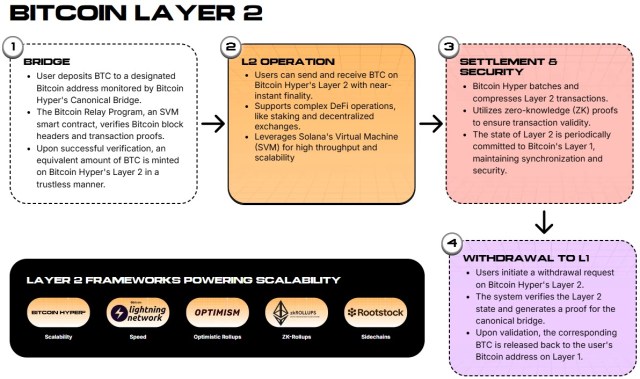
By using the SVM for execution, Bitcoin Hyper achieves the sub-second finality and low-latency performance DeFi developers require, all while anchoring its state to Bitcoin L1.

Finally, developers can write in Rust and deploy high-speed dApps that actually settle on Bitcoin. For the market, that utility is tangible. The protocol offers a Decentralized Canonical Bridge for seamless $BTC transfers and supports SPL-compatible tokens modified for Layer 2 operations.

This opens the door for high-frequency trading, gaming, and complex lending protocols directly on the Bitcoin network, use cases that were previously impossible. Plus, the integration of high-speed payments in wrapped $BTC with negligible fees addresses the precise scalability issues that have historically held the ecosystem back.

Check the $HYPER presale.

Whale Accumulation Signals Confidence With Over $31M Raised

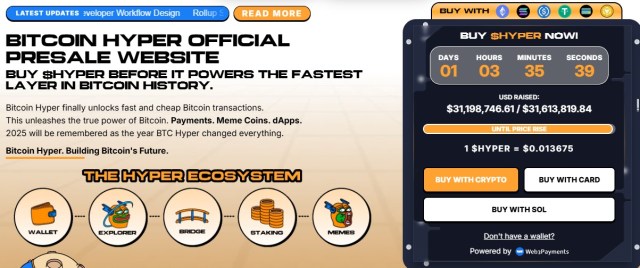
While Tether struggles to justify its valuation, smart money is aggressively positioning itself in the Bitcoin Hyper presale. The sentiment contrast is stark. According to official data, the project has raised over $31.2M. That figure suggests robust institutional confidence, even as the broader market hesitates on stablecoins.
Traders watching this setup will notice this pattern often precedes retail adoption, as whales position themselves before the Token Generation Event.

Frankly, the tokenomics look designed to discourage mercenary capital rotation. With the token currently priced at $0.0136751, early participants are eyeing immediate staking opportunities post-TGE. The protocol offers high APY staking rewards, with a modest 7-day vesting period for presale stakers to prevent immediate dump pressure.

For investors fatigued by the regulatory ambiguity surrounding centralized stablecoins, the programmatic certainty of a Bitcoin L2 offers a compelling alternative, while the presale performance creates the expected FOMO.

Buy your $HYPER today.

Disclaimer: The content of this article is for informational purposes only and does not constitute financial advice. Cryptocurrency investments, including presales and Layer 2 tokens, carry inherent risks. Always perform your own due diligence before investing.


Related Questions

QWhy has Tether (USDT) failed to achieve a $500 billion market valuation according to the article?

AInstitutional investors balked at the metrics due to transparency concerns and a regulatory landscape favoring decentralized alternatives, signaling a shift in risk appetite.

QWhat is Bitcoin Hyper ($HYPER) and how does it address the limitations of Bitcoin?

ABitcoin Hyper is a Bitcoin Layer 2 solution that integrates the Solana Virtual Machine (SVM) to enable sub-second finality, low-latency performance, and support for high-speed dApps, gaming, and DeFi on Bitcoin, solving its scalability and smart contract limitations.

QHow much has the Bitcoin Hyper ($HYPER) presale raised and what does this indicate?

AThe Bitcoin Hyper presale has raised over $31.2 million, indicating robust institutional confidence and smart money positioning ahead of retail adoption, contrasting with Tether's struggles.

QWhat technical feature allows Bitcoin Hyper to achieve high-speed execution while maintaining Bitcoin's security?

ABitcoin Hyper uses the Solana Virtual Machine (SVM) for execution, achieving sub-second finality and low-latency performance while anchoring its state to Bitcoin L1, thus maintaining Bitcoin's security.

QWhat are the benefits of Bitcoin Hyper's integration of SPL-compatible tokens and a Decentralized Canonical Bridge?

AThe integration allows seamless $BTC transfers, supports Layer 2 operations for SPL-compatible tokens, and enables high-frequency trading, gaming, and complex lending protocols directly on the Bitcoin network with negligible fees.

Related Reads

In-Depth Report on the On-Chain Lending Market: When Off-Chain Credit Meets On-Chain Liquidation

The on-chain lending market has evolved from a peripheral DeFi niche into core financial infrastructure. As of early 2026, total value locked (TVL) in on-chain lending protocols has reached $64.3 billion, accounting for 53.54% of total DeFi TVL, making it the largest and most mature vertical within decentralized finance. Aave dominates the sector with approximately $32.9 billion in TVL, commanding nearly half of the market—a leadership position that is unlikely to be challenged in the foreseeable future. However, the path of on-chain lending forward is not without risk. Liquidation cascades, credit defaults, and cross-chain vulnerabilities remain systemic threats hanging over the industry. At the same time, a deeper structural transformation is underway: on-chain lending is shifting from a “leverage tool for crypto-native users” to a “compliant gateway for institutional capital”. The scale of RWA (Real World Asset) lending has surpassed $18.5 billion, with U.S. Treasuries and government securities increasingly serving as core collateral. Institutional capital inflows are reshaping both the user base and risk appetite of the sector. This report systematically analyzes the evolution of on-chain lending definitions, competitive dynamics, core risks, and future trends, providing a comprehensive industry outlook for investors and trade practitioners. Key findings suggest that the “one dominant player with several strong challengers” structure will persist in the short term, while fixed-rate lending, compliant collateral, and institutional credit underwriting will define the next phase of competition. For investors focused on DeFi infrastructure, three key opportunity tracks stand out, namely, the Aave ecosystem (Morpho, Spark), RWA lending protocols (Ondo, Maple) and fixed-rate innovation (Notional, Pendle).

HTX Learn27m ago

In-Depth Report on the On-Chain Lending Market: When Off-Chain Credit Meets On-Chain Liquidation

HTX Learn27m ago

Fu Peng's First Public Speech in 2026: What Exactly Are Crypto Assets? Why Did I Join the Crypto Asset Industry?

Fu Peng, a renowned macroeconomist and now Chief Economist at New火 Group, delivered his first public speech of 2026 at the Hong Kong Web3 Festival. He explained his perspective on crypto assets and why he joined the industry, framing it within the context of macroeconomic trends and financial evolution. Fu emphasized that crypto assets are transitioning from an early, belief-driven phase to a mature, institutionally integrated asset class. He drew parallels to the 1970s-80s, when technological advances (like computing) revolutionized traditional finance, leading to the rise of FICC (Fixed Income, Currencies, and Commodities). Similarly, current advancements in AI, data, and blockchain are reshaping finance, with crypto assets becoming part of a new "FICC + C" (C for Crypto) framework. He noted that institutional capital, including traditional hedge funds, avoided early crypto due to its speculative nature but are now engaging as regulatory clarity emerges (e.g., stablecoin laws, CFTC classifying crypto as a commodity). Fu predicted that 2025-2026 marks a turning point where crypto becomes a standardized, financially viable asset for diversified portfolios, akin to commodities or derivatives in traditional finance. Fu defined Bitcoin not as "digital gold" in a simplistic sense but as a value-preserving, financially tradable asset. He highlighted that crypto's future lies in regulated, institutional adoption, moving away from retail-dominated trading. His entry into crypto signals this maturation, where traditional finance integrates crypto into mainstream asset management.

marsbit1h ago

Fu Peng's First Public Speech in 2026: What Exactly Are Crypto Assets? Why Did I Join the Crypto Asset Industry?

marsbit1h ago

Justin Sun Sues Trump Family: What $75 Million Bought Was Only a Blacklist

Justin Sun, founder of Tron, has filed a lawsuit in federal court against World Liberty Financial (WLF), alleging he was made the "primary target of a fraudulent scheme" after investing $75 million. Sun claims the investment secured him an advisor title and WLFI tokens, which were later frozen by WLF, causing "hundreds of millions in losses." The dispute began in late 2024 when Sun's investment helped revive WLF's struggling token sale, which ultimately raised $550 million. Shortly after, the SEC dropped its lawsuit against Sun following Donald Trump's inauguration. However, relations soured when Sun refused WLF's demands for additional funding. In August 2025, WLF added a "blacklist" function to its smart contract, allowing it to unilaterally freeze tokens. Sun's holdings, worth approximately $107 million, were frozen, and he was threatened with token destruction. The lawsuit highlights WLF's structure, which directs 75% of token sale profits to the Trump family, who had earned $1 billion by December 2025. WLF's CEO is Zach Witkoff, son of U.S. Middle East envoy Steve Witkoff. The project faces scrutiny for opaque operations, including a controversial loan arrangement on the Dolomite platform, co-founded by a WLF advisor. Despite Sun's history with the SEC, the case underscores centralization risks within DeFi, as WLF controls governance and holds powers to freeze assets arbitrarily. Sun's tokens remain frozen as legal proceedings begin.

marsbit1h ago

Justin Sun Sues Trump Family: What $75 Million Bought Was Only a Blacklist

marsbit1h ago

Trading

Spot
Futures
活动图片