Tether-backed Northern Data sold mining firm to Tether execs: FT

cointelegraphPublished on 2025-12-22Last updated on 2025-12-22

Abstract

Northern Data, a Tether-backed data center operator, sold its Bitcoin mining business, Peak Mining, for up to $200 million to three companies run by Tether executives, including its co-founder and CEO. The sale occurred just before Rumble, a video-sharing platform in which Tether holds a major stake, agreed to acquire Northern Data. This is the second attempt to sell the mining unit to a Tether-linked entity. Northern Data is under investigation in Europe for suspected tax fraud and has a complex financial relationship with Tether, including a €610 million loan. The sale highlights Tether's expanding interests beyond stablecoins into mining, AI, and other ventures.

The Tether-backed data centre operator Northern Data reportedly sold its Bitcoin mining business, Peak Mining, to three companies run by Tether executives.

Northern Data was sold for up to $200 million to Highland Group Mining, Appalachian Energy, and an Alberta-based company, run by Giancarlo Devasini, Tether co-founder and chair, and its CEO, Paolo Ardoino, the Financial Times reported on Friday.

Filings reportedly show that Highland Group’s directors are Devasini and Ardoino, and the sole director of the Alberta company is Devasini, while it remains unclear who runs Delaware-based Appalachian Energy.

Northern Data initially announced the Peak Mining divestment in November, but did not identify the buyers, as it was not required by German regulators.

The deal also happened just before video-sharing platform Rumble, in which Tether holds nearly a 50% stake, agreed to acquire Northern Data.
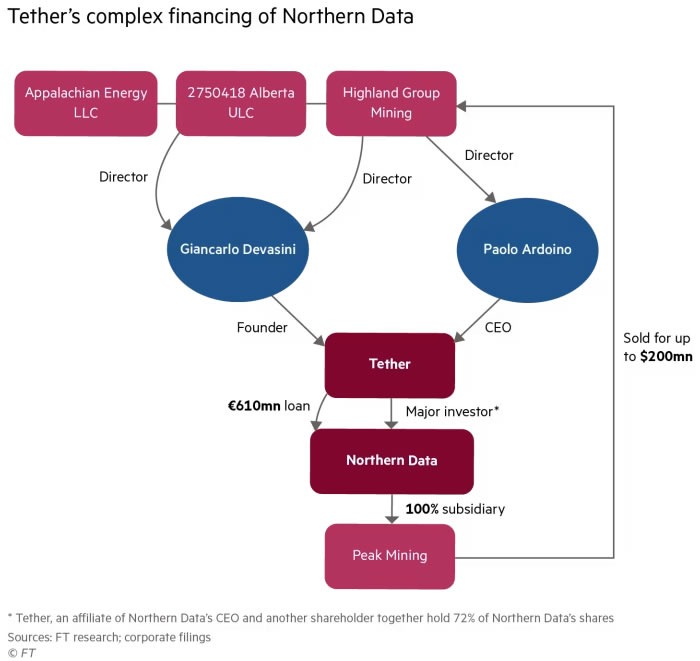
Tether’s complex web of financial ties. Source: The Financial Times

Web of complex financial ties

It is also the second attempt to sell Peak Mining to a Devasini-controlled company. The first deal announced in August was with Elektron Energy for $235 million, but it fell through amid whistleblower allegations.

Northern Data faces investigation by European prosecutors for suspected tax fraud, and its offices were raided in September.

Related: Tether deepens AI bet, backs Italian firm’s humanoid robots

Tether has also agreed on a $100 million advertising deal with Rumble and plans to buy $150 million worth of GPU services from it as it delves deeper into Bitcoin mining.

Northern Data also currently has a 610 million euro ($715 million) loan from Tether.

The stablecoin issuer will receive half of the loan balance in Rumble stock as part of the acquisition, with the rest paid in the form of a new loan from Tether to Rumble, secured against Northern Data assets, the FT reported.

Tether branching out from stablecoins

Tether remains the world’s dominant player in the stablecoin sector with a 60% market share and $187 billion in circulating supply of USDT.

In addition to Bitcoin mining, AI, and video-sharing platforms, it is also eyeing sports teams.

On December 12, Tether launched a $1.1 billion bid to acquire the Italian professional soccer club, Juventus Football Club, but it was rejected by the club’s owners.

Magazine: Big questions: Would Bitcoin survive a 10-year power outage?

Related Questions

QWhat is the name of the Bitcoin mining business sold by Northern Data, and to whom was it sold?

ANorthern Data sold its Bitcoin mining business, Peak Mining, to three companies run by Tether executives: Highland Group Mining, Appalachian Energy, and an Alberta-based company.

QWho are the key Tether executives involved in the purchase of Peak Mining, according to the Financial Times report?

AThe key Tether executives involved are Giancarlo Devasini, Tether's co-founder and chair, and its CEO, Paolo Ardoino. Devasini is a director of Highland Group and the sole director of the Alberta company.

QWhat significant event happened just before Rumble agreed to acquire Northern Data?

AJust before Rumble agreed to acquire Northern Data, the deal to sell Peak Mining to the Tether executives' companies took place.

QBesides stablecoins, what other industries is Tether investing in, as mentioned in the article?

ATether is investing in Bitcoin mining, artificial intelligence (AI), video-sharing platforms (through its stake in Rumble), and has also made a bid to acquire the Italian soccer club Juventus.

QWhat is the nature of the financial relationship between Tether and Northern Data beyond the recent sale?

ANorthern Data currently has a 610 million euro ($715 million) loan from Tether. As part of Rumble's acquisition of Northern Data, Tether will receive half of this loan balance in Rumble stock, with the rest paid as a new loan from Tether to Rumble, secured against Northern Data's assets.

Related Reads

20 Billion Valuation, Alibaba and Tencent Competing to Invest, Whose Money Will Liang Wenfeng Take?

DeepSeek, an AI startup founded by Liang Wenfeng, is reportedly in talks with Alibaba and Tencent for an external funding round that could value the company at over $20 billion. This marks a significant shift, as DeepSeek had previously relied solely on funding from its parent company,幻方量化 (Huanfang Quantitative), and had resisted external investment. The potential valuation would place DeepSeek among the top-tier AI model companies in China, comparable to competitors like MoonDark (valued at ~$18 billion) and ahead of recently listed firms like MiniMax and Zhipu. The funding—which could range from $600 million (for a 3% stake) to $2 billion (for 10%)—is seen as a move to secure resources for model development, retain talent, and support infrastructure needs, particularly as competition in inference models and AI agents intensifies. Both Alibaba and Tencent are eager to invest, not only for financial returns but also to integrate DeepSeek into their broader AI ecosystems. However, DeepSeek’s leadership is cautious about maintaining independence and may prefer financial investors over strategic ones to avoid being locked into a specific tech ecosystem. Alternative options, such as state-backed funds, offer longer-term capital and policy support but may come with slower decision-making and potential constraints on global expansion. With competing AI firms accelerating their IPO plans, DeepSeek’s window for securing optimal terms may be narrowing. The final decision will reflect a trade-off between capital, resources, and strategic independence.

marsbit39m ago

20 Billion Valuation, Alibaba and Tencent Competing to Invest, Whose Money Will Liang Wenfeng Take?

marsbit39m ago

After Losing 97% of Its Market Value, iQiyi Attempts to Use AI to Forcefully Extend Its Lifespan

After losing 97% of its market value since its 2018 peak, iQiyi is aggressively pivoting to AI in a desperate attempt to survive. At its 2026 World Conference, CEO Gong Yu announced an "AI Artist Library" with over 100 virtual performers and a new AIGC platform, "NaDou Pro," promising faster production and lower costs. This shift comes as the company faces severe financial distress: its market cap sits near delisting thresholds at $1.36 billion, with significant losses, declining membership revenue, and depleted cash flow. The AI strategy has sparked controversy. Top actors have issued legal threats against unauthorized digital replicas, while in Hengdian, over 134,000 background actors are seeing their already scarce job opportunities vanish as AI replaces them for background roles. iQiyi's move represents a fundamental shift from being a high-cost content buyer to a landlord" to becoming a "platform capitalist" that transfers production risk to creators. This contrasts with competitors like Douyin (TikTok's Chinese counterpart), which is investing heavily in *real* actor-led short dramas, betting that authentic human connection retains users better than AI-generated content. The article draws a parallel to the 1920s transition to "talkies," which made cinema musicians obsolete but ultimately enriched the art form. In contrast, iQiyi's AI drive is framed not as an artistic evolution but as a cost-cutting measure that could degrade storytelling, replacing genuine human emotion with algorithmically calculated stimulation and potentially numbing audiences' capacity for empathy. The core question remains: can a company focused solely on financial survival preserve the art of storytelling?

marsbit43m ago

After Losing 97% of Its Market Value, iQiyi Attempts to Use AI to Forcefully Extend Its Lifespan

marsbit43m ago

Only a 50% Chance of Passing This Year, Can the CLARITY Bill Succeed Before the Midterm Elections?

The CLARITY Act, which passed the House in July 2025 with strong bipartisan support (294-134), faces a critical juncture in the Senate. The Senate Banking Committee is expected to hold a markup soon, but key issues remain unresolved, including stablecoin yield provisions, DeFi regulations, and securing full Republican committee support. Other contentious points involve the Blockchain Regulatory Certainty Act (BRCA), ethics amendments for government officials, and SEC-related matters. The legislative calendar is tight, with limited time before the midterm elections. If the committee markup is delayed beyond mid-May, the chances of passage in 2026 drop significantly. Senator Cynthia Lummis has warned that failure this year could delay comprehensive crypto market structure legislation until 2030 or later. Galaxy estimates the probability of the CLARITY Act becoming law in 2026 is only about 50%. The bill provides crucial regulatory clarity by defining jurisdictional boundaries between the SEC and CFTC, establishing a path for decentralization, and bringing digital commodity intermediaries under federal regulation. Its passage is seen as vital before potential power shifts in the next Congress, which could bring less favorable leadership to key committees. The timeline is compressed, and the bill must compete for floor time with other priorities like Iran authorization and DHS appropriations. Key hurdles include finalizing the stablecoin yield compromise text, addressing law enforcement concerns about BRCA, and navigating political dynamics around SEC nominations. The outcome of the Banking Committee markup and the level of bipartisan support will be critical indicators of its future success.

marsbit1h ago

Only a 50% Chance of Passing This Year, Can the CLARITY Bill Succeed Before the Midterm Elections?

marsbit1h ago

Trading

Spot
Futures
活动图片