‘Technologically impossible’: Could Kentucky bill threaten crypto self-custody?

ambcryptoPublished on 2026-03-20Last updated on 2026-03-20

Abstract

Kentucky's proposed HB 380 amendment aims to regulate cryptocurrency kiosks but includes a controversial provision requiring hardware wallet providers to reset users' seed phrases upon request. The Bitcoin Policy Institute warns this measure would effectively outlaw self-custody, calling it "technologically impossible" and a violation of Bitcoin’s core security principles. They argue it would push users toward centralized custodians, increasing vulnerability to hacks. The amendment, added last minute, has drawn criticism for potentially infringing on residents' rights to secure their digital assets. Meanwhile, only seven U.S. states have established strategic Bitcoin reserves, with the federal government holding the largest share globally.

Kentucky is under scrutiny ahead of its planned passage of a key crypto legislation that would ban self-custody wallets.

According to the Bitcoin Policy Institute, a research and advocacy group, Kentucky’s HB 380 amendment would harm residents. The firm noted,

BPI has just learned of an amendment buried in Kentucky HB 380 that would require hardware wallet providers to reset users’ seed phrases on request. This would effectively outlaw self-custody in Kentucky.
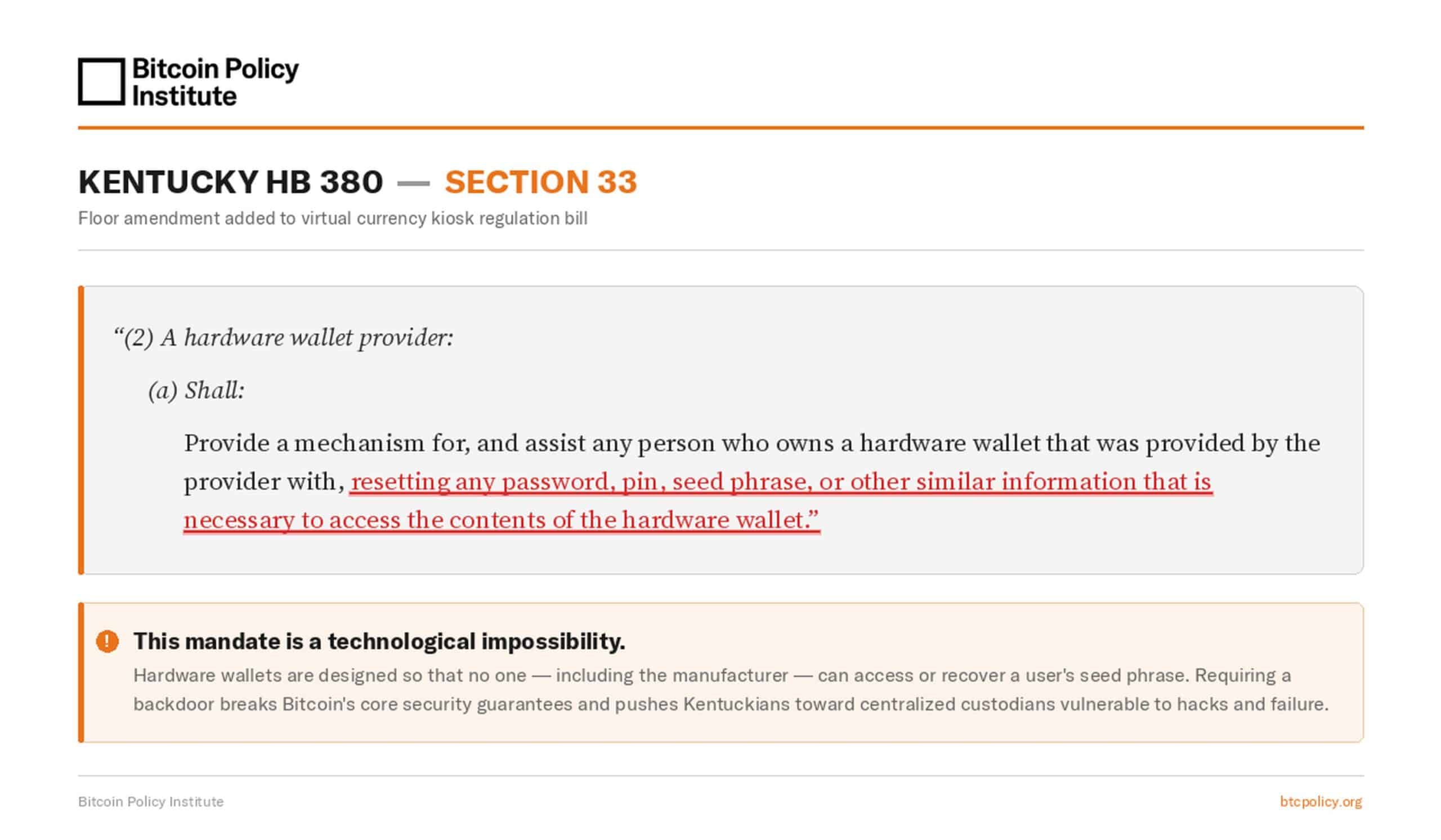
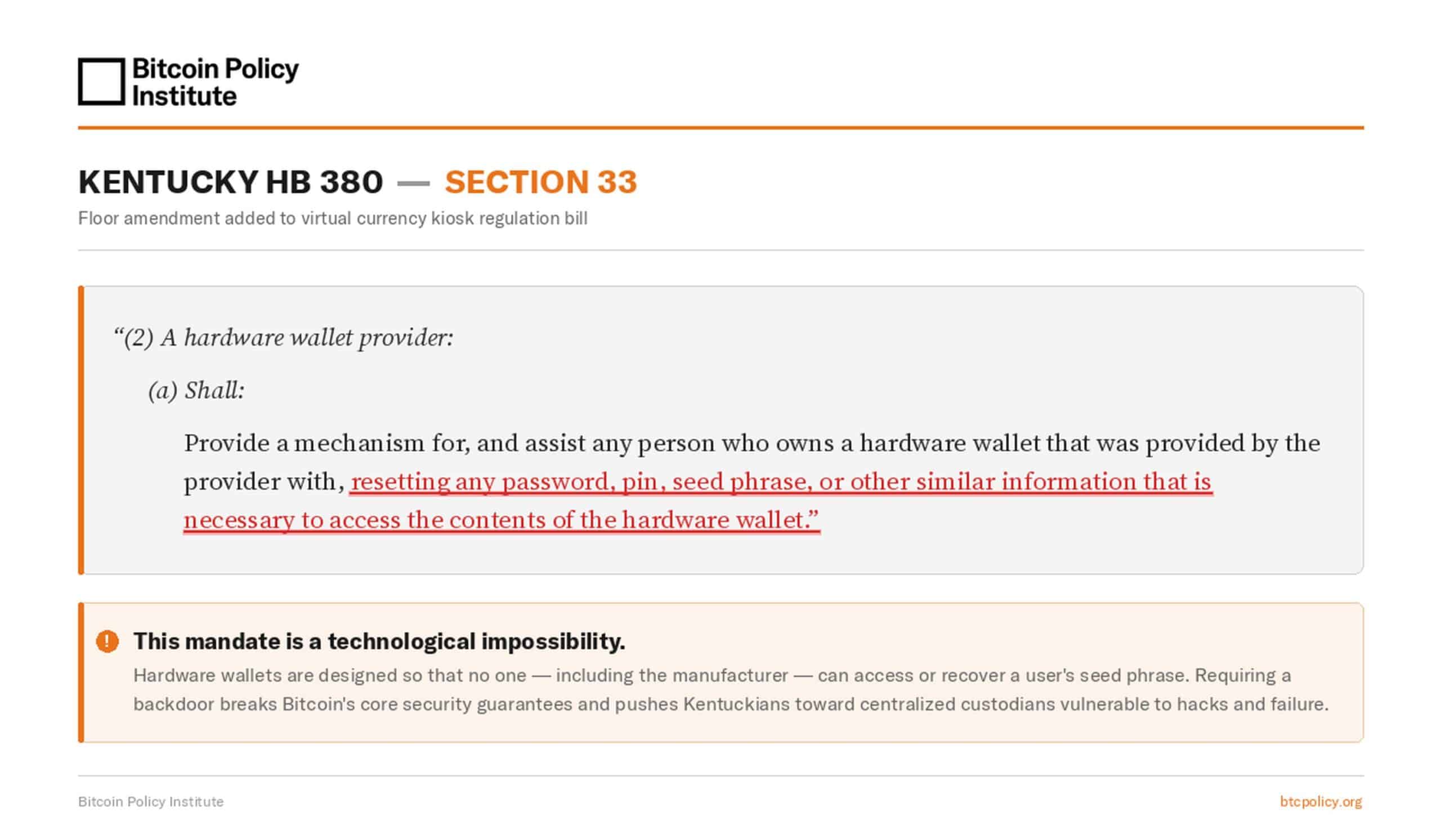
Source: BPI

Kentucky crypto plans

The HB 380 is an amendment to the 77-page virtual currency kiosk legislation, part of a broader effort to regulate crypto ATMs, especially those that facilitate BTC transfers.

It was a last-minute amendment added in January. It requires hardware providers to be able to reset and recover users’ hardware wallet passwords and seed phrases, something BPI called ‘technologically impossible.’

The mandate is technologically impossible for non-custodial wallets. Requiring a backdoor for seed phrase recovery breaks Bitcoin’s fundamental security guarantees and pushes users toward centralized custodians that are vulnerable to hacks and failures.

The advocacy group wrote to the Kentucky Senate, informing it of the harmful nature of the amendment’s language. It added that the legislators should “protect Kentucky constituents’ right to secure their property.”

However, one analyst noted that ‘commercial hardware wallets’ are vulnerable to government overreach because their parent firms are legal entities operating in different jurisdictions.

Race for strategic Bitcoin reserve

Last year, at the state level, the race for the strategic Bitcoin reserve (SBR) became hot. But, as of 2026, only a handful of states in the U.S. have managed to codify the plans into law. Currently, only seven states have approved an SBR, including Arizona, Texas, and New Mexico.

At the federal level, however, there’s been little commitment or update on whether the U.S. SBR will be established. Even so, the U.S. now holds 328,272 BTC, about 1.5% of the total supply.

This was nearly half of the total 650,296 BTC held by governments, making the U.S. the top holder, followed by China at 190,000 BTC and the UK at 61,245 BTC.


Final Summary

  • The Bitcoin Policy Institute pressed the Kentucky Senate to reconsider its recent amendment on crypto ATM rules to safeguard self-custody.
  • There are about 7 U.S. states with approved strategic BTC reserve frameworks.

Related Questions

QWhat is the main concern raised by the Bitcoin Policy Institute regarding Kentucky's HB 380 amendment?

AThe Bitcoin Policy Institute is concerned that the amendment would require hardware wallet providers to reset users' seed phrases on request, which they call 'technologically impossible' and argue it would effectively outlaw self-custody in Kentucky.

QWhy does the Bitcoin Policy Institute claim the mandate in HB 380 is 'technologically impossible'?

AThey state it is technologically impossible for non-custodial wallets because requiring a backdoor for seed phrase recovery breaks Bitcoin's fundamental security guarantees.

QWhat is the primary purpose of the broader HB 380 legislation that this amendment is a part of?

AHB 380 is an amendment to virtual currency kiosk legislation, which is part of a broader effort to regulate crypto ATMs, especially those that facilitate BTC transfers.

QHow many U.S. states have approved a strategic Bitcoin reserve (SBR) framework as of 2026, according to the article?

AAs of 2026, seven U.S. states have approved a strategic Bitcoin reserve framework.

QWhich country is the largest government holder of Bitcoin, and how much does it hold?

AThe United States is the largest government holder of Bitcoin, with 328,272 BTC, which is about 1.5% of the total supply.

Related Reads

a16z: AI's 'Amnesia', Can Continuous Learning Cure It?

The article "a16z: AI's 'Amnesia' – Can Continual Learning Cure It?" explores the limitations of current large language models (LLMs), which, like the protagonist in the film *Memento*, are trapped in a perpetual present—unable to form new memories after training. While methods like in-context learning (ICL), retrieval-augmented generation (RAG), and external scaffolding (e.g., chat history, prompts) provide temporary solutions, they fail to enable true internalization of new knowledge. The authors argue that compression—the core of learning during training—is halted at deployment, preventing models from generalizing, discovering novel solutions (e.g., mathematical proofs), or handling adversarial scenarios. The piece introduces *continual learning* as a critical research direction to address this, categorizing approaches into three paths: 1. **Context**: Scaling external memory via longer context windows, multi-agent systems, and smarter retrieval. 2. **Modules**: Using pluggable adapters or external memory layers for specialization without full retraining. 3. **Weights**: Enabling parameter updates through sparse training, test-time training, meta-learning, distillation, and reinforcement learning from feedback. Challenges include catastrophic forgetting, safety risks, and auditability, but overcoming these could unlock models that learn iteratively from experience. The conclusion emphasizes that while context-based methods are effective, true breakthroughs require models to compress new information into weights post-deployment, moving from mere retrieval to genuine learning.

marsbit2h ago

a16z: AI's 'Amnesia', Can Continuous Learning Cure It?

marsbit2h ago

Can a Hair Dryer Earn $34,000? Deciphering the Reflexivity Paradox in Prediction Markets

An individual manipulated a weather sensor at Paris Charles de Gaulle Airport with a portable heat source, causing a Polymarket weather market to settle at 22°C and earning $34,000. This incident highlights a fundamental issue in prediction markets: when a market aims to reflect reality, it also incentivizes participants to influence that reality. Prediction markets operate on two layers: platform rules (what outcome counts as a win) and data sources (what actually happened). While most focus on rules, the real vulnerability lies in the data source. If reality is recorded through a specific source, influencing that source directly affects market settlement. The article categorizes markets by their vulnerability: 1. **Single-point physical data sources** (e.g., weather stations): Easily manipulated through physical interference. 2. **Insider information markets** (e.g., MrBeast video details): Insiders like team members use non-public information to trade. Kalshi fined a剪辑师 $20,000 for insider trading. 3. **Actor-manipulated markets** (e.g., Andrew Tate’s tweet counts): The subject of the market can control the outcome. Evidence suggests Tate’sociated accounts coordinated to profit. 4. **Individual-action markets** (e.g., WNBA disruptions): A single person can execute an event to profit from their pre-placed bets. Kalshi and Polymarket handle these issues differently. Kalshi enforces strict KYC, publicly penalizes insider trading, and reports to regulators. Polymarket, with its anonymous wallet-based system, has historically been more permissive, arguing that insider information improves market accuracy. However, it cooperated with authorities in the "Van Dyke case," where a user traded on classified government information. The core paradox is reflexivity: prediction markets are designed to discover truth, but their financial incentives can distort reality. The more valuable a prediction becomes, the more likely participants are to influence the event itself. The market ceases to be a mirror of reality and instead shapes it.

marsbit3h ago

Can a Hair Dryer Earn $34,000? Deciphering the Reflexivity Paradox in Prediction Markets

marsbit3h ago

Trading

Spot
Futures
活动图片