Tax Evasion Goes Digital: Criminals Shift To Novel Crypto Instruments – Analysts

bitcoinistPublished on 2026-05-22Last updated on 2026-05-22

Abstract

Italian police uncovered a tax fraud case worth over $1 million where the suspect used novel Bitcoin-based tools, the Ordinals protocol and BRC-20 token standard, to conceal undeclared capital gains. The individual allegedly created and sold tokens, funneling profits back into a primary Bitcoin wallet in a repeated cycle to avoid tax records. Analysts from Chainalysis note that while tax evasion using cryptocurrency is not new, methods are becoming more creative, with bad actors increasingly turning to NFTs, DeFi, and new token standards. However, a fundamental weakness exists: the blockchain provides a permanent, unchangeable record of all transactions. Blockchain intelligence tools can trace these transactions and link them to individuals, especially when combined with data from exchanges. This case demonstrates that technical novelty does not guarantee anonymity. The tax gap remains a significant issue globally, with studies showing low reporting rates among crypto owners. As new digital assets generate wealth, the discrepancy between on-chain activity and declared income is drawing increased scrutiny from investigators worldwide.

An Italian police unit cracked a tax fraud case worth over a million dollars — and at the center of it was not a secret bank account or a shell company, but Bitcoin inscriptions.

A New Way To Hide Old Money

Italy’s Economic and Financial Police Unit in Foggia uncovered a scheme in which a suspect allegedly used the Bitcoin Ordinals protocol and the BRC-20 token standard to generate and conceal roughly 1 million euros, or about $1.1 million, in undeclared capital gains.

According to blockchain analytics firm Chainalysis, the suspect created tokens using those tools, listed them on marketplaces, sold them for far more than they originally cost, and funneled the profits back into a primary Bitcoin wallet.

The cycle repeated — earnings went straight into new inscriptions, keeping the money moving and off tax records.

Introduced in 2023, the Ordinals protocol works by assigning a serial number to a satoshi, the smallest unit of Bitcoin, and embedding data such as images or text into a Bitcoin transaction. The BRC-20 standard builds on that by letting users deploy, mint, and transfer tokens directly on the Bitcoin blockchain.

Tax Authorities Playing Catch-Up

Tax evasion through crypto is not new. What is changing is how creative the methods are getting. Chainalysis said bad actors are increasingly turning to NFTs, decentralized finance protocols, and emerging token standards in hopes of keeping wealth hidden from authorities. The firm published its findings Wednesday.

BTCUSD now trading at $77,065. Chart: TradingView

Compliance data suggests the problem runs deep. A study released in March found that only 32% to 56% of US crypto owners report their gains to tax authorities. In Norway, that figure dropped to just 12%, based on research published in August 2024.

Meanwhile, the US Internal Revenue Service puts the country’s gross tax gap — the total taxes legally owed but not collected — at around $606 billion.

A Trail That Never Disappears

Despite the technical creativity behind schemes like the one in Italy, Chainalysis said there is a built-in weakness in using crypto to hide money. The blockchain keeps a permanent record of every transaction, and that record cannot be changed or deleted.

The Fatal Flaw Of Crypto Fraud

Blockchain intelligence tools are capable of rebuilding a complete financial network and comparing it with information crypto exchanges are required to disclose, making it possible to trace transactions back to suspected tax cheats. Officials said the Italian case shows that technical novelty does not equal anonymity.

As new types of digital assets continue to appear and generate income, analysts say the gap between actual on-chain wealth and what people declare on their taxes will draw more attention from investigators around the world.

Featured image from Tax Central, chart from TradingView

Related Questions

QWhat novel digital tools were allegedly used by a suspect in Italy to conceal undeclared capital gains?

AThe suspect allegedly used the Bitcoin Ordinals protocol and the BRC-20 token standard to generate and conceal the undeclared capital gains.

QAccording to Chainalysis, what are some of the crypto-based methods increasingly being used by bad actors to hide wealth from tax authorities?

AAccording to Chainalysis, bad actors are increasingly turning to NFTs, decentralized finance protocols, and emerging token standards to hide wealth.

QWhat is the inherent weakness of using crypto to hide money, as highlighted by the article?

AThe inherent weakness is that the blockchain maintains a permanent, unchangeable record of every transaction, creating a traceable trail.

QWhat is the estimated gross tax gap in the United States, as mentioned in the article?

AThe US Internal Revenue Service estimates the country's gross tax gap to be around $606 billion.

QBased on the article's example, what does the Italian tax fraud case demonstrate about technical novelty in crypto?

AThe Italian case demonstrates that technical novelty in crypto does not equal anonymity, and transactions can be traced back to suspects using blockchain intelligence tools.

Related Reads

ByteDance Adopts Arm CPUs, Jensen Huang: So Sad I Didn't Buy Arm

**Summary:** At Computex 2026, Arm CEO Rene Haas announced that ByteDance and Oracle have adopted Arm's self-designed Arm AGI data center CPU. The company expects significant revenue growth from this product, projecting $20 billion in demand for the 2027/2028 fiscal years. Haas noted that restricting AI-capable CPUs from the US to China is nearly impossible due to their widespread applications. Arm's stock has surged dramatically this year, notably rising 16% after NVIDIA's Arm-based Vera CPU and RTX Spark announcements. A highlight was the informal, humorous on-stage conversation between Haas and NVIDIA CEO Jensen Huang. Huang joked about NVIDIA's failed attempt to acquire Arm and playfully lamented selling his Arm shares. Both executives showed a clear sense of camaraderie and shared regret over the missed merger. Key technical topics were discussed: 1. **AI PC Design:** Huang explained NVIDIA's RTX Spark superchip (with a 20-core Arm CPU) is designed for future AI agents that will autonomously run and use tools on PCs, blending local and cloud processing. 2. **Agent vs. OS:** Huang emphasized the operating system remains crucial, as AI agents rely on its APIs and tools to function. 3. **Growth Constraints:** He identified the shift to "useful AI" that generates profitable tokens as a primary driver for immense, almost limitless, computational demand. Haas outlined Arm's strategy across PC and data centers. For PCs, Arm collaborates with partners like NVIDIA and MediaTek, offering its compute subsystem (CSS) for custom SoCs. In data centers, its Arm AGI CPU (built on TSMC's 3nm process) has gained major partners including OpenAI, Meta, and now ByteDance and Oracle. Arm presented a multi-year roadmap for its in-house CPU line. The article concludes that while GPUs dominated the AI training race, the explosion of AI agents is shifting significant focus to CPUs for inference, state management, and tool orchestration. The industry is trending towards vertical integration, with companies like cloud providers designing chips and chip/IP firms offering full solutions, all competing to deliver more efficient computing per watt.

marsbit18m ago

ByteDance Adopts Arm CPUs, Jensen Huang: So Sad I Didn't Buy Arm

marsbit18m ago

New Wall Street Play: Yen Shorts Still Adding, But Japan Stocks Don't Rely on Carry Trade Unwinding

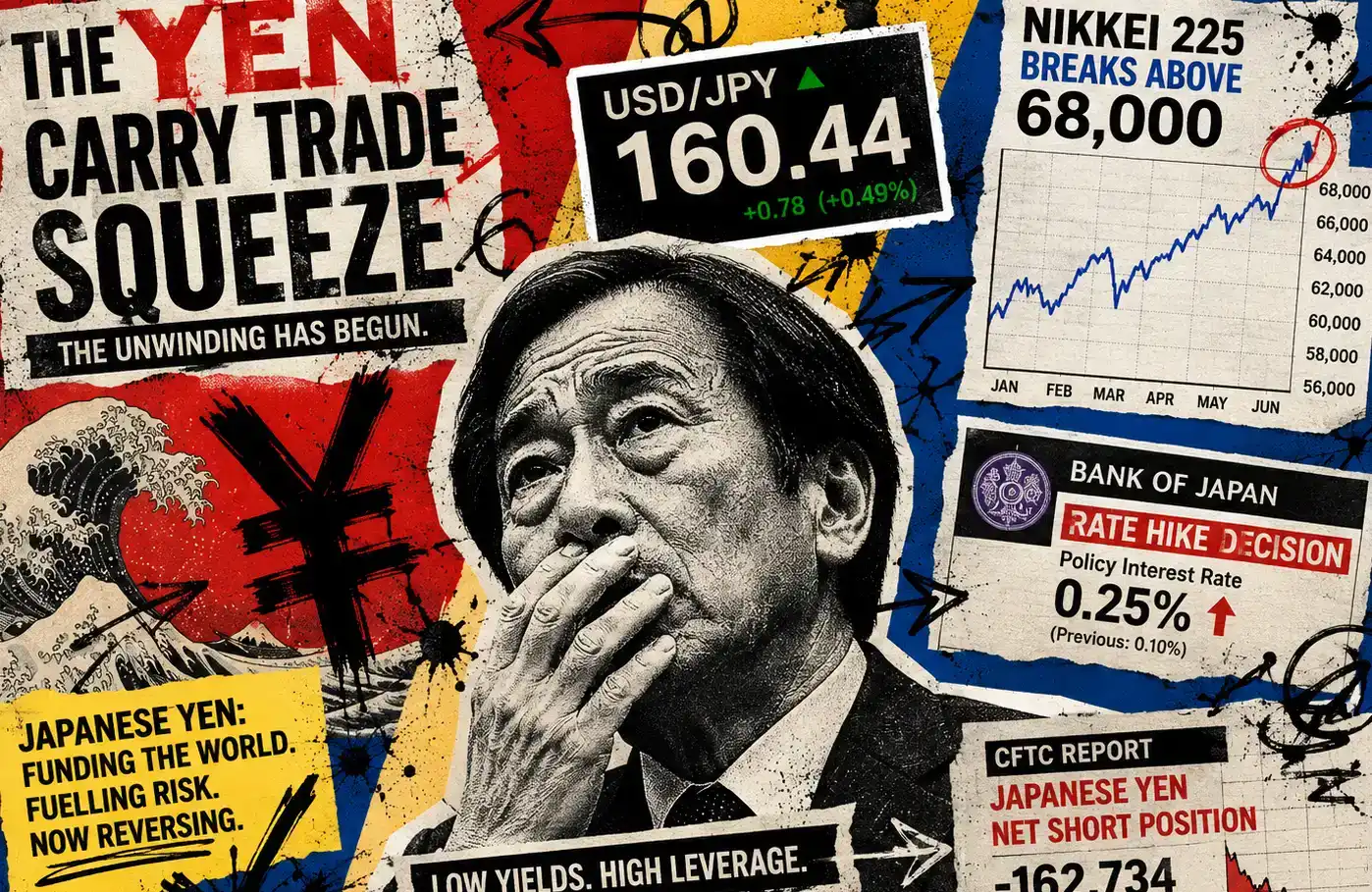
On June 3rd, USD/JPY hit 160.44, its highest level since July 2024, while the Nikkei 225 surged past 68,000 points. Contrary to popular narratives of an imminent "carry trade unwind" akin to August 2024, data reveals a more complex picture. Speculative net short positions in yen futures have actually increased, reaching -114,667 contracts by late May, suggesting traders are doubling down rather than retreating. Meanwhile, Japan's Finance Ministry conducted its largest-ever single-round FX intervention (11.73 trillion yen) in April-May but failed to hold the 160 yen line. The Nikkei's rally is not driven by carry trade dynamics. Foreign investors are aggressively buying Japanese stocks, with net purchases in 2026 running nearly 16 times higher than 2025 levels. This inflow is concentrated in AI and semiconductor-related stocks like SoftBank and Socionext, fueled by positive sector outlooks, rather than being a flight from unwinding yen shorts. Furthermore, the Nikkei has continued climbing despite the Bank of Japan's (BOJ) rate hikes to 0.75%. This disconnect exists because the current equity boom is fueled by AI-driven foreign investment, not reliant on cheap yen funding. However, this relationship remains fragile. Should the BOJ hike rates further (e.g., to 1.0%) while dollar weakness increases carry trade costs, the trajectories of the yen and Japanese stocks could reconverge, potentially triggering volatility.

marsbit22m ago

New Wall Street Play: Yen Shorts Still Adding, But Japan Stocks Don't Rely on Carry Trade Unwinding

marsbit22m ago

Broadcom's Q3 Guidance Misses Expectations by $12 Billion, After-Hours Trading Plummets Over 13%, AI Narrative "Cooling"?

On June 3, Broadcom released record Q2 FY26 results with revenue of $22.19B, up 48% YoY, and AI chip sales of $10.8B, up 143%. Adjusted EPS of $2.44 beat estimates. However, its Q3 AI semiconductor revenue guidance of $16B, while up over 200% YoY, fell roughly $1.2B (7%) short of analyst consensus expectations of $17.2B. This miss, coupled with slightly weaker-than-expected software revenue, triggered a severe market reaction. CEO Hock Tan maintained the FY26 AI revenue outlook of over $100B but did not raise it, disappointing investors who had priced in more robust growth. The stock plummeted over 13% in after-hours trading, erasing roughly $270B in market cap. The sell-off extended to peers like Marvell. A key concern for markets, particularly for Chinese optical module suppliers, was Tan's comment that the contribution of AI networking (e.g., Ethernet switches, optical interconnect chips) to AI revenue, currently near 40%, is expected to normalize to around 30% over time, signaling a potential peak in growth for that segment. Despite the guidance shortfall, Tan reiterated that AI demand remains "insatiable" and reaffirmed the long-term target of exceeding $100B in AI revenue by FY27. The reaction highlights the heightened sensitivity and premium valuation placed on AI-exposed stocks, where anything less than stellar guidance can prompt significant profit-taking. The broader question is whether this represents a cooling AI narrative or a correction in overstretched valuations.

marsbit22m ago

Broadcom's Q3 Guidance Misses Expectations by $12 Billion, After-Hours Trading Plummets Over 13%, AI Narrative "Cooling"?

marsbit22m ago

Trading

Spot
Futures
活动图片