# Risk Related Articles

HTX News Center provides the latest articles and in-depth analysis on "Risk", covering market trends, project updates, tech developments, and regulatory policies in the crypto industry.


2025 Tether Financial Analysis: An Additional $45 Billion in Reserves Needed to Maintain Stability

The article analyzes Tether's financial stability in 2025, arguing it functions as an unregulated bank rather than a simple payment operator. It applies a banking regulatory framework (Basel Capital Framework) to assess if Tether holds sufficient capital (its ~$6.8B in excess reserves) to cover potential losses from its asset portfolio. The core issue is whether Tether's total capital is adequate for its risk-weighted assets (RWAs). Its $181.2B in assets are largely in low-risk instruments (~77%), but ~13% is in volatile commodities like gold and Bitcoin. The analysis estimates Tether's RWAs between $62.3B and $175.3B, depending on the conservative treatment of its Bitcoin holdings. Under a baseline scenario, Tether's capital ratio is near minimum regulatory requirements. However, compared to well-capitalized banks, it may need an additional ~$4.5B in capital to support its current $USDT issuance. A more punitive treatment of Bitcoin could imply a deficit of $12.5B-$25B. Tether's counter-argument points to substantial group-level profits and equity (~$20B+), but these are not legally committed to the token entity and are invested in illiquid ventures like mining and AI. The article concludes that the sufficiency of Tether's capital is a complex, structural question without a definitive answer, dependent on asset risk weightings and the firm's willingness to mobilize group resources in a crisis.

marsbit2 days ago 07:31

2025 Tether Financial Analysis: An Additional $45 Billion in Reserves Needed to Maintain Stability

marsbit2 days ago 07:31

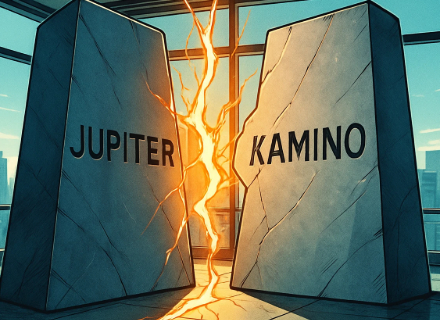
Solana's Two Leading Lending Protocols Clash, Foundation Steps In to Mediate

Summary: Over the weekend, a public dispute erupted between Solana's two leading lending protocols, Jupiter Lend and Kamino, centered on the definition of "risk isolation." The conflict began when Kamino's co-founder, Marius Ciubotariu, accused Jupiter Lend of misleading users. He argued that Jupiter's early marketing claimed its lending pools were "risk-isolated," preventing cross-contamination between assets. However, Kamino contends that Jupiter Lend's design, which allows for the rehypothecation (re-use) of collateral across pools, creates a risk of contagion, contradicting its marketing. In response, Jupiter's COO, Kash Dhanda, admitted the initial "zero contagion risk" social media posts were inaccurate and apologized. The debate highlights a core disagreement on the definition of "risk isolation." Jupiter and its supporters argue the term has design flexibility, noting that while pools share a liquidity layer, each has independent parameters. Kamino and its allies insist that any rehypothecation negates true risk isolation. The dispute escalated when Tushar Jain, a partner at Kamino investor Multicoin Capital, strongly criticized Jupiter, accusing the team of being either incompetent or deliberately misleading. In contrast, Solana Foundation President Lily Liu urged for cooperation, emphasizing that the Solana lending market is much smaller than Ethereum's and that internal conflict only helps competitors. The clash is seen as an inevitable result of intense competition. Kamino was long the Solana lending leader, but Jupiter Lend has rapidly gained significant market share. In a tighter market with reduced liquidity and heightened safety concerns, the competition between the two protocols has become increasingly fierce.

marsbit2 days ago 10:22

Solana's Two Leading Lending Protocols Clash, Foundation Steps In to Mediate

marsbit2 days ago 10:22

Solana Lending Internal Conflict: The Power Struggle Behind Foundation Mediation

Over the weekend, a public dispute erupted between Solana's two leading lending protocols, Jupiter Lend and Kamino. The conflict originated from Jupiter's earlier marketing claims that its lending product featured "risk isolation," implying that different lending pools would not be exposed to cross-contagion in the event of an asset failure. However, after Jupiter Lend launched, the market observed that its design did not align with the conventional understanding of risk isolation. The protocol allows for the rehypothecation (re-use) of collateral across pools to improve capital efficiency, which critics argue creates potential channels for risk contagion. Kamino's co-founder, Marius Ciubotariu, publicly accused Jupiter of misleading users with false advertising and subsequently blocked a migration tool from Kamino to Jupiter Lend. The core of the debate lies in differing interpretations of "risk isolation." Jupiter and its supporters argue their model offers a balanced approach with independent pool configurations, while Kamino and its allies insist that any form of rehypothecation negates true risk isolation and constitutes a failure in disclosure. The dispute drew reactions from key ecosystem players. Multicoin Capital, an investor in Kamino, strongly criticized Jupiter, accusing the team of either incompetence or intentional deception. In contrast, the Solana Foundation President, Lily Liu, called for unity, urging the two projects to focus on growing the overall market share against competitors like Ethereum rather than engaging in internal conflict. The clash is seen as an inevitable result of intensifying competition in a shrinking market. Jupiter Lend has been rapidly capturing market share from the formerly dominant Kamino since its launch. In a tighter, post-market-crash environment where safety is a paramount concern, Kamino seized on a perceived vulnerability in Jupiter's product design to launch a competitive attack. The incident highlights the fierce battle for dominance in Solana's DeFi lending sector.

比推Yesterday 16:55

Solana Lending Internal Conflict: The Power Struggle Behind Foundation Mediation

比推Yesterday 16:55

Don't Be Fooled by the Rebound! Bitcoin Could Retest Lows at Any Moment | Exclusive Analysis

**Bitcoin Weekly Analysis: Beware of a Potential Secondary Pullback** Last week, Bitcoin experienced significant volatility, forming a weekly doji candle with a slight gain of 0.03% and a wide 12.36% range. The price action perfectly validated the pre-defined key level of $89,000. Our analyst successfully executed two short-term trades based on this framework, resulting in a total gain of 6.93%. **Technical Outlook:** The weekly chart indicates Bitcoin is on the verge of entering a bear market, with momentum indicators pointing south. The daily chart shows a weakening bullish rebound within a broader bearish structure. **Price Projections for the Week (Dec 8-14):** The market is expected to remain range-bound. Key resistance levels are identified at $91,000, $94,000-$96,500, and $98,500-$100,000. Crucial support zones lie at $85,500-$87,500, $83,500, and around $80,000. **Trading Strategy:** A core medium-term short position (65% allocation) is maintained. For short-term swings (30% allocation), two scenarios are outlined: * **Scenario A (Rebound & Short):** Sell into strength if the price rallies to the $91,000-$94,200 or $98,500 resistance zones, with a stop-loss above $100,000. * **Scenario B (Dip & Buy):** Buy a potential bounce if the price drops to the $83,500-$80,000 support area, with a stop-loss below $80,000. **Macro Focus: The Fed's "Super Week":** This week's price action is heavily dependent on the Federal Reserve's policy decision. While a December rate cut is widely expected, the crucial factor for Bitcoin and risk assets will be the Fed's "dot plot" guidance for 2025 rate cuts. A hawkish dot plot (signaling fewer cuts) could trigger a pullback toward $85,000. A dovish signal (more cuts anticipated) could fuel a rebound above $90,000. Chairman Powell's commentary will be key to short-term volatility.

marsbitYesterday 19:49

Don't Be Fooled by the Rebound! Bitcoin Could Retest Lows at Any Moment | Exclusive Analysis

marsbitYesterday 19:49

活动图片