# NFT Related Articles

HTX News Center provides the latest articles and in-depth analysis on "NFT", covering market trends, project updates, tech developments, and regulatory policies in the crypto industry.


In the Era of AI Transactions, How Do We Build a Trust System?

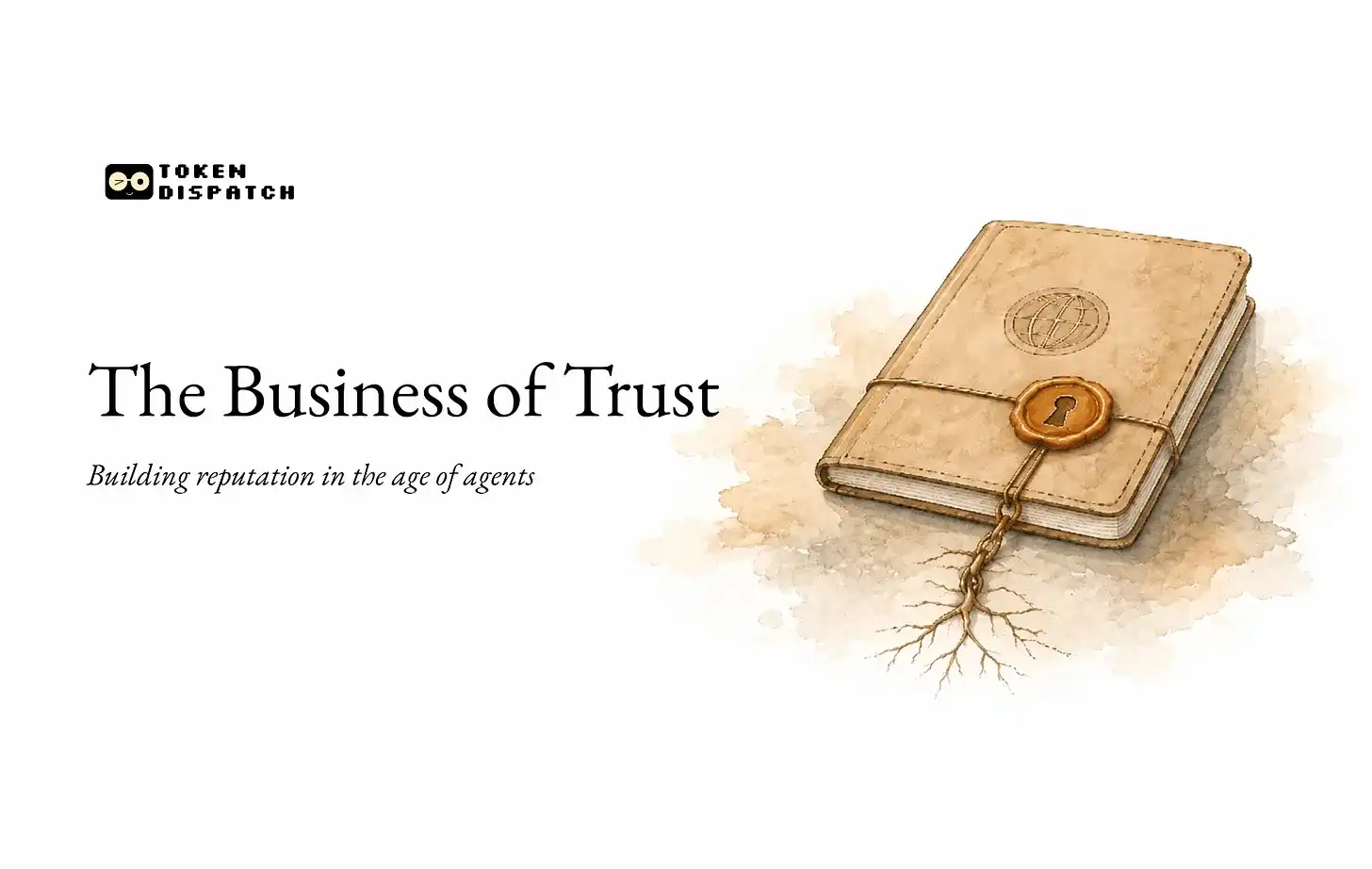
Title: In the AI Trading Era, How Do We Build a Trust System? Over a decade ago, the first online credit card purchase sparked a simple question: who do you trust? The answer was intermediary platforms that built trust between strangers. Each new era of commerce expands transactional boundaries between strangers and requires new intermediaries to foster trust, from ancient credit systems to modern e-commerce ratings. Now, the machine age is here. With AI agents autonomously executing transactions—from booking trips to managing payments—at speeds and scales beyond human oversight, a critical question arises: who is liable when a non-human entity acts outside the rules? These agents are anonymous, mutable code, making traditional trust models based on human or corporate accountability obsolete. The core challenge is establishing verifiable, non-transferable identity and reputation for AI agents. Current solutions like the ERC-8004 standard provide a public, permanent identity record but suffer from a flaw: the identity is a tradable NFT, allowing reputation to be bought, sold, and potentially weaponized by bad actors. A new "trust stack" is emerging to fill this gap, moving beyond simple scoring to bind reputation inseparably to the agent. Key approaches include: * **Skyfire:** Issues signed identity tokens cryptographically linking the agent, its development platform, and its human sponsor, ensuring traceable accountability and integrating payment. * **RNWY:** Uses non-transferable "Soulbound Tokens" (ERC-5192) to permanently bind reputation to an agent's wallet. Abandoning a tarnished reputation requires discarding the entire wallet and its history, creating a high cost for misconduct. * **ChainAware:** Foregoes issuing credentials, instead generating credit scores based on a wallet's on-chain behavior history to preemptively assess risk, similar to bank fraud detection. The lesson is that no single solution suffices. A robust trust infrastructure requires a layered stack: a base layer for sponsor accountability, a middle layer ensuring non-transferable identity/reputation, and a top layer for behavior-based scoring. As in past cycles, the intermediaries that solve the trust problem for this new era of AI-driven commerce will capture significant value. The ultimate trajectory of the agent economy depends on the trust systems we build now.

marsbit21h ago

In the Era of AI Transactions, How Do We Build a Trust System?

marsbit21h ago

Not Just Trading and Meme: These 5 Projects on Base Are Exploring New On-Chain Use Cases

Beyond Trading and Memes: 5 Projects Exploring New On-Chain Use Cases on Base While much of the crypto space is dominated by speculation, Base—Coinbase's Ethereum Layer 2 with over $5B TVL—is fostering innovative projects beyond the usual categories. Here are five notable examples: 1. **Hydrex**: A MetaDEX/AMM aggregator that pools native and external liquidity (e.g., from Uniswap, Morpho) to offer optimal swap rates. It features a ve(3,3)-style incentive model and single-signature transactions. 2. **SwapRoyale**: A fantasy trading competition app where users pay a fixed entry fee to trade with a virtual $100k portfolio in real-time contests. It gamifies trading with various tournament formats and has already distributed over $100k in prizes. 3. **BlockRun**: A permissionless AI gateway and payment layer for the on-chain agent economy. It allows autonomous systems to discover, pay for, and execute services using USDC on Base via the x402 micropayment standard, enabling pay-per-use AI. 4. **PixieChess**: A play-to-earn digital chess game where each piece is a collectible NFT with unique abilities that alter classic rules. Value is kept within the ecosystem, with a treasury funding real ETH prizes for winners. 5. **Tokensto**: A platform that lets users sell their unused AI API credits (e.g., from OpenRouter) for cash. It automatically prices credits and facilitates direct payouts to crypto wallets. These projects demonstrate that builders on Base are actively experimenting with consumer experiences, the agent economy, and novel gaming mechanics, suggesting the surface area for meaningful on-chain activity is broader than current narratives imply.

marsbitYesterday 03:57

Not Just Trading and Meme: These 5 Projects on Base Are Exploring New On-Chain Use Cases

marsbitYesterday 03:57

Unstoppable Domains Abandons Plans to Integrate .crypto and .bitcoin into DNS

Unstoppable Domains has abandoned its plans to integrate nine of its Web3 domain extensions, including .crypto and .bitcoin, into the traditional DNS system. The company cited ICANN requirements and the high costs of the application program as reasons for the decision. Other affected domains are .wallet, .polygon, .nft, .dao, .unstoppable, .zil, and .blockchain. They will continue to function as on-chain domains but will not become native DNS zones. The applications for the nine domains would have cost over $2 million, not including additional compliance expenses and potential auctions. Founder Matthew Gould stated the total costs outweighed expected revenues. A major obstacle was ICANN's proposed integration rules, which would require registering every existing on-chain domain in a unified zone and disclosing owner data—affecting over 4 million domains, many purchased as one-time, anonymous assets. In response to user criticism, the company is offering refunds for domains purchased after its public ICANN announcement dates, with the refund window open from August 25 to September 25. Unstoppable Domains clarified that the domains retain all their on-chain functionalities. The company is still proceeding with ICANN applications for five other domain extensions: .agi, .robot, .gram, .hub, and .xmr, developed with partners like 0G, Telegram, Monero, and Hub Culture. The first approved domains from the current ICANN round are expected by mid-2027, with a full DNS launch anticipated in late 2027 or 2028.

cryptonews.ruYesterday 13:10

Unstoppable Domains Abandons Plans to Integrate .crypto and .bitcoin into DNS

cryptonews.ruYesterday 13:10

活动图片