# Market Structure Related Articles

HTX News Center provides the latest articles and in-depth analysis on "Market Structure", covering market trends, project updates, tech developments, and regulatory policies in the crypto industry.

Hyperliquid's Compliance Journey: From Permissionless to Permissioned via HIP-3

Hyperliquid’s Compliance Path: From Permissionless to Permissioned HIP-3 Hyperliquid currently blocks U.S. access because its permissionless, on-chain infrastructure conflicts with U.S. market structure laws, which restrict futures trading to registered exchanges, clearinghouses, and brokers. Through its Hyperliquid Policy Center (HPC), the project is advocating for regulatory modernization, proposing that regulated entities be allowed to build products on HyperCore (its exchange and clearing layer) while fulfilling their compliance obligations. The platform’s modular stack separates roles like a traditional exchange (DCM), clearinghouse (DCO), and broker (FCM), but reconstructs them on-chain with code. This enables permissionless access, self-custody, and 24/7 global trading, but clashes with U.S. rules requiring KYC, specific margin models, and custodial arrangements. To resolve this, HPC is engaging with U.S. regulators (CFTC, SEC) to seek clarity that deploying on-chain software does not itself trigger licensing, and to establish exemptions allowing non-custodial wallets to route users to regulated derivatives. Recent political signals suggest openness to this approach. On the technical side, Hyperliquid Labs has introduced permissioned HIP-3 deployers on testnet. These allow regulated entities to launch markets, perform KYC, and whitelist compliant users. While these create separate order books, whitelisted market makers can bridge liquidity between them, ensuring deep, shared liquidity across the same L1. Features like payload-based “PA” permissions enable DEX-level account controls (e.g., reduce-only orders), mirroring traditional broker authorities. The strategy is not to open the native, permissionless front-end to U.S. users, but to position Hyperliquid as neutral infrastructure that U.S. regulated firms can use while meeting their legal duties. This paves a compliant path for U.S. investor access while preserving the protocol’s core, permissionless nature.

marsbit1h ago

Hyperliquid's Compliance Journey: From Permissionless to Permissioned via HIP-3

marsbit1h ago

Is RWA Still Meaningful Without DeFi?

The article "Would RWA Still Matter Without DeFi?" argues that tokenizing real-world assets (RWA) alone, like putting a barcode on a container, is not transformative. True value emerges when these tokenized assets are integrated into decentralized finance (DeFi) ecosystems, enabling valuation, financing, hedging, trading, and loss management in a programmable, automated manner. Tokenization provides digital representation, but DeFi provides utility through leverage, liquidity, and composability. The core challenge lies in aligning the different "time clocks" of blockchain (fast, 24/7), traditional markets (limited hours), and asset redemption (slow processes), which creates liquidation risks and gaps. Effective RWA integration requires more than a token; it needs a full stack: legally enforceable rights, reliable data oracles, clear transfer rules, executable secondary liquidity, appropriate collateral parameters, and credible loss resolution paths. Liquidity is defined not by total value locked (TVL) but by the ability to exit a position under stress within a required timeframe. Risk management for RWAs must be modeled as a dependency graph, monitoring interconnected nodes like issuers, custodians, oracles, and liquidity pools for early warning signs beyond just price data. While tokenized government bonds serve as an initial "ping test," the future lies in more complex assets like computing power and energy, which require bespoke risk models. Tokenized stocks paired with perpetual futures present a major test, combining global equity ownership with crypto-native leverage, necessitating robust architectural safeguards like isolation and dynamic collateral rules. The conclusion is that without DeFi, RWA tokenization offers limited value—improving distribution and transparency. The significant opportunity arises when tokenized assets become functional components within open, programmable capital markets, where they can be used as collateral and facilitate complex financial strategies. The token is merely the barcode; the market operating system is the real machine.

marsbit2 days ago 10:20

Is RWA Still Meaningful Without DeFi?

marsbit2 days ago 10:20

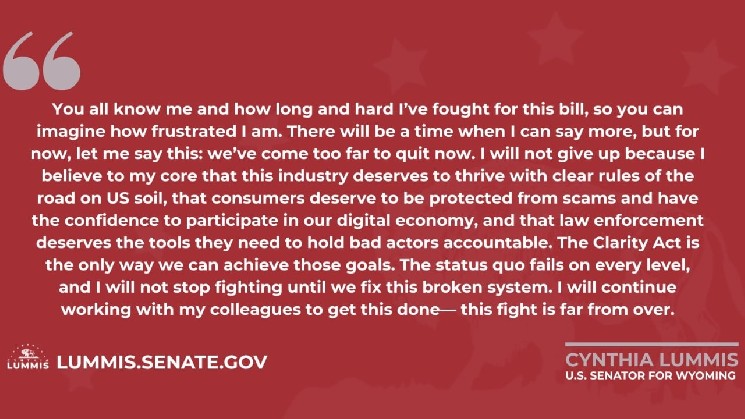
Vote on CLARITY Act in US Senate Scheduled for September 15

The U.S. Senate is scheduled to hold a key procedural cloture vote on the Digital Asset Market Clarity Act (CLARITY Act) on September 15. The motion was filed by Senate Majority Leader John Thune, aiming to advance the bill for floor consideration after lawmakers failed to reach an agreement before the August recess. The vote requires 60 votes to proceed, meaning Republican support from Democrats is necessary. The landmark crypto regulatory bill aims to establish a federal market structure for digital assets, clarify whether crypto assets qualify as securities or commodities, and delineate regulatory authority between the SEC and CFTC. However, negotiations have been stalled by disagreements over proposed ethics provisions, which would restrict government officials and their families from profiting from digital assets while in office, and rules governing stablecoin yields. To break the impasse, lawmakers are reportedly working on a bipartisan ethics amendment, partly addressing Democratic concerns about former President Trump's crypto-related financial interests. The outcome of the September 15 vote and the ability to resolve disputes over ethics and stablecoin rules before then will determine the bill's future. Passage would significantly shape U.S. digital asset regulation for years to come, though aligning SEC and CFTC operational standards post-enactment is expected to be a lengthy process.

cryptonews.ru08/08 16:05

Vote on CLARITY Act in US Senate Scheduled for September 15

cryptonews.ru08/08 16:05

Dark Pools Prevail, Whales Vanish: How Credible Are Public Market Signals?

Institutional cryptocurrency trading is increasingly shifting towards dark pools and over-the-counter (OTC) desks, with data from sFOX showing such venues accounted for 15% of total monthly volume by June, up from negligible levels in April. In July, 77.7% of institutional capital on sFOX's platform was routed through OTC desks, while only 18.4% went to public exchanges. A key driver is institutions' need to conceal large orders to avoid revealing trading patterns, preventing front-running and minimizing price impact. Firms like Jane Street and Citadel use dark pools and order-splitting across multiple venues to execute trades discreetly. This structural shift mirrors earlier developments in equities and forex markets. As a result, public order books now reflect only a fraction of actual market activity, eroding the once-significant advantage retail traders had in tracking large wallets and exchange flows. The proliferation of prime brokers and aggregation platforms is also rapidly closing simple arbitrage opportunities. The market may evolve toward a brokerage model for retail, similar to traditional stocks. Two scenarios emerge: an optimistic one where retail gains from narrower spreads and better order routing, and a pessimistic one where transparency declines faster than benefits trickle down, leaving smaller investors in the dark. Regardless, traders must adapt by not relying solely on exchange volume, comparing total execution costs, and using limit orders in thin markets. While reduced volatility from hidden large trades may seem positive, it comes at the cost of obscured market signals and institutional intent.

marsbit08/07 07:11

Dark Pools Prevail, Whales Vanish: How Credible Are Public Market Signals?

marsbit08/07 07:11

活动图片