# Backtesting Related Articles

HTX News Center provides the latest articles and in-depth analysis on "Backtesting", covering market trends, project updates, tech developments, and regulatory policies in the crypto industry.


Can You Make a Steady Profit by Blindly Following Polymarket's Pre-Game Win Probability to Bet on NBA Games?

**Can You Consistently Profit by Blindly Following Pre-Game Win Probabilities on Polymarket for NBA Games?** A backtest of the entire NBA 2025-26 regular season (1,096 games) was conducted to test the strategy of always betting $100 on the team with the higher pre-game win probability on Polymarket. The results show that this strategy is not profitable. The total amount wagered was $109,600, with a return of $107,545.20, resulting in a net loss of $2,054 and a Return on Investment (ROI) of -1.87%. This indicates that the market is highly efficient, and pre-game probabilities are accurately priced, leaving no simple arbitrage opportunity. In fact, blindly following the market would have been slightly less profitable than betting against it. However, a deeper analysis by team revealed significant differences. Certain teams consistently outperformed market expectations when they were favored to win: * Portland Trail Blazers (POR): 19% ROI * Philadelphia 76ers (PHI): 14% ROI * San Antonio Spurs (SAS): 12% ROI * Los Angeles Lakers (LAL): 11% ROI * Charlotte Hornets (CHA): 9% ROI In contrast, the market was highly efficient for the top-performing teams, offering minimal returns (e.g., Boston Celtics ROI: 4%, Denver Nuggets ROI: -5%). Results for the weakest teams were too inconsistent due to small sample sizes. The key finding is that team-specific factors, rather than the probability percentage itself, drive potential value, making a one-size-fits-all strategy ineffective.

Odaily星球日报6h ago

Can You Make a Steady Profit by Blindly Following Polymarket's Pre-Game Win Probability to Bet on NBA Games?

Odaily星球日报6h ago

Unlocking the 'Golden Key' in Prediction Markets Through 27.73 Million Transaction Data: 690 K-Line Strategies Struggle to Profit

The article investigates whether a profitable "golden key" strategy exists in prediction markets, using an analysis of 27.73 million transactions over 3,082 fifteen-minute BTC prediction markets. The study debunks several common approaches: Technical analysis based solely on price action, tested across 690 combinations of entry/exit points, stop-loss, and take-profit levels, yielded no positive expected value. Even high-win-rate strategies, like buying at 90% and selling at 99%, resulted in negative expectations due to poor risk-reward ratios. Similarly, arbitrage strategies aiming to profit from YES+NO prices below 1 were also unprofitable after accounting for real-world constraints. The research identifies two potentially viable strategies: 1. **Momentum-based trading**: A brief ~30-second window exists after sharp BTC price moves (>$150-$200) where prediction market token prices lag, allowing manual traders to capitalize on this inefficiency before algorithms adjust. 2. **Fair value model**: A model calculating a token's theoretical win probability based on BTC's volatility and time to expiry revealed that markets are inefficient. Profitable opportunities arise only when tokens trade at a significant discount (>10 cents) to their fair value. Buying at a premium, even with high win probability, leads to negative expected returns. The conclusion advises traders to abandon pure price-based technical analysis, focus on the underlying asset (BTC), respect probability valuations, and only buy at a discount to fair value to avoid being systematically outperformed by algorithms.

marsbit02/20 04:02

Unlocking the 'Golden Key' in Prediction Markets Through 27.73 Million Transaction Data: 690 K-Line Strategies Struggle to Profit

marsbit02/20 04:02

86% Return? How to Use a Bot to 'Earn Passively' on Polymarket

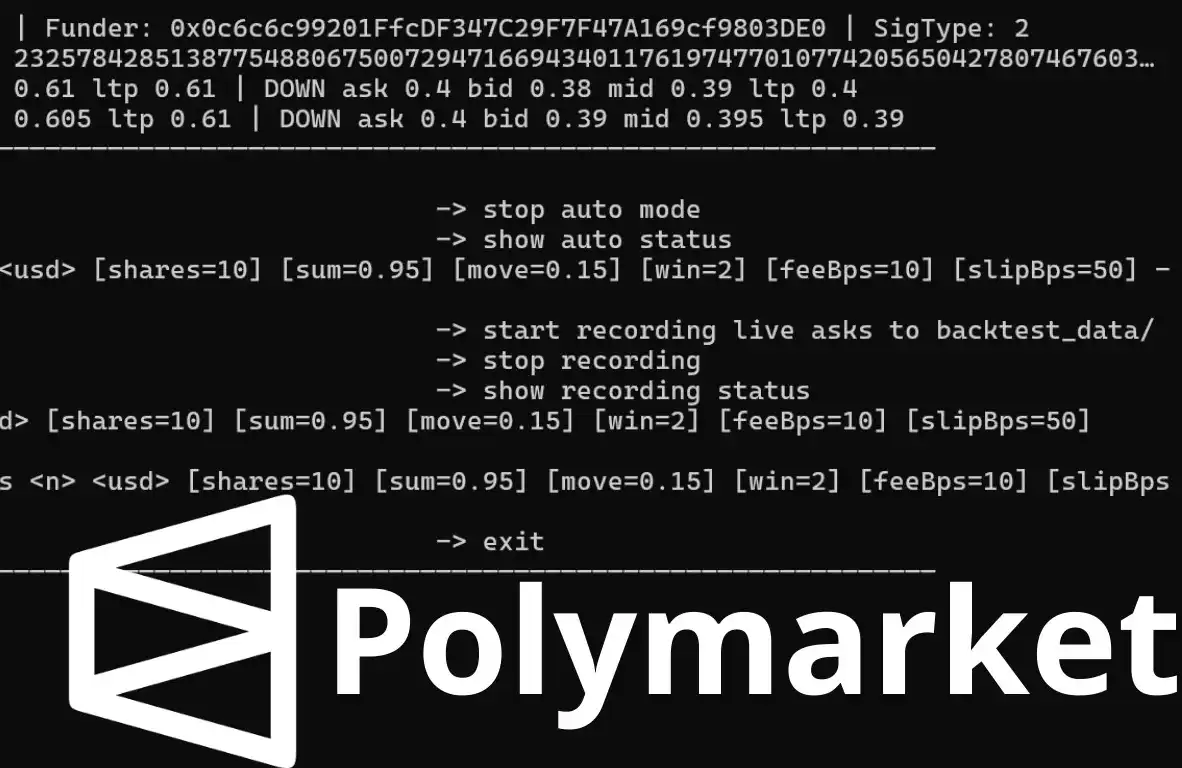
This article details the development and backtesting of an automated trading bot for the "BTC 15-minute UP/DOWN" market on Polymarket. The author identified market inefficiencies and automated a manual strategy to exploit them. The bot operates in two modes. In manual mode, users can directly place orders. In auto mode, it runs a two-leg cycle: First, it observes the market for a set time after a round begins. If either the "UP" or "DOWN" side drops by a specified percentage (e.g., 15%) within seconds, it triggers "Leg 1" and buys the crashed side. It then waits for "Leg 2," a hedging trade on the opposite side, which is only executed if the sum of the Leg 1 entry price and the opposite ask price meets a target threshold (e.g., ≤ 0.95). Due to a lack of historical market data from Polymarket's API, the author created a custom backtesting system by recording 6 GB of live price snapshots over four days. A conservative backtest with parameters of a 15% crash threshold and a 0.95 sum target showed an 86% ROI, turning $1,000 into $1,869. An aggressive parameter set resulted in a -50% loss, highlighting the critical role of parameter selection. The author acknowledges significant limitations of the backtesting, including its short data period, failure to model order book depth, partial fills, variable network latency, and the market impact of the bot's own orders. Future improvements include rewriting the bot in Rust for performance, running a dedicated node, and deploying on a low-latency VPS.

marsbit12/30 04:07

86% Return? How to Use a Bot to 'Earn Passively' on Polymarket

marsbit12/30 04:07

活动图片