Author: The Block
On Wall Street, the "TACO trade" is outdated. Now everyone is talking about a new trading pattern—"NACHO".
Since the US-Israel airstrikes on Iran on February 28, the Strait of Hormuz has remained closed. Currently, oil prices are up over 50% compared to pre-war levels, and the market's expectation for Fed rate cuts in 2026 has been compressed from 2 pre-war to the current 0. Yet during the same period, the S&P 500 hit a record high, rising for 6 consecutive weeks, marking its longest winning streak since 2024.
Wall Street has named this seemingly contradictory market state NACHO, which stands for "Not A Chance Hormuz Opens." It is the antonym of TACO ("Trump Always Chickens Out"). TACO bets on "people chickening out"—that Trump will back down at critical moments. NACHO bets on "things getting stuck"—that this time, the Strait of Hormuz cannot be reopened with just one Truth Social post.
eToro market analyst Zavier Wong describes this shift: "For most of the crisis, every ceasefire headline caused oil prices to plummet sharply. Traders kept betting on a solution that never arrived. NACHO means the market acknowledges that high oil prices are not a one-time shock but the current market environment itself."
Two Lines in Early April
March 23 was the tipping point for the TACO model's failure. That morning, Trump announced on Truth Social that he had a "very good constructive dialogue" with Iran and ordered the Pentagon to suspend strikes on Iranian energy facilities for 5 days. S&P 500 futures rebounded nearly 4% from the lows in minutes, instantly adding $1.7 trillion in market value. Brent crude fell from $109 intraday to $92.
Then, Iranian officials denied the existence of any dialogue. According to Iranian state media, a "senior security official" called it a market manipulation tactic, stating no dialogue ever took place. Gains were halved within two hours. The S&P closed up only +1.15%, and Brent bounced back to $99.94.
That was the first time in 14 months that Trump's "backing down" no longer worked for the market. The reason is not complicated. Backing down under the TACO model is one-sided, achievable with just one post. The backing down on March 23 required Iran's cooperation. When the opponent doesn't cooperate, backing down becomes a lie.
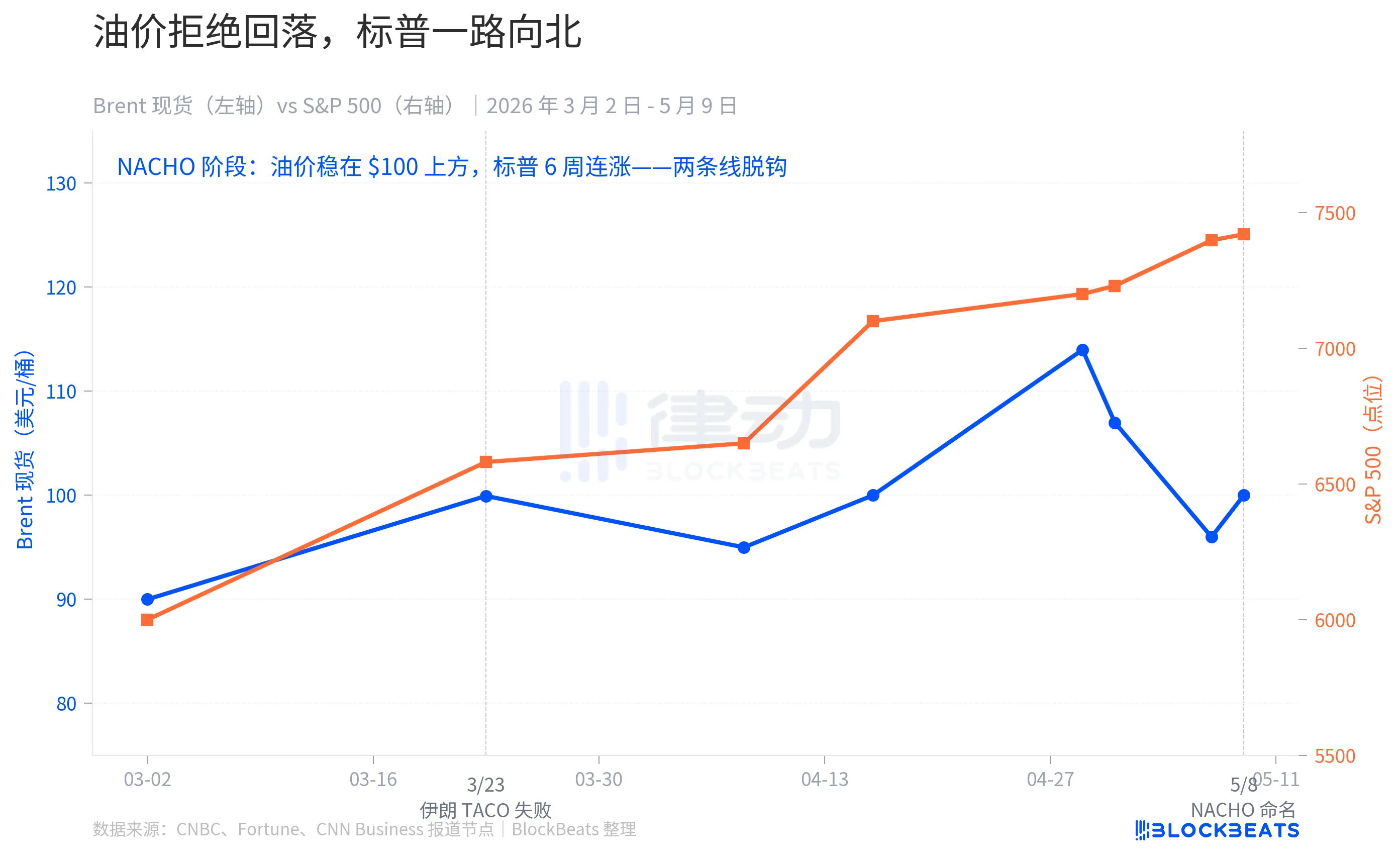
Starting that day, market behavior fundamentally changed. Brent crude never fell back to the pre-war level of $67 in the following 6 weeks, maintaining an average price of $109.57 in May. In between, there were the US-Iran ceasefire agreements on April 7-8, a period on April 17 when oil prices briefly returned to "initial war levels," and news on May 7 that the US and Iran were close to a deal. Each "ceasefire headline" failed to bring oil prices back to the baseline.
But the S&P marched northward. It rose 10% in April alone, its strongest month since November 2020, hitting 7 intraday record highs during the period. On May 1, it broke 7,230 points intraday; on May 7, it closed at 7,398 points.
The two lines completely decoupled in early April. In the TACO era, they moved in sync: threats caused oil and S&P to fall, backing down caused oil and S&P to rebound. In the NACHO era, they speak two different languages: oil says "Hormuz is shut for good," while the S&P says "not my problem."
Three Markets, Three Reactions
NACHO is not just talk; it's the same bet placed with real money across three independent derivatives markets.
The first layer is insurance. According to Strauss Center historical data, the war risk insurance rate for the Strait of Hormuz once soared to 3.5% of hull value during the 2003 US invasion of Iraq and reached 7.5% at the peak of the 1984 "Tanker War" during the Iran-Iraq War after the attack on the Yanbu Pride tanker. The baseline before this crisis was 0.125% to 0.25%. By early May, the rate had entered the 1% range, with some policies spiking to 3% to 8%.
Converted to the insurance cost per single voyage for a Very Large Crude Carrier (VLCC), the fee has jumped from about $250,000 pre-war to the current $800,000 to $8 million. The job of insurance companies is to price risk. The practical implication of this layer is: if insurers simply won't provide coverage, shipowners won't bear the risk of uninsured passage. "Physical opening" and "de facto navigation" of the Strait are two different things.
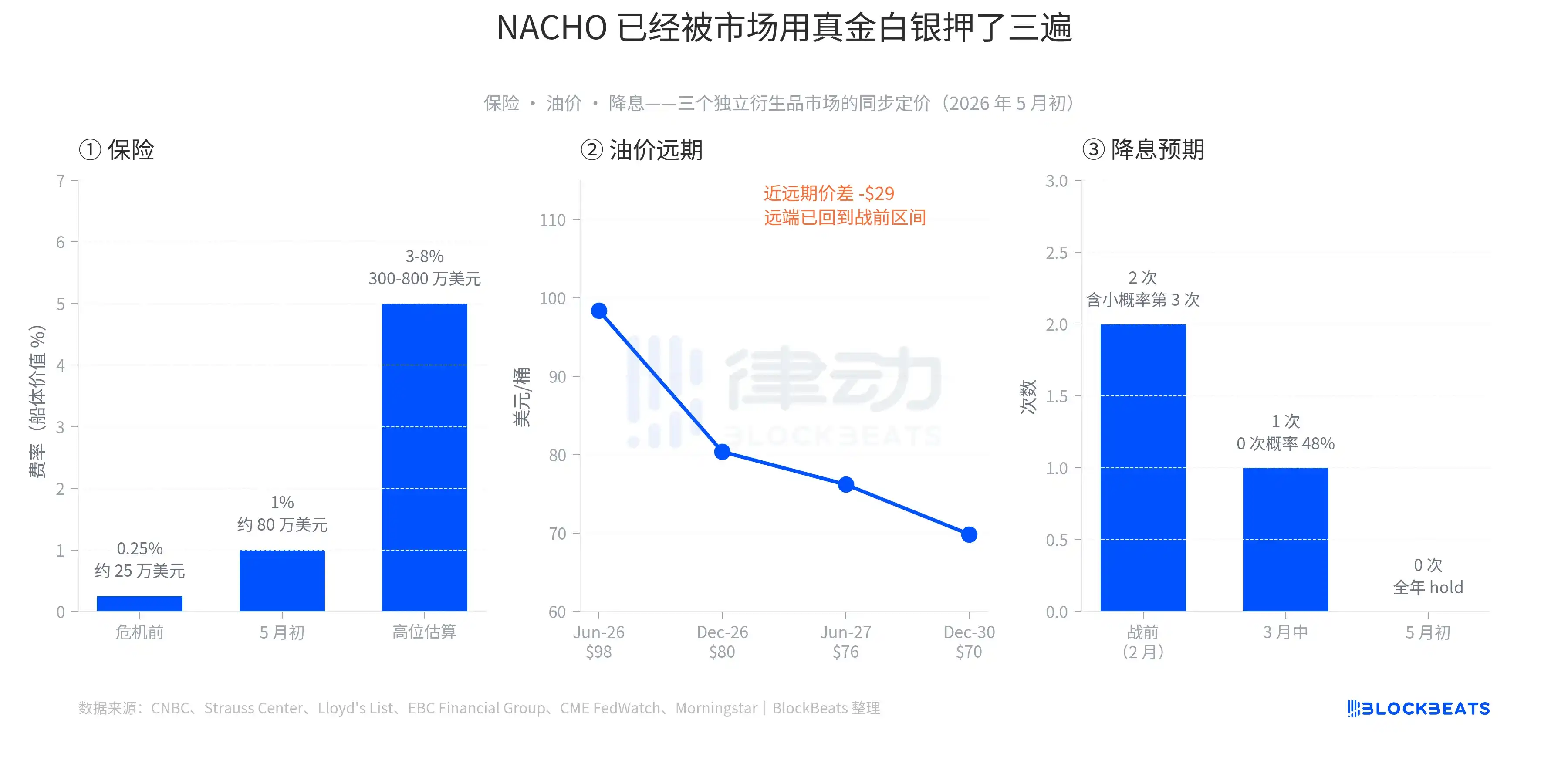
The second layer is oil prices. Early May data shows: Brent Jun-26 contract at $98.41, Dec-26 at $80.39, Jun-27 at $76.20, Dec-30 at $69.85. The spread between the front-month and Dec-30 is about $28.5, one of the steepest backwardation (near high, far low) structures in the past 5 years. This curve tells a very specific story: the market believes spot supply is tight but will eventually ease, with long-term prices returning to the pre-war range of $60-$70. In other words, high oil prices are not the final outcome but a bounded window. However, this window is long enough that traders don't bet on it ending suddenly.
The third layer is interest rate cuts. In early February 2026, the market expected the Fed to cut twice for the year, with a small chance of a third cut. By mid-March, after oil prices surged, it was compressed to one cut, with a 48% probability of 0 cuts. On April 29, the Fed held rates at 3.50% to 3.75%. On May 6, CME FedWatch showed a 70% probability of a continued hold at the June meeting. For all of 2026, the market is now pricing in 0 rate cuts. Hedge fund legend Paul Tudor Jones even said in a May 7 CNBC interview, "Not even Wash (likely meaning current Fed Chair) has a chance to make the Fed cut."
All three layers have left their mark in the derivatives markets—not just narrative, but real money.
The Differentiated Broad Market
The second subtle detail of NACHO is that it has already priced differentiation within the broad market.
As of the close on May 7, the Energy sector ETF (XLE, State Street's Energy Select Sector Fund) is up 31.63% year-to-date, the only major sector positive for all of 2026. Over the same period, the S&P 500 is up about 24%. The Transportation sector ETF (IYT, iShares U.S. Transportation ETF) is up only 8.79% year-to-date, underperforming the broader market by over 15 percentage points.
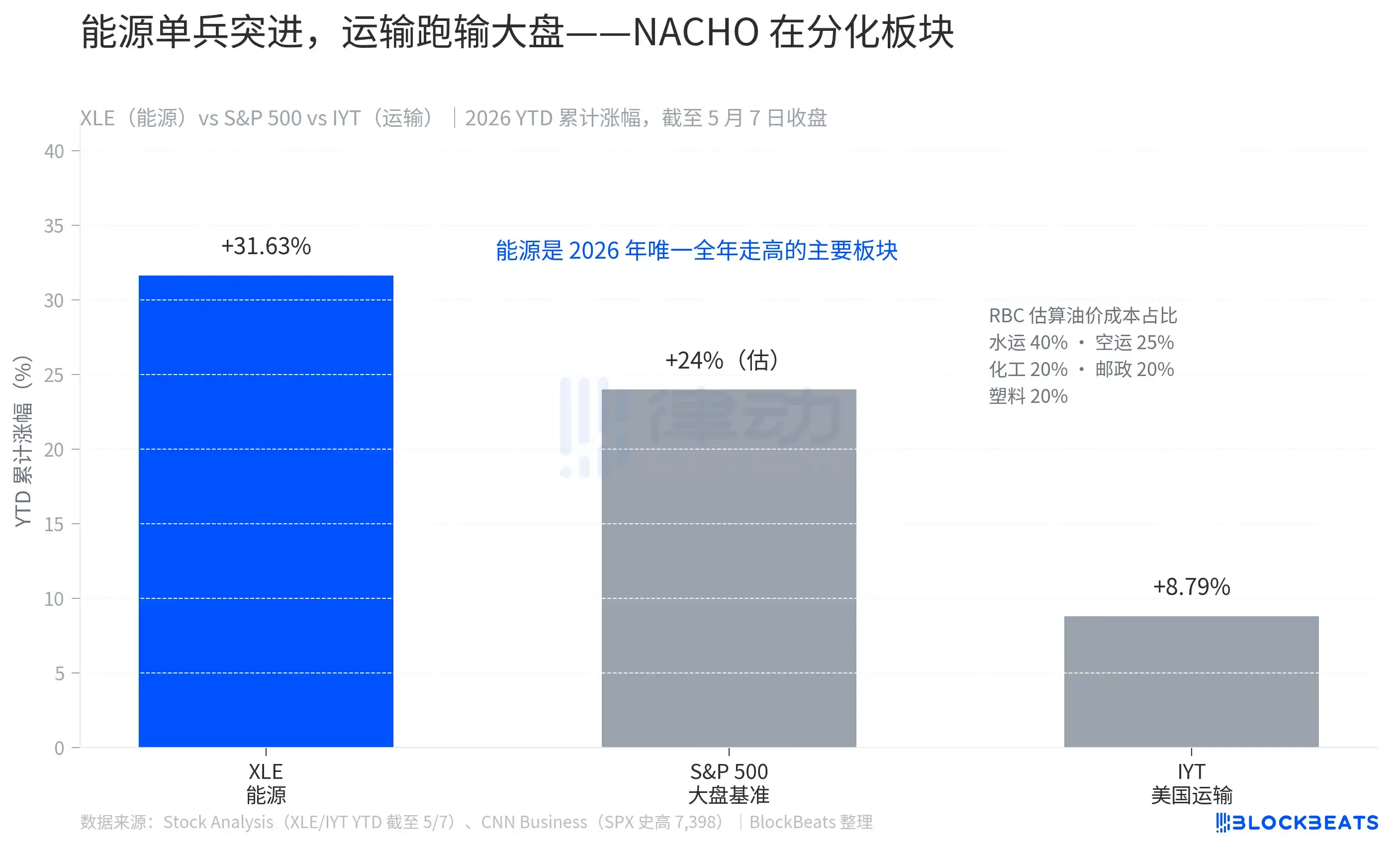
This gap is not random. According to RBC Capital Markets estimates, fuel costs account for 40% of operating costs in the water transport industry, 25% in air transport, and 20% each in chemicals, postal/courier services, and rubber/plastics. If fuel is a major item on your business's cost sheet, NACHO is a direct hit to your face.
XLE's 31.63% gain is not a short-term rebound; it's the result of 8 consecutive weeks of outperformance. IYT's 8.79% is not weakness; it's rising with the broad market while having its gains eroded by oil prices. The market has clearly shown readers how to calculate NACHO's odds—just look at the magnitude by which the Transportation ETF underperforms the market.
But NACHO is not a bet for an indefinite period; it has a very specific deadline: June 1.
According to JPMorgan's commodity research team estimates, global commercial crude oil inventories were about 8.4 billion barrels at the start of 2026, but only around 800 million barrels of that was "practically usable." The rest consists of pipeline fill, tank bottoms, minimum terminal stocks—maintaining the daily operation of the system. Since this crisis began, 280 million barrels have been drawn down, leaving about 520 million barrels of usable inventory remaining. JPMorgan's exact words: "Commercial inventories are expected to approach operational stress levels in early June."
"Operational stress level" is a specific physical concept. JPMorgan explains: "The system won't collapse because oil disappears; it will collapse because the distribution network no longer has sufficient working inventory." Once this line is breached, the only choices for businesses and governments are: either squeeze the minimum inventory necessary to maintain operations (which damages the infrastructure itself), or wait for new supply. If Hormuz remains closed until September, OECD commercial inventories could fall to the so-called "operational floor." According to a Fortune report, European aviation fuel inventories are expected to fall below the 23-day supply threshold in June, a key industry red line.
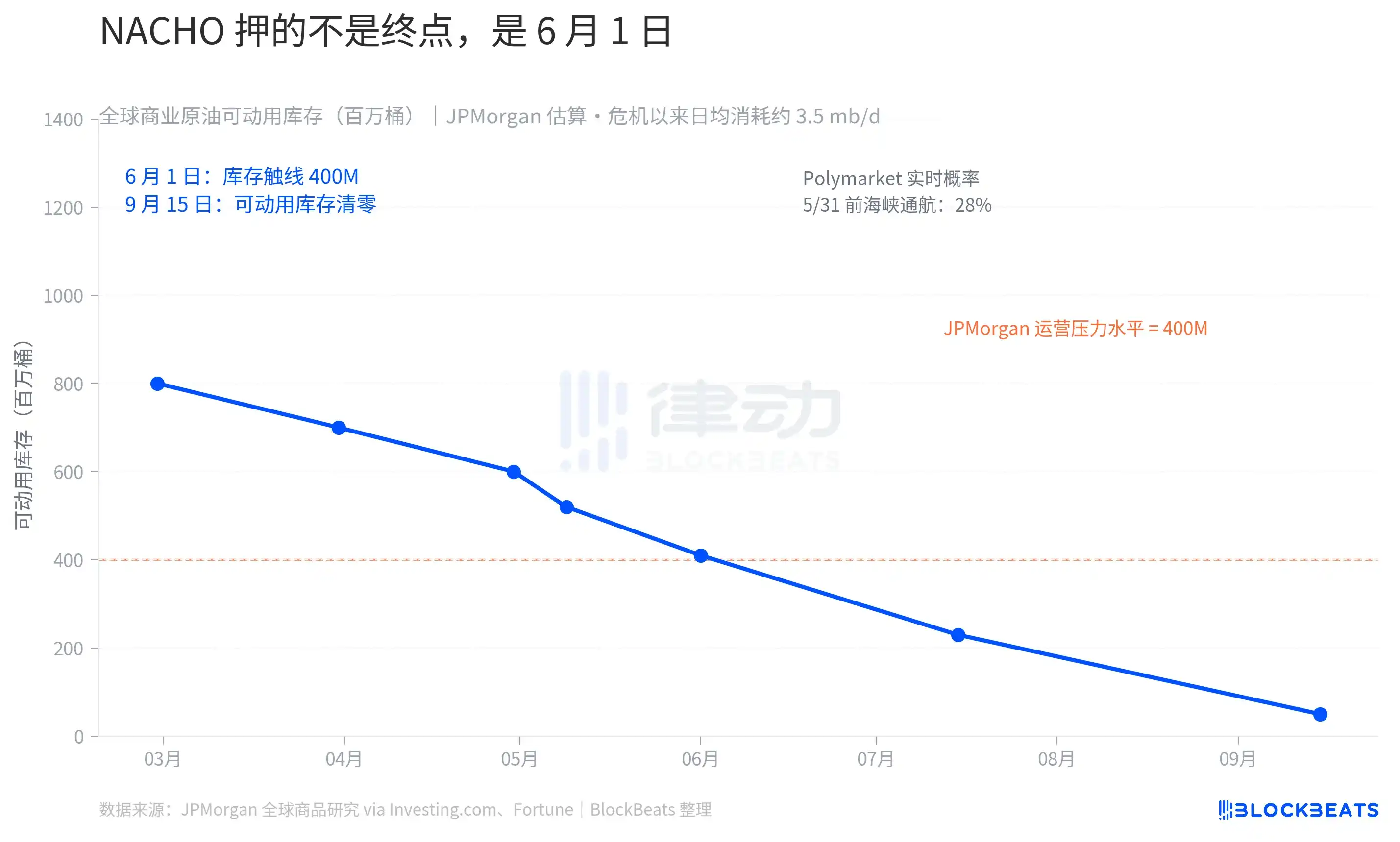
The market's prediction of odds is synchronized with the physical clock. According to Polymarket data on May 9, the probability of "Strait of Hormuz open for normal traffic by May 31" is 28%, and the probability before May 15 is only 2%. $9.92 million in active positions on that market are betting that NACHO will not fail, at least through May.
The market is no longer trading Trump's next Truth Social post; it's trading the early June inventory data for the Strait of Hormuz.






