Synthetix returns to Ethereum mainnet after 3 years: ‘We can run it back’

cointelegraphPublished on 2025-12-18Last updated on 2025-12-18

Abstract

Synthetix, a perpetuals trading platform, is returning to Ethereum's mainnet after three years, citing significantly improved network conditions. Founder Kain Warwick stated that high gas fees and congestion previously made it impractical to run complex trading infrastructure on Ethereum, leading many platforms, including Synthetix, to migrate to Layer-2 solutions. However, reduced demand and ongoing scaling improvements have now made Ethereum Layer-1 viable again. Warwick emphasized that Ethereum mainnet hosts most of crypto's liquidity, assets, and margin, making it the most efficient onchain market. He expects other perpetual DEXs to follow suit, leveraging Ethereum's enhanced capacity and lower transaction costs.

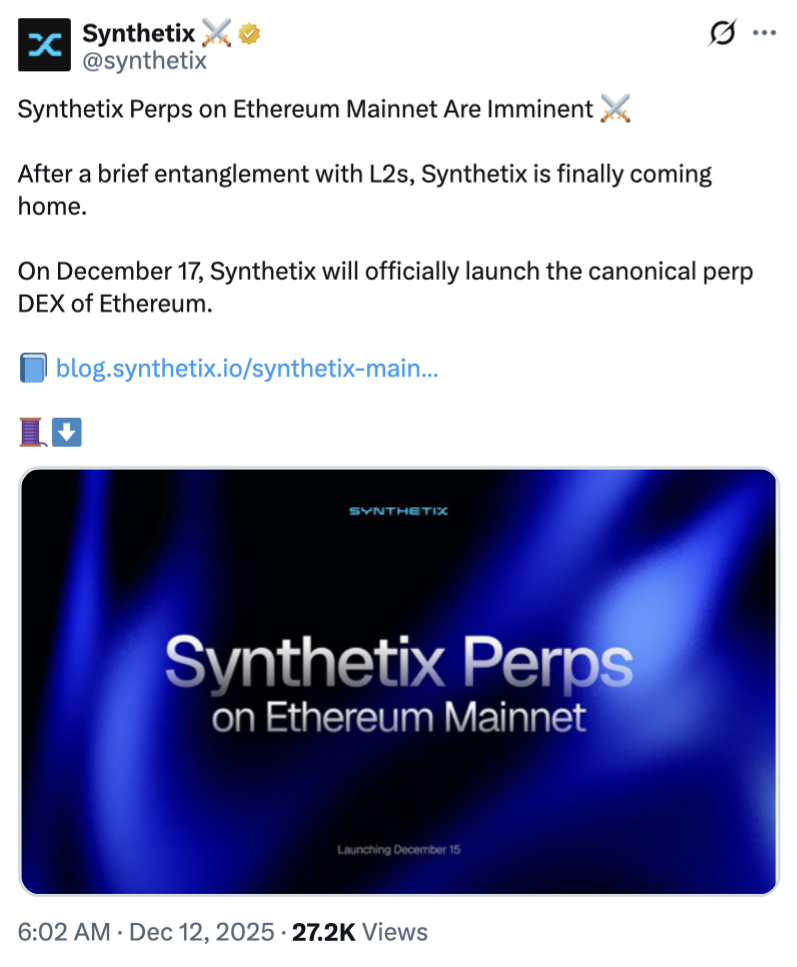
Perpetuals trading platform Synthetix is returning to Ethereum’s mainnet, with its founder arguing the network is now more than capable of supporting high-frequency financial applications after years of network congestion drove derivatives activity elsewhere.

“By the time perp DEXs became a thing, the mainnet was too congested, but now we can run it back,” Synthetix founder Kain Warwick told Cointelegraph during an interview on Wednesday.

“It’s kind of crazy that there really hasn’t been a Perp DEX on mainnet,” he added, explaining that reduced demand after the perp DEX exodus, combined with ongoing scaling improvements, has made Ethereum layer 1 more viable again.

“It’s definitely the best place to run a perp DEX,” he said.
Source: Synthetix

Warwick said that high gas fees and network congestion previously made it impractical to operate complex trading infrastructure on the network.

For several years, many perpetual platforms migrated to layer-2 networks or alternative blockchains, and Synthetix followed a similar path, he said, moving to the Ethereum layer-2 network Optimism in 2022 and later expanding to Arbitrum and Base.

Around the same time, decentralized derivatives exchange dYdX transitioned from mainnet to StarkWare layer-2 solution StarkEx.

Warwick says fees were “just too high” to make it feasible

Warwick said it wasn’t feasible to run critical infrastructure because the costs were “just too high.”

“The cost per transaction and therefore the efficiency of the markets on the chain really degraded,” Warwick said. On Wednesday, Ethereum’s average gas fee stood at approximately 0.71 gwei, nearly 26 times lower than on the same day twelve months ago, when it averaged 18.85 gwei, according to Etherscan.
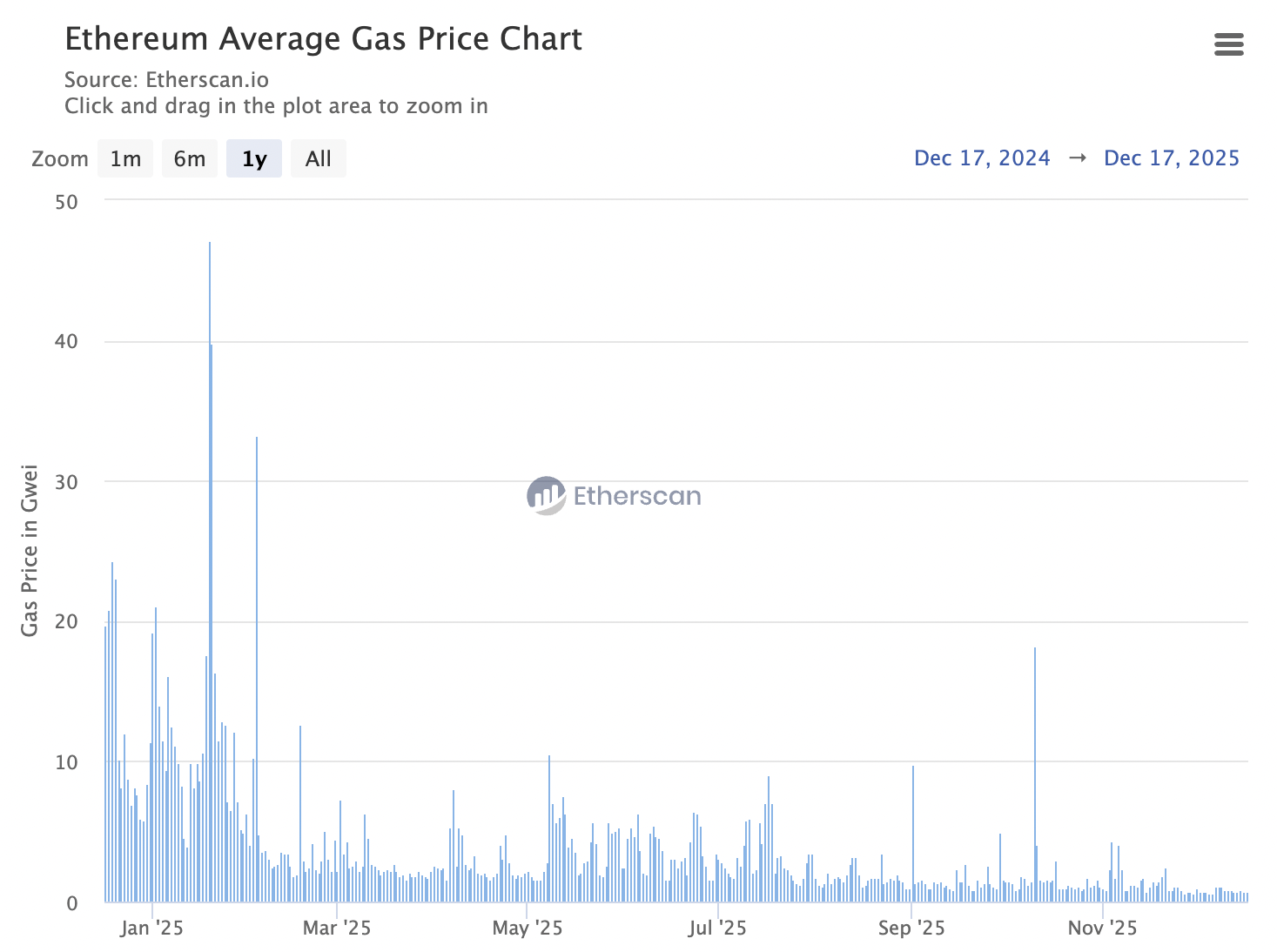
Ethereum gas fees are significantly lower than they were twelve months ago. Source: Ether Scan

Warwick said that the combination of layer-2 and layer-1 scaling means that ”you can actually run critical infrastructure on mainnet again.”

Some Ethereum proponents have predicted further improvements toward network capacity in 2026. Ethereum educator Anthony Sassano recently said the goal to significantly increase Ethereum’s gas limit to 180 million next year is a baseline rather than a best-case scenario.

Warwick expects other perpetual exchanges to follow Synthetix

Warwick expects other perpetual DEXs to follow Synthetix back to mainnet, arguing Ethereum now has the capacity to support multiple perp DEXs simultaneously.

Related: Ripple pilots RLUSD on Ethereum L2s in multichain push

“It wouldn’t be a Synthetix launch if someone didn’t try and, you know, follow us within 20 minutes,” Warwick said.

“The main advantage is most of the liquidity in the crypto world is on Ethereum mainnet; most of the assets, most of the margin, most liquidity, almost everything is there. It is the most efficient onchain market,” he said.

Warwick added that Ethereum’s development has improved significantly in 2025, and it has potentially been the best year for the network since the Merge in September 2022.

“There’s been a renewed kind of focus on, like, the needs of builders, in a way that I think in the past, maybe it was much more focused on the network itself,” he said.

Magazine: Big questions: Would Bitcoin survive a 10-year power outage?

Related Questions

QWhy is Synthetix returning to the Ethereum mainnet after three years?

ASynthetix is returning to the Ethereum mainnet because the network is now more capable of supporting high-frequency financial applications, with significantly lower gas fees and reduced congestion compared to the past.

QWhat was the main reason that originally drove Synthetix and other perpetual DEXs away from the Ethereum mainnet?

AHigh gas fees and network congestion made it impractical and too costly to operate complex trading infrastructure on the Ethereum mainnet, leading many platforms to migrate to layer-2 networks or alternative blockchains.

QAccording to the founder, what is the current state of Ethereum gas fees compared to a year ago?

AAs of the interview, the average Ethereum gas fee was approximately 0.71 gwei, which is nearly 26 times lower than the average of 18.85 gwei on the same day twelve months prior.

QWhat does Kain Warwick predict will happen after Synthetix moves back to the mainnet?

AKain Warwick predicts that other perpetual DEXs will follow Synthetix back to the Ethereum mainnet, as the network now has the capability to support multiple perp DEXs simultaneously.

QWhat does Warwick cite as the main advantage of running a perp DEX on Ethereum mainnet?

AThe main advantage is that most of the liquidity, assets, and margin in the crypto world are on the Ethereum mainnet, making it the most efficient onchain market.

Related Reads

Google and Amazon Simultaneously Invest Heavily in a Competitor: The Most Absurd Business Logic of the AI Era Is Becoming Reality

In a span of four days, Amazon announced an additional $25 billion investment, and Google pledged up to $40 billion—both direct competitors pouring over $65 billion into the same AI startup, Anthropic. Rather than a typical venture capital move, this signals the latest escalation in the cloud wars. The core of the deal is not equity but compute pre-orders: Anthropic must spend the majority of these funds on AWS and Google Cloud services and chips, effectively locking in massive future compute consumption. This reflects a shift in cloud market dynamics—enterprises now choose cloud providers based on which hosts the best AI models, not just price or stability. With OpenAI deeply tied to Microsoft, Anthropic’s Claude has become the only viable strategic asset for Google and Amazon to remain competitive. Anthropic’s annualized revenue has surged to $30 billion, and it is expanding into verticals like biotech, positioning itself as a cross-industry AI infrastructure layer. However, this funding comes with constraints: Anthropic’s independence is challenged as it balances two rival investors, its safety-first narrative faces pressure from regulatory scrutiny, and its path to IPO introduces new financial pressures. Globally, this accelerates a "tri-polar" closed-loop structure in AI infrastructure, with Microsoft-OpenAI, Google-Anthropic, and Amazon-Anthropic forming exclusive model-cloud alliances. In contrast, China’s landscape differs—investments like Alibaba and Tencent backing open-source model firm DeepSeek reflect a more decoupled approach, though closed-source models from major cloud providers still dominate. The $65 billion bet is ultimately about securing a seat at the table in an AI-defined future—where missing the model layer means losing the cloud war.

marsbit2h ago

Google and Amazon Simultaneously Invest Heavily in a Competitor: The Most Absurd Business Logic of the AI Era Is Becoming Reality

marsbit2h ago

Computing Power Constrained, Why Did DeepSeek-V4 Open Source?

DeepSeek-V4 has been released as a preview open-source model, featuring 1 million tokens of context length as a baseline capability—previously a premium feature locked behind enterprise paywalls by major overseas AI firms. The official announcement, however, openly acknowledges computational constraints, particularly limited service throughput for the high-end DeepSeek-V4-Pro version due to restricted high-end computing power. Rather than competing on pure scale, DeepSeek adopts a pragmatic approach that balances algorithmic innovation with hardware realities in China’s AI ecosystem. The V4-Pro model uses a highly sparse architecture with 1.6T total parameters but only activates 49B during inference. It performs strongly in agentic coding, knowledge-intensive tasks, and STEM reasoning, competing closely with top-tier closed models like Gemini Pro 3.1 and Claude Opus 4.6 in certain scenarios. A key strategic product is the Flash edition, with 284B total parameters but only 13B activated—making it cost-effective and accessible for mid- and low-tier hardware, including domestic AI chips from Huawei (Ascend), Cambricon, and Hygon. This design supports broader adoption across developers and SMEs while stimulating China's domestic semiconductor ecosystem. Despite facing talent outflow and intense competition in user traffic—with rivals like Doubao and Qianwen leading in monthly active users—DeepSeek has maintained technical momentum. The release also comes amid reports of a new funding round targeting a valuation exceeding $10 billion, potentially setting a new record in China’s LLM sector. Ultimately, DeepSeek-V4 represents a shift toward open yet realistic infrastructure development in the constrained compute landscape of Chinese AI, emphasizing engineering efficiency and domestic hardware compatibility over pure model scale.

marsbit3h ago

Computing Power Constrained, Why Did DeepSeek-V4 Open Source?

marsbit3h ago

Trading

Spot
Futures

Hot Articles

Discussions

Welcome to the HTX Community. Here, you can stay informed about the latest platform developments and gain access to professional market insights. Users' opinions on the price of ETH (ETH) are presented below.

活动图片