SUI Faces Daily $15 Million Token Unlock, While BEAT Leads $81 Million Token Release Wave This Week

cryptonews.ruPublished on 2026-07-29Last updated on 2026-07-29

Abstract

The article discusses significant token unlocks planned for this week in the crypto market. According to Cryptorank, seven assets, including $SUI and $BEAT, are set for major releases. Analyst account Top7 estimates a $74.9 million one-time unlock for $BEAT on August 1, constituting about 2.12% of its circulating supply. $EIGEN and $KITE will also unlock on the same day for $7.65M and $6.08M respectively, with $BTW and $ZAMA following on August 2 for a combined $13.24M. In contrast to these large, concentrated unlocks, the $SUI token follows a different, continuous daily vesting mechanism, distributing approximately $15.4 million worth of tokens weekly into circulation among community reserves, early contributors, and the Mysten Labs treasury. This gradual release is seen as less likely to cause immediate selling pressure compared to one-time events. As of July 29, $SUI trades at $0.69 with a market cap of around $2.78 billion. The piece explains that large unlocks are important for traders as they increase the pool of tokens available for sale, potentially creating downward price pressure if supply outpaces demand. This effect is considered strongest for "cliff" unlocks like $BEAT's. Despite being a regular feature on unlock trackers due to its volume and vesting schedule, $SUI's ecosystem has shown independent growth, including a reported influx of $65 billion in stablecoin volume following a recent fee reduction. A key test will be whether $SUI's price holds steady from ...

Token unlocking occurs when previously restricted circulation cryptocurrencies, typically reserved for the project team, early investors, or an ecosystem fund, become available for trading on the open market. In a Cryptorank review, $SUI was named one of seven assets with significant unlocks scheduled for this week, alongside $BEAT, $BTW, ENA from Ethena, $EIGEN from EigenLayer, $ZAMA from Zama, and $KITE from Kite AI.
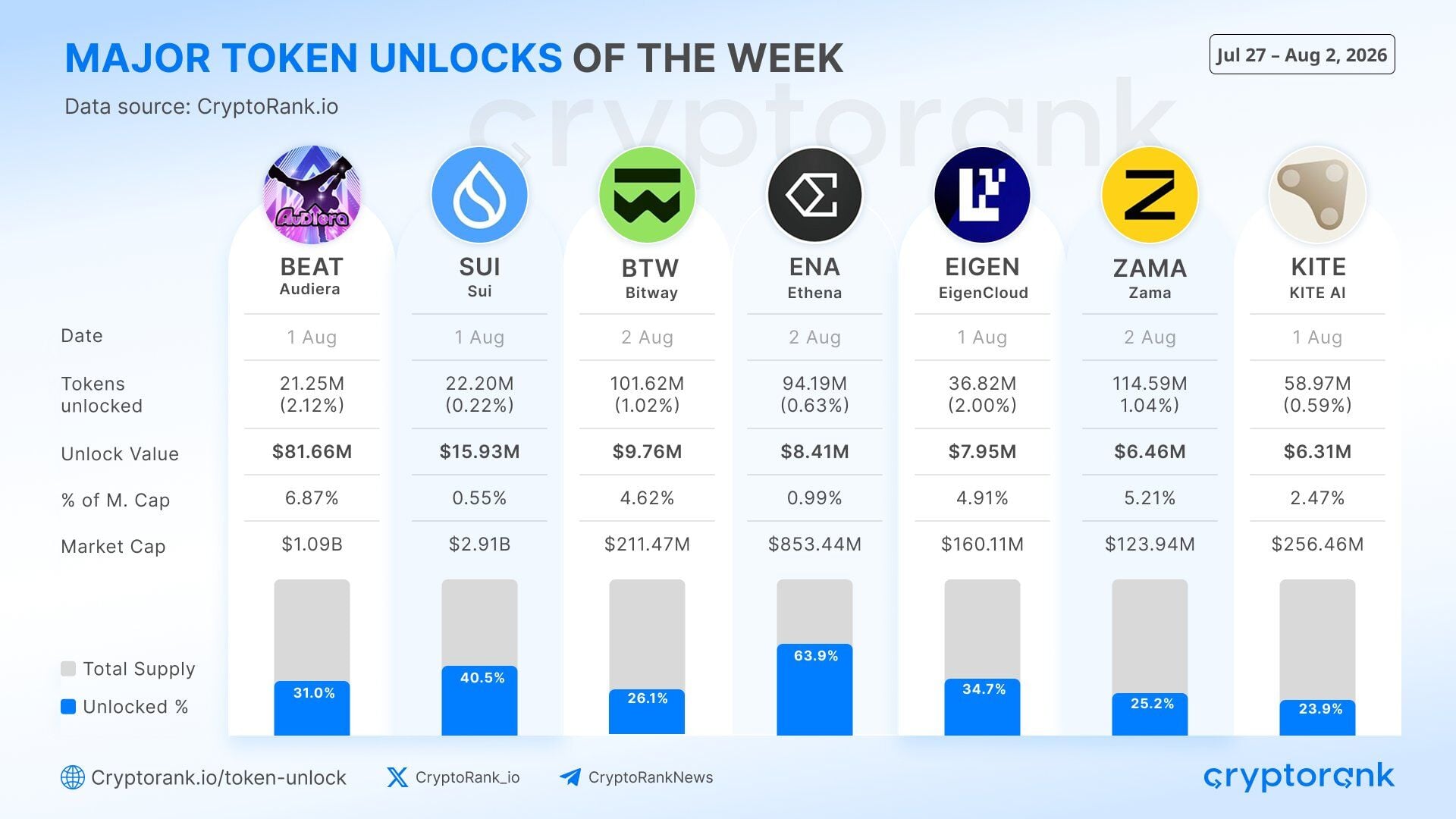
A separate tracker maintained by the crypto analytics account Top7 estimates the $BEAT release volume at $74.9 million, scheduled for a one-time unlock on August 1, representing approximately 2.12% of the total circulating token supply. The $EIGEN and $KITE token unlocks follow on the same day, valued at $7.65 million and $6.08 million respectively, while $BTW and $ZAMA follow on August 2 with a combined value of $13.24 million.

The $SUI Unlock Mechanism Works Differently

Unlike the one-time event for $BEAT, $SUI does not release tokens in a single batch. More precisely, the Sui network, developed by Mysten Labs, distributes the new supply on a constant daily basis to categories such as the Community Reserve, early contributors, and the Mysten Labs treasury.

This structure introduces approximately $15.4 million worth of $SUI into circulation over the week, rather than concentrating the impact on a single trading day.

The maximum supply of $SUI is capped at 10 billion tokens, with about 4.05 billion, or roughly 40%, already in circulation. As of July 29, the token is trading at $0.69, giving it a market capitalization of approximately $2.78 billion.

On August 1 alone, approximately 13.72 million $SUI will be unlocked, distributed among three stakeholder groups: 4 million will go to the Community Reserve, 7.65 million to early contributors, and 2.07 million to the Mysten Labs treasury.

Why Unlocks Affect Markets

Large unlocks are significant for traders as they increase the pool of tokens that can be sold simultaneously. When new supply hits exchanges faster than demand absorbs it, prices can experience downward pressure, especially for tokens where the unlocking holders include venture investors or early team members looking to realize profits.

Analysts tracking vesting schedules argue this effect is strongest with "cliff" unlocks, such as with $BEAT, where a significant portion of supply is released at once, as opposed to gradual daily releases like those for $SUI.

This aspect alone has made $SUI a regular feature on unlock watchlists, not necessarily signaling acute selling pressure. The token has appeared in weekly unlock listings throughout 2026, given its volume and continuous vesting mechanism, even as the Sui ecosystem has shown growth in other areas independent of this.

Earlier this year, Mysten Labs reduced transaction fees on the Sui network, and as reported by Bitcoin.com News, this move helped attract $65 billion worth of stablecoin volume to the network, indicating that trader attention to this asset extends far beyond its unlock schedule.

The next signal to watch is whether the price of $SUI holds steady between August 1 and 2, even as five other tokens simultaneously absorb concentrated releases—this test could determine how traders price in future weeks of unlocks on the Sui network.

end-content

Related Questions

QWhat is token unlocking in the context of crypto markets, and why is it significant?

AToken unlocking refers to the release of previously restricted or locked cryptocurrencies—typically reserved for project teams, early investors, or ecosystem funds—into the open market for trading. It is significant because it increases the supply of tokens available for sale. If new supply enters exchanges faster than demand can absorb it, prices can face downward pressure, especially when large, concentrated unlocks occur.

QAccording to the article, how is SUI's token unlock mechanism different from that of BEAT?

ASUI's token unlock mechanism differs from BEAT's in its distribution schedule. SUI does not release tokens in a single, lump-sum event. Instead, the Sui network, developed by Mysten Labs, distributes new supply on a continuous, daily basis to categories like community reserves, early contributors, and the Mysten Labs treasury. This spreads approximately $15.4 million worth of SUI into circulation over a week. In contrast, BEAT is scheduled for a one-time, lump-sum unlock of roughly $74.9 million on August 1.

QWhich token is expected to have the largest value unlock on August 1 according to the tracker mentioned in the article?

AAccording to the tracker from crypto analytics account Top7 mentioned in the article, the token expected to have the largest value unlock on August 1 is $BEAT, with an estimated value of $74.9 million.

QWhat are the three stakeholder groups that will receive unlocked SUI tokens on August 1, and what are the respective amounts?

AOn August 1, three stakeholder groups will receive unlocked SUI tokens: 4 million SUI will go to the community reserve, 7.65 million SUI to early contributors, and 2.07 million SUI to the Mysten Labs treasury.

QWhy do analysts suggest that 'cliff' unlocks (like BEAT's) have a stronger market impact than gradual daily unlocks (like SUI's)?

AAnalysts suggest that 'cliff' unlocks have a stronger immediate market impact than gradual daily unlocks because they release a significant portion of the token supply all at once. This sudden influx of new, sellable tokens can quickly outpace market demand, creating more pronounced downward pressure on prices. Gradual daily releases, like SUI's, distribute the selling pressure over time, which can be more easily absorbed by the market.

Related Reads

Low Investment Isn't Apple's Immunity Pass

While Meta and Google face investor scrutiny over ballooning AI capital expenditures, Apple's minimal AI investment has paradoxically become a strength. Its market cap recently reclaimed the global top spot, surpassing $5 trillion. The irony is deep: Apple's own AI efforts have lagged, with "Apple Intelligence" delayed and core talent lost, forcing reliance on partners like Google Gemini and Alibaba's Qianwen. Its Q3 FY2026 (Q2 CY) earnings initially seemed stellar. Revenue hit $109.4B (up 16% YoY), with iPhone and Mac sales, growing 22% and 29% respectively, driving most of the growth. However, the stock fell over 8% post-earnings. The primary concern was a weaker Q4 revenue growth forecast of 9-11%, below expectations, due to looming supply chain constraints. Apple is feeling the indirect cost of the AI boom. Soaring memory and chip prices, fueled by massive data center investments from Microsoft, Amazon, and others, are forcing Apple to raise Mac and iPad prices significantly. The upcoming iPhone launch is also expected to see substantial price hikes. Despite avoiding heavy AI infrastructure spending—its capital expenditures are actually down 28%—Apple cannot escape the industry-wide supply and cost pressures. While Apple's operating cash flow remains robust, its substantial R&D spending (up 32% YoY) has yet to yield major AI breakthroughs. As Tim Cook prepares to step down as CEO, Apple faces a challenging transition: balancing its premium hardware success against the strategic and cost pressures of the AI era it has so far cautiously navigated.

marsbit13m ago

Low Investment Isn't Apple's Immunity Pass

marsbit13m ago

PA Graphics Explanation | One Chart to Understand the Major Web3 Events in August 2026

**PANews Crypto Calendar: Key Web3 Events in August 2026** PANews introduces its revamped crypto calendar, featuring comprehensive coverage, flexible filtering, and easy export options. The market in August will be shaped by multiple key events across macroeconomics, regulation, tokenomics, and project developments: * **Macro & Policy:** Key US economic data releases (July Non-Farm Payrolls, CPI), the Federal Reserve meeting minutes, and the Jackson Hole Economic Symposium will be in focus. On the regulatory front, the US Senate plans to release a new draft of the *CLARITY Act*, while the EU's expanded crypto ban against Belarus comes into effect. * **Token Unlocks:** Significant token unlocks are scheduled for assets including ENA, AVAX, CONX, ZRO, and KAITO, which may influence market volatility. * **Project Updates & Shutdowns:** Several services, including Exchange Art, Ctrl Wallet, Zapper, NFTfi, and Summer.fi, are set to cease operations or undergo major adjustments. Users are advised to manage their assets accordingly. * **Corporate Activity:** Q2 earnings reports from companies like SpaceX, Circle, and Nvidia are due. Unitree Robotics will initiate its IPO subscription on the STAR Market, and Moonshot AI plans to begin a Pre-IPO financing round. * **Industry Events:** Major conferences such as Bitcoin Asia 2026 and the 2026 Digital Expo will take place. The overarching market narrative for August will revolve around macroeconomic expectations, regulatory developments, token unlock schedules, and ongoing industry consolidation.

marsbit24m ago

PA Graphics Explanation | One Chart to Understand the Major Web3 Events in August 2026

marsbit24m ago

Wall Street's Most Famous 'Cassandra' Now Has His Sights Set on Nvidia

Michael Burry, the famed "Big Short" investor, has once again captured Wall Street's attention with a series of short positions against major tech and semiconductor stocks, most notably Nvidia. In late June and July, through his "Cassandra Unchained" newsletter, Burry disclosed short bets against Nvidia, Tesla, Applied Materials, Caterpillar, the SOXX semiconductor ETF, and later, Micron Technology. His core thesis revolves around potential distortions in the AI infrastructure boom, specifically questioning whether extended depreciation schedules (e.g., 6 years vs. a realistic 2-3 years for AI chips) by cloud giants like Microsoft and Google artificially inflate profits. He also raises concerns about possible "off-balance-sheet circular financing," where chip demand might be propped up by vendor-backed funding to clients. Nvidia's stock experienced volatility following these disclosures, briefly dipping but largely holding near Burry's reported entry points, leaving his positions roughly flat or slightly underwater as of late July. This move is part of a pattern for Burry, whose track record since his legendary 2008 bet is mixed. He has faced notable losses, such as on Tesla in 2021, while scoring on broader market turns like the 2020 pandemic crash. His methodology focuses intensely on free cash flow and scrutinizing original financial documents to spot overvaluation and structural risks, but it often struggles with timing the market. The article contrasts Burry's stance with other prominent investors. Steve Eisman, another "Big Short" figure, is not shorting Nvidia, citing strong fundamentals but expressing nervousness about sustainability. Jim Chanos agrees with the broad "accounting mismatch" concern—comparing it to the dot-com bubble—but targets financial leverage in private equity firms rather than the chip stocks themselves. While Nvidia's short interest remains relatively low at 1.3-1.4% of float, the massive stock size means absolute short losses have been significant, exceeding $5 billion earlier this year. The piece concludes that for ordinary investors, the key takeaway is not replicating specific short bets but learning from the critical frameworks these investors use: questioning rosy accounting, identifying structural vulnerabilities, and maintaining skepticism during market euphoria, even if pinpointing the exact catalyst for a downturn remains elusive.

marsbit48m ago

Wall Street's Most Famous 'Cassandra' Now Has His Sights Set on Nvidia

marsbit48m ago

Weekly Selection丨Epic Stock Market Volatility, Changxin Tech's IPO Reshapes Storage Landscape, Saylor Aims to Re-Anchor STRC Around September 8th

PANews Weekly Digest: Market Turmoil, Tech Breakthroughs, and Crypto Developments. The week saw significant volatility across global markets. South Korea's KOSPI index experienced extreme turbulence, including multiple trading halts, largely driven by sharp declines in AI hardware stocks like SK Hynix. In contrast, China's Changxin Xinqiao (CXC) achieved a landmark IPO with a market cap surpassing 4 trillion yuan, marking a major success for the domestic DRAM industry after a decade of losses. In the crypto and Web3 space, several key narratives emerged. AI is driving demand for new infrastructure, with projects like AI agent wallets and programmable payments gaining traction, attracting interest from firms like Coinbase. The Bitcoin mining sector is pivoting, with companies like MARA focusing on energy management as electricity becomes a core AI-era asset. Meanwhile, the RWA (Real World Assets) sector faces a "utilization puzzle," with hundreds of billions in on-chain assets remaining dormant. Notable market movements included a historic single-day surge of over 17% for the KOSPI index and a significant migration of $16.5 billion in staked ETH within the Lido ecosystem. Michael Saylor announced a target to re-peg the STRC stablecoin around September 8th. Other highlights include discussions on Ethereum's ambitious 2030 roadmap for scaling and privacy, analysis showing high protocol revenues not always translating to token price gains, and warnings from Citi about potential extreme commodity price shocks by late 2026.

marsbit54m ago

Weekly Selection丨Epic Stock Market Volatility, Changxin Tech's IPO Reshapes Storage Landscape, Saylor Aims to Re-Anchor STRC Around September 8th

marsbit54m ago

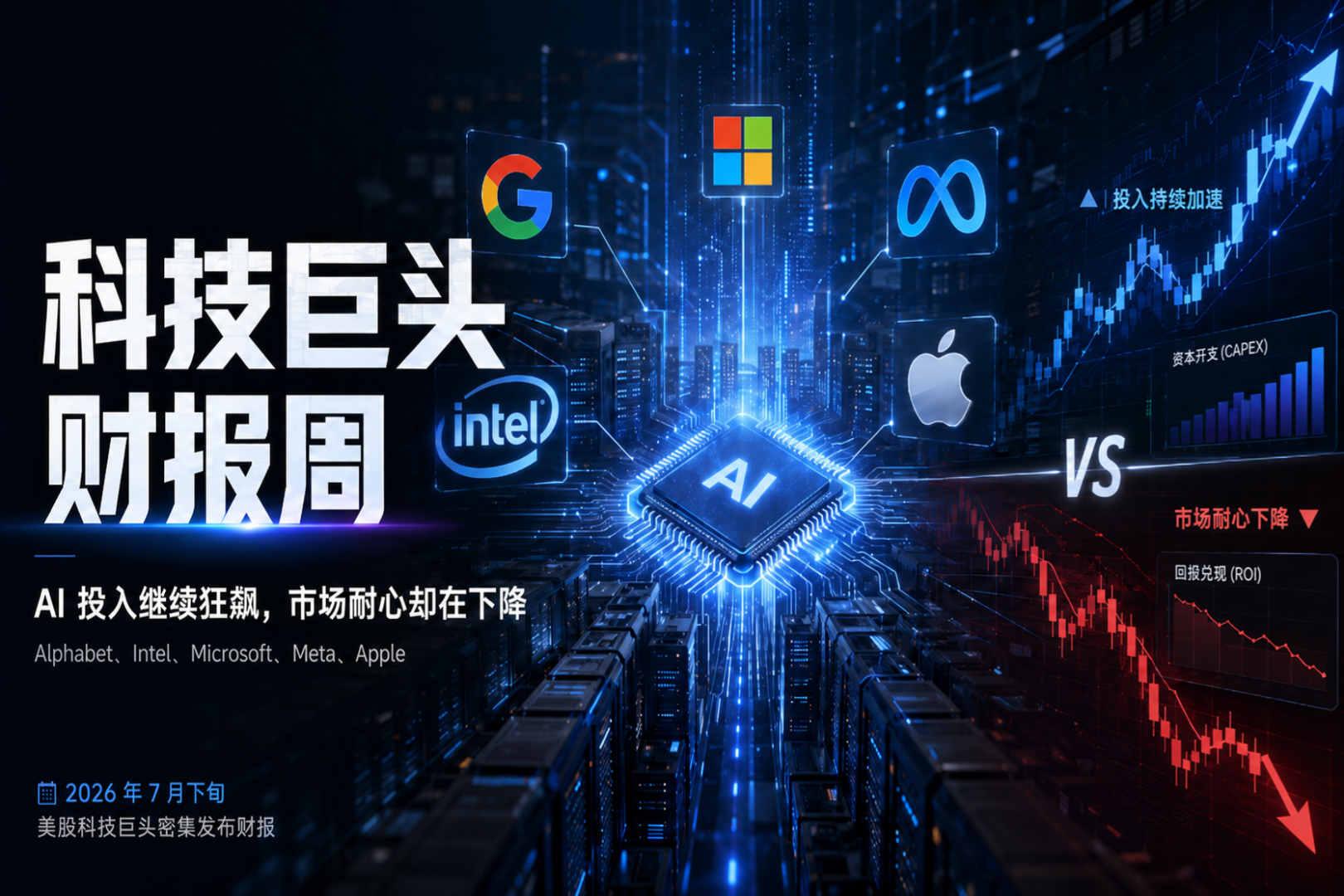
When the Market Begins to Question AI Capex: A Full Analysis of Q2 Earnings Reports from Five Tech Giants

In late July 2026, five major US tech giants—Alphabet, Intel, Microsoft, Meta, and Apple—released their Q2 earnings reports. While all companies exceeded revenue and profit expectations, driven by strong AI-related business growth, investor reactions diverged sharply due to concerns over escalating AI capital expenditures (capex) and their impact on free cash flow. Alphabet reported strong revenue growth and a surging cloud business, but its stock fell after announcing a doubled year-on-year capex and negative quarterly free cash flow for the first time. Intel posted its strongest revenue growth in over 15 years, but its stock experienced volatile trading after significantly raising its full-year capex guidance. Microsoft saw its stock surge after beating estimates and, crucially, lowering its capex forecast while projecting positive free cash flow. Meta faced the most severe sell-off as its profits declined despite revenue beats, with free cash flow plunging over 90% and its capex guidance raised. Apple reported record June-quarter results, but its stock plummeted after providing Q4 revenue guidance that fell short of expectations, citing supply chain constraints and forex headwinds. The overall takeaway is that the market's focus has shifted from validating AI demand to scrutinizing the timeline for returns on massive AI investments. Companies demonstrating a clearer path to managing capex and preserving free cash flow, like Microsoft, were rewarded, while those signaling continued aggressive spending faced investor skepticism.

Odaily星球日报1h ago

When the Market Begins to Question AI Capex: A Full Analysis of Q2 Earnings Reports from Five Tech Giants

Odaily星球日报1h ago

Trading

Spot
活动图片