Stole $2 Million from pump.fun, Sentenced to 6 Years in Prison, He Chose to 'Self-Destruct'

marsbitPublished on 2026-03-06Last updated on 2026-03-06

Abstract

In May 2024, pump.fun was exploited for approximately $2 million worth of SOL and meme coins. The attacker, Jarett Dunn (also known as Stacc), a former employee, was later sentenced to six years in prison. Two days prior to the sentencing, he leaked internal Telegram chats from his time at the company, claiming to be a whistleblower exposing misconduct. However, the leaked messages did not reveal deliberate malicious activities such as market manipulation or fee misconduct by pump.fun. Instead, Dunn highlighted issues like the team's failure to implement KYC/AML measures for live streaming features, which he had warned about, and what he perceived as irresponsible attitudes toward known "Ruggers" (developers who abandon projects after fundraising). Some messages also illustrated the company's early-stage disorganization, including rushed contracts under investor pressure. Dunn, a talented programmer diagnosed with paranoid schizophrenia at age 20, had joined pump.fun just six weeks before the attack. His mother had recently died, and he had been off medication for months. After the exploit, he was arrested near pump.fun’s London office and underwent mental health treatment. He later attempted to withdraw his guilty plea and expressed homelessness in social media posts. The leak included private phone numbers of pump.fun co-founders, raising privacy concerns. The overall narrative portrays a troubled individual whose actions were influenced by personal trauma and mental hea...

In May 2024, pump.fun was hacked, with the attacker stealing approximately $2 million worth of SOL and a large number of meme coins. At the time, the attacker claimed they would airdrop these funds randomly to players on Solana, once dubbed the "Robin Hood of the crypto world."

Jarett Dunn (online alias Stacc), the attacker, is a former pump.fun employee. Last December, he was sentenced to 6 years in prison by a judge in London.
Two days ago, he exposed a large number of Telegram chat records from his time at pump.fun.

So I spent a lot of time going through these chat logs one by one. Honestly, after reading them, I was confused because these records did not contain the kind of intentional malicious content I had imagined, such as the pump.fun team manipulating liquidity or secretly collecting user fees. There was also no content suggesting major personal moral issues with founder alon or other team members.

But in Jarett Dunn's tweet, he called himself a whistleblower and viewed his exposure as a form of "righteous self-destruction." Someone expressed the same doubt in his comments, to which he replied:
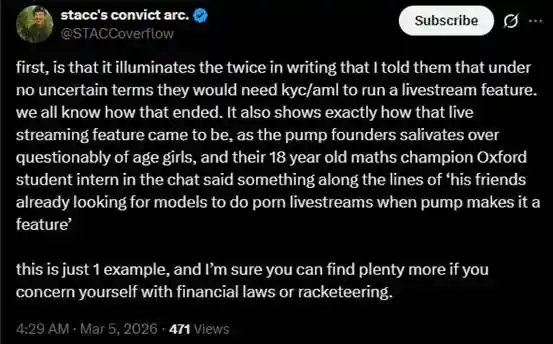
"These records show that I told them twice they must complete the KYC/AML process to enable livestreaming on the platform, (but they ignored it) and then we all know how things ended up (referring to the chaotic and unrestrained livestreaming scene on pump.fun in its early days)."

If this accusation has some merit, the next one is a bit more of a leap:

"An employee said something like this in the group: his friend was already looking for models to do porn as soon as pump.fun's livestreaming went live."

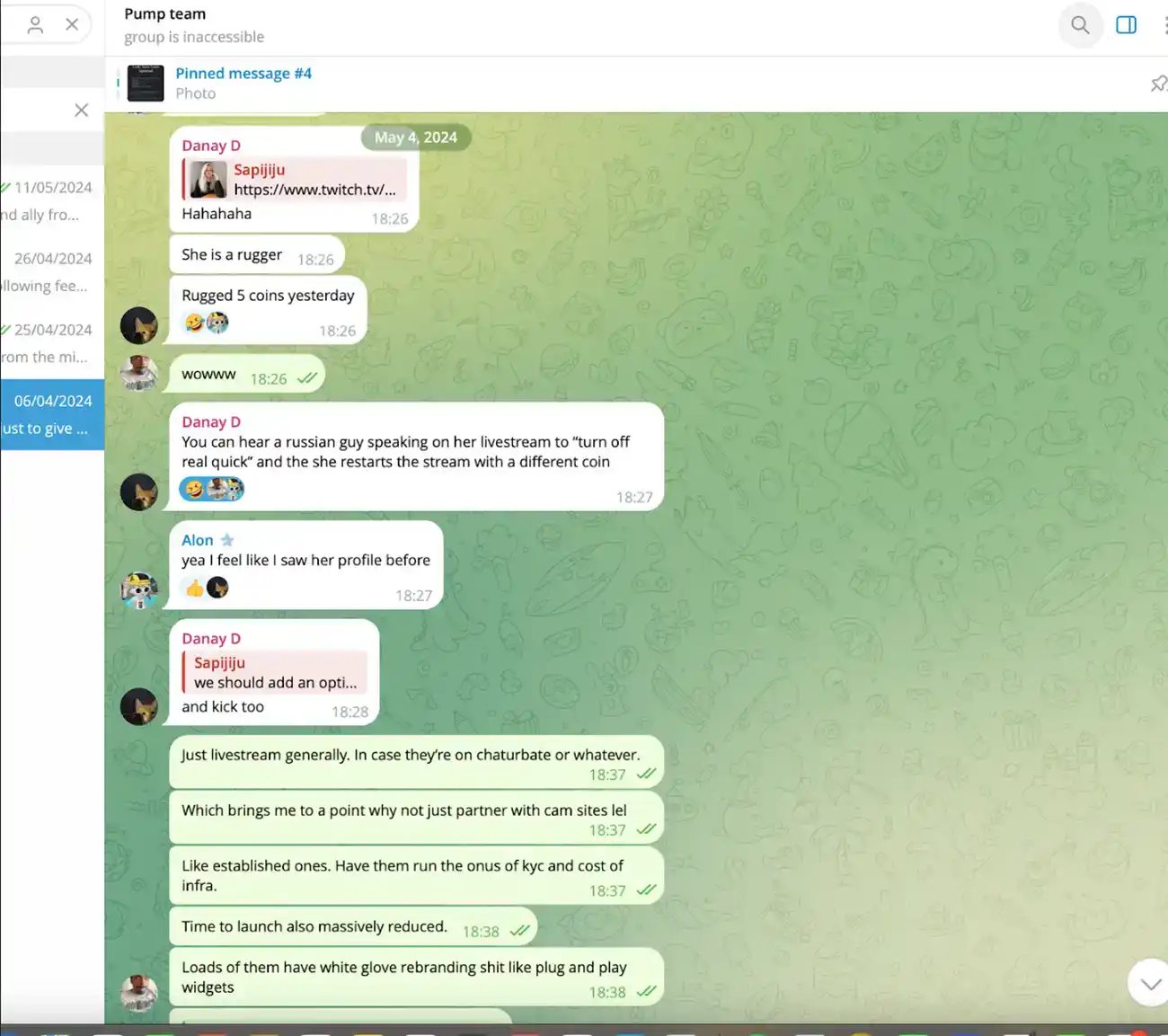
The chat record corresponding to this accusation is as follows. First, pump.fun co-founder Sapijiju shared a Twitch streamer in the pump.fun company group, saying another Twitch streamer had launched a token through pump.fun. An employee stated that this streamer was a Rugger (someone who performs a rug pull) and had rugged 5 tokens the day before.
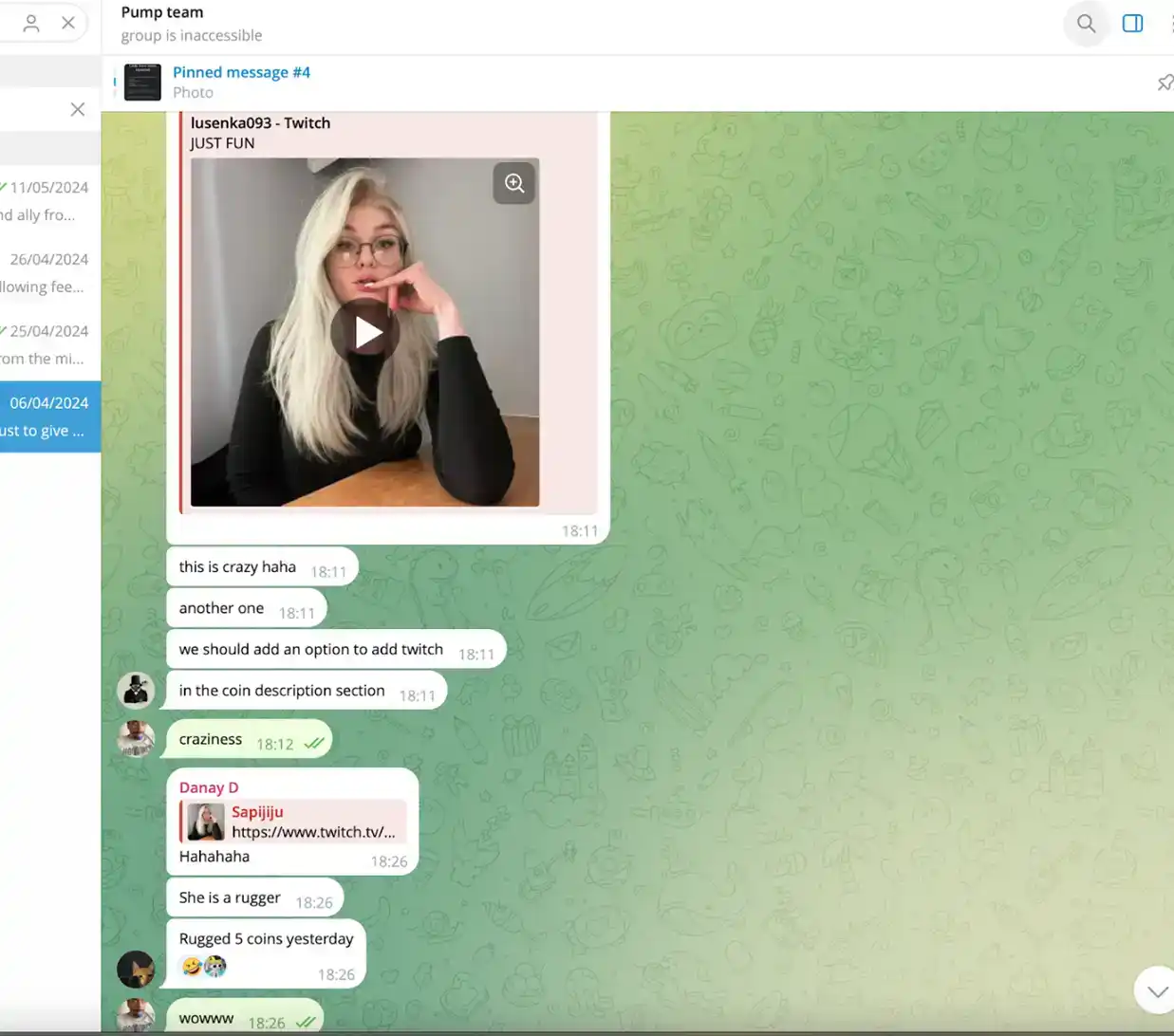
Then this employee said his friend was looking for "models" (to do the same thing). In context, this seems more like a joke. However, Jarett Dunn's suggestion was indeed interspersed, where he took the opportunity to express that partnering with a livestreaming platform would be better, as it would avoid KYC responsibilities and significantly shorten the time needed for pump.fun to launch its livestreaming feature.
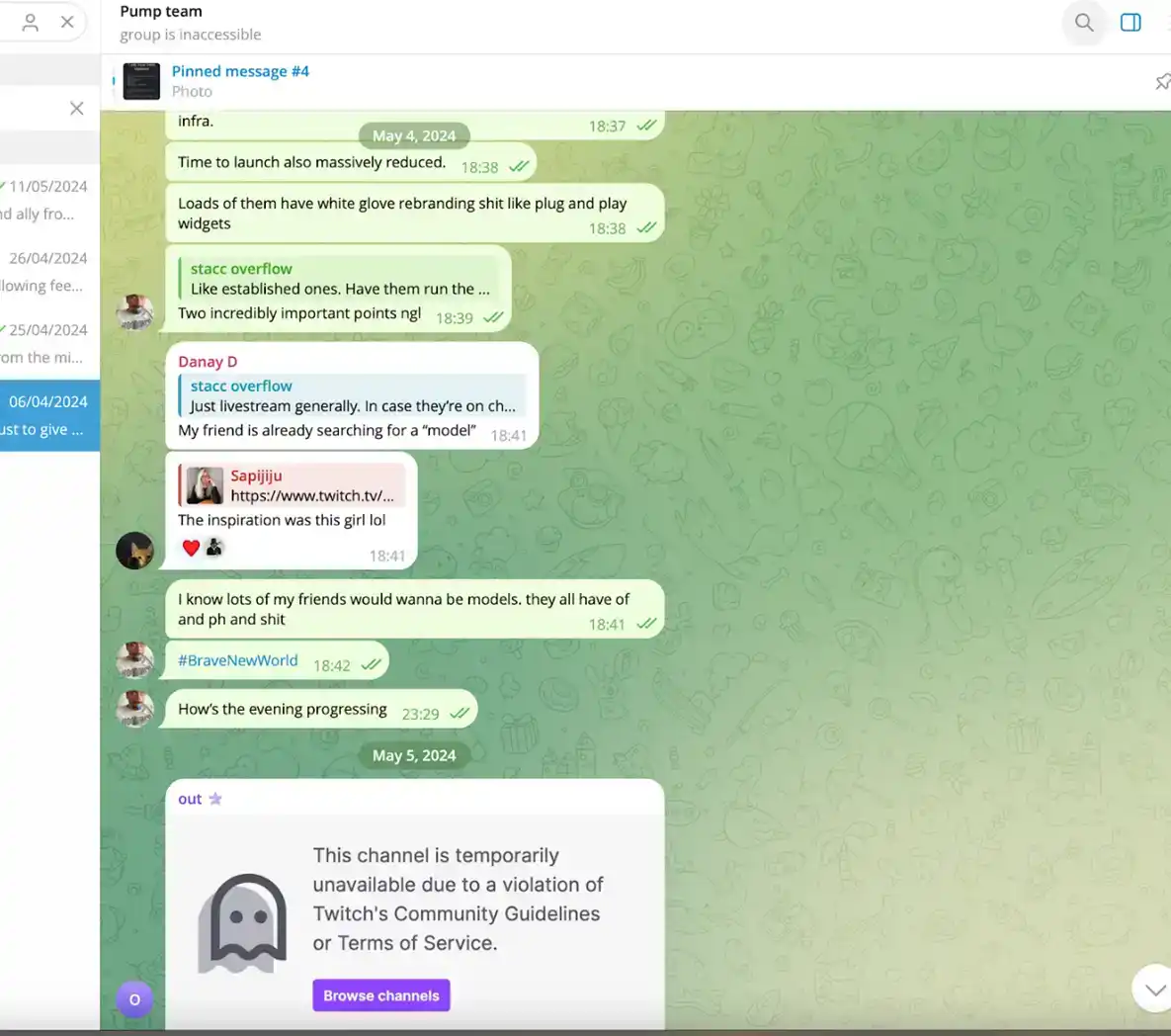
The more significant accusation here should be that the entire team, knowing this was a serial Rugger, still maintained a casual, joking attitude. alon, as a co-founder, stated in the records that he "felt like he had seen her profile before," and then nothing more came of it.
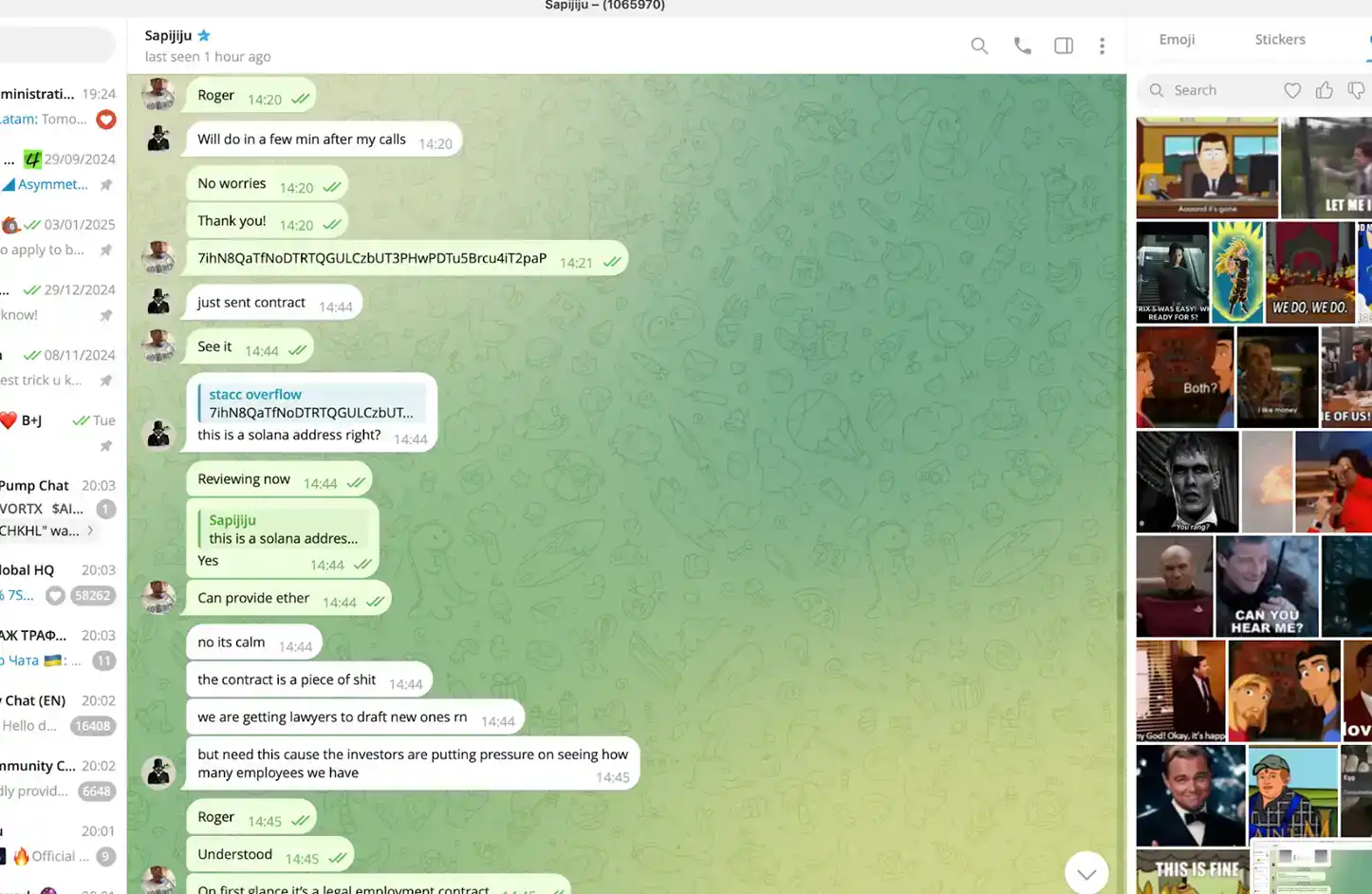
Some other records show the early "makeshift" nature of pump.fun. For example, creating a contract they themselves felt was "a piece of shit" just to handle investor pressure (needing to show investors how many employees the company had), while also looking for lawyers to draft a new one. For a then "young" pump.fun, it's hard to call this a black mark:
The most "explosive" part of the records disclosed by Jarett Dunn might be the release of the phone numbers associated with the Telegram accounts of alon and Sapijiju. Since this involves privacy, screenshots of this part will not be included in this article.

So, what kind of deep grudge is this? From the records, I cannot find the beginning of the enmity between Jarett Dunn and pump.fun, but he is a talented programmer who was also diagnosed with paranoid schizophrenia at the age of 20.

Two years ago, when he attacked pump.fun, his mother had recently passed away. At this time, he had only been with pump.fun for 6 weeks.

Four days after the attack, he was arrested at a hotel located just 90 meters from pump.fun's office in London; he was staying there. After his arrest, he was immediately deemed unfit for questioning by the police and sent to a hospital for a two-week mental health treatment, having been off his medication for months.

At his sentencing hearing two months after pleading guilty, he tried to withdraw his plea, a sudden change that made his legal team quit.

In September 2023, he wrote in a tweet, "I'm homeless, planning to sleep in the park, fighting the bugs I created with 5G."

Yet in the records, pump.fun reimbursed his flight tickets for him to fly from Canada to the UK. Was he happy and fulfilled back then?

Faced with such a complex, life-troubled programmer, I can only sigh at the vicissitudes of life.


Related Questions

QWho was the individual responsible for the $2 million hack of pump.fun and what was his sentence?

AJarett Dunn (also known as Stacc), a former pump.fun employee, was responsible for the hack. He was sentenced to 6 years in prison by a judge in London.

QWhat was the main reason Jarett Dunn gave for his 'whistleblower' act of leaking internal chats?

AHe claimed that he had twice warned the pump.fun team that they needed to complete KYC/AML procedures before launching a live-streaming feature, but they ignored him, which he implied led to the platform's early chaos.

QWhat personal circumstances were mentioned that may have contributed to Jarett Dunn's actions?

AHe was diagnosed with paranoid schizophrenia at age 20, his mother had recently passed away just before the attack, and he had been off his prescribed medication for several months.

QAccording to the article, what was the nature of the most 'explosive' information leaked by Dunn?

AThe most sensitive information leaked was the personal phone numbers associated with the Telegram accounts of pump.fun's co-founders, Alon and Sapijiju.

QHow did the author of the article characterize the internal chat logs that were leaked?

AThe author was initially confused because the logs did not contain evidence of intentional malicious acts like market manipulation or stealing user fees. Instead, they showed a 'ragtag' or immature early-stage startup culture with some questionable jokes and attitudes, but not major ethical scandals.

Related Reads

Will the Fed Definitely Raise Interest Rates in September? How Will Crypto and U.S. Stocks Withstand the Pressure?

The market's expectation for a September Fed rate hike surged dramatically in early August, jumping from under 50% to over 80% within a week. This shift followed a contentious July FOMC meeting, where a 9-3 vote to hold rates revealed growing dissent from hawkish members advocating for an immediate hike to combat persistent inflation. The primary catalyst for this repricing is rising oil prices, driven by renewed geopolitical tensions around the Strait of Hormuz, which threaten global supply. Energy costs directly influence inflation metrics, making the upcoming July CPI report (due August 12th) a critical data point. If it shows inflation reaccelerating, the probability of a September hike will solidify. For Bitcoin and crypto assets, this is typically bearish news. Bitcoin continues to behave as a high-beta, liquidity-sensitive risk asset. A rate hike raises the opportunity cost of holding non-yielding assets and could drive capital toward money markets, pressuring crypto prices in the short term. However, historical patterns suggest that if a hike is perceived as the end of a tightening cycle rather than the start, any negative price impact may be brief. U.S. stocks, particularly crypto-linked equities like Coinbase and growth-oriented tech stocks, are also vulnerable. Higher rates increase discount rates in valuation models, putting pressure on high-multiple companies. This coincides with a pivotal tech earnings season where investor focus has shifted from massive AI capital expenditure to tangible revenue and cash flow generation. Companies with negative cash flow and weak growth narratives could face heightened volatility if borrowing costs rise in September. In summary, a September Fed hike has evolved into a mainstream market scenario. Key factors to watch are oil prices, the July CPI report, and Fed communications, which will determine the final decision and its impact on volatile crypto and equity markets.

marsbit4m ago

Will the Fed Definitely Raise Interest Rates in September? How Will Crypto and U.S. Stocks Withstand the Pressure?

marsbit4m ago

A 'Overlooked' Market Event: Joint US-Japan-South Korea Intervention, Rare US Treasury Involvement, and Bessent's Quiet 'Market Rescue'?

Summary: The United States, Japan, and South Korea executed their largest coordinated foreign exchange intervention in nearly 30 years. The action targeted depreciation pressure on the Japanese yen and South Korean won. This move is seen as a significant effort by the US to stabilize the financial markets of its key allies and prevent the spillover of risks. Key details: * Japan reportedly intervened on July 30 using approximately 8.45 trillion yen (about $52.8 billion). South Korean authorities also intervened that day, selling dollars to support the won. * Notably, the US Treasury Department intervened directly in yen markets for the first time in roughly 30 years. The New York Fed, reportedly acting on behalf of the Treasury, sold euros to buy yen via Goldman Sachs and Morgan Stanley on July 31. Analysts view the use of the euro-yen pair as a way to alleviate yen pressure without adding selling pressure to the US dollar. * Prior to the action, the New York Fed conducted "rate checks" on both USD/JPY and EUR/JPY, a newer signaling tool that falls between verbal and physical intervention. The intervention is interpreted as going beyond traditional currency stabilization. Analysts, such as Michael Hartnett of Bank of America, suggest it resembles a "Price Keeping Operation" for the AI era. The core US objectives are perceived to be: 1. Preventing rapid yen depreciation from triggering a sharp rise in Japanese government bond yields. 2. Containing financial stress from spreading across Asian markets like South Korea and Japan. 3. Reducing the risk of disorderly capital flows impacting the US bond market. This coordinated action underscores the importance of Japan and South Korea as critical partners in the US semiconductor and AI supply chain. Stabilizing their financial markets is seen as vital to mitigating risks to the broader tech industry and the US market itself. The intervention coincides with market pressures, including the KOSDAQ index hitting a low since October 2022. While seen as a move to control volatility, some analysts caution it may not fundamentally reverse existing market trends.

marsbit8m ago

A 'Overlooked' Market Event: Joint US-Japan-South Korea Intervention, Rare US Treasury Involvement, and Bessent's Quiet 'Market Rescue'?

marsbit8m ago

Will the Federal Reserve Definitely Raise Interest Rates in September? How Will Cryptocurrencies and US Stocks Bear the Pressure?

In early August 2024, market expectations for a September Federal Reserve rate hike surged dramatically, from below 50% to over 80%, driven by renewed inflation concerns. This shift followed a contentious July FOMC meeting where a 9-3 vote to hold rates revealed a growing hawkish faction advocating for an immediate hike, citing prolonged above-target inflation. The key catalyst is escalating conflict near the Strait of Hormuz, which has pushed oil prices up approximately 20% in July, threatening to reignite inflation. The next critical data point is the July CPI report on August 12th; a hot reading could solidify hike expectations. For crypto assets, particularly Bitcoin, this represents near-term pressure. Bitcoin continues to exhibit high-beta, risk-on characteristics, making it sensitive to tightening liquidity and higher opportunity costs. However, historical precedent suggests that if a hike is perceived as the cycle's end rather than its start, the negative impact may be brief, with markets quickly pivoting to anticipate future rate cuts. U.S. stocks, especially crypto-linked equities like Coinbase and high-valuation tech stocks, face amplified volatility. Higher rates increase discount rates in valuation models, pressuring growth stocks. This coincides with a pivotal tech earnings season where investor focus has shifted from massive AI capital expenditures to demonstrable revenue and cash flow generation. Companies with negative cash flows and weak growth narratives could see severe pressure if a September hike materializes, as financing costs would rise. Key indicators to watch include oil prices, upcoming inflation data, and Fed commentary at events like the Jackson Hole symposium.

Odaily星球日报8m ago

Will the Federal Reserve Definitely Raise Interest Rates in September? How Will Cryptocurrencies and US Stocks Bear the Pressure?

Odaily星球日报8m ago

Trading

Spot
活动图片




