Stablecoins are leaving exchanges – and traders aren’t buying the dip

ambcryptoPublished on 2025-12-23Last updated on 2025-12-23

Abstract

Stablecoins are being withdrawn from cryptocurrency exchanges at the fastest rate in the current market cycle, signaling a sharp decline in short-term risk appetite among traders. Despite a growing overall stablecoin supply—largely backed by U.S. Treasuries—investors are choosing to hold capital off exchanges rather than deploy it during the market downturn. This cautious behavior is evident in the significant outflows from major exchanges like Binance, which saw nearly $1.9 billion in net outflows over 30 days. While Bitcoin has corrected roughly 36% from its October highs, traders have been unwinding leverage, with open interest falling more than 40%. However, stablecoins aren't exiting the crypto ecosystem entirely. Instead, they are migrating to safer blockchain networks like TON, Ethereum, and Polygon, while trading-focused chains such as Solana and Tron experience outflows. The shift reflects a defensive strategy: investors are prioritizing safety and yield offered by stablecoins—which function like low-risk money market instruments—over exposure to volatile assets. This trend is likely to persist until market confidence returns.

Stablecoins are moving off crypto exchanges at the fastest pace this cycle. Instead of putting capital to work, investors are choosing to wait.

This is happening even as stablecoin supply continues to grow, backed largely by U.S. Treasuries. Everyone’s staying liquid, but holding back until market conditions improve.

Traders take a step back

The speed at which stablecoins are being pulled has caused a drop in short-term risk appetite.

While Bitcoin’s correction fell further (now down roughly 36% from its early October highs), traders have been unwinding leverage. OI has fallen more than 40%.

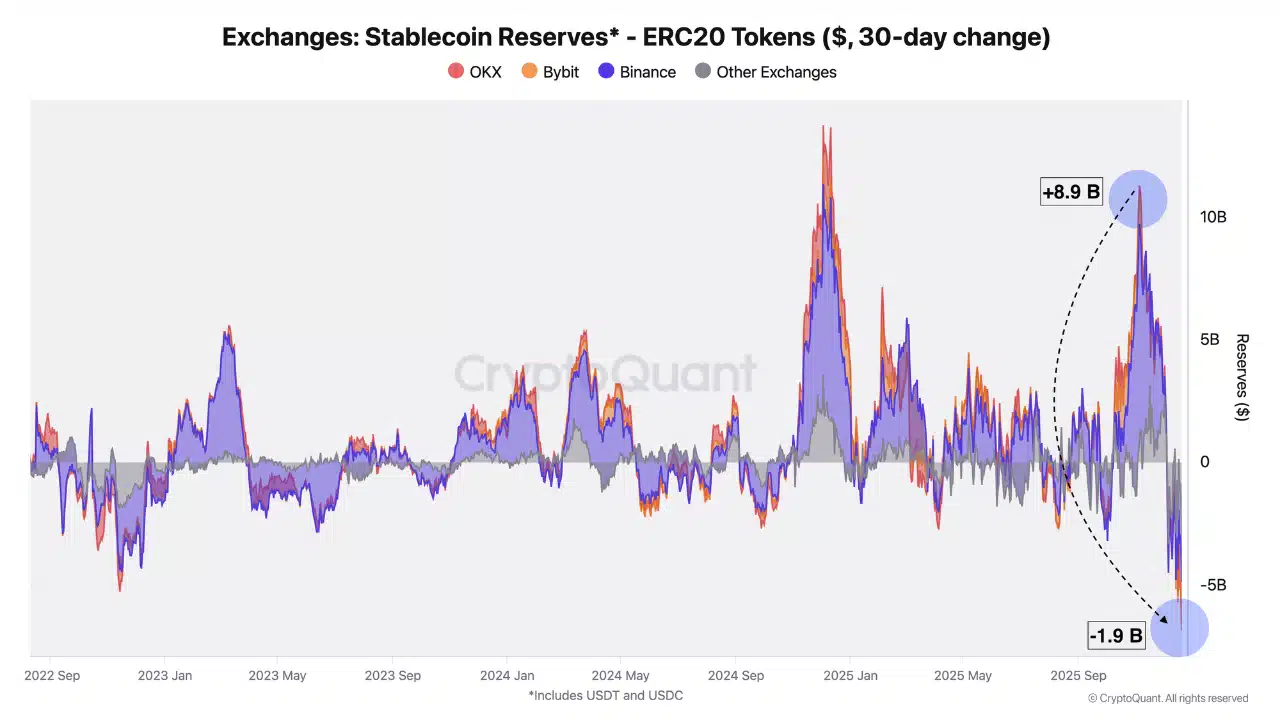
Source: CryptoQuant

December was the steepest decline in ERC-20 stablecoin reserves across major exchanges in this cycle. These tokens are usually on exchanges ready to be deployed.

This time, they are being pulled out instead. The change is easily visible on Binance, where an inflow trend flipped into nearly $1.9 billion in net outflows over 30 days. This is an obviously cautious move.

Stablecoins aren’t quitting crypto altogether though

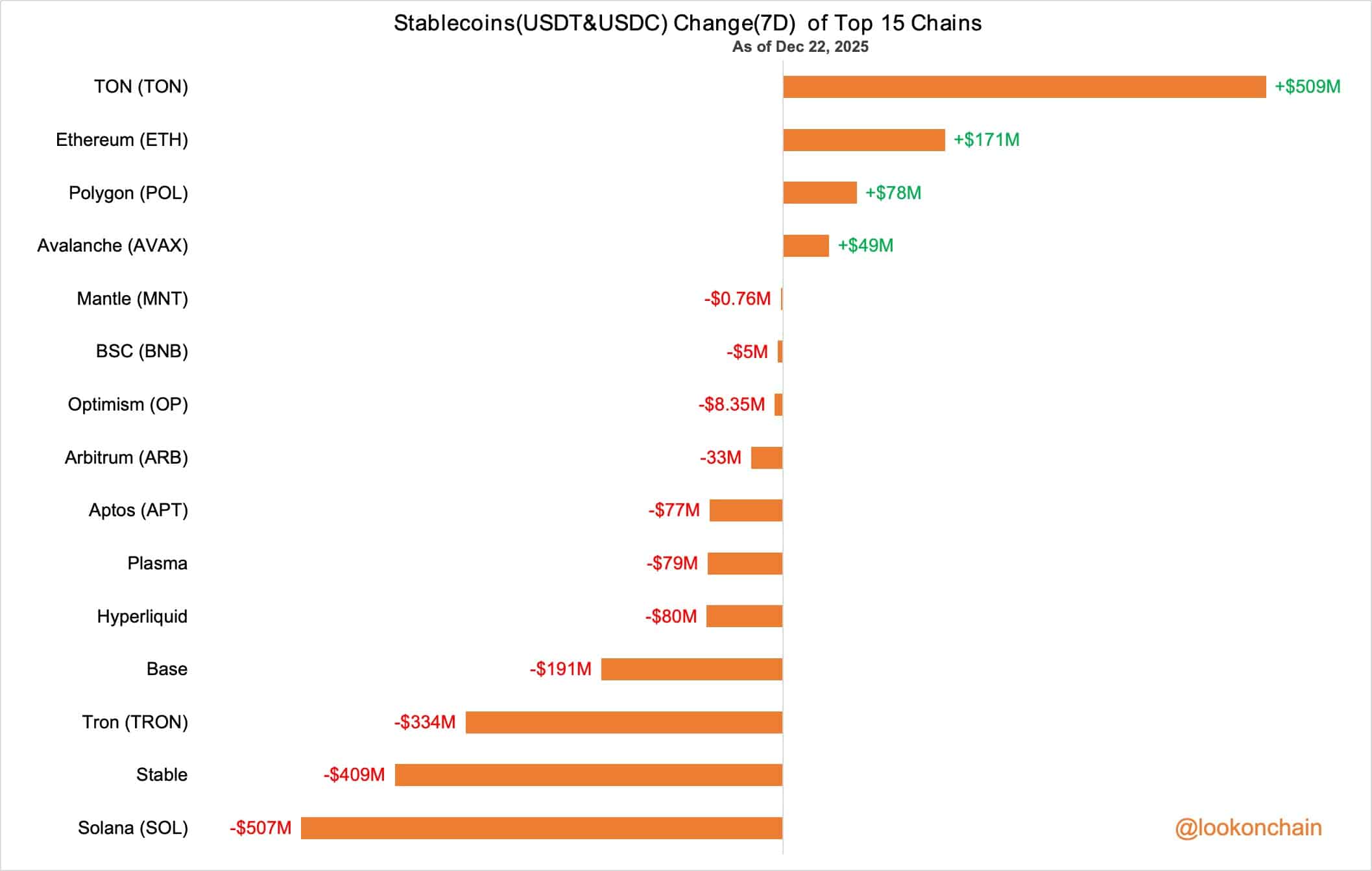
They are simply shifting across networks instead of being on exchanges. Over the past week, total stablecoin supply still grew by about $509 million.

Source: Lookonchain

The biggest inflows were seen on TON, which added over $500 million, followed by Ethereum and Polygon. In contrast, networks tied more closely to trading activity, such as Solana and Tron, saw large outflows.

Investors aren’t taking any new risks, and are simply waiting for clear signs before committing.

Defensive, not disappearing

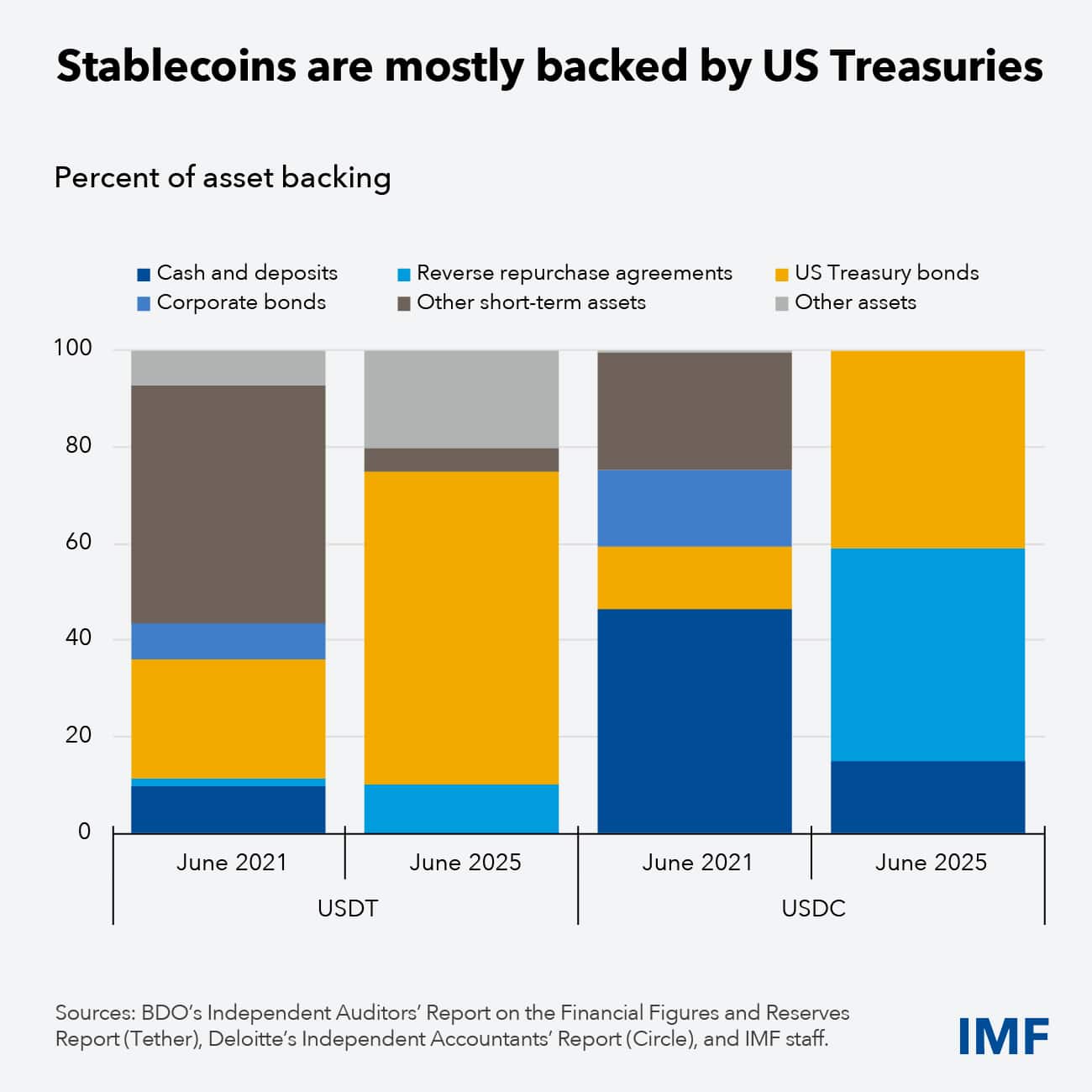
Today, most major stablecoins are backed largely by U.S. Treasuries and other short-term government assets, making them more or less low-risk money market instruments.

Source: IMF

This explains why capital is staying in stablecoins even as it leaves exchanges. Investors are choosing safety and yield over chaos. Until confidence returns, this defensive positioning is likely to persist.


Final Thoughts

  • Stablecoins are leaving exchanges at record speed as traders cut risk.
  • Capital is on safer chains until confidence returns.
Next: Solana: Short-term pain, long-term hope? SOL faces liquidation test
Share
  • Share
  • Tweet

Related Questions

QWhat is the main trend observed with stablecoins on crypto exchanges in the current cycle?

AStablecoins are moving off crypto exchanges at the fastest pace this cycle, with investors choosing to hold liquid assets rather than deploying capital.

QHow has the withdrawal of stablecoins affected market activity and trader behavior?

AThe rapid withdrawal of stablecoins has caused a drop in short-term risk appetite, leading traders to unwind leverage, with open interest falling more than 40%.

QWhich blockchain networks saw the largest inflows of stablecoins, and what does this indicate?

ATON saw the largest inflows, adding over $500 million, followed by Ethereum and Polygon, indicating a shift to safer chains rather than those tied to active trading like Solana and Tron.

QWhy are investors choosing to hold stablecoins even as they leave exchanges?

AInvestors are opting for safety and yield, as stablecoins are largely backed by U.S. Treasuries and short-term government assets, making them low-risk money market instruments.

QWhat was notable about Binance's stablecoin flows in December?

ABinance experienced a significant shift from inflows to nearly $1.9 billion in net outflows over 30 days, reflecting a cautious move by investors.

Related Reads

Stuck Polymarket: The Real Test After Riding the Traffic Boom Has Arrived

Polymarket, a leading prediction market platform, is facing significant technical challenges as its growth outpaces its current infrastructure on Polygon. Users are experiencing laggy transactions, unresponsive orders, and delayed confirmations, severely impacting the trading experience. In response, DeFi Engineering VP Josh Stevens outlined a comprehensive engineering overhaul. The plan includes reducing on-chain data delays, fixing order cancellation issues, rebuilding the central limit order book (CLOB), improving website performance, and developing a unified SDK and API. A major revelation was the ongoing "chain migration," indicating a potential move away from Polygon. The core issue is that Polymarket has evolved from a simple prediction market into a high-frequency trading platform, making Polygon's limitations—such as block space, gas fees, and block time—a ceiling for further growth. The migration is not just a simple chain switch but a fundamental rebuild of its trading system to support more complex products like perpetual contracts (Perps). This announcement has sparked competition among chains like Solana, Sui, and Algorand, all vying to host Polymarket. For Polygon, losing this key application, which contributes significantly to its gas fee revenue, would be a major setback. The real test for Polymarket is no longer attracting users but proving it can provide a stable, reliable trading environment that retains them.

Odaily星球日报1h ago
Stuck Polymarket: The Real Test After Riding the Traffic Boom Has Arrived

Odaily星球日报1h ago

Trading

Spot
Futures

Hot Articles

How to Buy T

Welcome to HTX.com! We've made purchasing Threshold Network Token (T) simple and convenient. Follow our step-by-step guide to embark on your crypto journey.Step 1: Create Your HTX AccountUse your email or phone number to sign up for a free account on HTX. Experience a hassle-free registration journey and unlock all features.Get My AccountStep 2: Go to Buy Crypto and Choose Your Payment MethodCredit/Debit Card: Use your Visa or Mastercard to buy Threshold Network Token (T) instantly.Balance: Use funds from your HTX account balance to trade seamlessly.Third Parties: We've added popular payment methods such as Google Pay and Apple Pay to enhance convenience.P2P: Trade directly with other users on HTX.Over-the-Counter (OTC): We offer tailor-made services and competitive exchange rates for traders.Step 3: Store Your Threshold Network Token (T)After purchasing your Threshold Network Token (T), store it in your HTX account. Alternatively, you can send it elsewhere via blockchain transfer or use it to trade other cryptocurrencies.Step 4: Trade Threshold Network Token (T)Easily trade Threshold Network Token (T) on HTX's spot market. Simply access your account, select your trading pair, execute your trades, and monitor in real-time. We offer a user-friendly experience for both beginners and seasoned traders.

10.8k Total ViewsPublished 2024.03.29Updated 2025.03.21

How to Buy T

Discussions

Welcome to the HTX Community. Here, you can stay informed about the latest platform developments and gain access to professional market insights. Users' opinions on the price of T (T) are presented below.

活动图片