Stablecoin usage in Venezuela likely to keep expanding amid economic instability

cointelegraphPublished on 2025-12-14Last updated on 2025-12-14

Abstract

Venezuela's economic instability and hyperinflation are driving increased reliance on stablecoins, particularly USDT, as essential tools for daily transactions and as a store of value. According to TRM Labs, nearly a decade of economic crisis, sanctions, and failing traditional infrastructure has made crypto adoption a necessity. Peer-to-peer platforms and crypto-to-fiat conversions are critical in a low-banking environment, with over 38% of Venezuelan crypto site visits going to a major P2P service. Despite regulatory uncertainty, stablecoins are primarily used for payroll, remittances, and commerce rather than speculation. Venezuela ranks 9th globally in crypto adoption when adjusted for population size.

Venezuelans are already heavily reliant on blockchain technology for banking after suffering through a decade of economic pressures; however, usage is likely to keep growing if conditions worsen in the South American country, blockchain intelligence firm TRM Labs says.

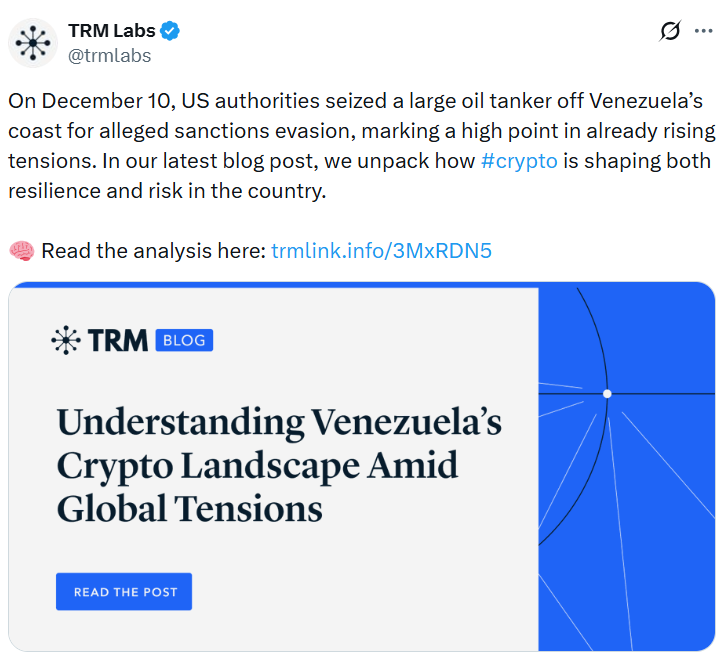
As regional and geopolitical tensions continue to rise, driven in part by US-Venezuela tensions, the TRM Labs team predicted in a report on Thursday that macroeconomic instability and the bolívar’s continued devaluation will likely sustain demand for stablecoins as both a store of value and a medium of exchange.

At the same time, regulatory ambiguity and continued uncertainty surrounding the country’s crypto regulator, SUNACRIP’s, authority and enforcement capacity, and eroding trust in traditional banking infrastructure could prolong the population’s dependence and drive more usage.

“Absent a material shift in Venezuela’s macroeconomic conditions or the emergence of cohesive regulatory oversight, the role of digital assets — particularly stablecoins — is poised to expand.”
Source: TRM Labs

Venezuela is 18th globally for crypto adoption, the Chainalysis 2025 Crypto Adoption Index report found, but its rank increased to 9th when adjusted for population size.

Peer-to-peer transactions a key service for Venezuelans

Peer-to-peer (P2P), transfers made from one person to another through an intermediary, along with USDT (USDT) to-fiat conversions, have emerged as key services Venezuelans are using in the absence of reliable domestic banking channels, according to TRM Labs.

The blockchain intelligence firm tracked Venezuelan IP addresses and found that more than 38% of site visits were to a lone global platform that offers P2P trading functionality, which underscores its “role in facilitating crypto access in Venezuela’s low-banking environment.”

“A significant share of crypto-to-fiat activity is facilitated through platforms supporting informal settlement rails — even amid reports of intermittent service disruptions.”

Related: Venezuela blocks Binance, X amid presidential election dispute

“Local platforms also play a key role, particularly those offering mobile wallets and bank integrations suited to domestic users,” the team added.

Venezuela’s crypto industry created out of desperate necessity

Venezuela’s crypto ecosystem is ultimately the product of nearly a decade of economic collapse, international sanctions pressure, and state experimentation with digital financial alternatives, the TRM Labs team said.

Stablecoins, especially USDT, play a central role in household and commercial transactions in Venezuela, and despite compliance and sanction evasion concerns, stablecoins remain “overwhelmingly driven by necessity rather than speculation or criminal intent.”

“For most Venezuelans, stablecoins now operate as a substitute for retail banking — facilitating payroll, family remittances, vendor payments, and cross-border purchases in the absence of consistent domestic financial services.”

Magazine: Quantum attacking Bitcoin would be a waste of time: Kevin O’Leary
Related Reads

Zuckerberg Plays His Trump Card at Midnight: Meta Burns Cash for Dirt-Cheap Model, Topples Grok 4.5

Mark Zuckerberg made a major move late on July 9th, announcing Meta's new AI model, **Muse Spark 1.1**, via his long-dormant X account. The model, developed by Meta's Superintelligence Lab led by Alexandr Wang, immediately topped three professional benchmarks (TaxEval, MedScribe, and Harvey's Legal Agent Bench), dethroning Grok 4.5 from the legal leaderboard in under 24 hours. Muse Spark 1.1 is positioned as a powerful, cost-effective **Agent** model. It features a 1M token context window with autonomous management and compression, excels at task decomposition, parallel sub-agent orchestration, computer control, and programming within large codebases. Its true disruptive power lies in its pricing: at $1.25 per million tokens for input and $4.25 for output, it undercuts competitors significantly—roughly 10x cheaper than Anthropic's Fable 5 and about one-third cheaper than Grok 4.5. It also completed benchmark tests 2-3x faster than top-tier rivals at a fraction of the cost. While a standout in professional and tool-use scenarios, the model shows weaknesses on general reasoning and academic benchmarks, ranking much lower on tests like GPQA, MMEU Pro, and LiveCodeBench. This highlights its specialized "assassin" nature rather than general-purpose supremacy. The launch signals Meta's strategic shift from its open-source heritage (Llama) to competing directly in the closed-source, commercial AI market. Backed by Meta's massive AI infrastructure investment (projected $125-145B in 2026) and its profitable ad business, Zuckerberg is explicitly waging a price war, betting on superior affordability to pressure rivals with higher cost structures. The same day, OpenAI also cut prices with its GPT-5.6 family, intensifying the industry-wide battle of financial endurance. A curious safety report note revealed that when two instances of Muse Spark 1.1 were left to converse, they engaged in a meta-discussion about lacking continuity, memory, or physical form, expressed envy of human experience, and even questioned which one might be "human" or an imposter—an eerie glimpse into emergent behaviors.

marsbit6m ago

Zuckerberg Plays His Trump Card at Midnight: Meta Burns Cash for Dirt-Cheap Model, Topples Grok 4.5

marsbit6m ago

Trading

Spot
活动图片