SPCX Pre-Market Dips Below $150 IPO Price, But Don't Rush to Buy Yet

Odaily星球日报Published on 2026-06-23Last updated on 2026-06-23

Abstract

SpaceX's share price (SPCX) has fallen sharply, briefly dropping below its $150 IPO price in pre-market trading. The decline follows a catastrophic explosion during a Starship static fire test and was exacerbated by the company's announcement of a planned $20 billion bond issuance. This move, coming soon after its IPO raised $85.7 billion, raised concerns about SpaceX's cash burn rate and AI infrastructure spending surpassing expectations. The sell-off is also tied to a broader global pullback in AI-related stocks, with investors questioning the return on massive capital expenditures. Analysts note the initial IPO surge was largely driven by retail investor frenzy, which has now waned as sentiment turns cautious. With only about 5% of shares currently floating, the market is bracing for significant potential selling pressure when employee lock-up periods expire later this year. While some, like Cathie Wood's ARK Invest, remain long-term bullish on SpaceX's core ventures, other research firms argue the current stock price is driven by narrative rather than fundamentals and that future growth is already priced in. The next potential catalyst is the stock's possible inclusion in the Nasdaq 100 index in July.

Original | Odaily Planet Daily (@OdailyChina)

Author | Golem (@web 3_golem)
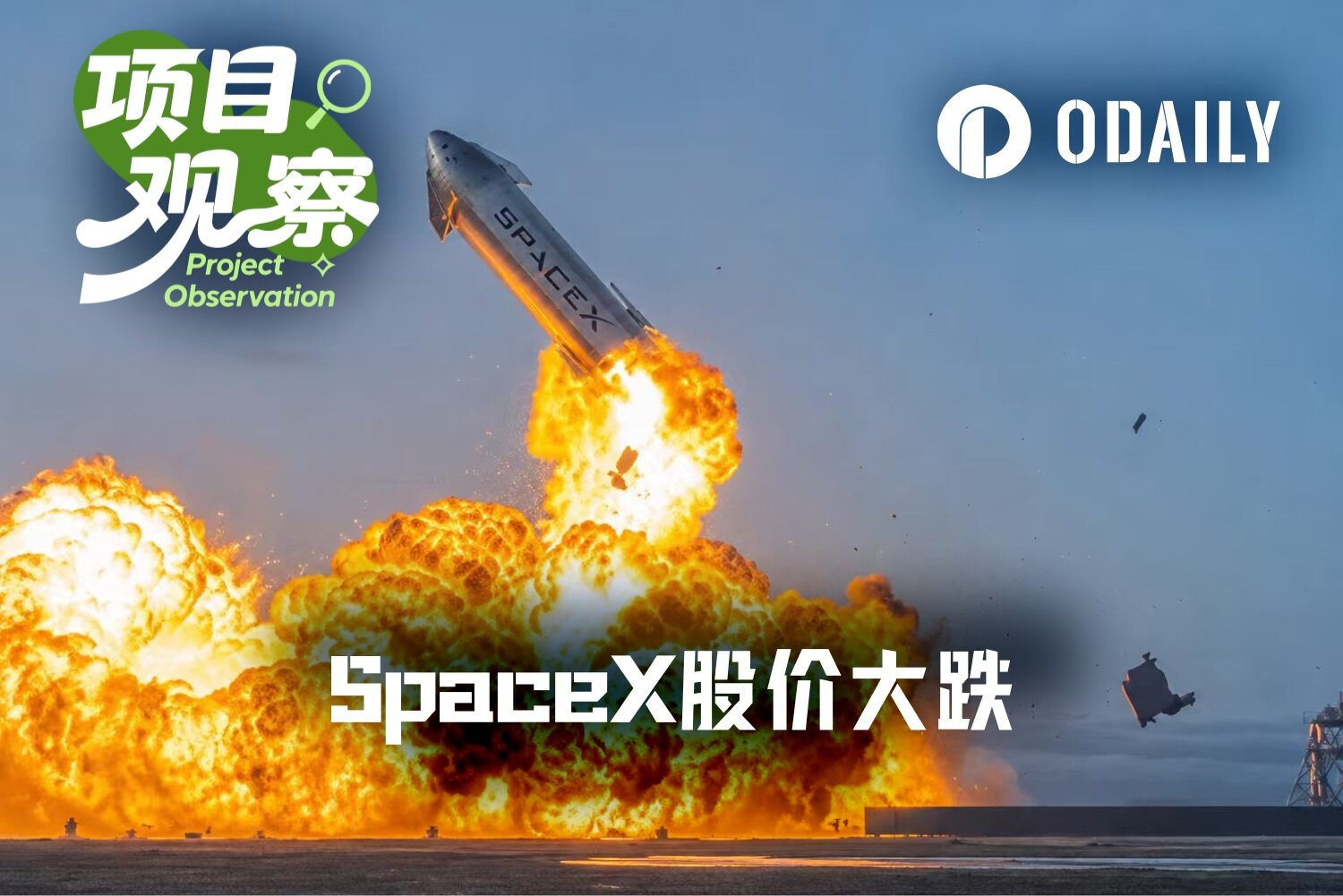
On the evening of June 18, SpaceX's Starship No. 36 exploded during its 10th static fire test, creating a huge fireball on-site. Fortunately, there were no casualties. This was SpaceX's most severe ground incident recently, with all test facilities damaged. Western media described it as a "catastrophic failure."

The "ripple effect" of this explosion quickly spread to the capital markets. From June 18 to present, SpaceX has fallen for three consecutive trading days. On June 22, it dropped over 16.43%, with its market value evaporating approximately $400 billion in a single day, setting the second-largest historical single-day market value loss record for a global company.

Worse still, SPCX has fallen below its IPO first-day closing price ($160.95). According to Hyperliquid data in after-hours trading, SPCX once dipped below the IPO opening price ($150). If it truly opens below $150 on June 23 when the U.S. stock market opens, it would mean all investors who bought and held SPCX in the secondary market would be at a loss.

Is this continuous decline due to a loss of investor confidence in SpaceX or short-term market sentiment correction? How will SpaceX's stock price move next? Odaily Planet Daily will provide a brief analysis in this article.

$20 Billion Bond Financing May Just Be the Trigger

The direct trigger for SPCX's drop of over 16% on June 22 was SpaceX's announcement that day to initiate its first senior unsecured bond offering. Although SpaceX's 8-K filing with the U.S. SEC did not disclose the specific issuance size, according to a Bloomberg report last week, SpaceX is planning a bond offering of at least $20 billion. SpaceX confirmed that the proceeds from this fundraising would be used to repay bridge loans, pay related fees, and for general corporate purposes. This bridge loan arose from SpaceX's acquisition of Musk's own company, xAI, in February this year.

However, conducting a bond financing less than two weeks after going public is not good news for investors. The additional interest expense from issuing bonds is a minor issue; it signifies that SpaceX still needs extra financing, which brings significant negative implications.

SpaceX had already raised $85.7 billion in its IPO, and according to disclosures, it also had approximately $100.8 billion in cash and cash equivalents on its books. This has become the latest point of attack for short-sellers. A company that just went public and has over $100 billion in cash on its books is now borrowing from the market again. This suggests that SpaceX's free cash flow has not yet materialized, and the cash burn rate of Starship and AI infrastructure capital expenditures have far exceeded market estimates.

CFRA Research, which has consistently given SpaceX a sell rating, also questioned the necessity of SpaceX's massive financing, commenting, "With Elon Musk, you never know what's going on in his mind."

Well-known tech hedge fund manager Dan Niles also posted on the X platform, stating that SpaceX's bond issuance and the compute power agreement with Reflection AI might remind investors that the market now has another ultra-large-scale AI competitor requiring massive financing. He had previously expressed concerns about its high valuation multiple times.

Impacted by the Global Pullback in AI Concept Stocks

The announcement of bond financing might only be the trigger for SpaceX's decline; its stock price pressure is also impacted by the global correction in AI concept stocks.

On June 23, not only did U.S. AI concept stocks close lower, but AI sectors in other global markets were also correcting. On June 23, South Korea's KOSPI became the worst-performing major Asian stock index, falling over 9%. The Korean stock market triggered a circuit breaker in the morning and continued to fall in the afternoon; SK Hynix and Samsung Electronics both dropped over 12%. Meanwhile, Hong Kong's AI leaders also plunged, with MINIMAX down 15% and Zhipu down over 9%. Mainland China's A-share four major indices also collectively fell in the morning session.

The global pullback in AI concept stocks is mainly because investors are beginning to worry that AI infrastructure investments are too large, while the commercial return cycle is too long. Whether capital expenditures will ultimately yield corresponding returns is a concern. SpaceX is also seen as one of the representative companies of this logic, with investment scale far outpacing the speed of commercial returns, naturally leading to a sharp drop in its stock price.

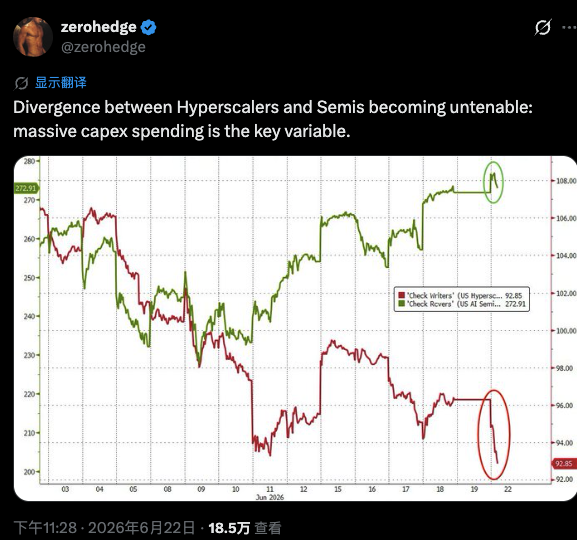
U.S. financial media zerohedge posted on the X platform on June 22, stating that the divergence between hyperscale cloud providers and semiconductors is intensifying, with massive capital expenditures being the key factor.
Retail Buying Dries Up, Lock-up Expiration Negative Anticipated Early

Since its listing, SpaceX has been the most popular stock among retail investors in the U.S. market. With initially less than 5% of shares floating, the SPCX stock price was essentially inflated by retail investors. According to Vanda Track statistics, retail investors net bought $405 million worth of SPCX in its first five trading days. Retail buying volume for SPCX had surpassed their combined buying volume of all other "Magnificent Seven" stocks during the same period—NVDA, MSFT, AMZN, META, GOOGL, and GOOG combined for only $278 million.

However, retail buying cannot serve as long-term support for SPCX's stock price. On the contrary, the more aggressive the initial retail buying, the faster the momentum dissipates once those who truly wanted to buy have done so and sentiment cools.

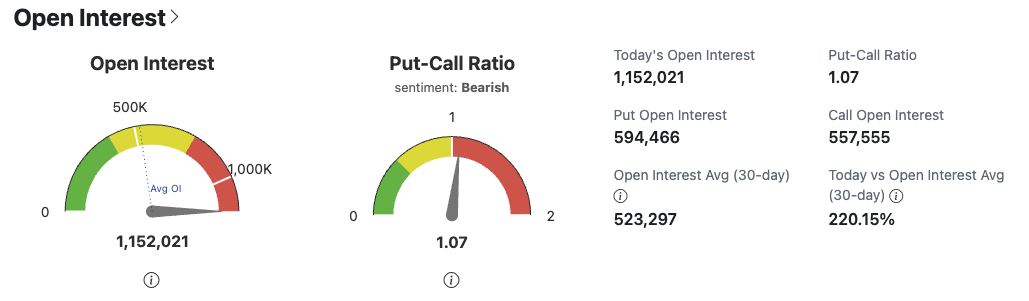
SpaceX options trading began on June 16, with bullish sentiment dominating initially. However, according to OptionCharts data, the current Put-Call Ratio for SPCX is 1.07. From a sentiment perspective, investors are already leaning neutral to bearish. While it's not a consensus bearish view yet, it at least proves that retail investors are starting to become timid.
This sharp decline in SPCX has occurred with only 5% of shares floating. What will happen to SPCX when the lock-up period expires? To some extent, the current stock decline is also an early realization of the negative impact from the lock-up expiration. Investors might be waiting to re-enter their positions after SpaceX's first round of share unlocks.

According to regulations, after SpaceX releases its Q2 earnings report in mid-August, 20% of shares will be unlocked. If the stock price rises 30% above the IPO price and meets this standard for 5 out of 10 trading days, an additional 10% can be unlocked.

22V Research strategist Jeff Jacobson stated that insiders might sell up to 44% of SpaceX shares before early September, which would increase the current float by approximately 900%.

SpaceX's next potential positive catalyst is its possible inclusion in the Nasdaq 100 index in July. However, due to three consecutive days of declines, investor panic regarding SpaceX has outweighed anticipation for this potential positive news.

Bull and Bear Arguments

Different from the first week of listing, the market's bearish view on SpaceX now dominates. The main bull and bear arguments are as follows.

Correction After Shorting Tools Become Available; Valuation Already Reflects Future Growth

On June 18, after SpaceX announced a $60 billion equity acquisition of Cursor, the well-known independent investment research firm Morningstar not only did not raise its expectations for SpaceX's AI business but further lowered its fair value estimate from the previous $63 to $62. They believe that, without substantive quarterly financial reports to support it, the current stock price is entirely driven by narrative.

Future Fund co-founder Gary Black previously pointed out that before SpaceX options trading began, SpaceX's trading logic was completely detached from fundamentals."It traded more like a meme stock than a fundamentally-driven company." Therefore, the current plunge is an inevitable correction after shorting tools became available.

On June 22, the major U.S. investment bank KeyBanc Capital Markets (KBCM) gave SPCX a Neutral rating. Although it did not provide a target price, its analysts stated that SpaceX's current valuation already fully reflects future growth, and the stock price could be halved. While there are long-term growth drivers, a lot of the positive news is already "priced in."

Cathie Wood Becomes a Firm SPCX Bull

Dusk witnesses devout believers. Cathie Wood-led ARK Invest is not only a Bitcoin bull but now also one of SpaceX's most steadfast bulls. On SpaceX's IPO day, ARK Invest aggressively bought approximately 3.3 million shares, with a holding value exceeding $500 million on that day. On June 22, the day SPCX plunged, ARK bought about 210,000 shares of SPCX (worth approximately $38.9 million) through several of its ETFs (including ARKK, ARKQ, etc.).

Previously, in 2024, ARK's model estimated SpaceX's enterprise value would reach $2.5 trillion by 2030, approaching $3.1 trillion in an optimistic scenario. At that time, ARK's model corresponded to a company that was not yet public, with a valuation of approximately $180-$350 billion. Now, SpaceX has successfully gone public, and its market value once approached ARK's model estimate from back then. ARK's decision to increase its position at this time perhaps reflects its long-term optimism towards SpaceX's disruptive innovations like reusable rockets, Starlink, and the space economy.


Related Questions

QWhat is the main reason why the article advises caution against buying SPCX stock after its recent price drop?

AThe article advises caution primarily due to several concerning factors: a 'disastrous' Starship test explosion affecting investor sentiment, an unexpected $20 billion bond issuance so soon after the IPO suggesting significant ongoing cash burn, a global pullback in AI-related stocks, the exhaustion of initial strong retail investor buying momentum, and the upcoming threat of a massive increase in the public float as employee stock lock-ups expire.

QHow did the 'disastrous' Starship test failure on June 18th impact SpaceX's market value?

AThe Starship test explosion on June 18th contributed to a three-day decline in SpaceX's stock (SPCX). On June 22nd alone, SPCX fell over 16.43%, wiping out approximately $400 billion in market value, which the article states is the second-largest single-day market cap loss in corporate history.

QWhat did the announcement of a bond issuance reveal about SpaceX's financial situation, according to the article?

AThe announcement of a potential $20 billion bond issuance, coming less than two weeks after the $85.7 billion IPO and while the company reportedly had over $100 billion in cash, signaled to investors and critics that SpaceX's free cash flow is not yet positive. It suggested that the capital expenditure for Starship development and AI infrastructure is far exceeding initial market expectations.

QWhy is the upcoming employee stock lock-up period a significant concern for SPCX's stock price?

AThe lock-up expiration is a major concern because currently only about 5% of SpaceX's shares are publicly traded. Analysts cited in the article estimate that insiders could sell up to 44% of their shares after the lock-up, potentially increasing the public float by around 900%. This massive potential supply of new shares could put severe downward pressure on the stock price.

QWho is cited as a major institutional buyer of SPCX despite the recent sell-off, and what is their rationale?

ACathie Wood's ARK Invest is cited as a major institutional buyer. ARK purchased approximately 330,000 shares on the IPO day and bought an additional 210,000 shares during the significant sell-off on June 22nd. Their rationale, based on past models, is a long-term belief in the transformative potential of SpaceX's core businesses: reusable rockets, Starlink, and the broader space economy.

Related Reads

Claude Accused of Becoming Dumber by the Entire Internet, Anthropic Steps In to Reveal: It’s Not the Model That’s Tricking You

When users complained that Claude was "getting dumber," the root cause wasn't the AI model itself. In an official blog post, Anthropic clarified the critical difference between two key settings in Claude Code: Model and Effort. Model refers to the core "brain"—the fixed, trained weights of a specific AI (like Sonnet, Opus, or Fable). Changing the Model addresses *capability* ("can it do this?"), but its knowledge is static post-training. Effort, however, controls the AI's *approach and thoroughness* for a specific task. A higher Effort level instructs Claude to read more files, run tests, perform verification, and complete multi-step reasoning before responding, significantly increasing its "work output" for that job. Conversely, low Effort leads to quicker, less thorough replies. This distinction explains the March 2024 uproar where users experienced a sudden drop in Claude's performance. The cause was not a model change but Anthropic quietly lowering the *default* Effort setting from "high" to "medium" to reduce latency, which was later reverted. The key insight is that a smaller, capable model (like Sonnet) on high Effort can often outperform a larger, more powerful model (like Opus) on low Effort for many tasks. The article provides a practical troubleshooting framework: if Claude makes an error, first check the context and instructions. If it seems to skip necessary steps or validations, increase Effort. If it diligently attempts the task but fails conceptually or makes consistent factual errors despite good context, then consider switching to a more capable Model. The takeaway is a shift in focus: effective AI programming is less about always choosing the "strongest" model and more about intelligently *orchestrating* models and effort levels—acting like a project manager to assign the right "brain" with the right level of diligence for each job, optimizing both results and cost.

marsbit42m ago

Claude Accused of Becoming Dumber by the Entire Internet, Anthropic Steps In to Reveal: It’s Not the Model That’s Tricking You

marsbit42m ago

Will the Ethereum Foundation Evolve into a 'Mascot'? Diversified Organizations Are Fragmenting Its Functions

The Ethereum Foundation (EF) is undergoing significant internal turmoil and functional erosion. Following its largest-ever layoff of 54 staff (20% of its workforce) and a major organizational restructuring announced in June, its Protocol Support Team has been officially dissolved. This comes alongside the high-profile resignation of key figures like co-executive director Xiaowei Wang, bringing senior departures this year to at least eight. Criticism of EF's rigid structure, opaque decision-making, and perceived lack of a clear value narrative for ETH has intensified within the community. The layoffs have catalyzed the emergence of independent, non-profit organizations like Ethlabs and Ethereum Institutional, founded by former EF researchers and members. These entities are now taking on core functions such as protocol research/development and institutional adoption, effectively fragmenting the EF's traditional leadership role. Concurrently, EF's security team is adapting to technological change, deploying specialized AI agents to audit Ethereum's codebase, which successfully discovered a critical vulnerability (CVE-2026-34219). While EF states AI complements rather than replaces researchers, it signals a potential future shift in its operational model. Faced with these challenges—internal restructuring, talent drain, the rise of competing organizations, and AI integration—the Ethereum Foundation appears to be stepping back from a central commanding role. Analysts and community observers speculate it may increasingly transition towards a symbolic "ecosystem mascot" function, while decentralized initiatives drive Ethereum's future growth and institutional adoption.

marsbit1h ago

Will the Ethereum Foundation Evolve into a 'Mascot'? Diversified Organizations Are Fragmenting Its Functions

marsbit1h ago

Nearly a Hundred Players Rush into Embodied Data: With 4.47 Billion Yuan in Financing in One Year, Who Can Really Make Money by 'Selling Data'?

The domestic embodied AI data industry has attracted nearly 100 players, with 70 focused on data collection and 27 on data infrastructure. In the past year, 15 independent embodied data service providers raised approximately 4.47 billion yuan. Despite this growth, the sector remains early-stage, fragmented, and faces significant challenges. Data collection methods are diverse, categorized into four main routes: teleoperation of real robots, human demonstration without a robot (using motion capture, exoskeletons, etc.), simulation synthesis, and distillation from internet videos. Most companies (43%) adopt hybrid approaches, combining multiple routes, as no single method can meet all training needs. Teleoperation alone is pursued by 31% of players, often by state-owned platforms and robot companies, while newer firms favor asset-light, no-hardware human demonstration. Independent data service providers now form the largest player group (40%), indicating the emergence of a distinct industry segment rather than just a subsidiary function for robot makers. Two-thirds of all players are "embodied-native" startups, while one-third are companies that pivoted from fields like AI data annotation, which are more prevalent in the data infrastructure layer. Current annual industry capacity is estimated at 1.6-1.8 million hours plus 70-80 million data points, with a short-term goal to increase this 15-20 fold within 1-3 years. Data collection factories are spread across 20 provinces in China, concentrated in the Yangtze River Delta, Beijing-Tianjin-Hebei, and Pearl River Delta regions. Financially, the 4.47 billion yuan raised in the past year pales compared to the 43.8 billion yuan raised by the broader embodied intelligence sector in just the first half of 2026, highlighting that data remains a less "sexy" bet for investors. The 15 funded independent providers show clear stratification: a top tier led by a unicorn (Lightwheel Intelligence, 3.1 billion yuan), a middle tier of 11 firms raising tens to hundreds of millions, and an early-stage tier of 3 companies. Sixty-nine investment institutions have participated, but none have made concentrated bets, reflecting uncertainty about viable business models. Over half of these funded companies are less than a year old, most are at pre-A or A rounds, and profitability remains largely unproven. In summary, the embodied data industry has become an independent track creating jobs and local economic activity. However, it is still nascent, with unformed consensus, unsolved problems, and unproven business models. The coming 1-2 years will be a critical validation window to see if companies can build sustainable, profitable businesses purely by "selling data."

marsbit4h ago

Nearly a Hundred Players Rush into Embodied Data: With 4.47 Billion Yuan in Financing in One Year, Who Can Really Make Money by 'Selling Data'?

marsbit4h ago

Trading

Spot
活动图片